Moyutsui Temple Iwate Prefecture | Complete Guide to the World Heritage Jodo Garden and the Prosperity of the Oshu Fujiwara Clan
Moyutsui Temple (Motsūji), located in Hiraizumi Town, Nishi-Iwai District, Iwate Prefecture, is a Tendai Buddhist temple founded by the Oshu Fujiwara clan during the Heian period. It was registered as a World Heritage site in June 2011 as part of “Hiraizumi – Temples, Gardens and Archaeological Sites Representing the Pure Land Buddhism” and is the only temple in Japan to receive the dual designation of National Special Historic Site and National Special Scenic Beauty.
This article comprehensively covers everything you need to know before visiting, from the historical background of Moyutsui Temple to the charm of its Pure Land garden, must-see sites, seasonal attractions, and access information.
History of Moyutsui Temple | The Splendor of the Past Praised as “Unparalleled in Our Nation”
Foundation and Great Master Jikaku Ennin
Moyutsui Temple is said to have been founded in 850 (Kasho 3), during the Heian period, by Great Master Jikaku Ennin, a renowned Buddhist priest of the Tendai school. Ennin is also credited with founding Chusonji Temple and establishing the foundations of Tendai Buddhist faith in Hiraizumi. While there are various theories about the origin of the temple’s name, a legend remains that Ennin was guided to this place by a white deer in the mist.
Construction and Development Under the Oshu Fujiwara Clan
Moyutsui Temple experienced significant development during the 12th century under the rule of the Oshu Fujiwara clan. Magnificent temple complexes were constructed under the rule of the Second Motohira and the Third Hidehira over two generations.
According to historical records in the “Azuma Kagami,” Moyutsui Temple is described as having “over forty halls and over five hundred monks’ quarters,” making its scale surpass that of Chusonji Temple. Moyutsui Temple, which came to be praised as “unparalleled in our nation,” was the largest temple complex in the Tohoku region during the late Heian period.
Motohira constructed the Kondo Enryuji and Kasho Temple, while Hidehira expanded the complex with a lecture hall, bell tower, and scripture repository. The grounds were filled with architectural groups rivaling the Golden Hall, housing the finest Buddhist art and treasures.
Decline Due to Fires and Present Day
Unfortunately, due to repeated fires from the Kamakura period onward, most of the temple buildings were destroyed. The current main hall was rebuilt in 1989 (Heisei 1). However, the ruins of the original temple complex are well-preserved underground, and excavation surveys have revealed the splendid appearance of the ancient structure.
Value as a World Heritage Site | Pure Land Buddhism Expressed
Position Among Hiraizumi’s Cultural Assets
Moyutsui Temple is one of five assets comprising Hiraizumi’s World Heritage (Chusonji, Moyutsui, Kanjizaiokokuoin Ruins, Muryokoin Ruins, and Kinkeiyama). Hiraizumi forms a culturally unique landscape, designed based on Pure Land Buddhist ideology that is rarely seen in the world.
The Oshu Fujiwara clan sought to recreate on earth “the Pure Land,” the idealized Buddhist paradise. Since the eastern end of Moyutsui Temple’s land division aligns with the extension line running south from the peak of Kinkeiyama, it is evident that the temple’s design had an intimate relationship with Kinkeiyama’s location. This is important evidence indicating that all of Hiraizumi was planned and constructed as a unified religious space.
Dual Designation as Special Historic Site and Special Scenic Beauty
The grounds of Moyutsui Temple are designated as both a National Special Historic Site and a National Special Scenic Beauty. This is an extremely rare example throughout Japan, indicating that both historical and artistic values are recognized at the highest level.
As a special historic site, the temple ruins are valued, and as a special scenic beauty, the Pure Land garden is valued. It is a precious cultural asset that preserves the architecture and garden aesthetics of temples from the Heian period.
A Landscape of the Pure Land | Japan’s Representative Garden
Composition and Characteristics of the Pure Land Garden
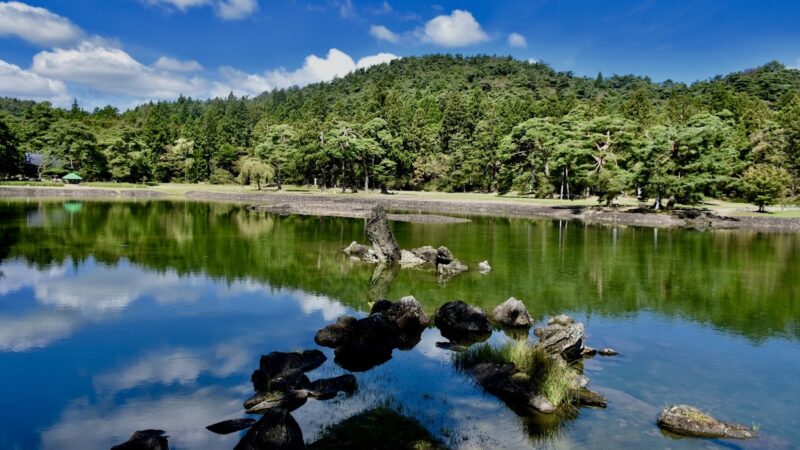
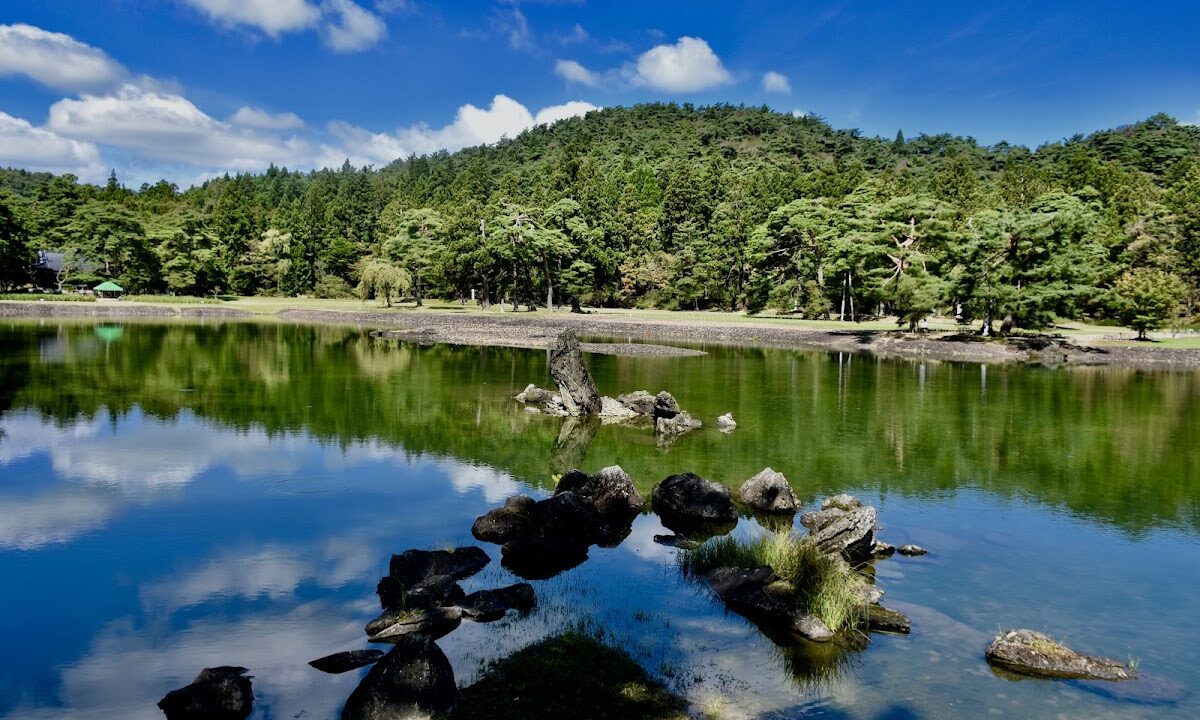
The Pure Land garden of Moyutsui Temple is one of Japan’s most representative gardens, with Heian-period garden structures remaining in nearly perfect condition. At its center lies a large pond known as “Daisen Pond,” measuring approximately 180 meters east-west and 90 meters north-south.
The Pure Land garden expresses the Buddhist paradise on earth and is composed of the following elements:
- Daisen Pond: Expresses the treasure pond of the Pure Land paradise
- Dejima (outcroppings): Cape-like formations projecting into the pond
- Tsukiyama (artificial hills): Man-made mountains forming the background
- Yariomizu (water channels): Curved waterways
- Suhama (pebbled shores): Pond banks paved with polished stones
These elements harmonize with nature to create an elegant and serene landscape.
The Kyokusui no En and Curved Water Banquet
Particularly noteworthy in Moyutsui Temple’s garden is the “yariomizu” (water channel). This is an extremely valuable artifact, the only remaining Heian-period example of its kind in Japan, and functioned as a waterway to direct water into the pond.
The yariomizu is more than a simple water channel; it is an important element of garden aesthetics. The pond bottom is paved with polished stones, with water chutes and waterfall stones arranged throughout. Every year on the fourth Sunday of May, the “Kyokusui no En” (Curved Water Banquet) is held on this yariomizu, with poets dressed in Heian attire composing waka poetry, recreating this elegant traditional event.
Showa Period Restoration and Present Appearance
The beautiful Pure Land garden visible today is the result of excavation and restoration work that began in 1954 (Showa 29). The pond embankments, outcroppings, and artificial hills were restored based on the original Heian design, reviving the garden’s ancient beauty.
Grassland spreads throughout the garden, with flowering trees and plants of each season planted throughout. Excavation surveys continue to the present day, with new discoveries continuing to emerge.
Major Attractions at Moyutsui Temple
The Main Hall and Yakushi Nyorai
The current main hall, rebuilt in 1989 (Heisei 1), enshrines Yakushi Nyorai (Medicine Buddha) as the principal deity, with Suryaprabha Bodhisattva and Chandraprabha Bodhisattva as attendants. Sutra recitation is performed each morning in the main hall, creating a solemn atmosphere.
The Jogo Hall
Located west of the main hall, the Jogo Hall is a hipped-roof structure housing Mahavairocana Buddha (Amida Buddha). Annually, the “Hatsuka Yoru Festival” is held on January 20, and “Ennen dances” are performed during New Year celebrations, continuing these traditions designated as Important Intangible Folk Cultural Properties.
The Founder’s Hall and Kasho Temple Ruins
The Founder’s Hall houses a wooden statue of Great Master Jikaku Ennin. Nearby are the remains of Kasho Temple, built by Motohira, where foundation stones and bases can be observed.
Kondo Enryuji Temple Ruins
On the east side of Daisen Pond stands the Kondo Enryuji Temple Ruins, built by Motohira. Excavation surveys have revealed a magnificent temple layout with the south gate, middle gate, main hall, and lecture hall arranged in a straight line. Currently only foundation stones remain, yet one can sense the former grandeur.
The Bell Tower and Bronze Bell
In the temple grounds stands a bell tower housing a bronze bell designated as an Important Cultural Property. This bell was cast during Hidehira’s era and continues to ring beautifully to this day.
Seasonal Attractions | Autumn Foliage Information and Annual Events
Spring: Cherry Blossoms and Fresh Greenery
From late April to early May, cherry blossoms bloom splendidly throughout the temple grounds. The contrast between cherry blossoms reflected on the waters of Daisen Pond and the fresh greenery is breathtaking. The “Kyokusui no En” held on the fourth Sunday of May is a representative spring event attracting many visitors.
Summer: Verdant Garden
Summer at Moyutsui Temple is enveloped in lush green grass and rich foliage. A walk around Daisen Pond brings cool breezes that dispel the summer heat.
Autumn: Autumn Foliage Spectacular
The peak foliage season at Moyutsui Temple typically occurs from late October to early November. Japanese maples, maples, and ginkgo trees color the Pure Land garden. The sight of autumn leaves reflected in Daisen Pond is particularly spectacular, drawing many photography enthusiasts.
During foliage season, the grounds are sometimes illuminated at night, allowing visitors to enjoy the garden in a magical nighttime atmosphere. Check the official website for the latest foliage information.
Winter: Snow Scenery and New Year Observances
Winter at Moyutsui Temple, blanketed in snow, is wrapped in silence and feels like another world. The snow-covered Pure Land garden is strikingly beautiful, evoking thoughts of the Pure Land paradise. On January 20, the “Hatsuka Yoru Festival” features religious services at the Jogo Hall, with prayers for protection from misfortune and good health.
Access and Admission Information | Essential Information to Know Before Visiting
Basic Information
- Official Name: Tendai Buddhist Exceptional Honzan Moyutsui Temple
- Location: 〒029-4102 Moyutsui, Hiraizumi Town, Nishi-Iwai District, Iwate Prefecture
- Phone Number: 0191-46-2331
- Visiting Hours:
- March 5 – November 4: 8:30 AM – 5:00 PM
- November 5 – March 4: 8:30 AM – 4:30 PM
- Closed: Open year-round
- Admission Fee:
- Adults: 700 yen
- High school students: 400 yen
- Elementary and junior high school students: 200 yen
Access by Train
From JR East Honshu Line “Hiraizumi Station,” it is about a 10-minute walk. Hiraizumi Station is about 10 minutes by local train from “Ichinoseki Station” on the Tohoku Shinkansen. The route to Moyutsui Temple is in the opposite direction from Chusonji Temple, so follow the directional signs.
Access by Car
- From Tohoku Expressway “Hiraizumi-Maesawa IC”: approximately 10 minutes
- Parking: Town-operated Moyutsui Temple parking lot (regular vehicles 330 yen, large buses 1,030 yen)
Combination with Nearby Attractions
Hiraizumi has many other World Heritage sites and historic sites besides Moyutsui Temple:
- Chusonji Temple: About 20 minutes on foot, about 5 minutes by car
- Kanjizaiokokuoin Ruins: About 5 minutes on foot
- Muryokoin Ruins: About 10 minutes on foot
- Kinkeiyama: About 15 minutes on foot
The circular “Runrun” shuttle bus operates within Hiraizumi Town, allowing efficient visits to tourist attractions.
Enjoying Moyutsui Temple More Deeply
Recommended Length of Stay
Allow approximately 1 to 1.5 hours for a leisurely viewing of the temple grounds. The walking path around the Pure Land garden takes about 20 minutes, but for fully enjoying seasonal flowers and garden aesthetics, visiting with ample time is recommended.
Photography Spots
The following points are recommended for photographing the Pure Land garden:
- North shore of Daisen Pond: Composition overlooking the Jogo Hall across the pond
- Near the outcroppings: Wide-angle photography including pond surface and background tower hill
- Water channel (yariomizu): Water flow and stone arrangement details
- Near the Founder’s Hall: Autumn foliage season color beauty
Special Experiences
Moyutsui Temple offers meditation and sutra-copying experiences (advance reservation required). These provide valuable opportunities to calm the mind and experience Buddhist culture in the temple’s quiet surroundings.
Historical Context of Hiraizumi and the Oshu Fujiwara Clan
Prosperity of the Oshu Fujiwara Clan
The Oshu Fujiwara clan governed the Tohoku region from Hiraizumi over four generations—the first Kiyohira, second Motohira, third Hidehira, and fourth Yasuhira—for approximately 100 years. Hiraizumi at that time prospered as Japan’s second major city after Kyoto, with a population said to have exceeded 100,000.
The Oshu Fujiwara clan’s economic foundation was built on the abundant gold deposits and horse production in Oshu. Backed by this wealth, magnificent temples and gardens were built in succession, making Hiraizumi a major center of Buddhist culture.
Realization of Pure Land Buddhism
What the Oshu Fujiwara clan sought to achieve in Hiraizumi was an ideal world based on Pure Land Buddhist ideology. After experiencing long periods of warfare, including the Former Nine Years’ War and the Later Three Years’ War, Kiyohira wished to commemorate all war dead regardless of enemy or ally and build a peaceful world without conflict.
This ideology is embodied in Moyutsui Temple’s Pure Land garden. Daisen Pond represents the treasure pond of the Pure Land paradise, and the surrounding garden expresses the idealized world of Buddha, designed as a space bringing spiritual peace to visitors.
Differences Between Moyutsui Temple and Chusonji Temple
The two major temples representing Hiraizumi, Moyutsui and Chusonji, each have distinct appeal.
Chusonji has surviving buildings including the Golden Hall, allowing direct observation of Heian-period Buddhist art. With structures arranged on a mountainside, it features a solemn atmosphere.
In contrast, Moyutsui has lost most of its buildings but has its Pure Land garden restored to its ancient appearance, allowing visitors to experience Heian-period garden aesthetics. Spread across flat terrain in an open space, its charm lies in the landscape integrated with natural seasonal changes.
Visiting both temples enables understanding the diversity and depth of the Oshu Fujiwara clan’s culture.
Understanding the Value of World Heritage “Hiraizumi”
Universal Value of Hiraizumi
The World Heritage site “Hiraizumi – Temples, Gardens and Archaeological Sites Representing the Pure Land Buddhism” was registered for its evaluation of cultural landscape based on Pure Land Buddhist ideology.
The UNESCO World Heritage Committee recognizes the following points about Hiraizumi:
- Evidence of unique cultural traditions based on Pure Land Buddhist ideology
- Excellent examples of Buddhist temples and Pure Land gardens
- Expression of humanity’s universal value of seeking peace
Preservation and Succession Efforts
Moyutsui Temple conducts continuous preservation management to protect its value as a World Heritage site. Multiple activities are carried out, including excavation surveys, garden maintenance, and building conservation and restoration.
Furthermore, local residents, government, and researchers cooperate in efforts to transmit Hiraizumi’s cultural heritage to future generations. Visitors to the site also bear the important responsibility of valuing these precious cultural assets and preserving them for posterity.
Conclusion | Experiencing Heian-Period Beauty and Spirit at Moyutsui Temple
Moyutsui Temple in Hiraizumi Town, Iwate Prefecture, is a national treasure recognized internationally as a World Heritage site. The Oshu Fujiwara clan’s magnificent temple complex, praised as “unparalleled in our nation,” and their realization of the Pure Land on earth endure today in the form of the Pure Land garden.
The garden aesthetics centered on Daisen Pond, the yariomizu representing the only Heian-period example of its kind, and the natural expressions that change with the seasons—all harmonize to bring spiritual peace to those who visit.
Why not visit Hiraizumi with Chusonji Temple and contemplate the peaceful world the Oshu Fujiwara clan dreamed of, and the Pure Land ideal? The serene space of Moyutsui Temple poses a question to those of us living in modern times: what is true wealth?
A journey to Hiraizumi is not merely tourism but a spiritual experience of touching Japan’s history and culture and humanity’s universal wish for peace. By all means, take your time and savor the full charm of Moyutsui Temple.