Takkoku-no-Iwaya Bishamon Hall, Iwate Prefecture | Complete Guide to a Sacred Site on Sheer Cliffs with 1,200 Years of History
Located in Hiraizumi Town, Iwate Prefecture, Takkoku-no-Iwaya Bishamon Hall (達谷窟毘沙門堂) is one of Japan’s most sacred sites, with a hall built in the suspended-cliff construction style clinging to sheer rock faces, emanating an overwhelming presence. Founded in 801 (Enryaku 20) by Sakanoue no Tamuramaro, the great general who conquered the Emishi, this sacred place has a history older than both Konjikudō Temple and Mōtsū Temple, and has continued to draw believers for over 1,200 years.
This article provides a comprehensive guide to everything you need to know before visiting Takkoku-no-Iwaya Bishamon Hall, including its historical background, highlights, access methods, and visitor information.
History and Origins of Takkoku-no-Iwaya Bishamon Hall
Circumstances of Its Founding by Sakanoue no Tamuramaro
The history of Takkoku-no-Iwaya Bishamon Hall dates back to 801 (Enryaku 20) in the early Heian period. Acting under the orders of Emperor Kanmu, the great general Sakanoue no Tamuramaro embarked on an expedition to the northeastern regions to suppress the Emishi led by Akuro-ō (悪路王), who had been causing suffering to the local people in this area.
Before his expedition, Sakanoue no Tamuramaro performed prayers for victory at Kiyomizu Temple in Kyoto, praying for the protection of Bishamon-ten. After fierce battles, he defeated Akuro-ō and subdued the Emishi. Tamuramaro attributed his victory to the grace of Bishamon-ten and decided to build a shrine of gratitude at this Takkoku-no-Iwaya in appreciation.
A Nine-Bay, Four-Sided Shrine Modeled After Kiyomizu Temple
Sakanoue no Tamuramaro built a nine-bay, four-sided shrine in the rock cave of Takkoku-no-Iwaya, modeled after Kiyomizu Temple where he had performed his prayers for victory. This shrine enshrined 108 statues of Bishamon-ten and became an important place of prayer for the protection of the nation.
Tatsutani Saikōji, the supervising temple, was founded the following year in 802 (Enryaku 21), and has since conducted the rituals of Takkoku-no-Iwaya Bishamon Hall for over 1,200 years. This temple, which belongs to the Tendai sect, is notable for having a torii gate despite being a Buddhist temple.
Important Historical Events
According to the “Azuma Kagami” (Mirror of the East) dated September 28, 1189 (Bunji 5), records indicate that Minamoto no Yoritomo stopped at “Tanigutsu” on his way back to Kamakura after defeating the Ōshū Fujiwara clan in Hiraizumi. Yoritomo is said to have visited the site, recognizing it as the historically significant location where Sakanoue no Tamuramaro had conquered the Emishi fortress.
Throughout its long history, Takkoku-no-Iwaya Bishamon Hall has been struck by fire many times. Particularly in the fire of 1946 (Shōwa 21), the hall was destroyed and many Bishamon-ten statues were lost. However, it was rebuilt in 1961 (Shōwa 36), and approximately 30 Bishamon-ten statues remain today.
Highlights of Takkoku-no-Iwaya Bishamon Hall
The Suspended-Cliff Construction Hall Clinging to Sheer Cliffs
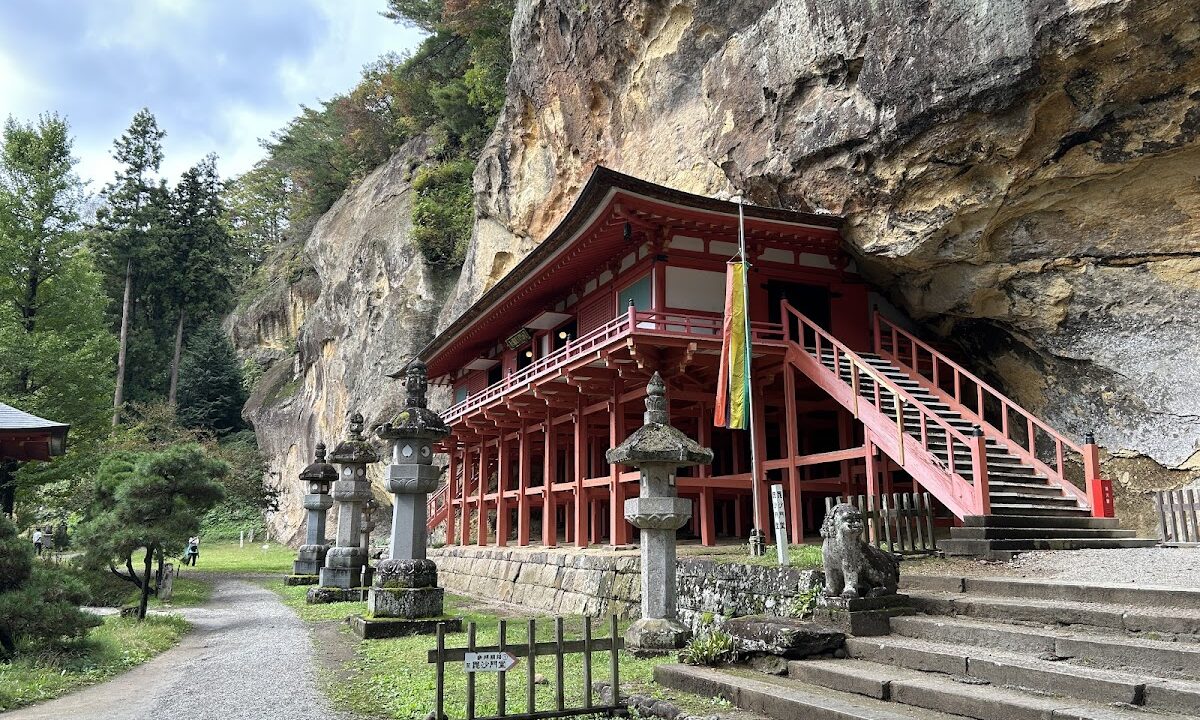
The greatest highlight of Takkoku-no-Iwaya Bishamon Hall is undoubtedly the hall built in suspended-cliff construction style, clinging to sheer rock faces. The Bishamon Hall, built in a rock cave at the base of a cliff spanning approximately 150 meters east to west with a maximum elevation difference of about 35 meters, appears to be integrated with the rock wall itself, overwhelming first-time visitors.
This architectural style is said to be modeled after the stage of Kiyomizu Temple in Kyoto, and it testifies to the high level of Japanese architectural technique in skillfully utilizing natural rock formations. Bishamon-ten statues are enshrined within the hall, and a solemn atmosphere permeates the space.
The Cliff-Face Great Buddha (Carved Buddhist Image) – The Northern Limit of Colossal Buddhas
On the upper part of the cliff face on the western side of the grounds is a colossal carved Buddhist image called the “Ganmen Daibutsu” (岩面大佛). This carved image is said to represent either Mahavairocana or Amitabha Buddha, and is said to be the northernmost carved Buddhist image in Japan.
Due to weathering, it is now difficult to distinguish its form, though records remain indicating that a clear Buddha image was once carved into the rock face. This cliff-face Great Buddha is an important cultural property demonstrating that Takkoku-no-Iwaya was not merely a building but that the natural rock formation itself was an object of faith.
The Sixteen-Foot Acalanatha Statue (Prefecture-Designated Cultural Property)
Enshrined on the grounds is a sixteen-foot Acalanatha statue carved in the Heian period, which is designated as a cultural property of Iwate Prefecture. “Sixteen-foot” (jōroku) refers to a unit of measurement for Buddhist statues, meaning one jō and six shaku (approximately 4.85 meters).
This Acalanatha statue retains the distinctive characteristics of Heian-period Buddhist sculpture and attracts the attention of many visitors and researchers as an important cultural property testifying to the ancient history of Takkoku-no-Iwaya Bishamon Hall.
The Golden Hall and Himemachi Acalanatha Hall
In addition to the Bishamon Hall, the grounds contain structures such as the Golden Hall and the Himemachi Acalanatha Hall. The Golden Hall houses the principal deity, and the Himemachi Acalanatha Hall enshrines Acalanatha. These halls are important elements demonstrating the multifaceted faith associated with Takkoku-no-Iwaya as a sacred site.
A Temple with a Torii Gate
A distinctive feature of Takkoku-no-Iwaya Bishamon Hall is that, despite being a Buddhist temple, a torii gate is installed. This is a remnant of the syncretism of Shinto and Buddhism, and represents a valuable example through which one can experience the history of Japanese religious culture.
Cultural Property Designations and Value of Takkoku-no-Iwaya
Takkoku-no-Iwaya has been designated as a National Historic Site due to its historical and cultural value. It is also registered on the Cultural Properties Online database and is protected as an important cultural property of Japan.
As part of the Hiraizumi cultural heritage group, it stands alongside Konjikudō Temple, Mōtsū Temple, Muryōkōin Temple ruins, and Kinkeisan, demonstrating the historical significance of the region. Takkoku-no-Iwaya, located approximately 6 kilometers southwest of central Hiraizumi, deepens the history of Hiraizumi as a place of faith continuing from before the time of the Ōshū Fujiwara clan.
Takkoku-no-Iwaya Bishamon Hall as a Power Spot
In recent years, Takkoku-no-Iwaya Bishamon Hall has attracted attention as one of Iwate Prefecture’s most powerful spiritual sites. It is particularly known as a power spot for “rebirth,” and many people undergoing major life transitions or wishing to change their circumstances visit here.
The solemn atmosphere created by the hall built on sheer cliffs combined with its 1,200-year history exerts a deep spiritual influence on visitors. The landscape where nature and human-made structures are integrated creates a special space separated from daily life, serving as a place to calm the mind and gain new insights.
Visitor Information and Admission Fees
Visiting Hours
The visiting hours for Takkoku-no-Iwaya Bishamon Hall are 8:00 AM to 5:00 PM. There may be minor seasonal variations, so it is recommended to confirm before your visit.
Admission Fees
- Adults: 500 yen
- Junior and Senior High School Students: 200 yen
- Elementary School Children and Below: Free (when accompanied by a guardian)
Admission fees are used for maintenance of the grounds and protection of cultural properties.
Closed Days
Generally open year-round, but may close temporarily due to weather conditions or events.
Access Methods
Location
〒029-4102 Iwate Prefecture, Hiraizumi Town, Hiraizumi, Kitazawa 16
Access by Car
- From Hiraizumi-Maesawa IC on the Tōhoku Expressway: Approximately 10 minutes
- From Hiraizumi Station: Approximately 5 minutes by car
- Parking: Free parking available (approximately 50 regular cars)
Access by Public Transportation
- From JR East Line Hiraizumi Station: Approximately 5 minutes by taxi, approximately 40 minutes on foot
- Bus Service: From Hiraizumi Station on Iwate Kōtsū Bus “Geibi Gorge Line” to “Takkoku-no-Iwaya” bus stop, then immediately on foot (limited number of services, check schedule in advance)
Combination with Nearby Attractions
Though somewhat removed from central Hiraizumi, visiting Takkoku-no-Iwaya Bishamon Hall in combination with Konjikudō Temple and Mōtsū Temple allows for a deeper understanding of Hiraizumi’s history. When visiting Hiraizumi, it is recommended to include Takkoku-no-Iwaya Bishamon Hall in your itinerary.
Contact Information
Takkoku-no-Iwaya Bishamon Hall Supervising Temple Tatsutani Saikōji
- Phone: 0191-46-4931
- Official Website: https://www.iwayabetto.com/
For details regarding admission, group visits, and acceptance of school educational trips, please contact directly.
Precautions and Etiquette When Visiting
Clothing and Equipment
The grounds have stairs and slopes, so comfortable walking shoes are recommended. Particular care is needed during rainy weather or winter when paths become slippery.
Photography
Photography within the grounds is generally permitted, but avoid photographing inside the halls or engaging in behavior that disturbs other visitors. Permission must be obtained in advance for commercial photography.
Visitor Etiquette
Takkoku-no-Iwaya Bishamon Hall is currently functioning as a place of faith and a sacred site. Please visit quietly, and treat the halls and cultural properties with care.
Nearby Attractions
Konjikudō Temple
A temple representing Hiraizumi with numerous national treasures and important cultural properties including the Golden Hall. Located approximately 15 minutes by car from Takkoku-no-Iwaya Bishamon Hall.
Mōtsū Temple
A temple founded by Motohira, the second lord of the Ōshū Fujiwara clan, known for its beautiful Pure Land garden. Approximately 10 minutes by car from Takkoku-no-Iwaya Bishamon Hall.
Geibi Gorge
A gorge designated as a National Scenic Site where you can enjoy natural beauty throughout the seasons. Located approximately 15 minutes by car from Takkoku-no-Iwaya Bishamon Hall.
Educational Tours and Experience Programs
Takkoku-no-Iwaya Bishamon Hall also accepts school trips and educational tours. As a venue for history education and for experiencing Japanese traditional culture, many schools visit the site.
Experience programs and lectures can also be arranged, so if you are considering an educational trip, it is recommended to contact the temple in advance.
Takkoku-no-Iwaya Bishamon Hall Through the Seasons
Spring (March to May)
Fresh greenery is beautiful, and the contrast between rock walls and the hall appears vivid. During cherry blossom season, the combination of surrounding cherry blossoms and Bishamon Hall creates a spectacular view.
Summer (June to August)
Surrounded by deep green vegetation, the grounds create a cool atmosphere. The sound of clear water dripping from the rock walls echoes pleasantly.
Autumn (September to November)
During autumn foliage season, the red leaves adorning the rock walls and the suspended-cliff construction hall create a magnificent landscape. The autumn foliage at Takkoku-no-Iwaya Bishamon Hall is said to be particularly beautiful even by Hiraizumi standards.
Winter (December to February)
Takkoku-no-Iwaya Bishamon Hall covered in snow displays fantastic beauty. However, snow and icing can make the ground dangerous, so extreme caution is necessary when visiting.
Conclusion: The Charm of Takkoku-no-Iwaya Bishamon Hall
Takkoku-no-Iwaya Bishamon Hall in Hiraizumi Town, Iwate Prefecture, is one of Japan’s foremost sacred sites with a history spanning over 1,200 years. The story of its founding by Sakanoue no Tamuramaro, the suspended-cliff construction hall clinging to sheer cliffs, the cliff-face Great Buddha as the northernmost carved Buddhist image, and the Heian-period sixteen-foot Acalanatha statue—this place concentrates historical and cultural value.
Though older in history than Konjikudō Temple and Mōtsū Temple, it remains somewhat unknown as a tourist destination, making it attractive for quiet prayer. When visiting Hiraizumi, please make the effort to visit Takkoku-no-Iwaya Bishamon Hall and experience the deep spirituality and historical weight this place possesses.
For those experiencing major life transitions, for those wishing to take a new step forward, Takkoku-no-Iwaya Bishamon Hall, as a power spot for “rebirth,” will hold special meaning. Please experience firsthand the power of faith woven through 1,200 years of history.