.jpg)
Sayama Lake / Yamaguchi Reservoir (Saitama Prefecture) Complete Guide|History, Highlights, Access, and Surrounding Attractions Thoroughly Explained
Sayama Lake (Yamaguchi Reservoir), which spans the border between Tokorozawa City and Iruma City in Saitama Prefecture, is an artificial lake completed in 1934 (Showa 9) as an important water source for Tokyo. Surrounded by the rich nature of the Sayama Hills, this reservoir serves not only as a water supply facility but is also cherished by many people as a tourist destination where visitors can enjoy beautiful scenery throughout the four seasons.
This article provides detailed explanations of everything you should know before visiting Sayama Lake, from its historical background to highlights, access methods, and surrounding tourist spots.
Sayama Lake (Yamaguchi Reservoir): Basic Information and Overview
Official Name and Nickname
The official name of Sayama Lake is “Yamaguchi Reservoir (Yamaguchi Chosui Chi),” with the English name being “Yamaguchi Reservoir.” It is commonly known as “Sayama Lake (Sayama Ko)” among local residents and tourists, and this name is widely used.
This reservoir spans Tokorozawa City and Iruma City in Saitama Prefecture and is managed by the Tokyo Metropolitan Water Authority, Murakami-Yamaguchi Reservoir Management Office. It was constructed by skillfully utilizing the topography of the Sayama Hills, which spans the border between Tokyo and Saitama prefectures.
Location and Management System
Address: Shouraku-ji, Kamiyamaguchi, Tokorozawa City, Saitama Prefecture; Sayama-dai, Iruma City
Sayama Lake is a Tokyo metropolitan water supply facility, yet most of it is located within Saitama Prefecture. It is managed by the Tokyo Metropolitan Water Authority and, together with the adjacent Murayama Reservoir (Lake Tama), functions as a vital water source for the Greater Tokyo Area.
The surrounding area is designated as Saitama Prefectural Sayama Natural Park, where natural environment conservation and utilization are promoted. This park is known as one of the most nature-rich spots in the Kanto region, with many wild birds and plants inhabiting it.
History of Sayama Lake|A Large-Scale Project in the Early Showa Period
Background and Purpose of Construction
The construction of Sayama Lake (Yamaguchi Reservoir) was planned in response to rapid population growth and urbanization in Tokyo from the late Taisho period through the early Showa period. At that time, Tokyo faced severe water shortages, making the securing of a stable water source an urgent issue.
Yamaguchi Reservoir was positioned as the second reservoir following the Murayama Reservoir (Lake Tama), which had already been completed in 1924 (Taisho 13), and took on the role of serving as Tokyo’s water supply. The site was chosen at the Sayama Hills because the deep valley made it possible to secure a large reservoir capacity.
Details of Construction Work
The construction of Yamaguchi Reservoir began in 1927 (Showa 2) and was completed in 1934 (Showa 9) after seven years of work. It was a large-scale project employing the most advanced civil engineering technology of the time.
The construction resulted in portions of Shouraku-ji Village and Yamaguchi Village being submerged, requiring the relocation of local residents. The embankment (dam) was constructed in an earth dam format, with a dam length of 716 meters and a height of 34.5 meters. The total reservoir capacity is approximately 19.5 million cubic meters, equivalent to about 16 Tokyo Domes.
Historical Value and Evaluation as a Cultural Asset
Sayama Lake is highly valued for its historical and cultural significance as a facility that represents the pinnacle of civil engineering technology in the early Showa period. It has been selected as one of the “100 Famous Dam Lakes in Japan,” occupying an important position in the history of dam construction in Japan.
Nearly 90 years after its completion, it continues to maintain its original functions while serving as an important water source for Tokyo’s water supply. This long-term stable operation testifies to the excellence of the original design and construction techniques.
Four Seasons at Sayama Lake and Highlights|Enjoying Natural Beauty
Spring Cherry Blossoms|A Spectacular View of Approximately 20,000 Cherry Trees
Spring at Sayama Lake is renowned for the spectacular sight of approximately 20,000 cherry trees in bloom. Centered around Somei Yoshino and Yamato cherry blossoms, the entire lake shore is dyed a pale pink, making it one of the most famous cherry blossom viewing spots in Saitama Prefecture, captivating many flower-viewing enthusiasts.
The cherry blossoms typically bloom from late March to early April. The sight of cherry blossoms reflected on the lake surface and the cherry blossom tunnel along the embankment are excellent photo spots. On clear days, the contrast between the blue sky, cherry blossoms, and lake surface is beautiful, allowing visitors to fully enjoy nature’s beauty.
Summer Green Foliage and Birdwatching
In summer, Sayama Lake is surrounded by the lush green forests of the Sayama Hills, offering a refreshing landscape. This season is ideal for birdwatching as bird activity becomes active.
Various birds inhabit the Sayama Hills, and rare species such as kingfishers, golden eagles, and paradise flycatchers can be observed. Birdwatching enthusiasts are frequently seen walking the lakeside trails with binoculars in hand.
Autumn Foliage|Autumn Colors Reflected on the Lake Surface
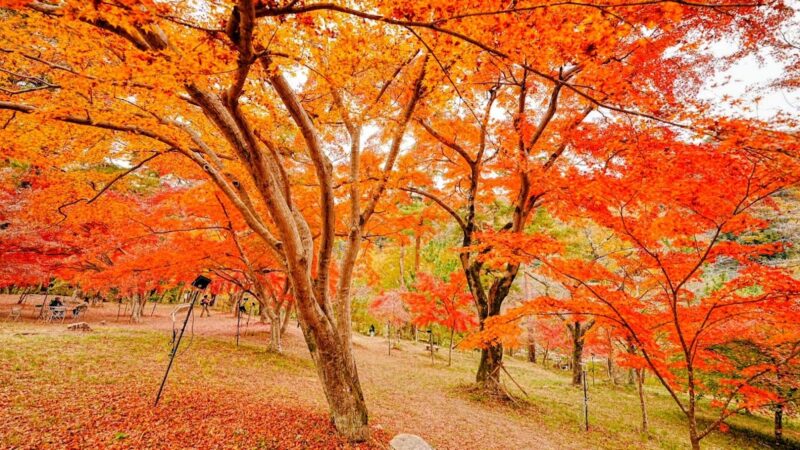
Autumn at Sayama Lake captivates visitors with the beauty of fall colors. Maples, Japanese maples, and zelkovas turn red and yellow, and the autumn foliage reflected on the lake is breathtakingly beautiful.
The peak season is typically mid-November to early December. Particularly, the foliage illuminated by evening light creates a fantastical atmosphere. The undulating terrain of the Sayama Hills creates a three-dimensional autumn foliage landscape, making it one of the most outstanding foliage viewing spots in the Kanto region.
Winter Silence and Views of Mount Fuji
Winter at Sayama Lake offers an open landscape with views stretching far through the bare trees. On clear days in particular, Mount Fuji can be seen across the lake, offering spectacular winter scenery.
On clear winter mornings, the silhouette of Mount Fuji is most beautiful. Many photographers gather at the quiet lakeside at dawn to capture Mount Fuji as a backdrop.
Access Methods|How to Get There by Train, Bus, or Car
Access by Train and Bus
Using Seibu Railway
- From the east exit of Seibu Shinjuku Line “Sayama City Station,” take a Seibu bus for approximately 17 minutes toward “Seibu-en Yuuenchi” or “Seibu Ballpark Mae,” and get off at the “Sayama Lake” bus stop
- From the east exit of Seibu Ikebukuro Line “Tokorozawa Station,” take a Seibu bus for approximately 30 minutes toward “Seibu Ballpark Mae,” and get off at the “Sayama Lake” bus stop
- Approximately 15 minutes on foot from “Seibu Ballpark Mae Station” on the Seibu Sayama Line
Using JR
- From JR Musashino Line “Higashi-Tokorozawa Station,” take a Seibu bus for approximately 20 minutes toward “Seibu Ballpark Mae,” and get off at the “Sayama Lake” bus stop
The number of buses varies depending on the time of day. It is recommended to check the Seibu Bus timetable in advance. Especially on weekends, buses can be crowded with tourists, so it’s best to plan with time to spare.
Car Access and Parking Information
Using the Kanetsu Expressway
- Approximately 20 minutes from Tokorozawa Interchange
- Approximately 15 minutes from Iruma Interchange
Using the Kanto Central Expressway
- Approximately 15 minutes from Iruma Interchange
Parking
There are multiple parking lots around Sayama Lake. The parking lot at Saitama Prefectural Sayama Natural Park is free to use, but it often fills up during peak seasons for cherry blossoms and autumn foliage, so early arrival is recommended. You can also use the paid parking lot at Seibu-en Yuuenchi and access the area on foot.
Tourist Spots Around Sayama Lake|Recommended Destinations to Visit Together
Lake Tama (Murayama Reservoir)
Lake Tama (Murayama Reservoir), located just south of Sayama Lake, is another artificial lake that serves as a water source for Tokyo. This historic reservoir was completed in 1924 (Taisho 13) and is recommended to visit as a set with Sayama Lake.
A walking trail connects the two lakes, offering a popular approximately 30-minute hiking course. There is also an observation point along the way with a spectacular view overlooking both lakes.
Totoro’s Forest (Sayama Hills)
The Sayama Hills are known as the model for the setting of the Studio Ghibli masterpiece “My Neighbor Totoro.” The area is preserved as “Totoro’s Forest,” where abundant nature remains.
Multiple Totoro’s Forest areas are scattered throughout, and visitors can feel the world of the movie while walking the trails. The forests managed by the nature conservation group “Totoro’s Furusato Fund” have informational signs.
Seibu-en Yuuenchi
Seibu-en Yuuenchi, located within walking distance of Sayama Lake, is a theme park themed around Showa-era retro aesthetics. After reopening in 2021, its area recreating the streetscape of the 1950s Showa period has become popular.
It is an ideal spot for families to visit in combination with sightseeing at Sayama Lake, and seasonal events are held throughout the year.
Tokorozawa Aviation Memorial Park and Tokorozawa Aviation Birth Museum
Tokorozawa City, the birthplace of aviation in Japan, is home to Tokorozawa Aviation Memorial Park and Tokorozawa Aviation Birth Museum. Real aircraft are displayed throughout the expansive park, where visitors can learn about the history of aviation.
Located approximately 15 minutes by car from Sayama Lake, it is an educational tourist spot enjoyed by both children and adults.
Dining and Restaurant Information Around Sayama Lake
Popular Local Cafes
Cafe Mame Usagi
A popular cafe in the Sayama Lake area offering freshly roasted coffee and homemade sweets. With its calm atmosphere, it’s ideal for a rest break during sightseeing. Lunch menus using local ingredients are also popular.
Recommended Local Cuisine
Udon Place Masatada
An established udon restaurant in Tokorozawa City known for its chewy hand-pulled udon noodles. It’s a long-beloved spot by local residents and recommended for a stop on the way back from Sayama Lake sightseeing.
Jerateriya HIRANUMA
A specialty gelato shop offering diverse flavors made with seasonal fruits. Many tourists stop by for dessert after Sayama Lake walks, making it a popular establishment.
Dining Options in the Area
There are numerous restaurants in the Tokorozawa and Iruma city centers near Sayama Lake. Visitors can enjoy a variety of cuisines, including dishes made with fresh local vegetables and Saitama Prefecture’s B-class gourmet offerings. Especially on weekends, advance reservations are recommended due to crowding.
Accommodation and Hotel Information Around Sayama Lake
Hotels in the Tokorozawa Area
The Tokorozawa Station area offers a variety of accommodation options, from business hotels to city hotels. Access to Sayama Lake from the station is good, making it a convenient tourism base.
Major hotels are concentrated around the west exit of Tokorozawa Station, offering a range of affordable rates. Early reservations often allow for discounted plans.
Accommodation Facilities in the Iruma Area
There are also business hotels around Iruma City Station, convenient for accessing Sayama Lake. Extending slightly further, hot spring inns in Hanno City are also options.
Hot Spring Balcony King & Queen
This area is popular for accommodations with hot springs. Combined travel plans featuring Sayama Lake sightseeing and hot springs are also recommended.
Surrounding Tourism Bases
Plans for day trips to Sayama Lake while staying in nearby tourist cities like Tokyo or Kawakoe are also popular. Especially Kawakoe, known as “Little Edo,” allows visitors to enjoy Saitama tourism combining it with Sayama Lake.
How to Enjoy Sayama Lake and Recommended Plans
Day Hiking Courses
Several hiking courses for beginners to intermediate hikers are available around Sayama Lake. Representative courses are as follows:
Sayama Lake and Lake Tama Tour Course (approximately 3 hours)
A classic course that tours both lakes, allowing visitors to enjoy nature while walking along lakeside trails. With minimal elevation changes, it’s suitable for families.
Sayama Hills Trekking Course (approximately 4-5 hours)
A more serious course along the ridge of the Sayama Hills, offering forest bathing while birdwatching is also possible. Routes passing through Totoro’s Forest areas are particularly popular.
Photography Spots
Sayama Lake is also popular among photography enthusiasts. Recommended photography points include:
- Full Lake View from the Embankment: Morning and evening light is beautiful, capturing the four seasons’ different expressions
- Around the Intake Tower: The intake tower floating on the lake is an iconic symbol of Sayama Lake
- Mount Fuji View Point: Mount Fuji can be photographed across the lake on clear winter days
- Cherry Blossom and Autumn Foliage Spots: Seasonal colors can be captured together with the lake
Enjoying by Cycling
The area around Sayama Lake is also suitable for cycling. Routes using rental bicycles touring Sayama Lake to Lake Tama and further through Totoro’s Forest are popular.
Rental bicycle facilities are available near Tokorozawa Station and Seibu Ballpark Mae Station, with electric-assist bicycles also available for rental. Even with the undulating terrain, electric-assist makes riding comfortable.
Precautions and Etiquette When Visiting Sayama Lake
Restrictions as a Water Supply Facility
As Sayama Lake is an important water source for Tokyo, access to certain areas is restricted. Never enter areas marked with fences or “No Entry” signs.
Additionally, fishing, water play, and boat recreation on the lake are prohibited. To maintain water quality, littering is strictly forbidden. When visiting, always take your trash with you.
Etiquette for Nature Conservation
Plant collection and feeding wildlife are prohibited within Saitama Prefectural Sayama Natural Park. When enjoying nature observation, practice “looking only, photographing only” to help protect the natural environment.
When birdwatching, be considerate not to get too close to birds or interfere with nests. Use binoculars or telephoto lenses to observe from an appropriate distance.
Seasonal Clothing and Supplies
Appropriate seasonal clothing and preparation are important when visiting the nature-rich area around Sayama Lake.
- Spring and Autumn: Prepare layers for cool mornings and evenings
- Summer: Prepare hats, sunscreen, and water for replenishment due to strong sunlight
- Winter: Take proper cold-weather precautions as winds can be strong
When hiking, also prepare comfortable walking shoes, drinking water, maps, and smartphone chargers.
The Appeal of Sayama Lake|Selected as One of Saitama’s Natural 100 and One of Japan’s 100 Famous Dam Lakes
Selection as One of Saitama’s Natural 100
Sayama Lake has been selected as one of “Saitama’s Natural 100,” recognized as a representative natural landscape of Saitama Prefecture. This selection was made through public voting, demonstrating that the location is loved by local residents.
The scenery of the lake harmonizing with the rich forests of the Sayama Hills is a rare sight that conveys natural beauty despite being an artificially constructed reservoir. The landscape changing with each season offers new discoveries with every visit.
Value of Being One of Japan’s 100 Famous Dam Lakes
Sayama Lake (Yamaguchi Reservoir Dam) has also been selected as one of the “100 Famous Dam Lakes in Japan,” chosen by the Foundation for Research and Promotion of Dam Reservoir Environment. This evaluation comprehensively considers scenic beauty, regional harmony, and historical significance.
Being selected as one of 100 dam lakes among many throughout Japan demonstrates its nationwide recognition. It is highly valued for maintaining both cultural heritage value and functions as a modern water supply facility.
Connection with Local Community
Sayama Lake plays an important role as a gathering place for local residents. It is used daily for morning walks and jogs, and weekend family picnics.
Regular cleanup activities and nature observation meetings organized by local nature conservation groups and citizen organizations are held, with the lake serving to deepen community bonds. These close connections with the community are the driving force in maintaining Sayama Lake’s beautiful environment.
Conclusion|Experience Nature and History at Sayama Lake
Sayama Lake (Yamaguchi Reservoir) was born as a crystallization of civil engineering technology in the early Showa period and has continued to play an important role as Tokyo’s water source for nearly 90 years. Simultaneously, it is cherished as one of Saitama Prefecture’s representative natural landscapes.
Sayama Lake presents a different face with each season—spring cherry blossoms, summer greenery, autumn foliage, and winter views of Mount Fuji—offering new discoveries and inspiration with each visit. Good access from the urban center also allows for convenient day trips.
Why not experience nature and history at Sayama Lake surrounded by the rich nature of the Sayama Hills, with various ways to enjoy it including hiking, birdwatching, and photography? Sayama Lake, boasting some of the finest natural scenery in the Kanto region, is a special place that brings peace and comfort to all who visit.
The area is rich in surrounding tourist attractions, dining, and accommodations, allowing for a full day of enjoyment. Please visit Sayama Lake to experience the different charms of each season and feel the wonderful nature of Saitama.
-800x450.jpg)
-800x450.jpg)