
.jpg)
Tenranzan Mountain (Saitama Prefecture) Complete Guide | Thorough Explanation of a Famous Peak in Hanno City That Even Beginners Can Climb
Tenranzan Mountain (Tenranzan), located near the city center of Hanno City in Saitama Prefecture, is one of the finest hiking spots in the Kanto region, blessed with history, nature, and views, despite being a low mountain at 197 meters above sea level. With good access from central Tokyo, it is enjoyed by a wide range of people, from beginners to experienced mountaineering enthusiasts.
This article will convey all the charms of Tenranzan Mountain and provide thorough explanations of climbing courses, access methods, nearby tourist spots, and seasonal highlights.
What is Tenranzan Mountain? Basic Information and Characteristics
Tenranzan Mountain is located in Hanno City, Saitama Prefecture, at an elevation of 197 meters (some summit signs indicate 195 meters). Although the elevation is low, the views from the summit are excellent, offering a panoramic view of Hanno City, and on clear days, you can see Mount Fuji, Tokyo Skytree, and the mountains of the Oku-Musashi and Okutama regions.
History and Origin of the Name of Tenranzan Mountain
Tenranzan Mountain has a storied history with changing names over time.
Atago Mountain Era
Originally, it was called “Atago Mountain” because Atago Gongen was enshrined at Nenin Temple at the base of the mountain.
Rakan Mountain Era
During the Edo period, as an expression of gratitude for the recovery from illness of the 5th Shogun Tokugawa Tsunayoshi, his mother Keishoin donated sixteen stone statues of Rakan (Arhat), and the mountain became known as “Rakan Mountain.” These sixteen Rakan statues remain on the mid-slope to this day and are one of the important highlights.
Change to Tenranzan Mountain
On April 18, 1883 (Meiji 16), Emperor Meiji observed from the summit of this mountain the spring exercises of the Imperial Guards held at the base of the mountain (tenshin/imperial inspection), which led to the name “Tenranzan Mountain.” A monument commemorating this imperial visit is built on the summit, preserving this historical event for posterity.
As a result of this history, Tenranzan Mountain was designated as the first nationally designated scenic spot in Saitama Prefecture and is known as a mountain of high historical and cultural value.
Geographic Features of Tenranzan Mountain
While resembling a hill more than a mountain, Tenranzan Mountain is positioned as the starting point of the Oku-Musashi Nature Trail. To its west lies Tono-Suyama Mountain, and hiking courses combining both mountains are popular.
The greatest appeal is the ease of access: approximately 20 minutes on foot from Hanno Station to the trailhead, about 5 minutes on foot from the “Tenranzan-shita” bus stop if using the bus, and about 20 minutes from there to the summit.
Access Methods to Tenranzan Mountain
Access by Train
Using the Seibu Ikebukuro Line
- Board the “Hanno-bound” or “Seibu-Chichibu-bound” train from Ikebukuro Station on the Seibu Ikebukuro Line
- Get off at Hanno Station (Travel time: approximately 50 minutes by express)
- Walk approximately 20 minutes north from Hanno Station North Exit, or use the bus
Using the JR Hachioji Line
- Take the JR Hachioji Line from the Hachioji area and get off at Hanno Station
Access by Bus
From the Hanno Station North Exit bus stop using Kokusai Kogyo Bus:
- Take the “Seibu Hanno-Hidaka” line and get off at “OH!!!・Tenranzan-shita” (approximately 10 minutes)
- Or take the “Naguri area” line and get off at “Citizen’s Hall/Museum” (approximately 10 minutes)
From the bus stop to the trailhead is approximately 5 minutes on foot.
Access by Car
Using the Kan-Etsu Expressway
- Approximately 15 minutes from Sayama-Hidaka IC
- Approximately 10 minutes from Hanno IC
Using the Ken’o Expressway
- Approximately 30 minutes from Ome IC
- Approximately 15 minutes from Sayama-Hidaka IC
Parking Information
There are several parking areas around Tenranzan Mountain:
- Tenranzan-shita Parking Area (free, limited spaces)
- Citizen’s Hall Parking Area
- Nenin Temple Parking Area (for temple visitors)
Weekends and holiday seasons become crowded, so using public transportation is recommended.
Climbing Courses and Time Required for Tenranzan Mountain
Beginner-Friendly: Tenranzan Round-Trip Course
Time Required: Approximately 1 to 1.5 hours
Walking Distance: Approximately 2km
Difficulty Level: Beginner
This is the most basic course, a round-trip route from the trailhead to the summit. With a well-maintained trail, even small children and beginner mountaineers can walk with confidence.
Course Characteristics:
- Approximately 10 minutes from the trailhead to the mid-slope sixteen Rakan statues
- Approximately 10 minutes from the Rakan statues to the summit
- Average gradient is 2.1 degrees, quite gentle
- There are stairs and rocky sections, but there are almost no dangerous areas
Popular Course: Tenranzan・Tono-Suyama Round-Trip Course
Time Required: Approximately 2 to 3 hours
Walking Distance: Approximately 5 to 7km
Cumulative Elevation Gain: Approximately 254m
Difficulty Level: Beginner to Intermediate
This course extends to Tono-Suyama Mountain (271 meters elevation), located northwest of Tenranzan Mountain. It is a standard route for Hanno hiking, enjoyed by many climbers.
Recommended Route:
- Start at Tenranzan Trailhead
- Tenranzan Summit (197m)
- Ridge walk to Tono-Suyama
- Tono-Suyama Summit (271m)
- Descend toward Hongo, or return to Tenranzan
Course Highlights:
- Different views from two mountain summits
- Forest bathing on a nature-rich ridge trail
- Opportunities for bird watching
Advanced: Hanno Alps Ridge Traverse Course
Time Required: Approximately 4 to 6 hours
Walking Distance: Approximately 10 to 15km
Difficulty Level: Intermediate to Advanced
A ridge traverse course starting from Tenranzan Mountain and continuing through the Oku-Musashi mountains toward Tono-Suyama, Ryugai-yama, and Izugadake. Recommended for those confident in their stamina or seeking more serious mountaineering.
Highlights and Attractions of Tenranzan Mountain
360-Degree Panoramic View from the Summit
Despite being a low mountain at 197 meters, the view from the summit is spectacular. From the observation platform, you can enjoy the following scenery:
Eastern Side:
- Panoramic view of Hanno City
- On clear days, Tokyo Skytree is visible
- Urban skyline toward central Tokyo
Western Side:
- Mountains of the Oku-Musashi and Okutama regions
- Mountain ranges including Tono-Suyama
Southwestern Side:
- Majestic view of Mount Fuji on clear days
- Mountain ranges of the Tanzawa Mountains
Particularly in winter when the air is clear or in early morning, spectacular views extending far into the distance unfold.
Sixteen Rakan Statues (Mid-Slope Highlight)
On the mid-slope of the mountain stand sixteen stone Rakan statues donated by Keishoin, mother of Tokugawa Tsunayoshi, during the Edo period. These stone Buddhas, which have remained from the Edo period, possess high historical and cultural value and are one of the important highlights of Tenranzan Mountain.
Located along the hiking trail, you will inevitably visit them while heading to the summit. These Rakan statues, standing quietly in the forest, create a mystical atmosphere.
Nenin Temple (Ancient Temple at the Base)
Near the trailhead of Tenranzan Mountain stands Nenin Temple, a Soto Zen temple deeply connected to Tenranzan Mountain’s history. With a beautiful garden and main hall, it is worth visiting before or after climbing.
Nenin Temple Highlights:
- Chisen-kaiyushiki Garden (pond-based stroll garden)
- Historic main hall and gate
- Flowers throughout the seasons
Natural Beauty by Season
Spring (March to May)
- Known as a cherry blossom viewing spot, with cherry blossoms blooming from the base to mid-slope
- Azaleas are also magnificent, with their prime viewing period in late April to early May
- Season of beautiful new greenery with refreshing hiking
Summer (June to August)
- Season of forest bathing covered in deep green
- Since elevation is low, heat countermeasures are essential
- Early morning climbing is recommended
Autumn (September to November)
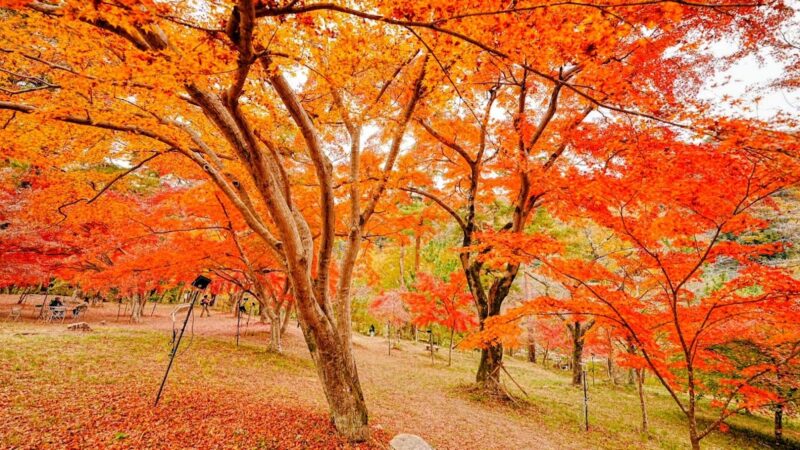
- Known as a foliage viewing spot with many tourists visiting
- Autumn foliage prime viewing period is late October to mid-November
- Clear air allows for distant views, and Mount Fuji is easier to see during this season
Winter (December to February)
- Season with the clearest air and best views
- Almost no snowfall, making winter climbing possible
- With proper cold-weather preparations, you can hike comfortably
Anime “Yama no Susume” Holy Site
Tenranzan Mountain has garnered attention as a holy site for pilgrimage after appearing in the popular anime “Yama no Susume.” Depicted as a representative mountain of Hanno City, the setting of the work, anime fans have increasingly visited the mountain.
The hiking trail and summit offer scenery reminiscent of the work, and there is the added enjoyment of photographing the same angles as the anime. Since various “Yama no Susume” related spots are scattered throughout Hanno City, it is recommended to visit them together.
Precautions and Preparations for Tenranzan Mountain Climbing
Clothing and Equipment
Even though it is a low mountain, basic mountaineering equipment is necessary:
Essential Equipment:
- Comfortable hiking shoes (trekking shoes recommended, running shoes acceptable)
- Easy-to-move clothing (moisture-wicking, quick-drying materials)
- Hat
- Drinking water (500ml to 1 liter)
- Towel
- Rain gear (folding umbrella or rain jacket)
Useful to Have:
- Trekking poles
- Trail snacks (chocolate, nuts, etc.)
- First aid kit
- Map or smartphone (with GPS function)
- Camera
Safety Precautions
- Be careful on days with poor weather or after rain when the ground is slippery
- During summer, ensure sufficient hydration to prevent heat stroke
- If climbing alone, inform family or friends of your climbing plan
- Manage time to descend before sunset
- Be alert to wildlife (wild boar, poisonous snakes, etc.)
Physical Fitness and Time Guidelines
Calories Burned: Approximately 947 kcal (Tenranzan and Tono-Suyama round-trip course)
Required Water: Approximately 1 liter
Recommended Physical Level: No problem for those who exercise lightly regularly
For beginners or those with children, it is recommended to start with the Tenranzan round-trip course.
Tourist Spots Around Tenranzan Mountain
OH!!! (Fermentation Theme Park)
A complex facility with fermentation as its theme, located right in front of the Tenranzan-shita bus stop. It brings together restaurants, cafes, and shops utilizing Hanno City’s regional resources, making it ideal for meals and breaks after climbing.
Facility Contents:
- Restaurant using fermented foods
- Local products market
- Workshop space
- Cafe
Hanno City Museum・Central Park
Located at the foot of Tenranzan Mountain, this museum allows you to learn about Hanno City’s history and nature. The surrounding Central Park is spacious and suitable for picnics and rests.
Akebono Children’s Forest Park (Moomin Valley)
Located approximately 10 minutes by car from Tenranzan Mountain, this is a park with a concept based on the Moomin world. With Nordic-style buildings and a nature-rich environment, it is popular with families.
Miyazawa Lake Onsen Kirari Bettei
For recuperation after climbing, day-use hot spring facilities in Hanno City are recommended. You can relax in an open-air bath while enjoying views of the Oku-Musashi mountains.
Gourmet Information Around Tenranzan Mountain
Local Gourmet of Hanno City
Suiito Poteto (Sweet Potato Sweets)
Hanno City is known as a sweet potato region, and there are various shops offering sweet potato sweets throughout the city.
Hand-Made Soba
The Oku-Musashi region is also a soba production area, and enjoying hand-made soba after climbing is standard.
Hanno Suiito
A local dish made of kneaded wheat flour in dumpling form, served as a warm soup with plenty of vegetables.
Recommended Restaurants and Cafes
- Restaurants in OH!!!: Healthy menus using fermented foods
- Cafes around Nenin Temple: Stylish cafes in renovated old houses
- Dining establishments around Hanno Station: Various genres of dining options
Hotel and Accommodation Information Around Tenranzan Mountain
When staying around Tenranzan Mountain, hotels in Hanno City or the Tokorozawa/Sayama areas are convenient.
Hotels in Hanno City
Business Hotels:
- Several business hotels are available near Hanno Station with reasonable prices
- Convenient location for early morning departure for climbing
Private Lodges and Guest Houses:
- There are also mountain lodge-style accommodations in the Oku-Musashi area
- Enjoy a homey atmosphere and exchange with fellow climbers
Hotels in Tokorozawa and Sayama Areas
Tokorozawa and Sayama, adjacent areas to Hanno City, have more accommodation options:
- Business hotels along the Seibu Line
- City hotels
- Hotels with hot springs
Major Hotel Areas in Saitama Prefecture
When accessing Tenranzan from the Kanto region, you can also choose to stay in major cities in Saitama Prefecture:
- Omiya Area: Saitama’s largest city with diverse hotels
- Kawagoe Area: Popular as a tourist destination, allowing combined tourism with Tenranzan
When searching for accommodations, prioritizing good access to Hanno Station will make for a smooth climb the next morning.
Best Season for Tenranzan Mountain Climbing
Tenranzan Mountain can be climbed year-round, but there are best seasons depending on your goals.
For Views: November to February
Winter, when the air is clear and distant views are effective, is ideal for enjoying views of Mount Fuji and the urban landscape.
For Flowers and Foliage: April to May, October to November
Spring with cherry blossoms and azaleas, and autumn with foliage, are perfect for enjoying nature’s beauty.
For Beginners and Families: March to May, September to November
Spring and autumn with mild weather and easy walking are recommended.
Seasons to Avoid: Extremely Hot Days in July and August
Being low elevation, temperatures become extremely hot during mid-summer daytime. If climbing in summer, early morning is best.
Tips for Enjoying Tenranzan Mountain Climbing More
Advantages of Early Morning Climbing
Climbing early offers the following benefits:
- Fewer people and quiet mountain walks
- Beautiful scenery illuminated by morning light
- Cooler and more comfortable in summer
- More active bird watching opportunities
Photography Spots
- Summit Observation Platform: 360-degree grand panorama
- Sixteen Rakan Statues: Stone Buddhas with historical feeling
- Forest on the Trail: Beautiful dappled sunlight
- Nenin Temple Garden: Japanese garden aesthetics
Event Information
Throughout the year, various events are held in Hanno City:
- Spring: Cherry Blossom Festival
- Summer: Hanno Festival
- Autumn: Autumn Foliage Hiking Events
- Winter: Sunrise Climbing on New Year’s Day
Check the official tourism website for the latest event information.
Conclusion: Tenranzan Mountain is Ideal as an Introduction to Kanto Mountaineering
Tenranzan Mountain (Hanno City, Saitama Prefecture) is a charming mountain that combines history, nature, and views, all while being as accessible as its 197-meter elevation suggests.
Summary of Tenranzan Mountain’s Charms:
- Excellent accessibility, approximately 1 hour from central Tokyo
- Well-maintained trails safe for beginners and children
- History and cultural assets associated with Emperor Meiji
- Excellent views from the summit (Mount Fuji, Tokyo Skytree, Hanno City)
- Natural beauty throughout the seasons (cherry blossoms, azaleas, autumn foliage)
- Possibility for ridge traverses to Tono-Suyama and Hanno Alps
- Abundant nearby tourist spots and gourmet options
For beginner mountaineers, it is recommended to start with the Tenranzan round-trip course, and once accustomed, progress to the round-trip course with Tono-Suyama or the Hanno Alps ridge traverse.
Why not experience the joy of mountain walking with Tenranzan Mountain, a famous peak of which Saitama Prefecture boasts? The abundant nature, history, and warm local people will surely welcome you.
-800x450.jpg)
-800x450.jpg)
(埼玉県)-800x450.jpg)