
.jpg)
Korankei (Aichi Prefecture) Complete Guide | Autumn Leaves, Access, Highlights & Gourmet Food Thoroughly Explained
Korankei (こうらんけい) is a beautiful gorge formed by the Tomoe River, a tributary of the Yahagi River, located in Asuke Town, Toyota City, Aichi Prefecture. The autumn foliage landscape created by approximately 4,000 maple trees is known as the finest in the Tokai region, and every autumn brings many tourists from across Japan. However, the charm of Korankei is not limited to autumn leaves. It is a nature-rich tourist attraction that displays seasonal characteristics year-round—spring’s katakuri flowers, summer’s fresh greenery and fireflies, and winter’s serene landscape.
This article provides thorough explanations of information you should know before visiting Korankei, from its history and highlights to access methods, surrounding gourmet options, and event information.
The History and Origins of Korankei
The history of Korankei’s autumn foliage dates back to 1634 (the 11th year of the Kanei era) in the early Edo period. It is said to have begun when Sanei Waso, the 11th chief priest of Kojaku Temple (Kojaku-ji) in Asuke, planted maple and cedar trees along the approach path from the Tomoe River to Kojaku Temple.
Subsequently, from the Taisho to early Showa periods, planting efforts were advanced by local youth groups and residents, resulting in the current impressive scale of approximately 4,000 trees. Due to this historical progression, the autumn foliage of Korankei is not merely a natural landscape but also a cultural heritage in which people’s thoughts and efforts have accumulated over many generations.
The gorge area is designated as the Aichi Kogen Quasi-National Park, with efforts made to balance nature conservation and tourism. The clear stream of the Tomoe River and the topography centered on Iimori Mountain (254 meters in elevation) create a unique scenic beauty.
Korankei’s Autumn Foliage | Peak Viewing Period and Best Season
Peak Foliage Viewing Period
The best time to view Korankei’s autumn foliage is typically from mid-November to late November. However, the timing may vary depending on climate conditions, so it is recommended to check the latest foliage information before visiting.
The leaves begin to change color gradually from late October, and by early November, some areas are already at their peak. The peak arrives in mid-November, and beautiful autumn foliage can be enjoyed until late November.
Types of Trees That Change Color
Approximately 11 varieties of maple are planted at Korankei, each coloring at slightly different times. The main types include:
- Iroha Maple
- Large-leafed Japanese Maple
- Mountain Maple
- Urageenkokakaeде
- Small Hand Maple
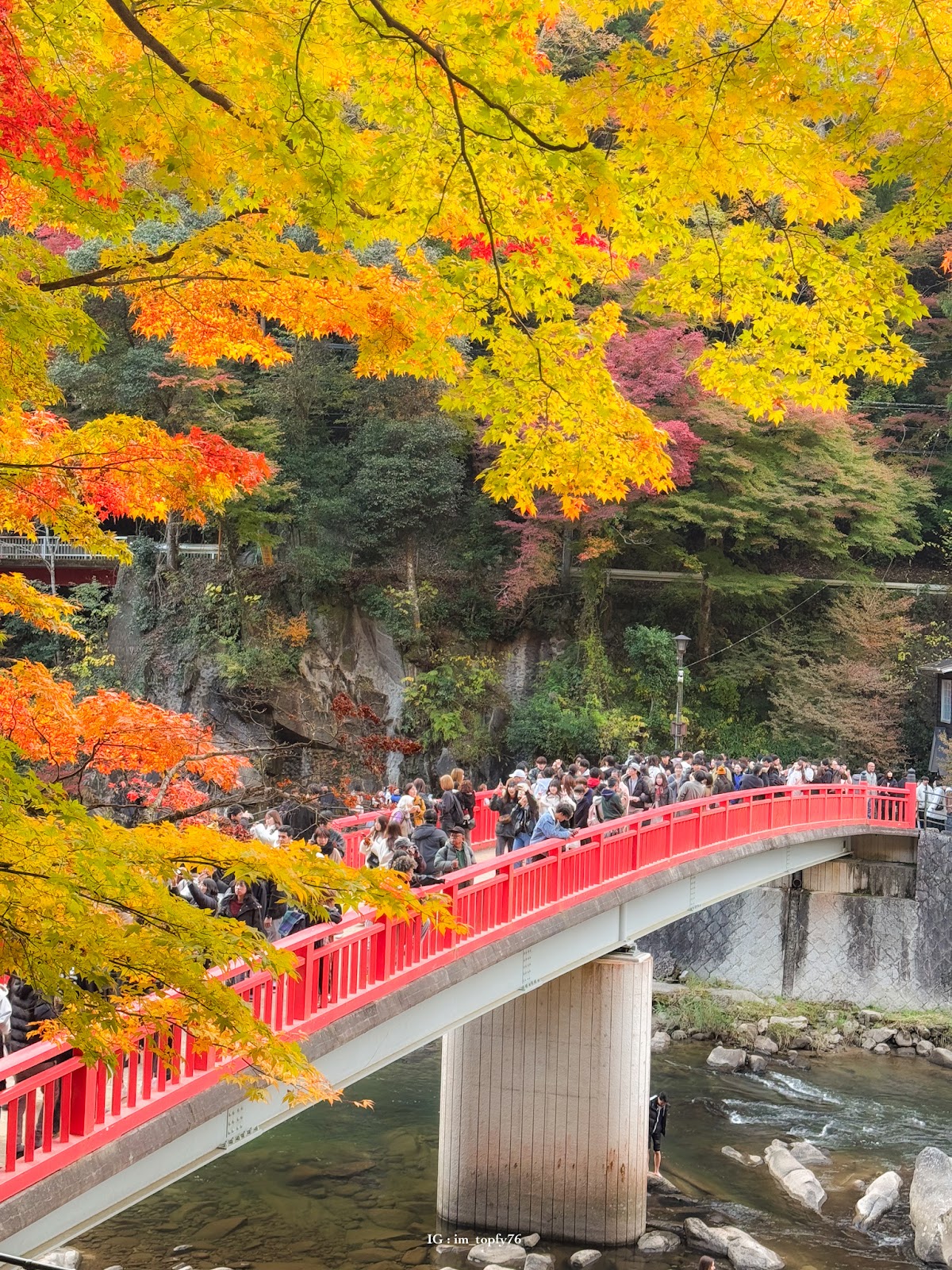
These diverse varieties change color at staggered times, making it possible to enjoy the foliage over an extended period, which is a characteristic feature of Korankei. In addition to red, the color changes in yellow and orange, creating a gradient-like palette that is another highlight.
Crowd Conditions and Visiting Tips
The foliage season, especially weekend mid-November, is extremely crowded. Even on weekdays, many tourists visit during peak foliage, so the following points are helpful:
- Early morning visits: Arriving before 8 a.m. avoids relatively large crowds
- Weekday visits: If possible, visiting on a weekday is recommended
- Use of public transportation: Consider using buses to avoid parking lot congestion
- Allow adequate time: Plan your schedule with extra buffer for traffic delays
Korankei Momiji Festival | Event Information
Every year from November 1st to 30th, the “Korankei Momiji Festival” is held. During this event period, various celebrations are held, making Korankei the most vibrant time of year.
Illumination Information
The biggest highlight during the Momiji Festival is the illumination that runs from sunset to 9 p.m. The foliage along the Tomoe River is lit up, creating a fantastical scenery reflecting in the river water that differs entirely from the daytime view.
The views from around Taigetsukyo Bridge (待月橋) and Tomoe Bridge are particularly beautiful and popular as photography spots. The experience of walking through an illuminated foliage tunnel while strolling is a charm unique to Korankei.
Main Events of the Momiji Festival
The following events are held during the festival period:
- Monkey performances: Traditional monkey show demonstrations
- Taiko drumming: Japanese drum performances
- Tea ceremony: Tea ceremony events at Kojaku Temple
- Craft fair: Sales of local specialty products and crafts
- Food stalls: Street food including goheimochi and local cuisine
Event schedules vary by year, so check the official website or tourist information center for the latest information.
Enjoying the Four Seasons at Korankei
Korankei is not only known for its autumn foliage but offers different charms throughout the year as an attraction.
Spring | Katakuri Flowers and Cherry Blossoms
From mid-March to early April, approximately 50,000 katakuri flowers bloom on the northwest slope of Iimori Mountain. The sight of delicate purple flowers covering the area is called the “fairy of spring,” offering beauty different from the autumn foliage.
Coinciding with the katakuri bloom, the “Katakuri Festival” is also held, featuring local specialty sales and guided tours. At the same time, cherry blossoms bloom, allowing you to enjoy the colors of spring.
Summer | Fresh Greenery and Firefly Viewing
From May to June, vibrant fresh greenery covers the gorge. The contrast between the murmuring of the Tomoe River and the green creates a refreshing atmosphere, making it popular as a summer retreat.
From early to mid-June, Genji fireflies can be observed around the Tomoe River. The light of fireflies dancing in the darkness is fantastical and becomes a hidden charm of summer Korankei. Firefly viewing occurs at night, so be careful of your footing.
Winter | Serene Gorge Beauty
With fewer tourists, winter Korankei has a separate charm wrapped in silence. After the leaves fall, the trees and clear stream, and occasionally snowy landscapes, offer scenery like an ink wash painting.
In winter, restaurants in Asuke serving game cuisine increase, where you can taste dishes using wild boar and venison. Enjoying warm local cuisine alongside winter Korankei is also recommended.
Main Highlights of Korankei
Taigetsukyo Bridge (待月橋)
This iconic red bridge of Korankei spans the Tomoe River. From this bridge, you can take in views of the foliage on both banks and the scenery reflected in the river. It is the most popular photography spot, with exceptional beauty especially during illumination.
Kojaku Temple (香積寺)
Kojaku Temple, which created the history of Korankei’s autumn foliage, is a Soto Zen temple. The foliage can be enjoyed from the temple grounds, and you can worship in a quiet atmosphere. Pay respects to the achievements of Sanei Waso during your visit.
Iimori Mountain (飯盛山)
Iimori Mountain, at 254 meters elevation, has a well-maintained hiking trail, and the summit offers a panoramic view of all of Korankei. The hiking takes approximately 30 minutes one way and can be enjoyed with light hiking. The view from the summit is spectacular, and during the foliage season, the entire mountain appears dyed red.
Momiji Tunnel
The approach path to Kojaku Temple becomes a “momiji tunnel” with maple trees covering both sides. Walking through the foliage overhead is a unique experience to Korankei.
Tomoe River Riverside Walking Path
The footpath maintained along the Tomoe River allows you to slowly enjoy the foliage while listening to the murmur of the river. There are benches for rest along the way where you can leisurely enjoy the scenery.
Gourmet Food & Street Food Around Korankei
The Korankei area and surrounding Asuke Town have various cuisine utilizing local ingredients.
Goheimochi (五平餅)
A local dish from the Mikawa region of Aichi Prefecture and a standard gourmet offering at Korankei. Flattened rice is attached to a skewer, grilled, and topped with miso or sesame sauce, characterized by simple flavors. Its convenience as a portable snack while strolling is also appealing.
Sweetfish & Freshwater Fish Cuisine
Sweetfish caught in the Tomoe River and other freshwater fish dishes are specialties. Whether salt-grilled or candied, you can enjoy the original flavor of these fish through simple cooking methods.
Chestnut Kinton & Chestnut Confections
The Asuke area is also known as a chestnut-producing region, and autumn brings many chestnut-based Japanese confections. Chestnut kinton and chestnut dumplings are popular and suitable as souvenirs.
Boar Hot Pot & Game Cuisine
Winter-exclusive wild boar hot pots and venison dishes are unique local flavors. These warming winter specialty dishes are popular.
Cafes & Rest Spots
Traditional-style cafes and tea houses dot the Korankei area, with some in renovated old houses. You can rest between walks while enjoying local sweets and coffee. Some seating offers views of the river, allowing a relaxed time.
Exploring the Historic Town of Asuke
Asuke’s old town, within walking distance of Korankei, is a historic district with buildings remaining from the Edo through early Showa periods. It retains the atmosphere of its past prosperity as a post-town on the Chuma Highway and is designated as an Important Preservation District for Groups of Historic Buildings.
Main Highlights of Asuke
- Manrin Alley: A narrow stone-paved lane with a time-slip atmosphere
- Former Inabashi Village Hall: Meiji-era Western-style architecture
- Merchant town streetscape: Traditional buildings with lattice doors and white walls
- Asuke Hachiman Shrine: A historic shrine protecting the town
Sanshū Asuke Dwelling (三州足助屋敷)
Sanshū Asuke Dwelling is an experience facility recreating traditional farmhouse life. You can view demonstrations of traditional crafts such as straw work, weaving, and bamboo crafts, with some available to try. You can experience old life culture in a cottage with an open hearth, offering a precious opportunity.
Asuke Castle
Asuke Castle is a reconstruction of a mountain fortress built in the 15th century. From the mountaintop, you can overlook the town of Asuke and is recommended for history enthusiasts. The main palace, observation tower, and high tower have been reconstructed, allowing you to learn about the structure of Sengoku-period mountain fortresses.
Access to Korankei
Access by Car
From the Nagoya area
- Approximately 70 minutes from “Nagoya IC” on the Tomei Expressway
- Approximately 15 minutes from “Chikaraishi IC” on the Sarugaku Green Road
- Approximately 20 minutes from “Toyota Kanpachi IC” on the Tokai Ring Expressway
From the Okazaki area
- Approximately 45 minutes via National Route 153
Address for GPS: Aichi Prefecture, Toyota City, Asuke Town, Iimori
Parking Information
Multiple parking areas are available around Korankei:
- Peak foliage season (November): Many paid parking lots are set up (approximately 1,000 yen per day)
- Regular season: Free parking is available
- Total capacity: Over 1,000 spaces combined
Weekend parking lots during the foliage season become full quickly, often reaching capacity in late morning. To avoid traffic, early arrival (before 8 a.m.) or use of public transportation is recommended.
Access by Public Transportation
Using Meitetsu Bus
- Approximately 70 minutes from Meitetsu “Higashi-Okazaki Station” on the “Asuke-bound” bus, get off at “Korankei”
- Approximately 45 minutes from Meitetsu “Toyota City Station” on the “Asuke-bound” bus, get off at “Korankei”
Using Toyota Oiden Bus
- Approximately 60 minutes from Aichi Kanjo Railway “Yagusa Station” on the “Sanage/Asuke Line”
Temporary Buses During Peak Foliage Season
Temporary direct buses from Nagoya Station and Fujiigaoka Station run during November’s peak foliage season. Some require advance reservations, so check the official website.
Using Taxis
When using a taxi from the nearest station:
- From Meitetsu “Toyota City Station”: approximately 30 minutes, fare approximately 5,000 yen
- From Aichi Kanjo Railway “Yagusa Station”: approximately 25 minutes
Convenient Facilities & Services for Tourism
Korankei Tourist Information Center
The tourist information center near the entrance to Korankei provides the latest foliage information, local maps, event schedules, and more. Booking of tourism volunteer guides is also available (by reservation).
Location: 39-3 Iimori, Asuke Town, Toyota City, Aichi Prefecture 444-2424
Hours: 9:00 a.m. to 5:00 p.m. (varies by season)
Restrooms & Rest Facilities
Multiple public restrooms are installed around Korankei. During the foliage season, additional temporary restrooms are set up, but wait times may occur during crowded periods.
Wi-Fi & Communication Environment
Free Wi-Fi is available in some areas, but cellular signal may be weak in mountainous areas. Downloading maps beforehand is recommended.
Model Courses for Korankei Sightseeing
Day Trip Course (Approximately 4-5 hours)
Morning
- 9:00 a.m. Arrive at Korankei, park
- 9:15 a.m. View and photograph foliage around Taigetsukyo Bridge
- 10:00 a.m. Stroll along the Tomoe River footpath
- 10:45 a.m. Visit Kojaku Temple
- 11:15 a.m. Hike Iimori Mountain (enjoy the summit view)
Lunch
- 12:00 p.m. Lunch near Korankei (freshwater fish cuisine or goheimochi)
Afternoon
- 1:00 p.m. Explore the historic town of Asuke
- 2:00 p.m. Visit Sanshū Asuke Dwelling
- 3:00 p.m. Shop for souvenirs
- 3:30 p.m. Depart Korankei
Illumination Viewing Course (Peak Foliage Season Only)
- 2:00 p.m. Arrive at Korankei, enjoy daytime foliage
- 3:00 p.m. Explore Asuke town
- 4:30 p.m. Early dinner
- 5:30 p.m. Secure photography spot before illumination begins
- 6:00 p.m. View illumination (timing varies by sunset)
- 7:30 p.m. Depart Korankei
1-Night, 2-Day Course with Surrounding Area Tourism
Day 1
- Morning: Arrive at Korankei, view foliage
- Afternoon: Explore Asuke’s historic town, visit Sanshū Asuke Dwelling
- Evening: Check into an onsen accommodation in Asuke
- Night: View illumination
Day 2
- Morning: Visit Asuke Castle, explore surrounding hiking trails
- Afternoon: Tour nearby attractions in Toyota City (Toyota Museum, etc.)
Notes and Advice for Korankei Tourism
Clothing and Items to Bring
- Comfortable walking shoes: While paths are maintained, mountain trails exist, so athletic shoes are recommended
- Season-appropriate clothing: Autumn evenings are cold, so bring a jacket
- Rain gear: Weather changes easily, so a folding umbrella is helpful
- Camera/Smartphone: Many scenic spots exist, ensure adequate charge
Crowd Management
- Foliage season weekends are very crowded; weekday visits are recommended
- Parking is easier to secure with early arrival (before 8 a.m.)
- Illumination times are particularly crowded, so early spot securing is necessary
Safety Precautions
- River footpath areas are slippery in places, so exercise caution
- Iimori Mountain hiking is possible with light equipment, but don’t overexert if unsure about fitness
- During night illumination viewing, watch your footing; a flashlight is convenient
Photography Etiquette
- Share space while photographing during crowded times
- When using tripods, be considerate of others around you
- Avoid trespassing on private property or restricted areas
Basic Information About Korankei
Name: Korankei (こうらんけい)
Location: 〒444-2424 Iimori, Asuke Town, Toyota City, Aichi Prefecture
Admission: Free
Viewing Hours: 24 hours (illumination from sunset to 9 p.m.)
Parking: Available (paid during foliage season, approximately 1,000 spaces)
Inquiry: Asuke Tourism Association TEL 0565-62-1272
Official Website: Latest information available on Toyota City Tourism Association and Asuke Tourism Association websites
Nearby Tourist Attractions to Visit with Korankei
Obara Four Seasons Cherry Blossoms (Toyota City, Obara District)
Approximately 30 minutes by car from Korankei, the Obara district offers the rare sight of cherry blossoms and foliage simultaneously in November. The four seasons cherry variety has the characteristic of blooming in both spring and autumn.
Matsudaira Township
The birthplace of the Matsudaira clan, which are the roots of the Tokugawa family. Historic highlights include Matsudaira Toshogu Shrine and Kogetsu Temple. Approximately 20 minutes by car from Korankei.
Sarugaku Shrine
An ancient shrine listed in the Engishiki records. Known as a power spot. Approximately 30 minutes by car from Korankei.
Otaki Gorge
Known as Toyota’s inner sanctuary, this gorge offers hiking and foliage viewing. With a quieter atmosphere than Korankei, you can fully immerse yourself in nature.
Conclusion | Korankei is an Aichi Prefectural Attraction Enjoyable Year-Round
Korankei is nationally known as the Tokai region’s premier autumn foliage spot with approximately 4,000 maple trees, but its charm extends beyond autumn. With spring katakuri, summer fresh greenery and fireflies, and winter’s serene landscape, it is worth visiting throughout the year.
With a history spanning since the Edo period, the clear Tomoe River, Iimori Mountain’s nature, and Asuke’s historic town, it is a comprehensive tourist destination where nature and culture harmonize, making it a representative spot in Aichi Prefecture.
The location’s appeal includes good accessibility at approximately 70 minutes by car from Nagoya and public transportation options. The peak foliage season’s illumination is particularly worthwhile, offering different faces to enjoy day and night.
When visiting Korankei, it is recommended to plan with adequate time to include surrounding attractions such as exploring Asuke’s historic town, visiting Sanshū Asuke Dwelling, and enjoying local cuisine. Create unforgettable memories at Korankei, where the seasonal natural beauty and historical culture merge.
-800x450.jpg)
-800x450.jpg)
-800x450.jpg)