
Mount Ontake Panorama Line Complete Guide|Autumn Foliage, Access, and Main Attractions Explained in Detail
The “Mount Ontake Panorama Line” stretching from Gero City to Takayama City in Gifu Prefecture is a spectacular scenic driving route with a clear view of Mount Ontake at 3,067 meters elevation. This driveway, which connects the junction to Suzuran Highland on Gifu Prefectural Route 441 to Nigorigawa Hot Spring, is known as a premier autumn foliage destination selected for the Hida-Mino Autumn Foliage 33 Selections, offering clear air and pristine natural scenery unmatched in the Tokai region as one of the finest mountain driving courses.
This article provides comprehensive information about the attractions of Mount Ontake Panorama Line, specific access methods, best seasons, and surrounding tourist spots—everything you need to know before visiting.
What is Mount Ontake Panorama Line?
Mount Ontake Panorama Line is a mountain road developed along the boundary between Gero City and Takayama City in Gifu Prefecture. Formally referring to part of Gifu Prefectural Route 441 (Nigorigawa Hot Spring Line), the approximately 15 km section from the junction heading to Suzuran Highland to Nigorigawa Hot Spring is fondly known as “Mount Ontake Panorama Line.”
Characteristics of Mount Ontake Panorama Line
The greatest charm of this driveway is, as the name suggests, the ability to enjoy a panoramic view of Mount Ontake. Since you drive at elevations of 1,500m to 1,800m, you can experience an impressive landscape where Mount Ontake appears at eye level.
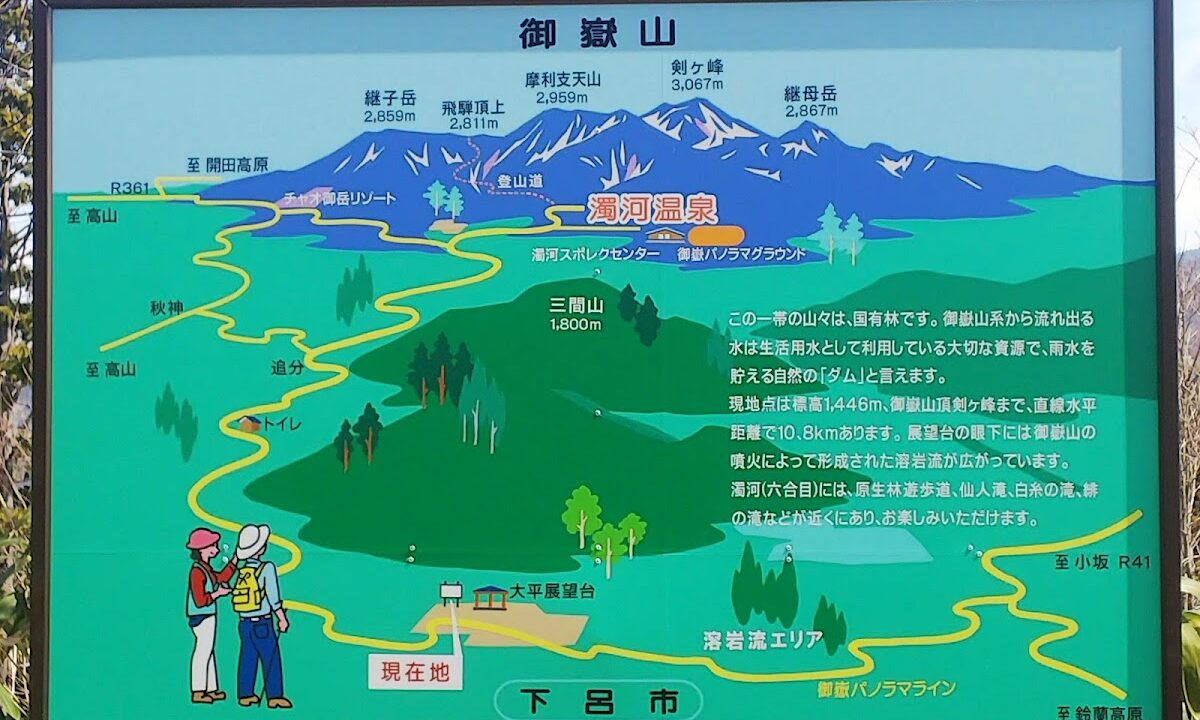
Approximately one-quarter of the entire road offers open scenery, and particularly around Daihira Observation Platform, you can command a full view of the majestic Mount Ontake. On clear days, you can capture the entire Mount Ontake from the snow-covered summit to its base—a perfect viewpoint.
History and Formation
Mount Ontake Panorama Line was developed as a tourist access route to Nigorigawa Hot Spring. Nigorigawa Hot Spring, located at 1,800 meters elevation, is one of Japan’s premier high-altitude hot springs, historically known as a therapeutic bathing destination. With road improvements to this hot spring area, the route became known for enjoying the spectacular views of Mount Ontake, taking on an aspect of a scenic tourism route.
Today, particularly during the autumn foliage season, it has become a popular spot visited by many drivers and touring enthusiasts.
Mount Ontake Panorama Line Attractions
Daihira Observation Platform|Overlooking Japan’s Longest Lava Flow
The greatest viewpoint on Mount Ontake Panorama Line is “Daihira Observation Platform.” From this observation platform, you can view the lava flow traces from Mount Ontake’s eruption, featuring Japan’s longest lava flow.
The lava flow extends approximately 5.5 km, and its scale is awe-inspiring. The sight of dark lava flow traces spreading across the mountainside like a crawling giant demonstrates the remarkable force of nature. An explanation board is installed at the observation platform, where you can learn about Mount Ontake’s volcanic activity history and the lava flow formation process.
On clear days, Mount Ontake’s summit is clearly visible, and especially during early morning or sunset’s raking light, you can enjoy three-dimensional scenery.
Spectacular Views of Mount Ontake
While driving on Mount Ontake Panorama Line, you can view Mount Ontake’s majestic figure at multiple points. At 3,067 meters, Mount Ontake is one of Japan’s Three Sacred Mountains alongside Mount Fuji and Mount Haku, having been an object of faith since ancient times.
Mount Ontake viewed from the road displays different expressions by season. From spring through summer, the mountain shows verdant green; in autumn, a contrast of autumn foliage and fresh snow; and in winter, a pure white snowy mantle—you can enjoy the beauty of all four seasons.
Particularly from early to mid-October, the summit often shows its first snow, and the beautiful contrast with autumn foliage is popular among photography enthusiasts.
Pristine Virgin Forest
Pristine virgin forest characteristic of high-altitude mountain areas spreads along Mount Ontake Panorama Line. The forest is primarily composed of conifers such as larch, Hondo spruce, and Hondo fir, with broadleaf trees such as birch and rowan mixed in, forming a rich forest ecosystem.
The forest along the road is natural woodland with minimal human intervention, offering a healing space enveloped in clear air and silence that makes you forget urban bustle.
Mount Ontake Panorama Line Autumn Foliage|Hida-Mino Autumn Foliage 33 Selections
Autumn Foliage Best Viewing Period
Mount Ontake Panorama Line is selected as one of the “Hida-Mino Autumn Foliage 33 Selections,” representing one of Gifu Prefecture’s premier autumn foliage destinations. Because of its high elevation, autumn foliage arrives earlier than in lowland areas.
Typical Best Viewing Period: Early October through Mid-October
Though it varies slightly year to year, the first to third weeks of October are typically peak season. Due to elevation differences, color change begins at higher elevations near Nigorigawa Hot Spring and progresses over approximately two weeks until the entire area is tinted with autumn foliage.
For the latest autumn foliage information, it is recommended to check the official websites of Gero City Tourism Association and Gifu Prefecture Tourism Federation.
Characteristics and Ways to Enjoy Autumn Foliage
Particularly beautiful about Mount Ontake Panorama Line’s autumn foliage is the brilliant red autumn foliage of poison ivy vines clinging to larches. The contrast between the golden color of larch and the deep crimson of poison ivy creates a landscape unique to this region.
Additionally, at higher elevations you can enjoy “three-stage autumn foliage,” simultaneously viewing Mount Ontake’s fresh snow and autumn leaves—white snow on the peak, green evergreens on mid-slopes, and autumn foliage at the base create a three-color gradient representing the ultimate in autumn mountain scenery.
When enjoying autumn foliage drives, it is important to stop your car in safe locations to savor the scenery. Avoid stopping at sharp curves or places with poor visibility, and use observation platforms or roadsides with wide shoulders.
Congestion Situations and Visiting Tips
During peak autumn foliage season, particularly weekends and holidays, many tourists visit, so congestion is expected. Because road width narrows in some sections, care is needed when passing oncoming vehicles.
Points to Avoid Congestion:
- Weekday visits are recommended
- Early morning (7:00 AM to 9:00 AM) is relatively uncrowded
- After 2:00 PM congestion tends to ease
- Slightly offset from peak foliage viewing (early or late October)
During autumn foliage season temperatures are low, and particularly in early morning, temperatures can drop below freezing. Prepare well for cold weather and consider readiness for winter tires or chains given the possibility of road surface freezing.
Access Methods and Road Information
Access by Car
Access to Mount Ontake Panorama Line is primarily by private vehicle or rental car. Public transportation access is limited, so plan your visit assuming car travel.
Access from Major Cities:
From Nagoya Area:
- From “Nakatsugawa IC” on Chuo Expressway via National Route 257 in approximately 90 minutes
- From “Tomi Seki IC” on Tokai Ring Expressway via National Routes 41 and 257 in approximately 100 minutes
From Gifu City Area:
- Head north on National Route 41, via Gero City in approximately 90 minutes
From Takayama City Area:
- Head south on National Route 41, via Gero City in approximately 60 minutes
Entry Route to Mount Ontake Panorama Line:
From Kosaka Town in Gero City, enter Prefectural Route 441 (Nigorigawa Hot Spring Line). Once you pass the junction toward Suzuran Highland, you enter the Mount Ontake Panorama Line section. Follow the directional signs showing “Nigorigawa Hot Spring.”
Road Conditions and Precautions
Because Mount Ontake Panorama Line is a mountain road, the following points require attention:
Road Characteristics:
- Entirely paved, but with some narrow road sections
- Many curves and some steep grades
- Winter closures (approximately late November through late April) occur in certain sections due to snow and ice
- Some areas lack guardrails, requiring cautious driving
Driving Precautions:
- Control speed, anticipating oncoming vehicles on curves
- Avoid sudden braking, decelerating sufficiently before curves
- Watch for wild animals darting onto the road (especially early morning and evening)
- Fog forms readily, so use fog lamps when visibility is poor
Traffic Restriction Information
Winter Closure:
Typically from late November through late April the following year, the section continuing to Nigorigawa Hot Spring is closed for winter. Because exact closure periods vary with snowfall conditions, it is recommended to verify with Gero City Hall or Gifu Prefecture Road Management Division before visiting.
Other Traffic Restrictions:
- Large vehicles (buses, trucks, etc.) encounter difficulty on some sections
- Road closures may occur during bad weather
- Danger from rockslides exists after typhoons or heavy rain, so check road information beforehand
The latest road information is available through the “Gifu Prefecture Road Information Providing System.”
Public Transportation Access
Direct public transportation access is extremely limited.
Nearest Stations:
- JR Takayama Line “Hida Kosaka Station” (Gero City)
- JR Takayama Line “Gero Station”
Since there is no bus service from these stations to Mount Ontake Panorama Line, taxi use is necessary. However, the distance results in high fares (from Hida Kosaka Station approximately 1 hour, over 10,000 yen).
Rental car use becomes the most practical option. Rental car shops are available near Gero Station and Takayama Station.
Nigorigawa Hot Spring|The Drive’s End Point
Located at the terminus of Mount Ontake Panorama Line, Nigorigawa Hot Spring is a secret hot spring at 1,800 meters elevation. Known as one of Japan’s premier high-altitude hot springs, it also serves as a base for Mount Ontake climbing.
Characteristics of Nigorigawa Hot Spring
Spring Quality:
- Sodium bicarbonate spring (baking soda spring)
- Clear, colorless, smooth texture
- Effective for neuralgia, muscle pain, joint pain, and similar conditions
Hot Spring Facilities:
Several hot spring inns exist at Nigorigawa Hot Spring, with some accepting day-tripper bathing. Because of the high elevation and clear air, watching stars from open-air baths is popular.
Major Hot Spring Inns:
- Nigorigawa Hot Spring Inn
- Nigorigawa Hot Spring Lodge
- Asahi Lodge
Day-use bathing hours and fees vary by facility, so advance confirmation is recommended.
Mountain Climbing from Nigorigawa Hot Spring
Nigorigawa Hot Spring is one of the primary trailheads for Mount Ontake climbing. From here the summit is approximately 4 hours away, making it a popular route as a relatively accessible climbing option.
Note: Mount Ontake is an active volcano, and climbing restrictions have continued since its 2014 eruption. If planning to climb, always confirm the latest volcanic information and entry restriction information.
Surrounding Tourist Spots
Suzuran Highland
Near Mount Ontake Panorama Line’s starting point, Suzuran Highland spreads across 1,200m to 1,400m elevation high plateau terrain. Summer features blooming alpine plants and is known for lily-of-the-valley colonies.
Camping grounds and hiking courses are developed, making it enjoyable for families.
Gandate Gorge (Gandate Kyo)
Located in Kosaka Town, Gero City, Gandate Gorge is a rock wall of columnar jointing approximately 72 meters high created by lava flows from Mount Ontake’s eruptions. Designated as a National Natural Monument, its powerful scenery deserves viewing.
Walking trails are developed in Gandate Park, and you can also enjoy waterfall touring. Particularly, “Three Falls” (Mitsu Falls) is popular as a large, beautiful waterfall.
Gero Hot Spring
Located approximately 40 minutes by car from Mount Ontake Panorama Line, Gero Hot Spring is counted among Japan’s Three Greatest Hot Springs. Known as a “beautiful skin hot spring,” many hot spring inns and day-use bathing facilities exist.
Combining Mount Ontake Panorama Line driving with accommodation at Gero Hot Spring is also recommended.
Waterfall Tours in Hida Kosaka
Kosaka Town, Gero City, is known as “Waterfall Town” with over 200 waterfalls throughout the town. Waterfall groups created by Mount Ontake’s abundant groundwater each have individual character, making waterfall touring trips popular.
Representative Waterfalls:
- Nested Waterfall (63m drop)
- Amatori Waterfall
- Sennin Waterfall
Guided tours are conducted, allowing beginners to safely enjoy waterfall touring.
Seasonal Enjoyment Methods
Spring (Late April through June)
Spring on Mount Ontake Panorama Line is a beautiful season featuring contrast between Mount Ontake’s remaining snow and fresh green leaves. After winter closure ends in late April, snow melt gradually progresses and green returns to mountainsides.
From May through June alpine plants begin blooming, particularly with lily-of-the-valley displaying delicate flowers on Suzuran Highland.
Summer (July through August)
Summer on Mount Ontake Panorama Line is an ideal summer retreat location because of high elevation, which keeps temperatures cooler than lowlands. Average temperatures hover around 20°C, allowing comfortable travel without air conditioning.
The landscape of lush green forest, blue sky, and Mount Ontake with remaining snow displays summer-unique freshness. Early morning cloud seas can be seen, offering chances to encounter dreamlike scenery.
Autumn (September through November)
Autumn is the season when Mount Ontake Panorama Line shines most brilliantly. During autumn foliage season from early to mid-October, larch and poison ivy stain mountainsides red and yellow, creating spectacular scenery in contrast with Mount Ontake’s fresh snow.
Clear air allows viewing distant mountains on many days, making it ideal for photography.
Winter (December through April)
The road closes during winter, making Mount Ontake Panorama Line inaccessible. However, driving through snow scenery is possible in early November before closure or shortly after opening in late April.
During this period, frozen road surface danger is high, making studless tires or chains essential.
Photography Spots and Best Times
Recommended Photography Points
Daihira Observation Platform:
- Popular spot commanding panoramic views of Mount Ontake and lava flow traces
- Wide-angle lens panorama photography recommended
- Parking available
Mount Ontake Viewpoints (Multiple Locations):
- Scattered open areas along the road
- Select wide shoulder areas for safe photography
- Telephoto lens close-ups of Mount Ontake effective
Autumn Foliage Forest Sections:
- Photograph larch and poison ivy autumn foliage up close
- Backlighting creates beautiful leaf translucency
- Macro lens captures autumn foliage details
Photography Best Times
Early Morning (Sunrise through 9:00 AM):
- Mount Ontake illuminated by morning sun is beautiful
- Cloud seas may develop
- Low temperatures with clear air
- Fewer tourists allow leisurely photography
Evening (4:00 PM through Sunset):
- Sunset-tinted Mount Ontake creates ethereal atmosphere
- Autumn foliage appears even more vibrant in sunset light
- Long shadows create three-dimensional effect
Weather:
- Clear skies show Mount Ontake distinctly
- Light overcast produces soft light beautiful for autumn foliage
- Post-rain clear air provides distinct far views
Necessities and Clothing Preparation
Essential Items
Driving-Related:
- Driver’s license
- Vehicle registration and insurance certificate
- Studless tires or chains (from late October onward, through April)
- Full gasoline tank (few gas stations in surrounding area)
Other:
- Cold-weather clothing (fleece, down jacket, etc.)
- Beverages and light snacks (limited vending machines and shops)
- Camera and smartphone
- Chargers and spare batteries
- Maps or car navigation system
- First-aid kit
Clothing Guidelines
Temperatures at high elevation are 10°C or more lower than lowlands. Seasonal clothing guidelines:
Spring and Autumn:
- Long-sleeve shirt plus fleece or sweater
- Windbreaker (winds can be strong)
- Long pants
- Sneakers or trekking shoes
Summer:
- Long-sleeve shirt (UV protection)
- Light jacket (mornings and evenings are cool)
- Hat and sunglasses
- Sunscreen
Late Autumn and Early Spring:
- Down jacket or thick coat
- Gloves and hat
- Scarf
- Cold-weather boots
Safety Notes for Enjoyment
Driving Precautions
- Control Speed: Control speed appropriately for curve-heavy roads with oncoming vehicle meetings, observing speed limits for safe driving.
- Shoulder Parking: When enjoying views, always stop in safe locations. Parking at curves or places with poor visibility is strictly prohibited.
- Wildlife: Deer, wild boar, monkeys, and others may dart onto the road. Special caution is needed during early morning and evening hours.
- Fog and Rain: In poor visibility, turn on lights, reduce speed, and proceed carefully.
- Rockslide: Mountain roads present rockslide danger. Travel slowly where rockslide warning signs appear, and avoid long-term stops.
Physical Condition Management
Persons at 1,500m or higher elevation may experience mild altitude sickness symptoms (headache, dizziness, shortness of breath, etc.).
Countermeasures:
- Adequate fluid intake
- Slow-paced activity
- Stop exertion if physical discomfort develops and descend
- Persons with heart or respiratory conditions should consult physicians beforehand
Cellular Phone Signal Coverage
Mountain terrain means some areas have poor cellular phone signals. In case of emergency, it is recommended to inform family or friends of your planned visit beforehand.
Volcano Activity Information Confirmation
Mount Ontake is an active volcano. Check Japan Meteorological Corporation volcanic information and avoid visiting if the eruption alert level rises.
Accommodation and Dining Information
Nearby Accommodation Facilities
Nigorigawa Hot Spring Area:
- Nigorigawa Hot Spring hot spring inns (several)
- Mountain lodges and cabins
- Experience secret hot spring atmosphere at high elevation
Gero Hot Spring Area:
- Large hot spring hotels to inns (numerous)
- Popular as one of Japan’s Three Greatest Hot Springs
- Approximately 40 minutes by car from Mount Ontake Panorama Line
Hida Kosaka Area:
- Private lodges and business hotels
- Homey atmosphere
- Relatively reasonable prices
Dining and Gourmet
Few restaurants exist near Mount Ontake Panorama Line, so it is recommended to eat in Gero city center or Hida Kosaka.
Local Gourmet:
- Hida beef cuisine
- Magnolia leaf-wrapped miso
- Niwatori chan (grilled chicken offal)
- Goheimochi (skewered rice cake)
- Hida buckwheat noodles
Nigorigawa Hot Spring lodging facilities offer dishes using local mountain vegetables and river fish.
Visit Planning Model Courses
Same-Day Trip Course (Total Time: Approximately 5-6 hours)
Morning:
- 8:00 AM Depart from Gero Station or Hida Kosaka Station vicinity
- 8:30 AM Arrive at Mount Ontake Panorama Line entrance
- 9:00 AM-11:00 AM Drive Mount Ontake Panorama Line, photograph and rest at Daihira Observation Platform
- 11:30 AM Arrive at Nigorigawa Hot Spring, day-use bathing
Afternoon:
- 1:00 PM Depart Nigorigawa Hot Spring, return via same route
- 2:00 PM Tour Gandate Gorge
- 3:30 PM Explore Gero Hot Spring town, purchase souvenirs
- 4:30 PM Head home
1-Night, 2-Day Course
Day 1:
- Morning: Travel from Nagoya or Gifu to Gero
- Afternoon: Drive Mount Ontake Panorama Line, enjoy autumn foliage
- Evening: Stay at Nigorigawa or Gero Hot Spring
Day 2:
- Morning: Tour Hida Kosaka waterfalls
- Afternoon: Explore Gero Hot Spring town, head home
Autumn Foliage Season Weekend Plan
Early morning departure is recommended to avoid congestion.
- 6:00 AM Depart lodging
- 7:00 AM Arrive at Mount Ontake Panorama Line (drive in morning sun)
- 7:30 AM-9:30 AM Photograph and enjoy autumn foliage at Daihira Observation Platform
- 10:00 AM Rest at Nigorigawa Hot Spring
- 11:00 AM Begin descent (before congestion)
- 12:00 PM Lunch at Hida Kosaka
- Afternoon: Explore surrounding area or head home
Conclusion
Mount Ontake Panorama Line is a spectacular scenic driving route Gifu Prefecture proudly offers. It features impressive close-up views of Mount Ontake at 3,067 meters elevation, beautiful autumn foliage selected for the “Hida-Mino Autumn Foliage 33 Selections,” and Daihira Observation Platform commanding views of Japan’s longest lava flow—attractions abound.
Particularly during autumn foliage season from early to mid-October, larch golden color, poison ivy deep crimson, and Mount Ontake’s fresh snow create three-stage autumn foliage forming spectacular scenery. Driving through clear air and pristine untouched nature becomes a special experience allowing you to forget daily routines.
Because this is a mountain road, safe driving and advance preparation are critical. Confirm weather and road conditions, and visit in appropriate clothing and equipment. The road closes in winter, so visits are possible from approximately late April through early November.
Combining the experience with Nigorigawa secret hot spring bathing, surrounding Gero Hot Spring, and Hida Kosaka waterfall tours creates an even more fulfilling journey. At “Mount Ontake Panorama Line,” Tokai region’s representative mountain driving route, enjoy unforgettable scenic encounters.
-800x450.jpg)
-800x450.jpg)
-800x450.jpg)