Shishigana-Shitsugen Wetland, Akita Prefecture | A Complete Guide to Agariako Daio and the Mysterious World of Moss
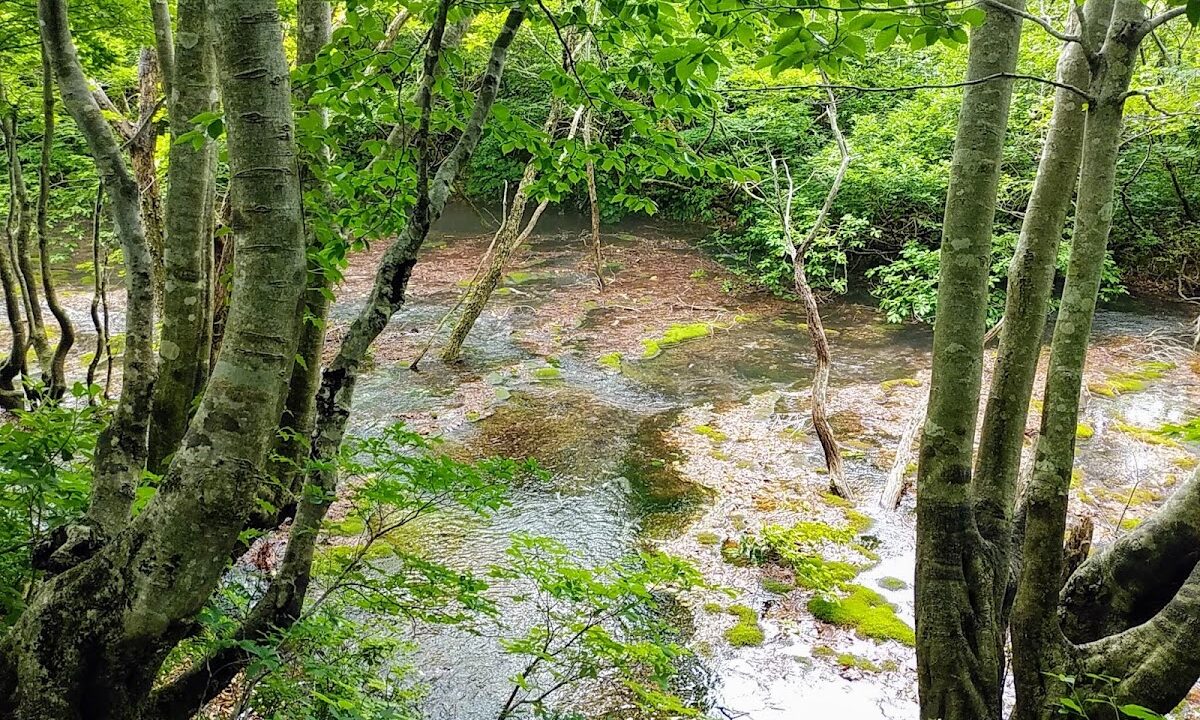
Located at an elevation of 550 meters on the slopes of Mount Chokai in Nikaho City, Akita Prefecture, Shishigana-Shitsugen Wetland is one of the most mystical natural spots in the Tohoku region. Surrounded by pristine beech forests, this approximately 260,000 square meter wetland features the giant beech tree called “Agariako Daio” with a tree age of about 300 years, unique deformed beech groves, globally valuable moss colonies, and clear spring water sources that continue to captivate all who visit.
What is Shishigana-Shitsugen Wetland?
Shishigana-Shitsugen Wetland is a nationally designated natural monument located within the “Nakajima-dai Recreation Forest,” a national park of the sacred Mount Chokai. Officially designated as the “Shishigana-Shitsugen Wetland Plant Community,” it forms a precious ecosystem where various plants thrive, including the “Mukashi Beech,” which is called a living fossil from the Ice Age.
The entire wetland is nourished by groundwater from Mount Chokai, with abundant water flowing out year-round. This clear, cold spring water serves as a crucial element supporting the unique ecosystem.
Value as a Natural Monument
The reason Shishigana-Shitsugen Wetland Plant Community is designated as a natural monument lies in its rarity and academic value. The special topography formed by Mount Chokai’s volcanic activity and the unique environment created by abundant spring water nurture a plant community unseen elsewhere.
Centered on Sphagnum wetland, the coexistence of beech forest, spring water areas, and moss colonies creates a complex ecosystem where each influences the other. This intricate natural environment has become a research subject in plant science, geology, and ecology, earning it the title of “Museum of Nature.”
Agariako Daio – Encounter with the Forest King
The symbol of Shishigana-Shitsugen Wetland is “Agariako Daio.” This giant beech tree, with a girth of 7.62 meters and an estimated tree age of approximately 300 years, greets visitors with an overwhelming presence.
Formation Process of Agariako Beech
“Agariako” is a general term for beech trees with unique tree forms. From the late Edo period through the Showa era, charcoal production was flourishing in this region. As beech trees were felled as a charcoal source, new shoots emerged from the stumps and continued growing, resulting in multiple trunks developing in a coppice form, creating a strange shape resembling a giant mushroom or octopus.
Agariako Daio is truly a living witness to the history of the interplay between artificial felling and nature’s regenerative power, as well as the history of human activity. Its unusual form conveys both a sense of mystery and powerful vitality.
Candlestick Beech and Other Deformed Giant Trees
Beyond Agariako Daio, Shishigana-Shitsugen Wetland contains numerous beech trees with distinctive tree forms called “Candlestick Beech.” True to their name, candlestick beeches have a shape in which multiple trunks extend upward like a candelabra, making them particularly striking in the forest.
These groves of deformed giant trees are not merely tourist attractions but also cultural heritage that transmits to the present day the history of regional forestry and coexistence with nature. Each tree has its own unique form, and new discoveries await with each visit.
Globally Valuable Moss Colony
Another major attraction of Shishigana-Shitsugen Wetland is its globally valuable moss colony. Particularly the spring water area is known as a rare moss habitat in the world and highly valued by photography enthusiasts and nature observers.
Chokai Marimo – Mysterious Spheres
In the spring water ponds within the wetland, “Chokai Marimo,” a globally rare moss, grows in abundance. Technically not true marimo but rather freshwater moss that has grown into a spherical shape, they are characterized by their unique form and beautiful green color.
In the transparent spring water, countless Chokai Marimo gently sway, creating a fantastical landscape as if one has wandered into another world. To protect this precious ecosystem, careful behavior is required, especially around the spring water ponds.
Moss Garden – Green Carpet
Surrounding the Sphagnum wetland area spreads a beautiful moss garden over a wide expanse. Dozens of moss species grow together, and the subtle color variations they create form a green carpet that soothes the viewer’s heart.
Especially beautiful are the mosses wet with morning dew or those illuminated by dappled sunlight. The mosses provide perfect photography subjects, and bringing a macro lens allows one to capture the fine structure of moss and the glimmer of water droplets.
Abundant Spring Water and Water’s Blessings
An important characteristic of Shishigana-Shitsugen Wetland is the abundant spring water from Mount Chokai. Water flowing out through volcanic layers maintains stable temperature year-round and is exceptionally clear.
Scientific Characteristics of Spring Water
Mount Chokai’s groundwater flows underground through geological layers that filter it over many years. As a result, while containing appropriate amounts of minerals, it maintains high transparency and water quality suitable for biological habitation.
The spring water temperature remains stable at approximately 10 degrees Celsius year-round, staying cold even in summer and rarely freezing in winter. This stable water temperature plays a crucial role in maintaining the unique ecosystem.
Detsubo – Mysterious Spring Water Pond
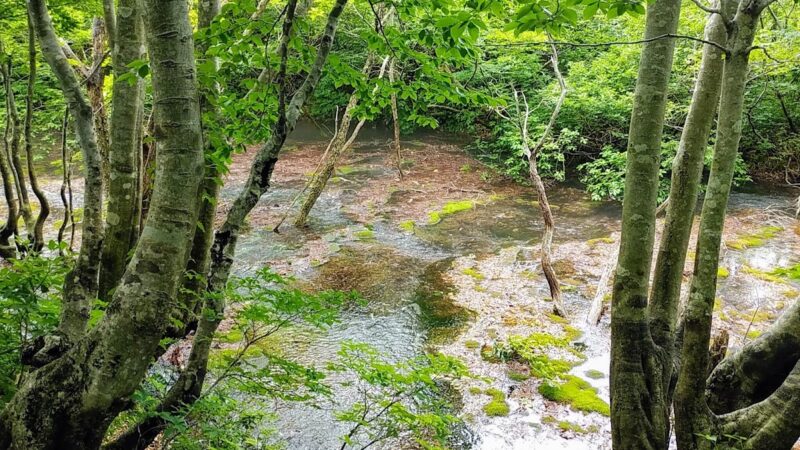
Within the wetland are scattered several spring water ponds called “Detsubo.” These are places where water springs from underground, with extremely high transparency allowing one to see the pond bottom clearly.
Around the Detsubo, aquatic plants including Chokai Marimo flourish abundantly, forming a unique underwater landscape. Combined with the reflection of trees on the water surface, they create a mystical atmosphere.
Walking Courses and Required Time
Shishigana-Shitsugen Wetland has approximately 5 km of well-maintained walking courses where visitors can enjoy the wetland’s nature while walking on wooden boardwalks. The time required to complete the entire loop is approximately 2 hours 20 minutes to 3 hours.
Highlights of the Main Course
The walking course departs from the parking area and passes through the following main spots:
- Entrance Area – Where the rest house and information signs allow visitors to prepare for the walk
- Beech Forest Zone – Wooden boardwalks wind through beautiful pristine beech forest
- Agariako Daio Area – The course highlight, a face-to-face encounter with the forest king
- Candlestick Beech Zone – An area where multiple deformed beeches are scattered
- Spring Water and Moss Area – Where Chokai Marimo and beautiful moss colonies thrive
- Sphagnum Wetland – An area where open wetland scenery spreads
Required Time by Season and Precautions
The time required for the walk varies depending on season, weather, and individual fitness level. When thoroughly enjoying photography or spending time on nature observation, plan for 3 or more hours.
Especially during autumn foliage and spring green seasons, the area becomes crowded with many visitors, making it necessary to allocate time generously. Additionally, wooden boardwalks have slippery sections, so it’s important to proceed carefully.
Attractions of Each Season
Shishigana-Shitsugen Wetland displays a different face with each season. Each season has its own unique beauty, and no matter how many times you visit, you’ll experience fresh emotions.
Spring (May-June) – Interplay of New Greenery and Lingering Snow
As snow melts in spring, beech trees’ new foliage becomes dazzling. The light green of young leaves envelops the entire forest, conveying the vitality of life. Spring water volume is abundant, and moss displays a lively appearance.
From late May through early June, wetland plants such as false hellebore bloom, allowing visitors to enjoy both flowers and new greenery. However, lingering snow may remain, so checking conditions beforehand is recommended.
Summer (July-August) – Shades of Green and the Coolness
In summer, Shishigana-Shitsugen Wetland is covered in deep green. Due to its elevation of 550 meters, it’s cooler than lowland areas, making it ideal as a summer retreat. The cold spring water is refreshing, and combined with the effects of forest bathing, it revitalizes both body and mind.
Even in summer, water flows abundantly, and in the spring water area, the sound of flowing water invites coolness. This is the season when moss displays its most beautiful green color, ideal for photography.
Autumn (September-October) – Golden Carpet of Autumn Foliage
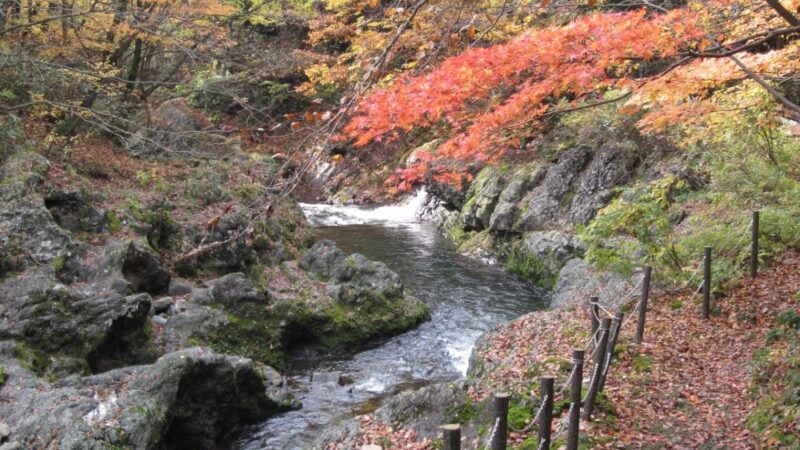
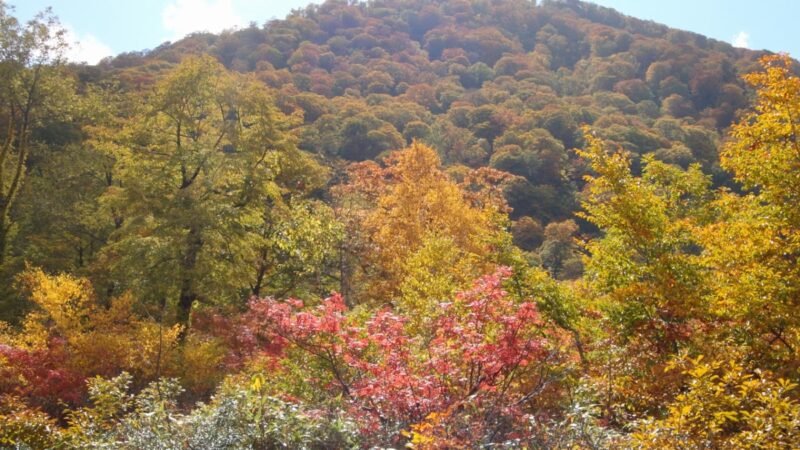
Autumn at Shishigana-Shitsugen Wetland is truly a spectacular season. Beech yellowing dyes the entire forest golden, and fallen leaves accumulate on the wooden boardwalks, creating beautiful paths as if a yellow carpet has been laid.
The autumn foliage peak is typically from early to mid-October, when many tourists and photography enthusiasts visit. The breathtaking beauty of the autumn foliage landscape becomes a lifetime memory. Walking on fallen leaves, breathing in the crisp autumn air, and experiencing the forest’s autumn fragrance allows one to savor autumn with all five senses.
Winter (November-April) – Silent Snowy Landscape
In winter, heavy snowfall makes ordinary walking courses difficult to use. However, with snowshoes or cross-country skiing equipment, one can experience the wetland wrapped in winter’s silence.
The deformed beech groves covered in snow present a different appearance. However, entering the mountains in winter requires adequate equipment and experience, and solitary entry should be avoided.
Access and Basic Information
Access to Shishigana-Shitsugen Wetland is primarily by automobile. Public transportation access is limited, so rental car use is recommended.
Address and Location
Address: Nakajima-dai, Yokooka, Shokata, Nikaho City, Akita Prefecture
Located in the mountainous area of Nikaho City on the Akita side of Mount Chokai, it is one of the major tourist attractions in the Yurihonjo-Chokai area.
Access by Car
- From Akita City: Approximately 2 hours via National Route 7
- From Honjo IC, Akita Expressway: Approximately 50 minutes via National Route 107 and Prefectural Route 58
- From JR Kisakata Station: Approximately 30 minutes by car
The parking lot is spacious and well-maintained with spaces for regular cars and large buses. During busy seasons such as autumn foliage, the lot may fill up, so arriving early is recommended.
Access by Public Transportation
JR Uetsu Main Line “Kisakata Station” is the nearest station, but it is approximately 15 km from the station to the wetland, and public transportation options are limited. Taxi use is practical, but advance reservation is recommended.
During tourist seasons, Nikaho City Tourism Association may operate seasonal shuttle buses, so checking in advance is advisable.
Opening Hours and Admission
- Opening Hours: Free to walk anytime (though daytime walking is recommended for safety)
- Admission: Free
- Walking Season: Late April to early November (varies depending on snow conditions)
In winter, heavy snowfall makes ordinary walking course use difficult. Regarding walkable periods, advance confirmation with Nikaho City Tourism Association is recommended.
Facility Information
The parking area is equipped with the following facilities:
- Rest House: Resting space, restrooms available
- Vending Machines: Beverages can be purchased
- Information Boards: Detailed information about walking courses and highlights
- Clean Restrooms: Barrier-free accessible
Once inside the walking paths, no facilities are available, so using restrooms beforehand and bringing drinking water are important.
Preparations and Precautions for Walking
Proper preparation and precautions are necessary to safely enjoy Shishigana-Shitsugen Wetland.
Clothing and Equipment
- Footwear: Trekking shoes or non-slip athletic shoes are essential. Wooden boardwalks are slippery when wet
- Clothing: Easy-to-move clothing allowing layering for seasonal conditions. Don’t forget insect repellent measures
- Rain Gear: Mountain weather changes rapidly, so rain wear is recommended
- Drinking Water: No vending machines on the course, so bring sufficient water
- Hat and Sunscreen: Especially necessary in summer
- Camera: To record beautiful scenery. Extra batteries provide peace of mind
Safety Precautions
- Walking on Boardwalks: Walk carefully as wet wooden boardwalks are slippery
- Stay on Designated Paths: Don’t leave marked courses to protect valuable vegetation
- Approaching Spring Water Ponds: To protect precious ecosystems like Chokai Marimo, avoid touching water or throwing objects
- Take Out All Trash: For nature conservation, always bring all trash with you
- Check Weather: Confirm weather forecasts beforehand and avoid walking in bad weather
- Mobile Phone: Signal may be weak in mountainous areas. Inform family of your destination in advance for emergencies
- Wildlife: Since bears and other wild animals may inhabit the area, carrying a bear bell is recommended
Etiquette and Rules
- Plant Collection Prohibited: As it’s a nationally designated natural monument, all plant collection is forbidden
- Quiet Observation: Control loud conversation to enjoy nature’s sounds
- No Smoking: Absolutely no smoking on courses to prevent fires
- Pets: Generally, pet accompaniment should be avoided to protect ecosystems
Nearby Tourist Spots and Hot Springs
Combining a visit to Shishigana-Shitsugen Wetland with nearby tourist spots and hot springs makes for a more fulfilling trip.
Mount Chokai
Standing at 2,236 meters, the sacred Mount Chokai spans both Akita and Yamagata prefectures and is a representative mountain of the Tohoku region. Besides climbing, one can enjoy the mountain views by driving the Chokai Blue Line.
Motaki Subterranean Waterfall
Located approximately 20 minutes by car from Shishigana-Shitsugen Wetland, this beautiful waterfall is fed by Mount Chokai’s groundwater. The sight of countless streams flowing from the rock face at approximately 30 meters wide and 5 meters high is magnificent.
Kisakata
A scenic spot visited by Matsuo Basho in “The Narrow Road to the Deep North.” Once characterized by islands floating in the sea, the landscape became landlocked after an 1804 earthquake. Today, a unique scenery unfolds with small islands scattered among rice paddies.
Hot Spring Facilities
Several hot spring facilities near Nikaho City soothe tired bodies after walking:
- Kisakata Hot Spring: A hot spring overlooking the Japan Sea with dishes featuring local seafood
- Kaneura Hot Spring: A hot spring with high beautifying effects
- Nigaushi Hot Spring: A hot spring facility loved by local people
Soothing tired bodies in hot springs and enjoying dishes prepared with local ingredients exemplifies the charm of an Akita trip.
Photography Tips
Shishigana-Shitsugen Wetland is a treasure for photography enthusiasts. Here are effective photography tips.
Best Photography Times
- Early Morning: Occasionally accompanied by morning mist, creating a fantastical atmosphere
- Morning: Dappled sunlight is beautiful, and moss’s green color stands out
- Late Afternoon: Oblique light creates dramatic lighting in the forest
Recommended Subjects
- Agariako Daio: Photograph from various angles to convey its size and unique form
- Moss Garden: Use macro lens to capture moss details. Water droplets enhance beauty
- Chokai Marimo: Photograph the swaying appearance in transparent spring water
- Beech Forest: Capture light penetrating through tree gaps
- Boardwalks and Fallen Leaves: The golden carpet of autumn leaves is a must-see
- Spring Water Ponds: Utilize water surface reflections of trees for composition
Photography Precautions
- Tripod use is allowed but position them to not obstruct other walkers’ paths
- Be mindful of positioning to avoid stepping on precious vegetation
- Remember consideration for other walkers
- High humidity means preparing lens fogging countermeasures
As an Educational Travel and Nature Learning Venue
Shishigana-Shitsugen Wetland holds high value as an educational travel destination and nature learning venue for schools.
Learning Themes
- Plant Ecology: Learn about wetland plants and beech forest ecosystem
- Geology: Understand the relationship between volcanic activity and spring water, and topographic formation
- Environmental Conservation: Consider the relationship between natural monument protection and human activity
- Local History: Learn about human-nature coexistence through charcoal culture and Agariako Beech formation
- Biodiversity: Recognize the importance of ecosystems where various organisms coexist
Educational Travel Applications
Nikaho City Tourism Association can arrange educational travel programs and guide tours. Combining pre-visit learning, on-site observation, and post-visit study enables deeper learning.
Contact Information and How to Obtain Latest Information
It’s important to confirm the latest information when planning a visit to Shishigana-Shitsugen Wetland.
Main Contact Points
Nikaho City Tourism Association
- Phone: 0184-43-3230
- Website provides the latest course conditions, event information, and more
Nikaho City Tourism Division
- Phone: 0184-38-4305
- Provides information about facility management and maintenance
Information to Confirm
Before visiting, check the following information:
- Course opening status (lingering snow, typhoon damage causing closures)
- Weather and temperature
- Parking lot congestion (especially during autumn foliage season)
- Information on events and guided tours
- Safety information such as bear sightings
Conclusion: Encountering Tohoku’s Original Landscape at Shishigana-Shitsugen Wetland
Shishigana-Shitsugen Wetland in Nikaho City, Akita Prefecture, with its 300-year-old “Agariako Daio” and other deformed beech groves, globally valuable Chokai Marimo colonies, beautiful moss gardens, and abundant spring water, is truly a mystical space.
Walking slowly for 2-3 hours along the approximately 5 km course allows one to face Tohoku’s rich nature in the silence surrounded by pristine beech forest. Spring’s new green, summer’s deep green, autumn’s golden foliage, and winter’s silence—each season displays a different face, and no matter how many times you visit, the wetland offers new discoveries and emotions.
To pass this precious ecosystem nurtured by Mount Chokai’s nature to future generations, please enjoy your walk while following proper etiquette and experience this treasure that Tohoku boasts. Your experience at Shishigana-Shitsugen Wetland will surely become a lifelong memory.