Yanoharasshitsugen Fukushima Prefecture | Thorough Explanation of the Attractions and Four-Season Charm of Japan’s Second Oldest Wetland
Yanoharasshitsugen (矢ノ原湿原), located in Showa Village, Ohnuma District, Fukushima Prefecture, is said to have been formed approximately 80,000 years ago and is Japan’s second oldest wetland. Spanning around 660 meters in elevation, this wetland is a precious natural environment where two different types of wetlands—high moor and low moor—can be observed, and was designated as a village natural monument in December 1973 (Showa 48) and as a Fukushima Prefecture natural environment conservation area in June 1976 (Showa 51).
Centered around Yanoharasshitsugen Marsh, this wetland is home to approximately 350 species of diverse plants, and serves as a true treasure trove of biodiversity with many wild birds and rare insects such as the Hatchō dragonfly and the endangered species Madara Naniwa dragonfly. With a well-maintained walking trail of approximately 40 minutes to complete the circuit, it is a hidden gem of the Okuaizu region where even trekking beginners can easily enjoy nature observation.
Overview and Historical Value of Yanoharasshitsugen
Formation and Academic Significance of Japan’s Second Oldest Wetland
Yanoharasshitsugen is estimated to have been formed approximately 80,000 years ago and holds extremely high academic value as Japan’s second oldest wetland. The wetland, formed over a long span of time, is characterized by abundant groundwater springs, and this rich water source serves as the foundation supporting a diverse ecosystem.
In the wetland formation process, complex interactions of volcanic activity, crustal deformation, and climate change resulted in the rare environment where the two distinct wetland types currently observed—high moor and low moor—coexist. This dual structure is one of the major characteristics of Yanoharasshitsugen.
Designation as a Natural Environment Conservation Area
Yanoharasshitsugen has received dual protective designations to preserve its precious natural environment. First, it was designated as a natural monument by Showa Village in December 1973, and subsequently designated as a natural environment conservation area by Fukushima Prefecture in June 1976.
Through these designations, a natural environment has been maintained where the wetland’s ecosystem is preserved while allowing visitors to interact with nature. The surrounding area consists of secondary forest communities dominated by Quercus dentata and Quercus mongolica, with comprehensive ecosystem conservation efforts encompassing the forests surrounding the wetland as well.
Seasonal Highlights of Yanoharasshitsugen
Spring: The Performance of Skunk Cabbage and Bog Bean
In spring, Yanoharasshitsugen awakens with the melting snow and overflows with the vitality of plants coming to life. The highlights are particularly the beautiful white spathes of skunk cabbage and the bog bean with its star-shaped white flowers.
Skunk cabbage reaches its peak from late April to early May, and the sight of it growing in clusters at the water’s edge of the wetland symbolizes the arrival of spring, captivating many photography enthusiasts. Bog bean is at its most abundant from mid-May to early June, displaying delicate flowers near the water surface—a landscape unique to spring wetlands.
During this period, amphibians and insects emerging from hibernation become active, allowing observation of the wetland’s vital appearance.
Summer: Pond Lily and the Paradise of Rare Dragonflies
Summer at Yanoharasshitsugen is when verdure deepens and aquatic plants grow most actively. Particularly noteworthy is the pond lily, named for its flowers blooming around the hour of the Sheep (approximately 2:00 PM). The white flowers floating on the water surface give the summer wetland a refreshing impression.
From July to August is the observation season for the Hatchō dragonfly, known as Japan’s smallest dragonfly. This tiny dragonfly, with a body length of only about 2 centimeters, is emblematic of the rich ecosystem of Yanoharasshitsugen. Males are a vivid red color while females are yellowish-brown, and the sight of them flitting between the wetland grasses is endearing.
Additionally, the Madara Naniwa dragonfly, designated as an endangered species, also inhabits the area, demonstrating that a precious natural environment is being maintained. When observing insects, it is necessary to stay on the walking trail and be careful not to disturb the ecosystem.
Autumn: The Golden Autumn Wetland and Beautiful Fall Colors
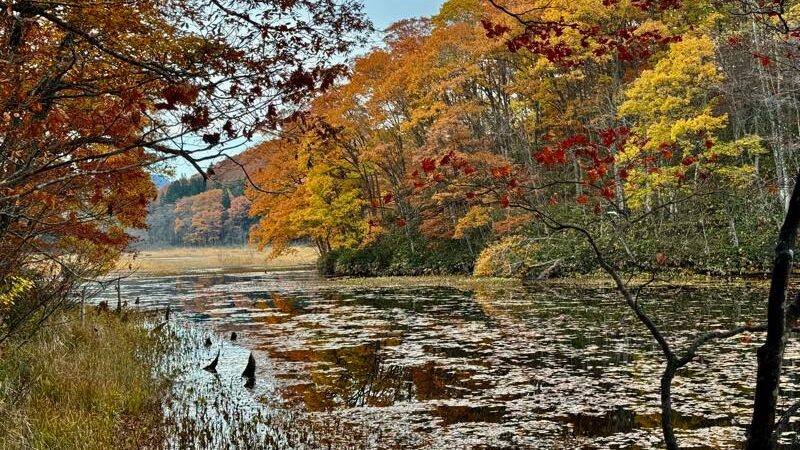
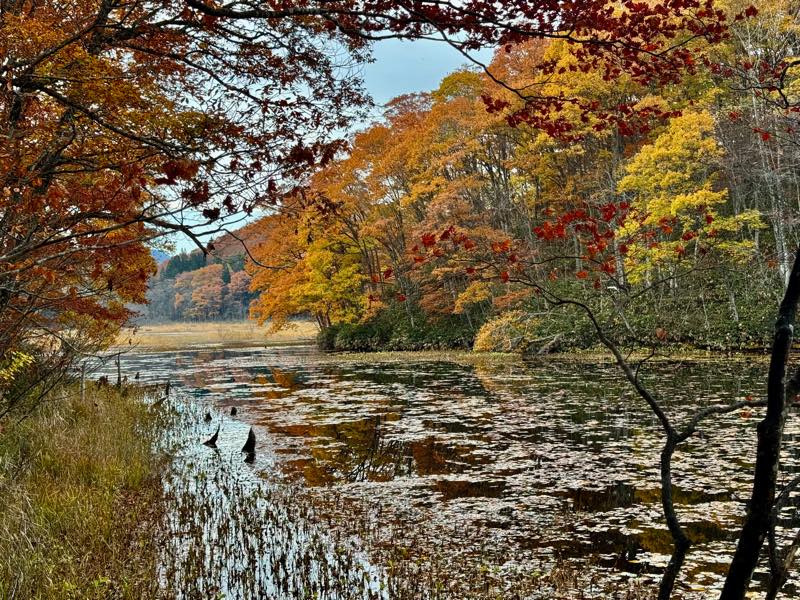
Autumn at Yanoharasshitsugen has fall foliage as its main attraction. From mid-October through early November, the deciduous trees such as Quercus dentata and Quercus mongolica surrounding the wetland change color, transforming the entire wetland into shades of red, yellow, and orange.
The grass coloration unique to wetlands is also spectacular, with herbaceous plants like susuki grass and reed grasses gleaming in golden hues—a different aesthetic from tree foliage. The landscape of fall colors reflected on the water’s surface is popular as a prime photography spot.
Autumn is the optimal season for viewing the entire wetland panorama due to clear air. Walking along the trail, one can feel the changing of seasons with all one’s senses.
Winter: Snow-Covered Landscape Enveloped in Silence
In winter, Yanoharasshitsugen is covered in snow and enveloped in silence. Access to the walking trail may become difficult during heavy snow, though snowshoe and cross-country skiing enthusiasts do visit.
The winter-barren wetland may appear to lack vitality at first glance, but beneath the snow, plants awaiting spring sleep quietly, and the vital activities of life continuing to endure the harsh winter continue.
Flora and Fauna Observable at Yanoharasshitsugen
Diverse Flora of Approximately 350 Species
Approximately 350 species of plants (some sources cite approximately 280 species) have been confirmed at Yanoharasshitsugen, with diversity levels among the highest in Fukushima Prefecture. Representative plants peculiar to wetlands include skunk cabbage, bog bean, pond lily, Japanese liatris, Japanese water iris, Japanese iris, and sundew.
In the high moor section, sphagnum moss forms thick layers, with small shrubs such as cloudberry and dwarf rhododendron growing on top. In the low moor section, reed and sedge species are dominant, with different herbaceous plants flowering with each season.
In the surrounding forest areas, deciduous broadleaf forest centered on Quercus dentata and Quercus mongolica has developed, with ferns and spring ephemerals also visible on the forest floor.
Bird and Insect Observation Spot
Yanoharasshitsugen is also known as a bird-watching spot. Birds favoring wetland environments such as the Japanese snipe, common stonechat, and bull-headed shrike visit during breeding season, and many forest birds can also be observed. At dawn, bird songs echo across the wetland, making it an attractive location for birdwatching enthusiasts.
Insect diversity is also rich, with various butterfly and beetle species inhabiting the area alongside the aforementioned Hatchō dragonfly and Madara Naniwa dragonfly. Particularly in summer, insect activity becomes active, and the area is utilized as a natural observation education site.
Dainan Shimizu and Genbei Shimizu: Spring Water Nourishing the Wetland
The rich ecosystem of Yanoharasshitsugen is supported by abundant groundwater springs. Along the walking trail, there is a spring water point called “Dainan Shimizu,” providing cool water to visitors.
According to tradition, Dainan Shimizu is named after a daimyo (feudal lord) who once refreshed himself with this clear water during a visit. The cold, clear water maintains a constant temperature even in midsummer, playing an important role as a water source for the wetland.
Additionally, another spring called Genbei Shimizu is known to exist, with these springs supporting the water circulation of the entire wetland. The abundance of groundwater springs is one of the major characteristics of Yanoharasshitsugen, and this water serves as the foundation maintaining a stable wetland environment throughout the year.
Walking Trail and Sightseeing Duration
Yanoharasshitsugen has a well-maintained wooden boardwalk trail that allows visitors to circuit the wetland. The circuit is approximately 1 kilometer, taking approximately 40 minutes at a leisurely pace, or about one hour including plant observation and photography.
The trail is relatively flat and well-maintained, making it safe for trekking beginners and families. However, the boardwalk can become slippery when wet from rain or morning dew, so visitors are recommended to wear slip-resistant shoes.
Along the way, benches and observation decks provide rest spots, allowing thorough observation of the wetland’s natural environment. Venturing beyond the trail into the wetland is prohibited from an ecosystem conservation perspective, so visitors should use only the designated trail.
Access and Facility Information
Access by Car
Car access to Yanoharasshitsugen is convenient. It is approximately 90 minutes from the Nishinasushio-Shiobara IC on the Tohoku Expressway via National Routes 400 and 121, or approximately 50 minutes from the Aizusaka IC on the Banyetsu Expressway via National Route 252.
A free parking lot is provided at the wetland entrance, accommodating approximately 20 regular vehicles. The lot may become full during peak seasons such as fall foliage, so early afternoon visits are recommended.
Access by Public Transportation
When using public transportation, the nearest station is Aizu Tajima Station on the JR Aizu Line; however, it is approximately 20 kilometers from the station to the wetland, and limited bus service makes taxi use or rental car arrangements practical.
The Showa Village Tourism Association occasionally organizes guided tours depending on the season, so advance inquiries are recommended.
Facility Information and Precautions
Since Yanoharasshitsugen is a nature conservation area, facilities such as restrooms and shops are minimal. It is recommended to use restroom facilities before visiting and to prepare necessary beverages and light snacks in advance.
Additionally, mobile phone signal is weak in some areas of the wetland, so visitors should verify maps beforehand and plan activities with adequate time margins. In summer, preparations such as insect repellent spray, hats, and sunscreen are necessary.
Tips for Enjoying Yanoharasshitsugen
Optimal Visiting Periods
Yanoharasshitsugen has charm in each season, but the following periods are particularly recommended for first-time visitors:
- Spring (mid-May to early June): Skunk cabbage and bog bean reach their peak, and fresh greenery is beautiful
- Summer (July to August): Optimal for viewing pond lily blooms and observing Hatchō dragonflies
- Autumn (mid-October to early November): Fall foliage is most beautiful, and the period is ideal for photography
Photography Tips
Yanoharasshitsugen is also popular as a photography spot. Morning mist often rises at dawn, providing opportunities to photograph fantastical scenery. When aiming to capture reflected fall colors or sky reflections on water, selecting a low-wind day is advisable.
Bringing a macro lens allows beautiful photography of small insects like the Hatchō dragonfly and fine details of wetland plants. While tripod use is permitted, care should be taken not to obstruct other visitors in narrow areas of the trail.
Utilizing Guided Tours
The Showa Village Tourism Association occasionally conducts guided nature observation tours by season. Walking while listening to expert guide explanations allows deeper learning about plants, insects, and wetland formation that might otherwise go unnoticed. Particularly for first-time wetland visitors or those wishing to understand nature more deeply, participation in guided tours is recommended. Contact the Showa Village Tourism Association for details.
Nearby Attractions and the Charm of Showa Village
Ramie Weaving Village of Showa
Showa Village, home to Yanoharasshitsugen, is known as a center for “ramie weaving.” Ramie is a plant historically used as a clothing material, and Showa Village continues to maintain traditional cultivation and weaving techniques.
The village houses the “Ramie Craft Museum,” where visitors can learn about the history and manufacturing process of ramie weaving. Weaving experiences are also available, allowing visitors to touch Showa Village’s culture along with their Yanoharasshitsugen visit.
Nature and Culture of Okuaizu
The Okuaizu region, including Showa Village, is gaining attention as an area preserving rich nature and traditional culture. Nearby are scenic spots on the Tadami Line, other wetlands, hot springs, and more, making a multi-day leisurely tour recommended.
Particularly, the Tadami Line is called “the world’s most romantic railway,” with breathtaking views from the train windows. Consider planning a trip to fully enjoy the nature and culture of Okuaizu together with your Yanoharasshitsugen visit.
Conservation Efforts and Visitor Etiquette
Yanoharasshitsugen requires visitors to observe several manners to protect its precious natural environment.
- Stay on the walking trail: Venturing into the wetland risks destroying the ecosystem
- Do not collect plants or organisms: All flora and fauna are protected
- Always carry away trash: Strictly adhere to taking trash home to protect the natural environment
- Avoid loud voices: Consideration for wildlife and other visitors is necessary
- Pets: Use caution when accompanying: While pets may be allowed, always use a leash and take away any waste
By observing these manners, this precious natural environment can be preserved for future generations.
Conclusion: Encountering Okuaizu’s Nature at Yanoharasshitsugen
Yanoharasshitsugen in Showa Village, Fukushima Prefecture, with its approximately 80,000-year history, is Japan’s second oldest wetland and possesses high value both academically and as a tourism destination. Spanning around 660 meters in elevation with its dual-structure high moor and low moor wetland, it is home to approximately 350 plant species and diverse birds and rare insects, presenting different faces with each season.
The approximately 40-minute walking trail is easy for beginners, and spring water spots like Dainan Shimizu dot the area. Spring’s skunk cabbage and bog bean, summer’s pond lily and Hatchō dragonfly, autumn’s fall foliage, and winter’s silence—different charm awaits depending on visiting season.
When visiting this precious wetland, protected as a Fukushima Prefecture natural environment conservation area and village natural monument, observe nature conservation manners while fully savoring Okuaizu’s rich nature. The Showa Village Tourism Association provides current information and guided tour information, making pre-visit confirmation recommended.
-800x450.jpg)
-800x450.jpg)