Kinuta Park, Tokyo – Complete Guide|Thoroughly Explained Access, Highlights, and Event Information
Kinuta Park (きぬたこうえん), located in Setagaya Ward, Tokyo, is a lush metropolitan park that allows you to forget the hustle and bustle of the city. On its vast grounds of approximately 390,000 square meters (equivalent to about 8 Tokyo Domes), various facilities are equipped including grassy meadows, sports facilities, the Setagaya Art Museum, and a bird sanctuary. During spring, the park is crowded with cherry blossom viewing enthusiasts as a renowned cherry blossom spot, and it is beloved by Tokyo residents as a place of respite where you can enjoy nature throughout the four seasons.
Basic Information about Kinuta Park
Kinuta Park is a metropolitan park boasting the second-largest area in Setagaya Ward and opened in 1957 (Showa 32). It originated from a large green space that was designated in urban planning as a project commemorating the 2600th anniversary of the imperial era, and has a history of serving as an air defense green space during wartime and being open to the public as a municipal golf course after the war.
Location: 1-1 Kinuta Park, Setagaya Ward, Tokyo
Opening Hours: Always open (some facilities have time restrictions)
Admission Fee: Free (except for some facilities)
Area: Approximately 391,262 square meters
Administrator: Tokyo Parks Association
The original development theme was “a park for families to enjoy together,” and in accordance with this basic plan, a family park zone composed of grassland and woodland, and a sports facility zone have been developed by utilizing the natural topography. The Yato River runs through the center of the park, also forming a rich aquatic environment.
Access Methods and Transportation Guide
Access to Kinuta Park is typically achieved by a combination of train and bus, or on foot. Since there are multiple routes available, you can choose the optimal method depending on your starting point.
Access by Train and Bus
From Odakyu Line “Chitosefunabashi Station”:
- Take the Tokyu Bus (bound for Denentoshi) and get off at “Kinuta Park Ryokuchi Entrance”
- Approximately 10 minutes by bus
From Odakyu Line “Seijo Gakuen-mae Station”:
- Take the Tokyu Bus (bound for Todai-daigaku-eki Kitakuchi) and get off at “Okamoto 1-chome”
- Approximately 15 minutes by bus
From Tokyu Toyoko Line “Yoga Station”:
- Approximately 20 minutes walk
- Or take the Tokyu Coach Bus (bound for Museum) and get off at “Museum”
From Tokyu Ooimachi Line “Futako-tamagawa Station”:
- Approximately 15 minutes by Tokyu Bus or Tokyu Coach Bus
Access by Car
From Metropolitan Expressway No. 3 Shibuya Line “Yoga Exit”:
- Approximately 5 minutes
Parking Information:
- Kinuta Park First Parking Lot (177 spaces)
- Setagaya Art Museum Parking Lot (60 spaces)
- Hours of Operation: 24 hours (paid)
- Rates: Regular vehicles ¥300 for 1 hour, then ¥100 for every 30 minutes thereafter
Parking lots tend to be congested on weekends and during cherry blossom season, so using public transportation is recommended.
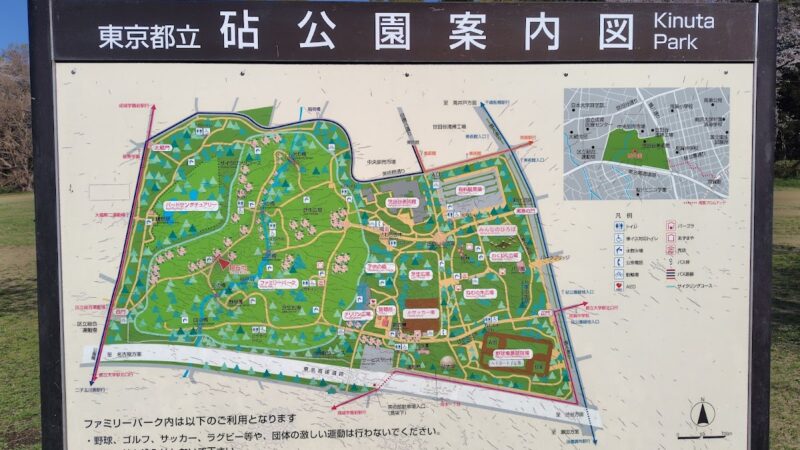
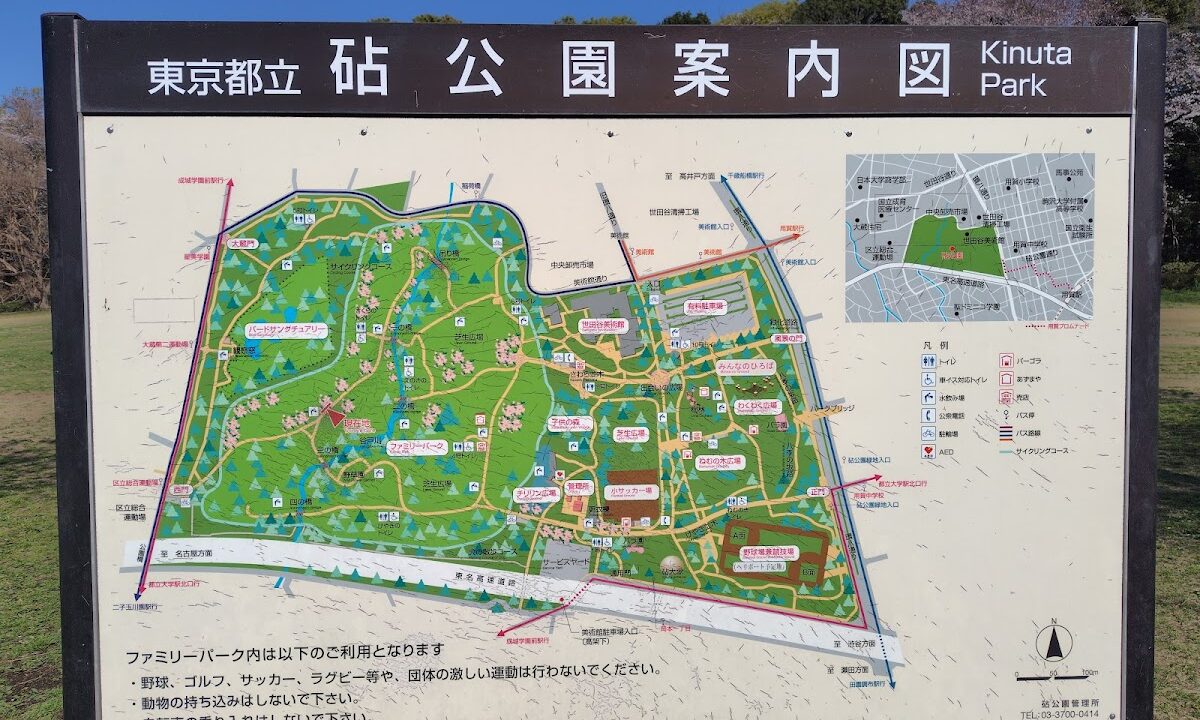
Park Map and Major Areas
Kinuta Park is divided into two main areas: the “Family Park Zone” and the “Sports Facility Zone.”
Family Park Zone
This family-oriented area spreads across the center of the park and is characterized by expansive grassy meadows. On weekends, many families visit with packed lunches to enjoy picnics and ball games. The grassland area is open and provides a safe environment for children to play.
This area includes the following facilities:
- Grassy meadow (approximately 8 hectares)
- Children’s Forest (play equipment area)
- Suspension bridge
- Walking paths along the Yato River
Sports Facility Zone
This area concentrates facilities for sports enjoyment. Advance reservations may be required for use of some facilities.
Main facilities:
- Soccer fields (2)
- Baseball field
- Tennis courts (8)
- Cycling course
- Jogging course
The small soccer field is also used by local soccer clubs and school club activities, and on weekends it is busy with many sports enthusiasts.
Highlights and Attractions
As a Cherry Blossom Viewing Spot
Kinuta Park is known as one of the most renowned cherry blossom viewing spots in Tokyo. Approximately 930 cherry trees are planted throughout the park, and during spring it is crowded with many flower viewing visitors.
Main Cherry Blossom Varieties:
- Somei-yoshino (approximately 840 trees)
- Yamazakura
- Oshima cherry
- Sato cherry
Around the grassland meadow in the center of the Family Park, large cherry trees with ages of several decades stand in rows, forming a spectacular cherry blossom tunnel when in full bloom. The charm of Kinuta Park is that you can enjoy the cherry blossoms leisurely sitting on the grass, and the sight of families spreading out leisure sheets and eating packed meals while appreciating the blossoms has become a spring tradition.
Best Viewing Period: Late March to Early April
During cherry blossom season, temporary food stalls also appear, allowing you to enjoy a festival-like atmosphere. However, this period is particularly crowded, so early visits are recommended.
Setagaya Art Museum
The Setagaya Art Museum, located in a corner of Kinuta Park, is a municipal museum that opened in 1986. The building, designed by architect Akizo Nai, is characterized by beautiful design that harmonizes with the surrounding natural environment.
Main Collections:
- Modern and contemporary art works
- Works by artists associated with Setagaya
- French naïve art works
Opening Hours: 10:00 AM to 6:00 PM (last admission 5:30 PM)
Closed Days: Mondays (if a holiday, the following day), year-end and new year period
Admission Fee: Varies depending on the special exhibition (general admission from ¥200)
The museum also has a café called “Le Jardin,” which is popular as a rest stop during park walks. Using the Tokyu Coach Bus bound for the Museum, you can conveniently get off right in front of the museum.
Bird Sanctuary
On the north side of Kinuta Park, there is a bird sanctuary developed as a protected area for wild birds. Various species of wild birds inhabit the approximately 1.2-hectare wetland, making it an excellent spot for birdwatching.
Main Bird Species Observable:
- Kingfisher
- Great tit
- Japanese white-eye
- Japanese pygmy woodpecker
- Spot-billed duck
- Gray heron
Observation huts are set up within the protected area, allowing you to observe birds quietly without disturbing them. Especially during early morning hours, bird activity is active, providing chances to observe many species.
While access to some areas of the bird sanctuary is restricted from a nature conservation perspective, you can sufficiently observe birds from the designated observation paths. Bringing binoculars will allow for more detailed observation.
Plants Throughout the Seasons
At Kinuta Park, in addition to cherry blossoms, you can enjoy various plants throughout the four seasons.
Spring:
- Azaleas (late April to early May)
- Flowering dogwood (late April to early May)
Summer:
- Crape myrtle (July to September)
- Rose of Sharon (July to September)
Autumn:
- Ginkgo (mid-late November)
- Japanese maple (late November to early December)
- Japanese zelkova (late November)
Winter:
- Plum blossoms (February to March)
- Camellia (December to March)
The woodland areas of the park are densely planted with deciduous broad-leaved trees such as Japanese chinkapin oak, Japanese oak, and nettle trees, allowing you to enjoy beautiful autumn foliage in fall.
Facilities for Enjoying with Children
Children’s Forest (Play Equipment Area)
Kinuta Park has a “Children’s Forest” play equipment area where children of all ages from infants to elementary school students can enjoy themselves with various play equipment installed.
Main Play Equipment:
- Large combined play structure
- Slides
- Swings
- Sandbox
- Net play equipment
Benches are extensively installed around the play equipment area, allowing guardians to rest while supervising. In summer, there is limited shade, so hats and sunscreen are recommended.
Suspension Bridge and Water Play
The suspension bridge spanning the Yato River is a popular spot with children. The experience of crossing a swaying bridge offers a sense of small adventure.
During the summer season, children can be seen enjoying water play in the shallow areas of the Yato River. However, as there are also deep spots, always supervise children carefully.
Bicycle Practice
The vast grassy meadow and paved paths within the park are ideal for bicycle practice. On weekends, you can see many children practicing with training-wheel bicycles. However, caution is needed during crowded times or in areas with many pedestrians.
Event Information
Various events are held at Kinuta Park throughout the year.
Regular Events
Cherry Blossom Festival (late March to early April):
A spring tradition held in conjunction with cherry blossom bloom. Vendor stalls line the park, and stage events are held on weekends.
Green Festival (May):
A nature experience event held during Green Month. Plant observation sessions and craft classes are conducted.
Birdwatching Class (year-round):
Wild bird observation sessions utilizing the bird sanctuary. Expert commentary makes it enjoyable even for beginners.
Sports Classes (year-round):
Various sports classes including tennis and soccer are regularly held.
Setagaya Art Museum Events
The museum holds special exhibitions, workshops, and lectures. It is also recommended to participate in museum events while enjoying park walks.
Event information is continuously updated on the official website of the Tokyo Parks Association and the official website of the Setagaya Art Museum. It is recommended to check before your visit.
Notes on Usage
Prohibited Activities
The following activities are prohibited to ensure that Kinuta Park can be used comfortably by all:
- Use of open flames such as fireworks or barbecues
- Golf practice
- Bicycle riding (except in some areas)
- Unleashing pets (leash use is required)
- Plant collection
- Feeding wild birds
- Drone flight
When Bringing Pets
Bringing pets into the park is permitted, but you must use a leash, and you must take away any feces. Special care for your surroundings is necessary in areas where many people gather, such as the grassy meadow.
Garbage Disposal
No trash bins are installed in the park. Please take all garbage such as lunch containers and plastic bottles with you when you leave.
Weather Precautions
Grassland becomes slippery during rainy weather or immediately after rain. Additionally, during sunny summer days, there is little shade, so prepare hats and drinks as heat exhaustion countermeasures.
Nearby Recommended Spots
Baji Koen (Equestrian Park)
About a 15-minute walk from Kinuta Park, Baji Koen is a facility that served as the venue for equestrian events at the 2021 Tokyo Olympics. It is now open to the public, offering opportunities for horse interaction and riding experiences.
Around Yoga Station
The area around Tokyu Toyoko Line Yoga Station has many cafés and restaurants where you can enjoy meals before and after park walks. The station-connected shopping complex also makes it convenient for shopping.
Seijo Gakuen-mae
The area around Odakyu Line Seijo Gakuen-mae Station is known as an upscale residential district. Stylish cafés and bakeries are scattered throughout, making it also recommended as a lunch spot.
How to Enjoy by Season
Spring (March to May)
Spring is the busiest season at Kinuta Park. During cherry blossom bloom, many visitors come to view the flowers, and the grassy meadow sometimes reaches capacity. Early morning or weekday visits are recommended for a more relaxed experience. After the cherry blossoms, azaleas and flowering dogwoods come into bloom.
Recommended Ways to Spend Time:
- Picnicking under the cherry blossoms
- Birdwatching (observing migratory birds)
- Jogging in fresh greenery
Summer (June to August)
In summer, Kinuta Park is best enjoyed taking shade under trees. Early morning jogs or walks and evening strolls are comfortable.
Recommended Ways to Spend Time:
- Reading in the shade
- Early morning birdwatching
- Water play in the Yato River (shallow areas only)
Autumn (September to November)
Autumn is the season for autumn leaves. Ginkgos and maples color beautifully, painting the park in beautiful hues. The comfortable weather makes it ideal for sports and picnics.
Recommended Ways to Spend Time:
- Autumn foliage viewing walks
- Grassland sports
- Autumn plant observation
Winter (December to February)
Winter at Kinuta Park has fewer visitors, allowing you to enjoy nature in peace. There are unique winter pleasures such as birdwatching in crisp, clear air and observing winter buds.
Recommended Ways to Spend Time:
- Winter bird observation
- Observing frost flowers and ice
- Plum blossom viewing (late February onwards)
Facility Usage Tips
Tips for Avoiding Crowds
- Weekday mornings are the least crowded
- Weekends during cherry blossom season (late March to early April) are particularly crowded
- Sunny days after rain are relatively uncrowded
Useful Items to Bring
- Leisure sheet (if resting on grass)
- Sunscreen, hat (in summer)
- Drinks (the park has vending machines but in limited locations)
- Insect repellent spray (in summer)
- Binoculars (for birdwatching)
- Camera (for photographing landscapes through the seasons)
Photography Spots
- Cherry blossom avenue in the center of the Family Park (spring)
- Suspension bridge and Yato River (throughout the year)
- From the observation hut at the bird sanctuary (bird photography)
- Setagaya Art Museum building and surrounding trees (architectural photography)
Park History and Cultural Background
The history of Kinuta Park traces back to the 2600th anniversary of the imperial era commemorative project in the early Showa period. At that time, a large-scale green space development was planned as part of Tokyo’s urban planning, and the Kinuta area was selected as one of the candidate sites.
During wartime, it functioned as an air defense green space, playing the role of preventing the spread of fires from air raids. After the war, from the early 1950s, it was opened to the public as a municipal golf course and was enjoyed as a recreation facility for Tokyo residents.
Following its formal opening in 1957, development has proceeded under the concept of “a park for families to enjoy together,” utilizing the natural topography. In 1986, when the Setagaya Art Museum opened, the park strengthened its character as a comprehensive park with cultural facilities.
A Japan Meteorological Agency AMeDAS rain gauge is also installed in the park, making it one of the meteorological observation points as “Tokyo (Kinuta Park).” The data from Kinuta Park is sometimes used when weather forecasts announce precipitation for “Tokyo.”
Community Involvement
Kinuta Park also plays a central role in the local community. Many students from nearby elementary schools and kindergartens visit on school excursions, and the park is utilized as a venue for environmental learning.
Volunteer activities by local residents are also active, contributing to cleaning activities, plant maintenance, and management of the bird sanctuary. The park is also used as a base for local sports clubs and circle activities, contributing to the health promotion of Setagaya Ward residents.
Conclusion
Kinuta Park is a vast metropolitan park in Setagaya Ward, Tokyo, and a place of respite for Tokyo residents where you can enjoy nature throughout the four seasons. It presents different aspects with the cherry blossoms of spring, green shade of summer, autumn leaves of fall, and quietness of winter.
On its grounds of approximately 390,000 square meters, various facilities are equipped including grassy meadows, sports facilities, the Setagaya Art Museum, and a bird sanctuary, allowing for a variety of enjoyments such as picnics, sports, art appreciation, and nature observation.
Access is excellent, with about a 20-minute walk from Tokyu Toyoko Line Yoga Station, or accessible by bus from various stations. With parking facilities also available, car access is convenient.
Kinuta Park can be enjoyed in any situation—families with children, couples, groups of friends, or those taking solitary walks. It is a precious spot in the center of the city where you can fully experience rich nature. Please visit as a weekend outing or as a part of your daily walking route.
Event information and flowering information are continuously updated on the official website of the Tokyo Parks Association, so it is recommended to check before your visit. Enjoy time touching nature and feeling at ease at Kinuta Park, which offers different charms throughout the year.