
Murooji Temple Nara Prefecture | Complete Guide to the History and Highlights of the “Women’s Koya” [Latest Edition 2025]
Murooji Temple (むろうじ), nestled in Muroo, Uda City, Nara Prefecture, is the head temple of the Shingon Buddhist sect Murooji-ha, affectionately known as the “Women’s Koya.” Located in the eastern part of the Nara Basin near the Mie Prefecture border, with pagodas and halls scattered across the foothills to mid-slopes of Muroo Mountain along the north bank of the Muroo River, a tributary of the Uda River, this mountain temple preserves valuable Heian period architectural structures and Buddhist statues to this day.
This article provides a comprehensive guide to Murooji Temple, covering everything from its historical background to the details of its National Treasures and Important Cultural Properties, seasonal attractions, access methods, and surrounding tourist spots.
The History and Establishment of Murooji Temple
Origins of Creation and Dragon Deity Belief
The history of Murooji Temple is deeply rooted in the dragon deity worship that has long been transmitted in this land. Mount Muroo contains a cave called the Dragon Cavern, and since ancient times has been revered as a sacred site inhabited by the dragon god, the deity of water. During times of drought, successive emperors dispatched imperial messengers to offer prayers for rain to the dragon god, making it a sacred site for rain-inviting ceremonies.
The official founding of Murooji Temple dates back to the late 8th century during the late Nara period. It is said to have been founded by Kenkei (Kenkei), a monk of Kofukuji Temple, to pray for the recovery from illness of the Crown Prince (who later became Emperor Kanmu, 737-806). As this prayer for recovery was answered, Murooji Temple became known as a temple of remarkable spiritual efficacy.
Temple Grounds Development by Shuuen
The temple grounds of Murooji as seen today are said to have been arranged by Shuuen, a disciple of Kenkei. Shuuen was an eminent monk of the early Heian period and was also known as a practitioner of esoteric Buddhism. During his era, major structures such as the Golden Hall and five-story pagoda were built, and Murooji Temple came to serve as a place for mountain hermitage and a learning center for various Buddhist sects.
Throughout the Heian period, Murooji Temple maintained strong ties as a subsidiary temple of Kofukuji, existing under its influence. Its remote, mountainous location was an ideal environment for the monks engaged in practice, and many practitioners devoted themselves to their training there.
Edo Period Revival and the Origin of “Women’s Koya”
Though there were periods of decline in the medieval era, Murooji Temple experienced a major turning point during the Genroku era (1688-1704) of the Edo period. Under the patronage of Keishouin, the mother of the fifth shogun Tokugawa Tsunayoshi, Murooji Temple experienced a remarkable revival.
From this period onward, Murooji Temple acquired an important characteristic. While the head temple of the same Shingon sect, Kongobuji Temple at Mount Koya, maintained a prohibition on women, Murooji Temple permitted women to visit. This led to it being called “Women’s Koya,” and it attracted the strong faith of women for whom pilgrimage to Mount Koya was not possible. Establishing its unique position as an esoteric Buddhist holy site open to women, Murooji Temple secured its place.
Highlights of Murooji Temple
National Treasure Five-Story Pagoda
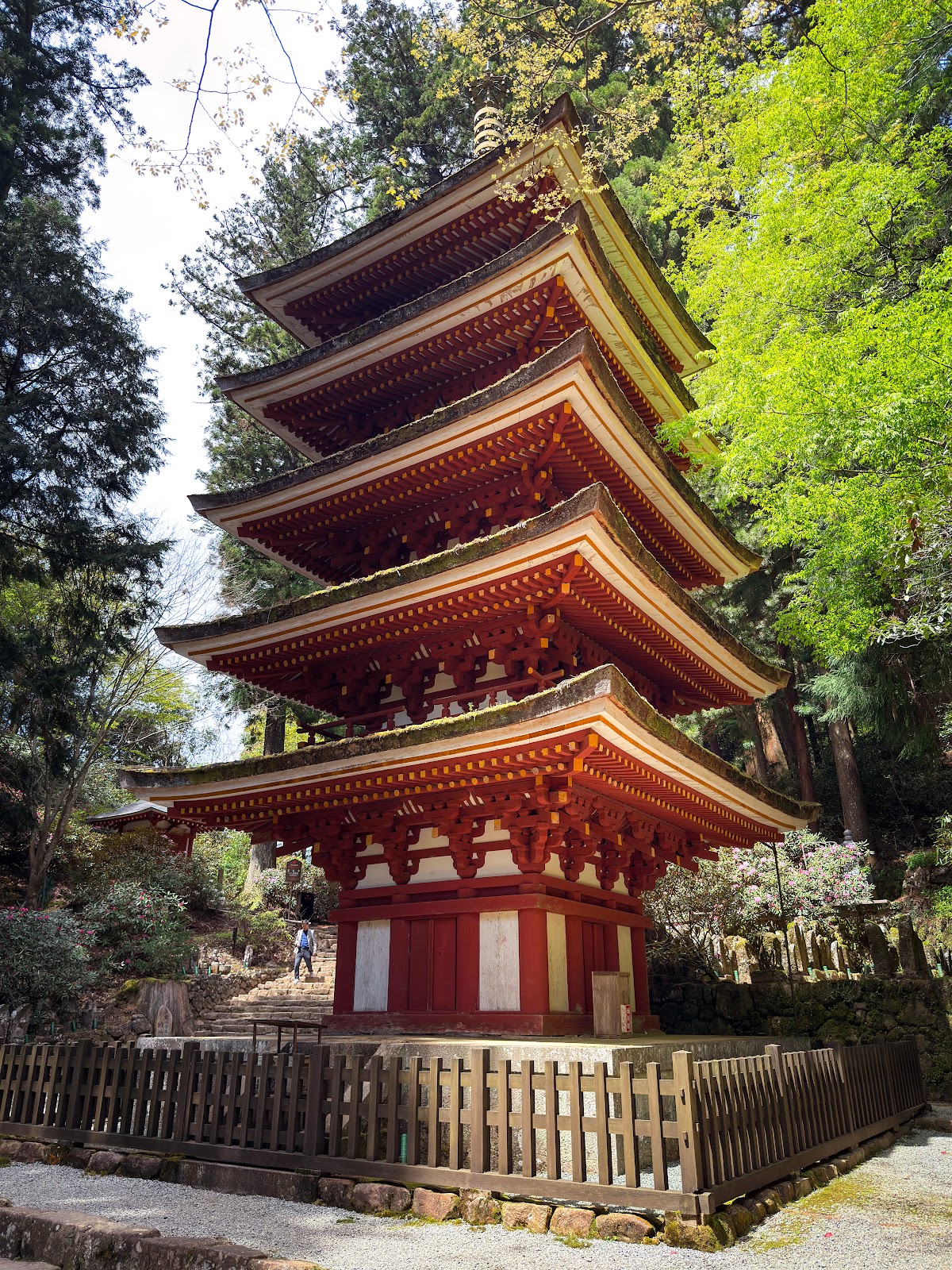
The signature structure of Murooji Temple is the five-story pagoda designated as a National Treasure. Known as Japan’s smallest five-story pagoda among outdoor ancient towers at approximately 16 meters in height, it is believed to have been constructed in the early Heian period (around 800). Its elegant form with a cypress bark roof harmonizes beautifully with the surrounding nature.
This five-story pagoda suffered significant damage from Typhoon 7 in 1998. A giant cedar tree over 600 years old fell and struck the pagoda directly. However, through meticulous restoration work, it has now recovered its former beauty. The five-story pagoda standing against the changing backdrop of nature through the seasons is a spectacular view that captivates all who visit Murooji Temple.
The Golden Hall and Jogan-Period Buddhas
The Golden Hall is an Heian period early architectural structure with a shingled roof designated as a National Treasure. Inside, five wooden Jogan-period Buddha statues are enshrined, including the principal image of Shakyamuni Buddha Standing (National Treasure), Eleven-faced Kannon Standing (National Treasure), Yakushi Nyorai Standing, Manjushri Bodhisattva Standing, and Jizo Bodhisattva Standing.
Jogan-period Buddhas refer to Buddhist statues made in the style of the Jogan era (859-877) of the early Heian period. Characterized by weighty and dignified sculptural form, the group of Jogan-period Buddhas at Murooji Temple is highly evaluated as an extremely important group of works in Japanese Buddhist art history. These Buddhist statues standing in the dim space of the Golden Hall continue to impart quiet emotion to visitors, transcending more than a thousand years.
The Main Hall (Kanjō-dō)
The main hall is a beautiful building with a cypress bark roof designated as a National Treasure. Also called the “Kanjō-dō” (Abhisheka Hall), it is the place where abhisheka, an important esoteric Buddhist ritual, is performed. The current building is said to be a Kamakura period reconstruction, but retains strong Heian period architectural style.
The main hall enshrines the principal image of the Wish-fulfilling Wheel Kannon Bodhisattva in seated form. This Kannon statue is carefully preserved as a secret Buddha and is revealed only on special occasions. The cypress bark roof undergoes regular re-thatching, and its beautiful curved lines convey the essence of Japanese architecture to the present day.
The Maitreya Hall and Shakyamuni Buddha Seated Statue
The Maitreya Hall is a Kamakura period building designated as an Important Cultural Property. It enshrines a National Treasure Shakyamuni Buddha Seated statue. This Buddhist statue also displays the style of Jogan-period Buddhas and is an excellent work; its imposing posture and meticulous carving technique speak to the high technical skill of Heian period Buddhist sculptors.
The Maitreya Hall is located in a relatively flat area within the temple grounds and is in an easily accessible location. The time spent slowly facing the Buddhist statue in the tranquil atmosphere of the hall provides visitors with profound spiritual peace.
The Inner Sanctuary and the Portrait Hall
Climbing stone steps from the left side of the five-story pagoda leads to the inner sanctuary. These stone steps are called the “Armor Slope,” and while they involve steep inclines, a different world awaits at the top.
The inner sanctuary houses the Portrait Hall, an Important Cultural Property, where the portrait of Kobo Daishi Kukai is enshrined. This location in the mid-slope of the mountain is enveloped in deep silence and is a sacred space where one can sense the essence of Murooji Temple as a place of practice. The view from the inner sanctuary is also wonderful, overlooking the mountains of Muroo.
Seasonal Flower Information
Spring Rhododendrons
Murooji Temple is also famous as a “Rhododendron Temple,” with approximately 3,000 rhododendrons cultivated on its grounds. From late April through early May each year, the temple grounds are colored in pale pink and white flowers, attracting many pilgrims and tourists.
The rhododendron is also written as 石楠花 (sekihanage), and at Murooji Temple they are particularly abundant along stone steps and around the five-story pagoda. The combination of Heian period architecture and the elegant rhododendron blossoms is truly like a painting. During the peak bloom season, events such as the “Rhododendron Festival” are held, and the temple grounds are enveloped in a festive atmosphere.
Fresh Green Season
The fresh green season from May through June is also a period when Murooji Temple’s charm stands out. The entire mountain is covered in vibrant greenery, and a visit in the refreshing air is exceptional. The contrast between the cypress bark roof and the fresh greenery is beautiful and ideal for photography.
Autumn Foliage
From mid to late November, Murooji Temple enchants many visitors as a famous autumn foliage viewing spot. Japanese maples and other maples color the temple grounds in reds and yellows, creating a magnificent landscape in harmony with the National Treasure structures. The combination of the five-story pagoda and autumn leaves is particularly known as a representative scene of Murooji Temple.
The foliage season also recommends early morning and dusk visits. The temple grounds wrapped in morning mist or autumn leaves illuminated by the setting sun create a fantastical beauty.
Winter Snow Scenery
In Uda City, Muroo, with its higher elevation even within Nara Prefecture, snow may fall and accumulate in winter. The appearance of the halls and pagodas covered in pure white snow, especially the beautiful cypress bark roofs laden with snow, reveals a serene beauty entirely different from other seasons.
Murooji Temple in winter has fewer visitors, allowing for unhurried viewing. The temple grounds enveloped in a silvery-white world exude a mysterious, otherworldly atmosphere.
Basic Information and Access
Location and Contact Information
Address: 633-0421 Muroo, Uda City, Nara Prefecture 78
Phone: 0745-93-2003
Official Website: https://www.murouji.or.jp/
Visiting Hours and Admission Fees
Visiting Hours:
- April 1 – November 30: 8:30 AM – 5:00 PM
- December 1 – March 31: 9:00 AM – 4:00 PM
Admission Fees:
- Adults (junior high school and above): ¥600
- Children (elementary school): ¥400
※Group discounts available
Access Methods
By Train:
- Get off at “Muroo-kuchi Ōno Station” on the Kintetsu Osaka Line, take the Nara Transportation Bus toward “Muroo-ji Temple” for approximately 15 minutes, and get off at the terminal
- From “Sanbon-matsu Station” on the Kintetsu Osaka Line, take a taxi for approximately 10 minutes
Bus Schedule Note:
The bus from Muroo-kuchi Ōno Station runs limited times, so it is recommended to check the schedule in advance. Particularly in winter, the number of runs decreases, so caution is necessary.
By Car:
- Approximately 30 minutes from “Hari IC” on the Meishin Expressway via Route 369
- Approximately 50 minutes from “Tenri IC” on the Nishi-Meishin Expressway via Routes 25, 165, and 369
Parking:
- Paid parking available (approximately 100 regular vehicles)
- Fee: ¥600 for regular vehicles, ¥200 for motorcycles
- Congestion is expected during busy seasons (rhododendron and autumn foliage seasons), so early arrival is recommended
Nearby Tourist Spots
Ryūketsu Shrine
Located approximately a 15-minute walk from Murooji Temple, Ryūketsu Shrine is the center of the dragon deity worship that was the origin of Murooji Temple’s founding. A cave called the “Dragon Cavern” lies deep within the shrine grounds and has been revered since ancient times as a sacred site for rain-inviting prayers. Visiting both Murooji Temple and this shrine deepens understanding of the faith history of this land.
The shrine is surrounded by deep forest and a mysterious atmosphere pervades. Particularly in the seasons of fresh greenery and autumn foliage, the beauty of nature combined with the sacred air imparts profound emotion to visitors.
Ōno-ji Temple
Located approximately 5 minutes on foot from Muroo-kuchi Ōno Station, Ōno-ji Temple is an ancient temple said to have been opened by Gyōgyōja. The Maitreya Buddha carved into the rock face (National Historic Site and Scenic Beauty) on the opposite bank of the Uda River is famous, and the massive stone Buddha standing at 13.8 meters in height is awe-inspiring.
In spring, a weeping cherry tree over 300 years old blooms in splendor, and with the main image Jizo Bodhisattva Standing known as the “Substitute Kannon,” it draws many pilgrims. It is ideally located to visit on the way to or from Murooji Temple.
Butsuryū-ji Temple (Butsuryū-ji)
Located approximately 15 minutes by car from Murooji Temple, Butsuryū-ji Temple is an ancient Shingon Buddhist temple said to have been founded in 850 by Kenkei, a senior disciple of Kobo Daishi Kukai. It is famous for the “Thousand-Year Cherry Tree” (Nara Prefectural Natural Monument), a cherry tree over 900 years old and the largest and oldest in the prefecture. In spring, many cherry blossom viewers flock to the temple.
Stone steps continue through the grounds, and the main hall positioned on the mid-slope of the mountain offers excellent views. Together with Murooji Temple, it is a place where one can feel the history of mountain ascetic Buddhism in Uda.
Annual Events at Murooji Temple
Major Annual Events
Shōjō-e (New Year Ritual): January 1
A ceremony praying for peaceful passage through the new year.
Setsubun-e (Seasonal Boundary Ceremony): February 3
A ceremony for warding off calamity and inviting good fortune on Setsubun.
Hana-matsuri (Flower Festival): April 8
A ceremony celebrating the birth of Shakyamuni Buddha.
Syakunanage-matsuri (Rhododendron Festival): Late April – Early May
Various events are held to coincide with the rhododendron bloom season.
Urabon-e (Ullambana Ceremony): August 13 – 15
A ceremony for the veneration of ancestors during the Bon season.
Autumn Foliage Illumination: Mid to late November (held in some years)
Special illumination may be performed during the autumn foliage season. Please check the official website for whether it is being held.
Secret Buddha Revelations
The principal image of the Wish-fulfilling Wheel Kannon Bodhisattva seated in the main hall is a secret Buddha and cannot normally be viewed. For information about special revelation opportunities, it is recommended to check the latest information on the official website or by inquiry.
Pilgrimage Tips and Etiquette
Time Required
Allow a minimum of one to one and a half hours to view the main structures on the grounds. If ascending to the inner sanctuary, add approximately another 30 minutes. If taking photographs slowly during your pilgrimage, allowing about two hours is recommended.
Clothing and Preparation
Since Murooji Temple is a mountain temple with many stone steps, and the path to the inner sanctuary has particularly steep inclines, wearing comfortable shoes and easy-moving clothing is essential. Also, remember to prepare for seasonal temperature changes and heat as appropriate.
In winter, there is a possibility of snow and ice, so wear non-slip shoes and exercise particular caution when walking. On rainy days, stone steps become slippery, requiring extra careful walking.
Photography
Photography within the grounds is generally permitted, but photography inside the halls is prohibited. Additionally, permission may be required for tripod use or commercial photography, so please verify in advance. Be mindful of other pilgrims and follow proper photography etiquette.
Accessibility Information
Due to the nature of Murooji Temple as a mountain temple, barrier-free accommodations have limitations. Wheelchair access is possible from the temple entrance to the area around the Golden Hall and five-story pagoda, but an attendant is essential. Access to the inner sanctuary is difficult. If you have concerns, it is recommended to consult with the temple office beforehand.
Suggested Model Courses
Day Trip Course Centered on Murooji Temple
Morning:
9:00 AM Arrive at Kintetsu Muroo-kuchi Ōno Station
9:10 AM Visit Ōno-ji Temple (weeping cherry, Maitreya Buddha carved in rock)
10:00 AM Travel to Murooji Temple by bus or taxi
10:15 AM Arrive at Murooji Temple, explore and visit grounds (2 hours)
Lunch:
12:30 PM Lunch in the Murooji Temple area (enjoy local cuisine at a local eatery)
Afternoon:
1:30 PM Visit Ryūketsu Shrine
2:30 PM If time permits, travel to Butsuryū-ji Temple (by car)
4:00 PM Return to Muroo-kuchi Ōno Station
4:30 PM Depart
Uda City Tour Course (1 Night, 2 Days)
Day 1:
Morning: Visit Murooji Temple
Afternoon: Visit Ryūketsu Shrine and Ōno-ji Temple
Evening: Stay at a hot spring inn in Uda City
Day 2:
Morning: Visit Butsuryū-ji Temple
Afternoon: Stroll through the old town of Uda Matsuyama district, view Matabe-sakura cherry tree (spring season)
Evening: Depart
This course allows you to fully enjoy the rich natural scenery and historical culture of Uda City.
Conclusion
Murooji Temple in Uda City, Nara Prefecture, is an ancient temple boasting over a thousand years of history as the “Women’s Koya,” an esoteric Buddhist sacred site open to women. The temple grounds, where National Treasure five-story pagoda and Golden Hall, precious cultural properties including Jogan-period Buddhas, and the beauty of nature through the seasons harmonize, provide visitors with profound emotion and spiritual peace.
Murooji Temple can be discovered with new charm in every season—spring rhododendrons, summer fresh greenery, autumn foliage, and winter snow scenes. Exerting a special presence even within Nara Prefecture, this temple is a precious place where one can experience the harmony of Japanese Buddhist culture and nature.
Though access requires some travel time, this allows visitors to enjoy unhurried pilgrimage in a quiet environment removed from urban bustle. Visiting together with nearby Ryūketsu Shrine, Ōno-ji Temple, and Butsuryū-ji Temple allows for deeper understanding of the faith history that breathes in the land of Uda.
When visiting Nara, please take time to visit Murooji Temple. At this place of prayer continuing from the Heian period, you await a precious opportunity to experience a thousand years of Japanese beauty and spirituality.
-800x450.jpg)
-800x450.jpg)
-800x450.jpg)