
.jpg)
Murouji Temple (Nara Prefecture) Complete Guide | History, Highlights, and Access Information for the “Women’s Koya”
Murouji Temple, nestled in Muro, Uda City, Nara Prefecture, is affectionately known as the “Women’s Koya” and serves as the head temple of the Shingon Buddhist sect’s Murouji branch. This ancient temple deep in the mountains captivates visitors with its harmonious blend of precious cultural treasures, including the National Treasure five-story pagoda, and natural beauty that changes with the seasons. This article provides a comprehensive explanation of Murouji Temple’s history, highlights, access methods, and visiting information.
About Murouji Temple | Overview of the Ancient Temple Known as the Women’s Koya
Murouji Temple is the head temple of the Shingon Buddhist sect’s Murouji branch located in Muro, Uda City, Nara Prefecture, and is a historic temple founded in the late Nara period. Positioned on the mid-slope of Mount Murouji, the temple grounds surrounded by the clear waters of the Murouji River and abundant nature have been revered since ancient times as “the sacred site of prayer for rain where the water deity resides.”
Origin of the Nickname “Women’s Koya”
Murouji Temple came to be called the “Women’s Koya” during the Edo period. In contrast to Kongobuji Temple at Mount Koya of the same Shingon sect, which prohibited women from entering, Murouji Temple permitted female pilgrims. Particularly following its restoration under the patronage of Keishoin, the mother of Tokugawa Ietsugu, the fifth Tokugawa shogun, during the Genroku era of the Edo period, the temple gathered extensive female devotion and became known as the “Women’s Koya.”
History as a Sacred Site for Prayer for Rain
The Murouji region is surrounded by ancient outer volcanic mountains, with streams flowing from mountain ranges centered on Seishinmine down into the Murouji River, making it a place abundant with water. Recorded as a sacred site for rain-calling ceremonies since ancient times, there are documents indicating that the imperial court and nobility requested rain prayer ceremonies during times of drought. This rain prayer belief became one of the important characteristics of Murouji Temple.
History of Murouji Temple | From Founding to the Present
Founding in the Late Nara Period
Regarding the founding of Murouji Temple, there are several theories, with the most credible being that it was founded in the late Nara period by Kenkei, a high priest of Kofukuji Temple, to pray for the recovery of the Crown Prince Emperor Kanmu from illness. Kenkei conducted prayers at the Murouji location, and through his achievements, the temple was constructed by imperial decree.
There are also traditions claiming that Gyougyoja opened the site, as well as theories that it was established as a shrine temple (a temple affiliated with a shrine) of the nearby Murouji Ryuketsu Shrine, and the existence of multiple founding traditions speaks to the depth of Murouji Temple’s history.
Development During the Heian Period
The temple’s current appearance is said to have been established by Shuuen, a disciple of Kenkei. Shuuen was known as a practitioner of Shingon esoteric Buddhism and developed Murouji Temple into an important Shingon sect training monastery. During the Heian period, many buildings and pagodas were constructed, and precious Buddhist statues were also created. The Jogan Buddha sculptures created during this period are still preserved as treasures of Murouji Temple.
Revival in the Edo Period and Development as the Women’s Koya
Although Murouji Temple had declined during the medieval period, it faced a major turning point during the Genroku era of the Edo period. Under the deep faith and patronage of Keishoin, the mother of Tokugawa Ietsugu, the buildings within the temple grounds were repaired and reconstructed. From this period onward, the temple actively accepted female pilgrims and became known as the “Women’s Koya,” gathering the faith of female believers.
Preservation and Restoration in the Modern Era
Having survived the wave of Buddhist persecution and destruction during the Meiji period, many buildings and Buddhist statues were designated as National Treasures and Important Cultural Properties during the Showa period. In 1998, the National Treasure five-story pagoda suffered major damage from a typhoon, but through meticulous restoration work, it has recovered its original appearance. Currently, the temple continues to welcome many pilgrims while balancing the preservation and public presentation of cultural properties.
Highlights of Murouji Temple | Treasure House of National Treasures and Important Cultural Properties
National Treasure Five-Story Pagoda | Beautiful Ancient Pagoda of the Smallest Class
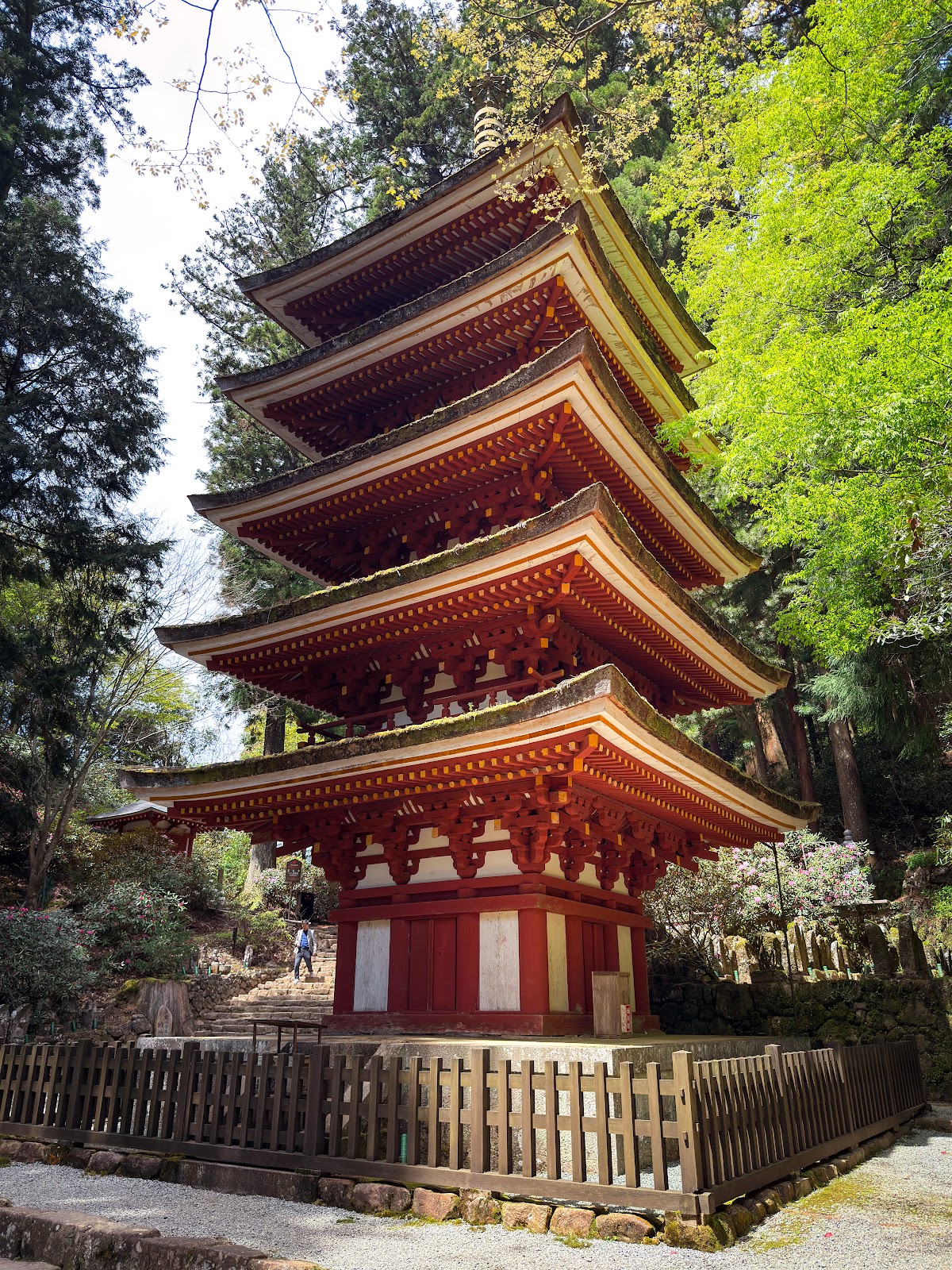
The representative structure of Murouji Temple is the five-story pagoda designated as a National Treasure. Despite being among the smallest scale of outdoor ancient pagodas in Japan at approximately 16 meters in height, its well-proportioned and beautiful appearance has earned it the title of “Japan’s Most Beautiful Five-Story Pagoda.”
Dating from the early Heian period (early 9th century), it is characterized by its elegant appearance with a cypress bark-tiled roof and red-lacquered pillars that harmonize beautifully. Surrounded by rhododendrons and autumn leaves, it presents different faces throughout the seasons. Although it suffered major damage from a typhoon in 1998, it has recovered its original beauty through restoration work employing traditional techniques.
National Treasure Golden Hall | Main Buddha Hall Housing Precious Jogan Buddha Statues
The Golden Hall is a National Treasure structure built in the early Heian period, characterized by its persimmon bark-tiled roof. Within the hall are enshrined five wooden Buddhist statues: the principal image of Standing Shakyamuni Buddha (National Treasure), Standing Avalokiteshvara with Eleven Faces (National Treasure), Standing Manjushri Bodhisattva (Important Cultural Property), Standing Medicine Buddha (Important Cultural Property), and Standing Ksitigarbha Bodhisattva (Important Cultural Property).
These are masterpieces of early Heian period Jogan sculpture, characterized by their robust and powerful forms. In particular, the principal Shakyamuni Buddha statue, carved from a single block of Kaya wood, exhibits the characteristic austere expression and dignified physique of Jogan Buddhist sculpture.
National Treasure Main Hall (Abhiseka Hall) | Sacred Space for Shingon Esoteric Buddhist Ceremonies
The Main Hall is a National Treasure structure built in the early Kamakura period with a beautiful cypress bark-tiled roof. Also called the Abhiseka Hall, it was the site where the abhiseka, an important ceremony of Shingon esoteric Buddhism, was performed. Within the hall is enshrined a Sitting Avalokiteshvara Bodhisattva (Important Cultural Property).
Positioned at the highest location within the grounds, the serene space reached by climbing stone steps continues to convey the nature of Murouji Temple as a training monastery.
Maitreya Hall and Sitting Shakyamuni Buddha Statue
The Maitreya Hall is a structure designated as an Important Cultural Property, containing a National Treasure Sitting Shakyamuni Buddha statue. This statue is also from the early Heian period Jogan period, with an impressive quiet expression of deep meditation. In contrast to the standing figure in the Golden Hall, visitors can appreciate the serene beauty of the seated statue.
Guardian Kings Gate and Arched Bridge
The Guardian Kings Gate, which serves as the entrance to Murouji Temple, is a beautifully vermillion-lacquered gate with Guardian King statues enshrined on either side. In front of the gate is an arched bridge spanning the Murouji River, symbolizing the boundary between the secular and sacred realms.
The experience of crossing the bridge and climbing stone steps to enter the grounds becomes an important element of the Murouji Temple pilgrimage.
Stone Steps to the Inner Hall and Natural Beauty
Beyond the Main Hall, stone steps leading to the Inner Hall continue deeper into the temple. The approximately 700-step staircase is steep, but the path, flanked by towering cedar trees and natural forest, is filled with a mystical atmosphere. The Inner Hall, which enshrines a hall dedicated to Kobo Daishi, becomes a quiet space of prayer.
The experience of climbing these steps provides a spiritual fulfillment akin to treading the path of ascetic practice.
Murouji Temple Through the Seasons | Seasonal Highlights
Spring | Renowned for Rhododendrons
Murouji Temple is also known as the “Temple of Rhododendrons.” From late April to early May, approximately 3,000 rhododendron bushes bloom throughout the grounds, creating a beautiful contrast between the vermillion pagoda and pink and white rhododendrons, particularly around the five-story pagoda.
The rhododendron blooming season is when Murouji Temple shows its most vibrant appearance, attracting many pilgrims and photography enthusiasts.
Summer | Deep Green and Serene Grounds
In summer, Murouji Temple is enveloped in deep green, with cool air filling the grounds. The murmur of the Murouji River and the sound of cicadas echo as visitors walk through shaded paths, offering a respite from urban bustle.
Early summer (late May to June) is particularly beautiful, with fresh, verdant green surrounding the buildings.
Autumn | Spectacular Autumn Leaves
From mid to late November, the grounds are adorned with autumn foliage. Maple trees in red and gold hues vividly color the five-story pagoda and Golden Hall. The paths from the arched bridge to the Guardian Kings Gate and the area around the five-story pagoda display especially spectacular leaves.
The autumn foliage season rivals spring’s rhododendron season in popularity, drawing many tourists.
Winter | Ethereal Beauty of Snow-Covered Roofs
Muro in Uda City is at a higher elevation within Nara Prefecture, and snow often falls in winter. Buildings with cypress bark or persimmon bark-tiled roofs covered in pure white snow truly embody the beauty of yugen (subtle profundity). The snow-covered Murouji Temple, visited by few, offers a special time surrounded by silence where one can experience profound spirituality.
Stories and Legends Related to Murouji Temple
Emperor Kanmu and the Miracle of Illness Recovery
The founding of Murouji Temple was prompted by the illness of Crown Prince Kanmu. When the high priest Kenkei of Kofukuji Temple conducted prayers at the Murouji location, a miracle occurred and the Crown Prince’s illness was cured. According to tradition, the temple was constructed by imperial decree in recognition of this achievement.
This tradition indicates that Murouji Temple started as a temple for national prayers.
Deep Relationship with Murouji Ryuketsu Shrine
Near Murouji Temple stands Murouji Ryuketsu Shrine, an ancient shrine that has been a sacred site of water deity worship since ancient times. According to one theory, Murouji Temple developed as a shrine temple (temple affiliated with a shrine) of this shrine, illustrating the history of syncretism between Shinto and Buddhism.
The Ryuketsu (Dragon Hole) at the inner sanctuary of Ryuketsu Shrine has been revered as a sacred site for rain-calling ceremonies since ancient times and is deeply connected to Murouji Temple’s rain prayer beliefs.
Keishoin and the Story of the Women’s Koya
During the Edo period, Keishoin, the mother of Tokugawa Ietsugu, deeply revered Murouji Temple and made substantial donations. Given her rise from low social standing to becoming the shogun’s mother, Murouji Temple, which accepted women, held special significance for her.
Following her patronage, the revived Murouji Temple became known as the “Women’s Koya” and attracted many female pilgrims.
Recovery from Typhoon Damage
In September 1998, Typhoon No. 7 caused severe damage to the National Treasure five-story pagoda, with parts of its roof blown away and its spire bent. However, through the dedicated efforts of craftsmen possessing traditional architectural techniques, repairs were completed over approximately two years.
This recovery narrative renewed public awareness of the importance of cultural property preservation and the excellence of Japanese traditional craftsmanship.
Access Methods to Murouji Temple
Access by Train and Bus
Nearest Station: Kintetsu Osaka Line “Murouji-guchi-Ohno Station”
- From Osaka/Namba: Approximately 1 hour 20 minutes via Kintetsu Osaka Line
- From Kyoto: Approximately 1 hour 40 minutes via transfers on Kintetsu Kyoto, Kashihara, and Osaka Lines
- From Nagoya: Approximately 2 hours via Kintetsu Nagoya and Osaka Lines
Bus from Murouji-guchi-Ohno Station
From Murouji-guchi-Ohno Station, take the Nara Kotsu Bus heading to “Murouji-ji-mae,” getting off at the final stop “Murouji-ji-mae” (approximately 15 minutes). It is approximately a 5-minute walk from the bus stop to the Guardian Kings Gate.
As bus frequencies are limited, checking the schedule in advance is recommended. Special care should be taken as there are fewer buses on weekdays.
Access by Private Vehicle
From Osaka
- Approximately 30 minutes via National Route 369 from “Hari IC” on the Nishi-Meihan Expressway
From Nagoya
- Approximately 40 minutes via National Routes 165 and 369 from “Ogura IC” on the Meihan National Expressway
Parking Information
Murouji Temple has a paid parking lot for visitors (capacity for approximately 100 regular vehicles). Parking can become congested during the rhododendron and autumn foliage seasons, so arriving early is recommended.
Taxi
Taxis are available from Murouji-guchi-Ohno Station. Travel time is approximately 10 minutes, with fares around 2,000 yen. Return taxis can be called from the temple.
Visiting Information | Hours, Admission, and Estimated Time
Visiting Hours
- April 1 to November 30: 8:30 AM to 5:00 PM
- December 1 to March 31: 9:00 AM to 4:00 PM
※Final entry is 30 minutes before closing
※Hours may change due to weather or events
Admission Fee
- Adults (Middle school and above): 600 yen
- Children (Elementary school): 400 yen
※Group discounts available (30 or more people)
※Discounts for visitors with disability certificates (card holder and one attendant)
Estimated Time Required
- Main temple grounds only: Approximately 60 to 90 minutes
- Including the inner hall: Approximately 120 to 150 minutes
The stone steps to the Inner Hall consist of approximately 700 steps, requiring 40 to 60 minutes for a round trip. Those without strong stamina can limit their visit to the main structures and still fully appreciate Murouji Temple’s charm.
Annual Events
- January 1: Shusho-e ceremony
- Second Sunday in April: Flower Festival
- Second Sunday in May: Rhododendron Festival
- August 15: Ten Thousand Lantern Festival
- Second Sunday in October: Moon Viewing Ceremony
Special ceremonies and events may be held during these occasions.
Nearby Tourist Attractions around Murouji Temple
Murouji Ryuketsu Shrine
Located approximately 15 minutes on foot from Murouji Temple, this ancient shrine dedicates itself to water and dragon deities. Visiting it alongside Murouji Temple provides deeper understanding of this region’s religious history.
Ono-ji Temple
A Shingon sect temple located near Murouji-guchi-Ohno Station, it was considered the west gate of Murouji Temple. The Maitreya cliff-carved Buddha (National Historic Site and Scenic Area) etched into the facing rock wall stands approximately 13.8 meters tall and is impressive. It is also known as a spot for viewing weeping cherry blossoms in spring.
Soni Plateau
Located approximately 30 minutes by car from Murouji Temple, this plateau becomes a spectacular sight in autumn when a vast grassland of pampas grass turns golden. Hiking courses are well-maintained, offering an opportunity to enjoy nature.
Uda Matsuyama Town Streetscape
A nationally designated Important Traditional Building Preservation District retaining the atmosphere of an Edo period castle town. Located approximately 20 minutes by car from Murouji Temple. One can stroll through picturesque streets lined with old merchant houses and sake breweries.
Etiquette and Manners for Visiting Murouji Temple
Clothing and Belongings
The grounds feature many stone steps, and the path to the Inner Hall is particularly steep. Walking shoes and comfortable, flexible clothing are recommended. Even in summer, it is wise to bring a layer since the temple is located in mountains.
Photography
Photography within the grounds is generally permitted, but photographing Buddhist statues inside buildings is prohibited. Use of tripods and commercial photography require permission. Be mindful not to disturb other pilgrims.
Maintaining Silence
Murouji Temple holds the character of a sacred training monastery. Avoid loud conversations and disruptive behavior, and maintain quiet during prayers. Approaching the site with reverence for dialogue with the temple’s natural surroundings, architecture, and Buddhist statues is key to truly appreciating Murouji Temple’s charm.
Conclusion | The Value of Visiting Murouji Temple
Murouji Temple is an ancient temple with over 1,200 years of history nestled in the mountains of Muro, Uda City, known as the “Women’s Koya.” As a repository of cultural heritage from the early Heian period, including the National Treasure five-story pagoda and Golden Hall, and bearing precious Jogan Buddha statues, it is a valuable temple. Its grounds, harmonizing with nature’s seasonal beauty, impart deep emotion to all who visit.
As a temple that accepted women and served as a sacred site for rain prayers, Murouji Temple has followed a unique historical path. Its serene space offers modern people spiritual peace and insight.
When visiting Nara, consider extending your journey to Murouji Temple and experiencing the harmonious blend of Japan’s beautiful cultural heritage and nature. It is certain to become a memorable and special time.
Basic Information about Murouji Temple
Name: Head Temple Murouji (Murouji)
Sect: Shingon Murouji Sect Head Temple
Location: 78 Muro, Uda City, Nara Prefecture 633-0421
Phone: 0745-93-2003
Official Website: https://www.murouji.or.jp/
Visiting Hours:
- April 1 to November 30: 8:30 AM to 5:00 PM
- December 1 to March 31: 9:00 AM to 4:00 PM
Admission: 600 yen for adults, 400 yen for children
Access: 15 minutes by bus from Murouji-guchi-Ohno Station to “Murouji-ji-mae,” then 5 minutes on foot
Parking: Available (paid, capacity of approximately 100 vehicles)
Major Cultural Properties: Five-Story Pagoda (National Treasure), Golden Hall (National Treasure), Main Hall (National Treasure), Standing Shakyamuni Buddha (National Treasure), and numerous others
-800x450.jpg)
-800x450.jpg)
-800x450.jpg)