.jpg)
Kongoin (Maizuru, Kyoto Prefecture) Complete Guide | History and Highlights of Tango’s Maple Leaf Temple
Kongoin (金剛院), nestled in the mountains of Maizuru City in Kyoto Prefecture, is a historic temple of the Shingon Buddhism Toji School that has continued since the Heian period. Known as “Tango’s Maple Leaf Temple,” the beauty of autumn leaves created by thousands of maples attracts many worshippers as one of the finest scenic spots in the Kansai region. This article provides a detailed explanation of Kongoin’s history, highlights, seasonal attractions, and access methods.
Basic Information and Location of Kongoin
Kongoin is a Shingon Buddhism Toji School temple located in Kashihara, Maizuru City in northern Kyoto Prefecture. Its formal name is “Rokugenzzan Jionji Kongoin,” with the mountain name Rogugenzzan and the temple name Jionji. The principal image is Namikiri Fudo Myoo, and it has marked a long history as the center of faith in the Tango region.
Located in the eastern mountains of Maizuru City, the surrounding area is designated as the “Kongoin Kyoto Prefecture Historic Natural Environment Conservation Area.” In the temple grounds and surrounding areas, a ginkgo tree affectionately called the “thousand-year kaya” and an ancient ginkgo tree grow along with natural forests of Castanopsis species, preserving an excellent historic natural environment.
Location and Access Information
- Address: 595 Kashihara, Maizuru City, Kyoto Prefecture
- Sect: Shingon Buddhism Toji School
- Mountain Name: Rogugenzzan
- Temple Name: Jionji
- Principal Image: Namikiri Fudo Myoo
- Temple Number: Kansai Flower Temple Pilgrimage Site No. 3
History of Kongoin | A Thousand-Year Story Continuing from the Heian Period
Founding and the Heian Period
The founding of Kongoin dates back to the 6th year of Tencho (829). According to tradition, it was established by Takaoka Shinnō (高岳親王), a prince of Emperor Heijo. Takaoka Shinnō was a student of Kobo Daishi (Kukai) and was known as a practitioner of Shingon Esoteric Buddhism.
From its founding, it prospered as a training center for Shingon Esoteric Buddhism and became a central hub of Buddhist culture in the Tango region. Various temple buildings including the main hall were constructed on the grounds, becoming a place where many monks engaged in ascetic practice.
Revival in the Muromachi Period
Over time, Kongoin fell into decline due to periods of warfare, but was revived during the Muromachi period. The three-story pagoda, currently designated as a National Important Cultural Property, was rebuilt during this period. As a valuable cultural asset conveying Muromachi period architectural style to the present day, it has become a symbolic structure of Kongoin.
The Azuchi-Momoyama Period and Hosokawa Yusai
Particularly noteworthy in Kongoin’s history is its connection to Hosokawa Yusai (Fujitaka), daimyo of Tango Province during the Azuchi-Momoyama period. Hosokawa Yusai was a samurai warrior excellent in both military and cultural arts, and was skilled in tea ceremony and garden design.
Yusai created the “Crane and Turtle Garden” at Kongoin, and simultaneously planted many maple trees. These maples became the foundation of Kongoin as the “Maple Leaf Temple of Tango” today. The Crane and Turtle Garden is designated as a Kyoto Prefecture Historic Place of Scenic Beauty, a valuable cultural asset conveying the garden style of the Azuchi-Momoyama period to the present day.
Development from the Edo Period Onwards
During the Edo period, the temple received protection from the Tanabe Domain (Maizuru Domain) and solidified its foundation as a temple. Improvements to the main hall and various structures were advanced, and it continued to develop as the center of regional faith.
Although affected by the Meiji-era anti-Buddhist movement, the temple survived through the support of the faith of the local people and has continued to mark more than a thousand years of history to the present day.
Connection with Yukio Mishima’s “The Temple of the Golden Pavilion”
Kongoin is also known as one of the settings in Yukio Mishima’s masterpiece “The Temple of the Golden Pavilion.” It is depicted in the novel as a temple visited by the protagonist and occupies an important position in literary history.
Highlights of the Temple Grounds | Harmony of National Important Cultural Properties and Nature
Three-Story Pagoda (National Important Cultural Property)
The most symbolic structure of Kongoin is the three-story pagoda designated as a National Important Cultural Property. This pagoda, rebuilt during the Muromachi period, stands approximately 25 meters tall and is highly valued as a representative Buddhist architecture of the Tango region.
The architectural style of the three-story pagoda preserves the characteristics of the Muromachi period well, and is notable for its well-balanced and beautiful proportions. Particularly during the autumn leaf season, the contrast between the vividly colored maples and the three-story pagoda creates a spectacular view. The landscape of the three-story pagoda and autumn leaves as viewed from the park opposite the temple grounds is popular with photography enthusiasts as a representative landscape of Kongoin.
Main Hall and Namikiri Fudo Myoo
The main hall enshrines the principal image, Namikiri Fudo Myoo. Namikiri Fudo Myoo is worshipped as a Buddha providing safe voyages and protection from misfortune, and is deeply connected to the regional character of Maizuru as a port town.
The main hall itself has high historical value, and houses numerous Buddhist images and Buddhist paintings inside. Worship at the main hall enveloped in silence offers a valuable experience of calming the mind.
Kongō Rikishi Statues (National Important Cultural Property)
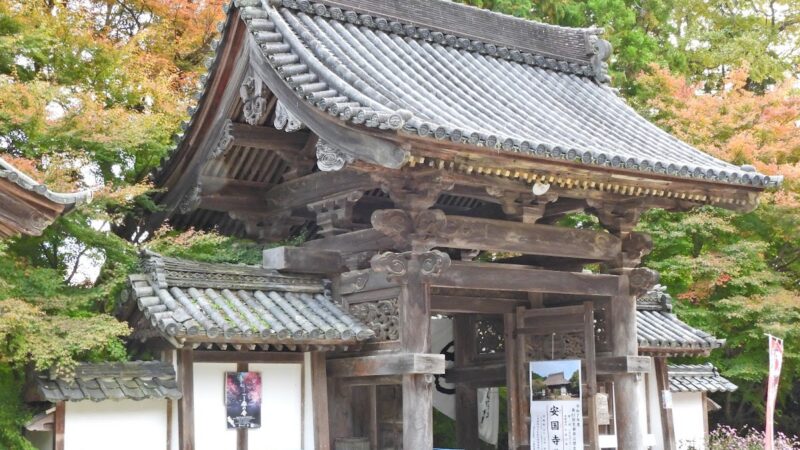
The Nio Gate (Deva Gate) houses the Kongō Rikishi statues (Nio statues) designated as a National Important Cultural Property. These statues, believed to have been created between the Kamakura and Muromachi periods, are known for their powerful forms and precise sculptural technique.
The two Kongō Rikishi statues, consisting of the Agyo (open-mouth form) and Ungyo (closed-mouth form), greet visitors as protectors of the temple.
Crane and Turtle Garden (Kyoto Prefecture Historic Place of Scenic Beauty)
The “Crane and Turtle Garden,” said to have been designed by Hosokawa Yusai, is a pond-viewing style garden designated as a Kyoto Prefecture Historic Place of Scenic Beauty. The garden, featuring crane and turtle islands, possesses traditional design elements symbolizing longevity and good fortune, conveying the garden aesthetics of the Azuchi-Momoyama period to the present day.
Within the garden, descendants of the maple trees planted by Yusai grow, displaying magnificent autumn leaves in fall. The garden, which presents different expressions through the seasons, allows visitors to enjoy different beauty depending on the time of visit.
Thousand-Year Kaya and Ancient Ginkgo Tree
On the temple grounds stands a ginkgo tree affectionately called the “thousand-year kaya.” Though its actual age is estimated at several hundred years, its imposing figure evokes a sense of long history. The kaya is an evergreen conifer whose deep green imparts a solemn atmosphere to the temple grounds.
The ancient ginkgo tree is also one of the highlights of the temple grounds. In autumn, its golden-hued leaves illuminate the temple, and the contrast between the scarlet of the maples and the golden of the ginkgo creates a beautiful landscape.
Natural Forests and Historic Natural Environment
The area surrounding Kongoin is designated as the “Kongoin Kyoto Prefecture Historic Natural Environment Conservation Area,” where natural forests of Castanopsis species are preserved in good condition. These natural forests represent precious natural heritage cultivated together with the temple’s history.
Various plants grow on the temple grounds and in the surrounding area, making it an important region from the perspective of biodiversity.
Tango’s Maple Leaf Temple | Attractions as a Famous Autumn Leaf Spot
The Spectacular Autumn Scenery of Thousands of Maples
The reason Kongoin is called “Tango’s Maple Leaf Temple” lies in the thousands of maples planted on the temple grounds. Beginning with the maples planted by Hosokawa Yusai and passed down through generations, the maples turn the entire temple grounds brilliant crimson in autumn.
Typically, beginning in early November, Japanese maple and other species begin to change color, with the peak autumn leaf season occurring from mid to late November. At its peak, the temple grounds are enveloped in brilliant red, attracting many worshippers as one of Kansai’s finest autumn leaf viewing sites.
Spectacular Viewpoint of Autumn Leaves and the Three-Story Pagoda
There are multiple spectacular viewpoints for enjoying the autumn leaves at Kongoin. The most popular is the view of the three-story pagoda and autumn leaves from the park opposite the temple grounds. The sight of the three-story pagoda surrounded by crimson leaves against blue sky is a representative landscape of Kongoin popular with photography enthusiasts.
The autumn leaves as seen while strolling through the temple grounds are equally spectacular. A tunnel of maple trees lining the approach, autumn leaves surrounding the main hall, and autumn leaves reflected in the Crane and Turtle Garden all offer different expressions of autumn color as one walks forward.
Autumn Leaf Illumination
During the autumn leaf season, nighttime illumination may be held for a limited period (whether implemented varies by year and requires advance confirmation). The fantastical sight of illuminated autumn leaves and the three-story pagoda possesses a different charm from daytime viewing.
Kansai Flower Temple No. 3 | Flowers Through the Four Seasons
Kongoin is designated as Temple No. 3 of the “Kansai Flower Temple Pilgrimage,” known not only for autumn leaves but also for flowers through the four seasons.
Spring Flowers
In spring, cherry blossoms color the temple grounds. Yoshino cherry and wild cherry trees bloom magnificently, their pale pink flowers standing out among the new green. Camellia japonica also colors the temple grounds as a spring flower.
From April to May, snowball flowers bloom in full white. The pure white flowers blooming in spherical form possess pristine beauty, creating a beautiful landscape in contrast with the new green.
Iris japonica also blooms as a spring flower in various spots on the temple grounds. The shiiga flower with its white petals marked with purple and yellow, favoring shade, shows its delicate form beneath the trees of the temple grounds.
Summer’s Fresh Green
In summer, the temple grounds enveloped in deep green exude a cool atmosphere. The fresh green of thousands of maples is striking to the eye, and even on hot summer days, the temple grounds remain relatively cool.
This season is suitable for quietly strolling through the temple grounds, with relatively few worshippers.
Autumn’s Autumn Leaves
As previously mentioned, autumn is the most radiant season for Kongoin. From mid to late November during the autumn leaf season, the temple grounds turn brilliant red, welcoming many worshippers as a representative autumn leaf viewing site of the Tango region.
Winter’s Silence
In winter, Kongoin may be covered with snow, and the landscape of snow and the three-story pagoda possesses ink-wash painting-like beauty. Winter, when there are few visitors, is a season to worship quietly surrounded by silence.
Kongoin as a Power Spot in Tango
Kongoin is also known as a power spot representing the Tango region. The spiritual presence of a temple with more than a thousand years of history, a rich natural environment, and the spiritual efficacy of Namikiri Fudo Myoo combine to make it a place where many worshippers find mental peace and strength.
In particular, worship at the main hall and meditation before the ancient trees of the temple grounds offer valuable experiences of stepping away from the hustle and bustle of daily life to calm the mind.
Viewing Information and Access
Viewing Hours and Admission
- Viewing Hours: 9:00–16:00 (varies by season)
- Admission: Adults ¥500, Middle and High School Students ¥300, Elementary School Children and Below Free (may vary during autumn leaf season)
- Parking: Free parking available (approximately 50 spaces)
Access Methods
By Car
- Approximately 20 minutes from “Maizuru East IC” on the Maizuru Wakasa Expressway
- Approximately 25 minutes from “Maizuru Oe IC” on the Kyoto縦貫 Expressway
- Free parking provided
By Public Transportation
- Approximately 20 minutes by taxi from “Higashi-Maizuru Station” on the JR Maizuru Line
- JR Maizuru Line to “Higashi-Maizuru Station” then Kyoto Kotsu Bus to “Kongoin-mae” bus stop (immediate vicinity, though bus frequency is limited and advance confirmation is necessary)
During the autumn leaf season, roads may become congested, so it is recommended to allow extra time for your visit.
Nearby Tourist Attractions
When visiting Kongoin, it is recommended to also visit other tourist attractions in Maizuru City.
Maizuru Red Brick Warehouse Group
A representative tourist attraction of Maizuru City, the red brick warehouse group consists of former Imperial Navy warehouses constructed during the Meiji and Taisho periods. The retro atmosphere is appealing, with museums and cafes housed within.
Goro Sky Tower
An observation facility overlooking Maizuru Bay, where visitors can enjoy the beautiful scenery of the ria-style coastline.
Maizuru Repatriation Memorial Museum
A museum conveying the history of repatriation after World War II, displaying materials registered as a UNESCO Memory of the World.
Events and Annual Activities
Various Buddhist rituals are held at Kongoin throughout the year.
- New Year: First shrine visit, New Year prayers
- Spring: Spring Grand Festival
- Summer: Obon Festival
- Autumn: Autumn Grand Festival, special autumn leaf viewing
- Winter: Hogmanay bell-ringing
Particularly during the autumn leaf season, special viewings and special openings of cultural properties may be held. Details are recommended to be confirmed through Kongoin’s official website or by telephone.
Manners and Precautions for Worship
Kongoin currently functions as a place of worship. When visiting, please observe the following manners.
- Maintain silence in the main hall and other structures
- Photography is permitted only in designated areas (photography is prohibited in halls in many cases)
- Do not touch plants or cultural properties on the temple grounds
- Take away all trash
- During the autumn leaf season, share space considerately due to crowding
Summary | An Ancient Temple of Tango Where Thousand-Year History and Nature Interweave
Kongoin in Maizuru City, Kyoto Prefecture, is an ancient temple of the Shingon Buddhism Toji School with more than a thousand years of history from its founding in 829 of the Heian period. History is layered across eras: the establishment by Takaoka Shinnō, the rebuilding of the three-story pagoda in the Muromachi period, and the creation of the Crane and Turtle Garden and planting of maples by Hosokawa Yusai.
In addition to cultural properties such as the National Important Cultural Property three-story pagoda and Kongō Rikishi statues and the Kyoto Prefecture Historic Place of Scenic Beauty Crane and Turtle Garden, the temple grounds represent a harmonious blend of history and nature—the spectacular autumn leaves created by thousands of maples known as “Tango’s Maple Leaf Temple,” the flowers through the four seasons as the third temple in the Kansai Flower Temple Pilgrimage, and ancient trees such as the thousand-year kaya and ginkgo—captivating all who visit.
Kongoin, where one can experience faith and culture passed down across a thousand years within a rich natural environment designated as a Kyoto Prefecture Historic Natural Environment Conservation Area, is a temple worth visiting when traveling to Tango. Particularly the beauty during the autumn leaf season is exceptional, creating a landscape visitors will not forget once they have visited.
-800x450.jpg)
-800x450.jpg)
-800x450.jpg)