Yakken Gorge (Aomori Prefecture) Complete Guide | Thorough Explanation of Autumn Leaves, Hot Springs, and Access Information
Yakken Gorge (やげんけいりゅう), located deep in the Shimokita Peninsula of Aomori Prefecture, is a hidden gem where you can enjoy beautiful natural scenery throughout the four seasons and high-quality hot springs. This article provides a comprehensive introduction to everything you should know before visiting, from the charm of Yakken Gorge to specific tourism information.
What is Yakken Gorge?
Yakken Gorge is a ravine in the upper reaches of the Oohata River in Oohata Town, Mutsu City, Aomori Prefecture. The name comes from the fact that the cross-section of the gorge resembles “yakken,” a tool used to crush herbal medicine in traditional Chinese medicine.
Geographical Features
Located at the southern base of the Osorezan mountain range in the central Shimokita Peninsula, the gorge spans an elevation range of approximately 200 to 400 meters. The clear waters of the Oohata River have carved away the bedrock over long periods of time, creating a distinctive gorge landscape.
A well-maintained walking trail extends for approximately 4 kilometers along the gorge, allowing visitors to easily enjoy the scenic ravine. The gorge is flanked by primeval forests on both banks, with deciduous broadleaf trees such as Japanese beech, maple, and oak being particularly abundant, offering different appearances depending on the season.
History and Culture
The Yakken area has long been known as a hot spring resort for therapeutic bathing. During the Edo period, it thrived as a therapeutic hot spring resort for the Nanbu clan. Beloved by local people over the years, the area continues to attract many tourists seeking hot springs and natural beauty today.
The Four-Season Appeal of Yakken Gorge
Spring (April–June)
As the snow melts, the gorge’s water volume increases, allowing visitors to enjoy the powerful flow of water. New greenery begins to sprout, and this is also the season for gathering mountain vegetables. However, caution is needed regarding remaining snow and frozen road surfaces.
From late May through June, alpine wildflowers begin to bloom, with particularly delicate flowers such as false hellebore and dogtooth violet visible along the walking trail.
Summer (July–August)
Wrapped in deep green, the gorge makes an ideal summer retreat. Aomori Prefecture’s summers are relatively cool, and the gorge is even cooler, making comfortable hiking possible even in the height of summer.
The healing space created by the cool sound of the gorge and the greenery of the trees allows visitors to forget the hustle and bustle of the city. In summer, the walking trail is in good condition, making it an ideal season for trekking.
Autumn (September–November)
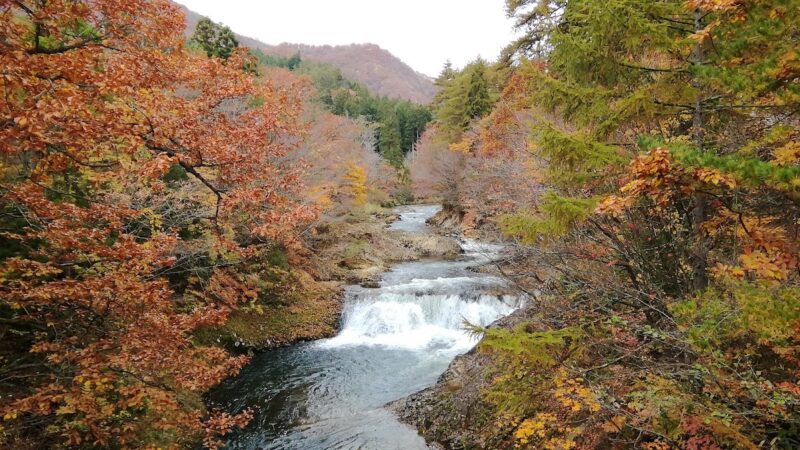
Autumn is the most beautiful season at Yakken Gorge. The gorge typically reaches peak autumn foliage from mid to late October, with the entire ravine transforming into shades of red and yellow.
Autumn foliage highlights:
- Vibrant red maple leaves
- Golden yellow Japanese beech
- Deep brown oak
- Contrast with evergreen foliage
The autumn leaves reflected in the clear gorge waters are particularly beautiful and popular for photography. The autumn foliage season can get crowded, so visiting on weekdays or taking an early morning hike is recommended.
Winter (December–March)
General tourists find it difficult to visit due to snowfall, but the snow-covered gorge displays a fantastical beauty. Roads may be closed during winter, so advance confirmation is essential.
Staying at a hot spring inn and enjoying a bath with a snow view is one of the delights of winter at Yakken.
The Appeal of Yakken Hot Springs
The Yakken Gorge area has multiple hot spring facilities where visitors can combine gorge hiking with hot spring enjoyment.
Spring Quality and Effects
Yakken Hot Springs are primarily simple hot springs featuring colorless, odorless, soft water. With a slightly alkaline pH, the water is gentle on the skin and is also called “beautiful woman’s bath.”
Main therapeutic effects:
- Neuralgia
- Muscle pain
- Joint pain
- Fatigue recovery
- Cold sensitivity
- Health promotion
The source water temperature is approximately 60 degrees Celsius, and many facilities allow bathing at comfortable temperatures without requiring dilution.
Kappa no Yu (The Kappa Bath)
The most famous hot spring facility at Yakken Gorge is “Kappa no Yu.” Formally called “Yakken Hot Spring Kappa no Yu,” it is a day-use bathing facility located along the gorge.
Facility overview:
- Hours: 7:00–21:00 (varies by season)
- Admission: Adults ¥350, Children ¥150 (prices subject to change)
- Spring quality: Simple hot spring
- Facilities: Indoor bath, open-air bath
The open-air bath offers views of the gorge landscape, making it especially scenic during autumn foliage season. The facility’s name derives from a kappa legend associated with this area.
Loved by local people, this unpretentious hot spring facility maintains a quiet, relaxed atmosphere rather than being overly commercialized.
Other Hot Spring Facilities
Yakken-so:
A hot spring inn built along the gorge that offers day-use bathing in addition to overnight lodging. The open-air bath overlooking the gorge is popular, allowing visitors to enjoy seasonal scenery.
Hotel New Yakken:
A relatively large hot spring hotel suitable for family and group accommodations. Meals are also substantial, with cuisine made from local ingredients.
How to Walk the Yakken Gorge Trail
Trail Overview
The well-maintained walking trail along Yakken Gorge allows visitors to enjoy the scenic ravine up close. The full-length course of approximately 4 kilometers allows hikers to turn back partway according to their physical ability.
Estimated time:
- One way: approximately 1 hour 30 minutes to 2 hours
- Round trip: approximately 3 to 4 hours
Major Points of Interest
Rest house area:
The starting point of the walking trail, with parking and restroom facilities. The trail continues along the gorge from here.
Gorge waterfalls:
Along the trail are waterfalls of various sizes, offering dramatic scenery when water volume is high.
Suspension bridge:
From the suspension bridge spanning the gorge, visitors can view both upstream and downstream scenery. This is a particularly beautiful photography spot during autumn foliage season.
Okuyakken:
The innermost part of the walking trail, where more primeval nature is preserved. Visitors can enjoy forest bathing enveloped in silence.
Clothing and Supplies
While the trail is relatively well-maintained, it remains a mountain path. The following equipment is recommended.
Essential items:
- Trekking shoes or slip-resistant athletic shoes
- Comfortable clothing (long sleeves and pants recommended)
- Drinking water
- Towel
- Rain gear (weather can change quickly)
Convenient to bring:
- Insect repellent spray (summer)
- Hat
- Sunscreen
- Camera
- Binoculars (for bird watching)
- Light snacks
Precautions
- The walking trail may be closed to traffic depending on season and weather conditions
- This is bear habitat, so carry something that makes noise such as a bell
- Always take trash with you
- Plant collection is prohibited
- Avoid traveling alone; travel in groups when possible
Access Methods
Driving
Driving is the most convenient way to reach Yakken Gorge.
From Aomori City:
- Via National Routes 4 and 279
- Travel time: approximately 2 hours 30 minutes
- Distance: approximately 120 kilometers
From Hachinohe City:
- Via National Route 279
- Travel time: approximately 2 hours
- Distance: approximately 100 kilometers
From central Mutsu City:
- Via National Route 279
- Travel time: approximately 30 minutes
- Distance: approximately 20 kilometers
GPS navigation:
Search for “Yakken Hot Spring” or “Kappa no Yu” for convenience.
Parking Information
Free parking is available near Yakken Gorge Rest House.
- Capacity: approximately 50 vehicles
- Fee: Free
- Early arrival is recommended, as the area becomes crowded during autumn foliage season
Public Transportation Access
Public transportation options are limited but available as follows.
By train:
- Get off at “Shimokita Station” on the JR Ominato Line
- Take a bus or taxi from Shimokita Station
By bus:
Take the Shimokita Kōtsū bus “Ōhata Line” to “Yakken Hot Spring” bus stop. However, service is extremely limited, so advance confirmation of the schedule is essential.
By taxi:
Taking a taxi from central Mutsu City or Shimokita Station is practical. Approximately 30 minutes one way; fare is approximately ¥5,000–¥7,000.
Car Rental Information
Car rental is convenient for touring the Shimokita Peninsula.
- Multiple car rental companies available in Mutsu City
- Renting a car from Aomori Airport or Misawa Airport for sightseeing is also recommended
- Advance reservations are recommended, as availability becomes tight during busy periods
Nearby Attractions
Introducing attractions around the Shimokita Peninsula worth visiting along with Yakken Gorge.
Osorezan
One of Japan’s three major sacred mountains, located approximately 40 minutes by car from Yakken Gorge. Visitors can enjoy unique scenery permeated with sulfur odor and hot springs.
Hotoke ga Ura
This rocky coastline in western Shimokita Peninsula features artistic landscapes created by nature. Approximately 1 hour 30 minutes by car from Yakken Gorge.
Omaezaki
Located at Japan’s northernmost point on Honshu in Ōma Town, which is famous for tuna. On clear days, Hokkaido may be visible. Approximately 1 hour by car from Yakken Gorge.
Mutsu City Attractions
- Kita no Boujin Ōminato Ando-kan: A facility where visitors can learn about Maritime Self-Defense Force history
- Mutsu Science and Technology Museum: Displays including the atomic ship Mutsu
- Kamafuse Yama: An observation platform with panoramic views of the Shimokita Peninsula
Dining Information
Local Specialty Dishes
Ōma Tuna:
Ōma tuna is synonymous with the Shimokita Peninsula. Hot spring inns sometimes serve it.
Scallops:
Fresh scallops from Mutsu Bay are exquisite.
Squid:
Squid caught in and around the Shimokita Peninsula is another specialty.
Mountain vegetable dishes:
Dishes using mountain vegetables harvested in the Yakken area are available.
Dining Establishments
Few restaurants exist in the Yakken Hot Spring area, so dining at a hot spring inn is the main option. For day visitors, plan meals in Mutsu City or the Ōhata district.
Lodging Information
Yakken Hot Spring Inns
In addition to Yakken-so and Hotel New Yakken mentioned earlier, small-scale lodging facilities such as family-run inns are also available.
Benefits of overnight stay:
- Ability to enjoy quiet gorge hiking at dawn and dusk
- Ideal for stargazing
- Opportunity to savor hot springs at leisure
- Cuisine featuring local ingredients
Notes when reserving:
- Early reservations are essential during autumn foliage season
- Some facilities close during winter, so confirmation is necessary
- Mobile phone signal is weak in some areas
Mutsu City Lodging
For more accommodation options, staying in central Mutsu is also an option. Various types of lodging are available, from business hotels to hot spring inns.
Photography Spots and Best Seasons
Recommended Photography Points
Gorge and autumn foliage:
The suspension bridge area of the walking trail is an excellent spot for photographing the gorge and autumn leaves together.
Around Kappa no Yu:
Compositions combining the hot spring facility, gorge, and background mountains are possible.
Waterfall scenery:
Waterfalls along the trail produce fantastical photos when shot with a slow shutter speed.
Best Photography Times
Early morning:
The gorge enveloped in morning mist is fantastical and ideal for photography due to fewer people.
Evening:
When sunlight enters from the west, autumn foliage appears even more vivid.
Overcast:
Interestingly, overcast conditions are suitable for autumn foliage photography. Colors don’t oversaturate, producing natural-looking results.
Practical Information for Visiting Yakken Gorge
Optimal Visiting Period
Overall recommendation:
Mid to late October autumn foliage season is most popular, but the fresh green of May–June and summer heat relief of July–August each have their own appeal.
Suggested Length of Stay
- Hot spring only: 1–2 hours
- Hiking trail only: 2–3 hours
- Hot spring + hiking trail: 4–5 hours
- Overnight stay: Ideally 1 night to enjoy leisurely
Mobile Phone and Internet Environment
The Yakken Gorge area, being mountainous, has weak mobile phone signals or dead zones in some places. Download necessary information in advance.
Restroom Information
Restrooms are available at the rest house, Kappa no Yu, and hot spring inns, but not along the walking trail. Use facilities before starting your hike.
Shops and Vending Machines
Shops and vending machines are limited in the Yakken Hot Spring area. It is recommended to prepare drinks and snacks in advance.
The Nature and Ecosystem of Yakken Gorge
Vegetation
The area around Yakken Gorge features cool-temperate deciduous broadleaf forests centered on Japanese beech. Main tree species include the following.
- Japanese beech
- Mongolian oak
- Japanese maple
- Fullmoon maple
- Linden
- Japanese cucumber tree
The forest floor is covered with Chishima bamboo, and numerous alpine wildflowers are visible in spring.
Wildlife
The Shimokita Peninsula is the only location on Honshu where Japanese macaques live in the wild, and they are occasionally sighted around Yakken. The following animals also inhabit the area.
- Asian black bears (caution required)
- Japanese serow
- Japanese macaques
- Foxes
- Raccoon dogs
- Squirrels
Birdlife
The gorge is suitable for bird watching, and the following bird species can be observed.
- White-throated dipper
- Grey wagtail
- Crested kingfisher
- Blue-and-white flycatcher
- Narcissus flycatcher
- Great spotted woodpecker
Advice for Enjoying Safely
Weather Preparedness
Mountain weather changes quickly, so bring rain gear even on sunny forecasts. Especially in autumn, bring warm clothing for sudden temperature drops.
Bear Precautions
The Shimokita Peninsula is Asian black bear habitat. Take the following measures.
- Carry noise-making items such as bear bells
- Avoid traveling alone
- Be especially careful at dawn and dusk
- Carefully manage food
- Return if you spot bear signs
Health Management
- Set course difficulty appropriate for your physical ability
- Drink water frequently
- Maintain a reasonable pace
- Carry medications if you have chronic conditions
Emergency Contact Information
- Emergency: 119
- Police: 110
- Mutsu City Ōhata Branch Office: 0175-34-2111
If mobile phone service is unavailable, seek help at the nearest hot spring facility.
History and Culture of Yakken Gorge
History of the Hot Springs
The discovery of Yakken Hot Springs dates back far, with the springs already known as a therapeutic bathing resort during the Edo period. The springs appear in records from the Nanbu clan, and clan warriors are said to have visited for therapeutic bathing.
After the Meiji era, the springs continued to be loved by local people, with full-scale hot spring inns being built beginning in the Showa period.
Kappa Legend
A kappa legend, which gave its name to “Kappa no Yu,” has been passed down in this area. According to local tradition, a kappa once lived in the gorge and guarded the hot spring, and locals today consider the kappa to be a guardian spirit of the hot springs.
Community Involvement
Yakken Gorge is a valuable tourism resource for the local Ōhata district, with conservation activities conducted by local residents. Trail maintenance and cleanup activities are supported by community volunteers.
Environmental Conservation Efforts
Ecotourism
Yakken Gorge promotes tourism that minimizes impact on the natural environment. Each visitor should keep the following in mind.
- Thorough trash collection
- Prohibition on collecting plants or animals
- Refrain from entering areas outside the walking trail
- Speak quietly (consideration for wildlife)
- Do not move plants for photography purposes
Sustainable Tourism
To preserve beautiful nature for future generations, visitors bear responsibility for acting responsibly. Observe local rules and tourism with respect for nature.
Summary: How to Fully Enjoy Yakken Gorge
Yakken Gorge is a natural treasure of which Aomori Prefecture’s Shimokita Peninsula can be proud. The gorgeous ravine landscape throughout the four seasons, high-quality hot springs, and rich ecosystem continue to captivate visitors.
Key points to maximize enjoyment of Yakken Gorge:
- Seasonal choice: While autumn foliage season is most popular, spring’s fresh greenery and summer’s cool refuge each offer their own appeal
- Time allocation: Combine gorge hiking with hot spring bathing for an ideal 4–5 hour stay
- Overnight stay: If possible, stay overnight to enjoy the quiet gorge at dawn and dusk
- Preparation: Wear appropriate clothing and bring proper equipment to safely enjoy nature
- Environmental care: Practice responsible tourism by respecting nature and following local guidelines
Escape the bustle of the city and be healed by the murmur of clear streams and hot springs at Yakken Gorge. When visiting Aomori Prefecture, be sure to venture here. The deep nature of the Shimokita Peninsula will surely welcome you warmly.
Before visiting, confirm the latest information and check weather and road conditions. Enjoy your wonderful trip to Yakken Gorge.