
.jpg)
Special Scenic Beauty Kenroku-en (Ishikawa Prefecture) Complete Guide: Thorough Explanation of the Charm and Highlights of One of Japan’s Three Great Gardens
Kenroku-en, located in Kanazawa City, Ishikawa Prefecture, is a renowned destination that attracts approximately 3 million visitors annually from Japan and abroad as one of Japan’s representative gardens. Counted among the “Three Great Gardens of Japan” alongside Mito’s Kairakuen and Okayama’s Korakuen, it has been designated as a Special Scenic Beauty by the national government due to its beauty and historical value. This article provides comprehensive coverage of information you should know before visiting Kenroku-en, including its history, highlights, seasonal charm, and access methods.
Kenroku-en: Historical Background of Special Scenic Beauty Designation
Origin of the Name Kenroku-en
The name Kenroku-en derives from the six conditions of celebrated gardens recorded in the Chinese text “Luoyang Mingyu an” (Record of the Famous Gardens of Luoyang): grandeur, depth, human workmanship, antiquity, water features, and distant views. These six elements are typically considered contradictory, and it is said to be extremely difficult to possess all of them. However, Kenroku-en was named as a garden that beautifully harmonized these six landscape elements.
Significance of Special Scenic Beauty Designation
Kenroku-en was designated as a National Scenic Beauty in 1922 (Taisho 11) and was upgraded to Special Scenic Beauty status in 1985 (Showa 60). Special Scenic Beauty designation is granted to scenic beauties of exceptional value among designated cultural properties, and as of 2024, only 36 such sites exist nationwide. As one of these, Kenroku-en is strictly protected as a cultural heritage of Japan.
History of Kenroku-en: Conveying the Prosperity of the Kaga Clan to the Present
Construction During the Edo Period
The history of Kenroku-en began in 1676 (Enpou 4) when Maeda Tsunanori, the fifth daimyo of the Kaga clan, constructed “Hasuike-tei” (Lotus Pond Garden) on sloped land adjacent to Kanazawa Castle. Over approximately 180 years, successive daimyo continued to add their own touches, resulting in the garden’s current form.
Large-scale landscaping was particularly undertaken during the era of the 13th daimyo, Maeda Narihararu (1822-1874), during which the current fundamental landscape centered on Kasumi-ga-ike was completed. Backed by the immense financial resources of the Kaga clan, known as “Kaga Million Koku,” the domain gathered outstanding gardeners and craftsmen, pursuing the ideal garden without sparing time or expense.
Public Opening After the Meiji Restoration
After the Meiji Restoration, Kenroku-en was opened to the public in 1874 (Meiji 7). Until then, it had been the private garden of the Kaga daimyo family, accessible only to the feudal lord, his family, and select guests. With its opening to the public, Kenroku-en began a new chapter as a park where citizens and tourists could enjoy the beauty of the four seasons.
Highlights of Kenroku-en: 15 Must-See Spots
1. Kotoji Lantern (徽軫灯籠)
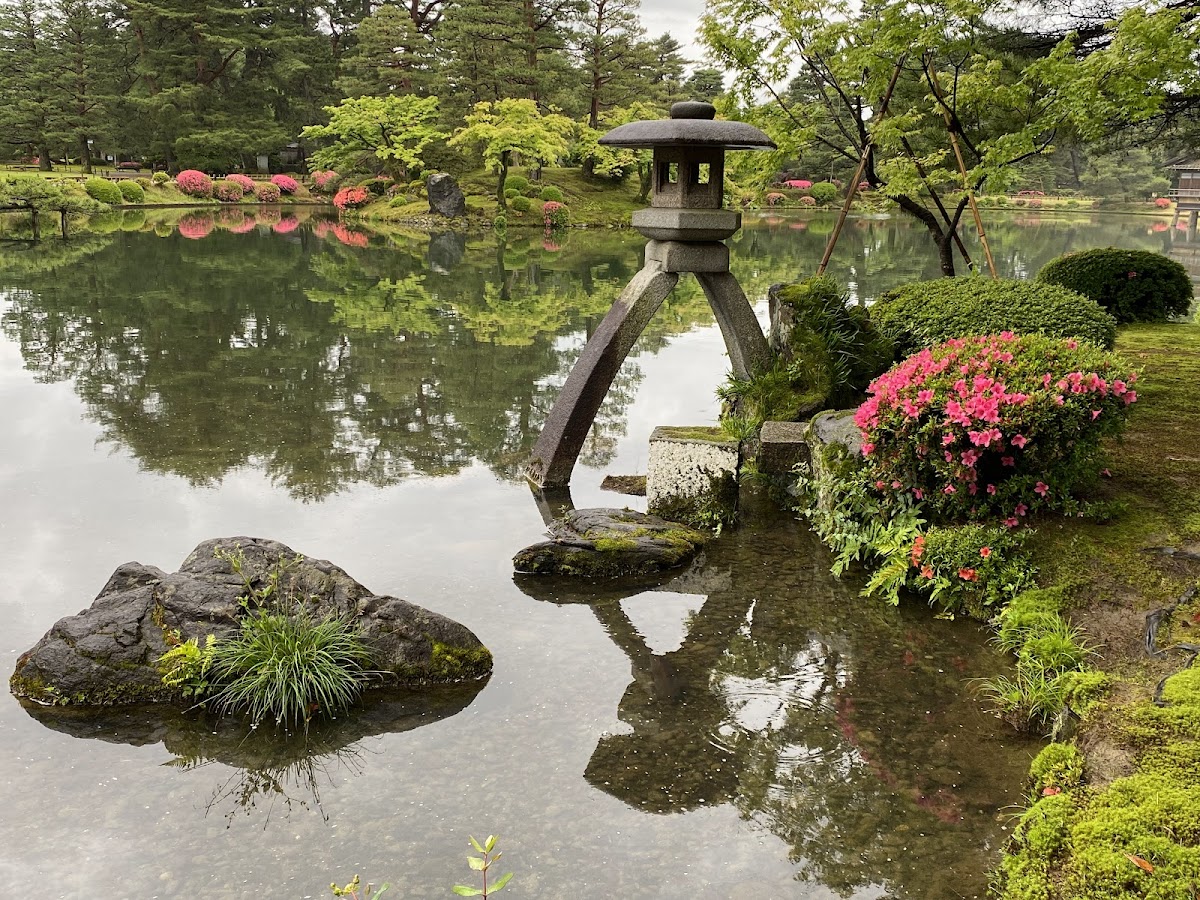
The Kotoji Lantern, a symbol of Kenroku-en, is a uniquely shaped lantern standing on the north shore of Kasumi-ga-ike pond. With legs of unequal length, it resembles a kotoji, the bridge piece used on a traditional stringed instrument (koto), which gives it its name. Photographed together with the Rainbow Bridge, this scene is known as representing Kenroku-en and is a popular spot for souvenir photographs.
2. Kasumi-ga-ike Pond
The Kasumi-ga-ike pond, with an area of approximately 5,800 square meters, is the largest pond at the center of Kenroku-en. Within the pond lies an island called Hourai-jima, modeled after the legendary Mount Hourai where immortals are said to dwell. As you circuit around the pond’s perimeter, you can appreciate the garden’s beauty from various angles, making it the focal point of this stroll garden.
3. Karazaki Pine
The Karazaki Pine stands on the shore of Kasumi-ga-ike. According to tradition, the 13th daimyo, Maeda Narihararu, obtained seeds from Karazaki on the shore of Lake Biwa and cultivated this tree. During winter, it is decorated with “yuki-tsuri” (snow-supporting ropes) to protect branches from snow’s weight, making it famous as a winter symbol of Kenroku-en. The snow-tying work, which begins November 1st, is a traditional event signaling winter’s arrival in Kanazawa.
4. Neagari Pine (根上松)
The Neagari Pine displays roots exposed to a height of approximately two meters above ground. The 13th daimyo, Maeda Narihararu, spent approximately 40 years nurturing this famous tree. With roots spreading as if gripping the earth, it represents one of Kenroku-en’s characteristic landscapes and is cherished as a tree of good fortune, as “root rising” (neagari) sounds similar to “value rising” (neagari) in Japanese.
5. Gankō Bridge (雁行橋)
The Gankō Bridge is a stone bridge made of 11 red Tomurogawa stones arranged to resemble wild geese flying in formation. Pieces of stone cut into hexagonal shapes are arranged alternately, allowing visitors to appreciate the beauty beneath their feet while walking. It preserves valuable evidence of the advanced masonry techniques of the Edo period.
6. Hisago Pond (瓢池)
Hisago Pond is the oldest pond in Kenroku-en and served as the center of the Hasuike-tei constructed by the 5th daimyo, Maeda Tsunanori. Named for its gourd shape, the pond contains a waterfall called Midori-taki. Surrounding the pond are teahouses such as “Yūgao-tei” and “Suiryaku-tei,” offering a tranquil atmosphere.
7. Kyokusui (曲水)
The Kyokusui is a small stream flowing from Kasumi-ga-ike that meanders through the garden. The winding water flow evokes the “Kyokusui no Utage” (Festival of the Winding Stream), where Chinese literati would compose poetry on the water’s edge. The burbling sound of the stream makes this a soothing spot for strolling.
8. Fountain
The Kenroku-en fountain is said to be one of Japan’s oldest fountains, constructed in 1861 (Bunkyū 1). Without electricity or pumps, it uses the natural water pressure from height difference with Kasumi-ga-ike to spray water to approximately 3.5 meters, demonstrating the advanced technical capabilities of the period.
9. Monument to the Meiji Era (Yamato Takeru Statue)
The Yamato Takeru statue, erected in 1880 (Meiji 13), was established to honor Ishikawa Prefecture natives who died in the Southwest War. Standing approximately 5.5 meters tall, this bronze statue is the highest point in Kenroku-en and serves as a notable landmark visible from a distance.
10. Sazae-yama (栄螺山)
Sazae-yama, located southeast of Kasumi-ga-ike, is an artificially constructed hill with a spiral path to its summit. Approximately nine meters high, the summit offers an excellent vantage point overlooking the entire Kenroku-en.
11. Funa-no-Ochin Pavilion (舟之御亭)
The Funa-no-Ochin Pavilion, built on the east shore of Kasumi-ga-ike, is a shelter where daimyo rested during boating excursions. Constructed to jut out over the pond, it allows views of the garden from near water level. Though the current structure is a restoration, it conveys the atmosphere of the original period.
12. Shigure Teahouse (時雨亭)
Shigure Teahouse, restored in 2000, recreates a tea house that existed during the Edo period. You can enjoy matcha tea and refined sweets while taking in the garden’s beauty (fee required). A moment of tea while viewing the changing seasonal scenery becomes a cherished memory of your Kenroku-en visit.
13. Uchihashi Pavilion (内橋亭)
Uchihashi Pavilion, also called the Water Pavilion, is a rest house seemingly floating on Kasumi-ga-ike. With its stage-like structure extending over the pond, it creates a beautiful landscape unified with the water’s reflection. Currently available as a rest area.
14. Plum Grove
The plum grove on the south side of Kenroku-en features approximately 200 trees of red and white plum blossoms. Typically in bloom from late February to mid-March, it announces early spring’s arrival. Strolling surrounded by plum fragrance is a special experience of winter’s end.
15. Sakura-ga-oka
Kenroku-en has approximately 420 cherry trees planted throughout, with the Sakura-ga-oka area being particularly noted as a cherry blossom destination. With varieties including Somei-yoshino, Higan-zakura, and Yamato-zakura, they bloom in succession from early to mid-April.
Kenroku-en’s Seasonal Charm: Beauty Throughout the Year
Spring Kenroku-en (March – May)
Spring in Kenroku-en is a vibrant season when plums, cherries, and azaleas bloom in succession. Particularly during cherry blossom season, free admission is offered, and nighttime illumination is provided. The simultaneous blooming of approximately 420 cherry trees is spectacular, attracting many flower-viewing visitors.
In late March, the snow-supporting ropes (yuki-tsuri) installed during winter are removed, marking spring’s arrival. May brings fresh green buds, and the contrast between new greenery and blue skies is beautiful.
Summer Kenroku-en (June – August)
In early summer, from early to mid-June, approximately 5,000 Japanese irises bloom in splendor. The iris garden near Hisago Pond is particularly stunning, with purple, white, and yellow flowers adorning the water’s edge.
From July to August, the greenery deepens, with tree shade providing coolness. Early morning strolls offer the fresh air of gardens wet with dew.
Autumn Kenroku-en (September – November)
Autumn in Kenroku-en is renowned for its beautiful autumn foliage. From early to late November, maples, zelkovas, and enkianthus turn red and yellow, transforming the garden into a brocade-like landscape.
From November 1st, snow-tying work begins on the Karazaki Pine and other trees, and these winter preparations become sightseeing attractions. Autumn free admission periods and nighttime illumination of the foliage create magical scenes.
Winter Kenroku-en (December – February)
Winter’s greatest attractions in Kenroku-en are snow-covered landscapes and snow-tying. Particularly on snowy mornings, a white world unfolds in serene silence, offering the ethereal beauty of profound tranquility.
The Karazaki Pine’s snow-tying is nationally renowned as a winter symbol of Kenroku-en, and its cone shape secured with blue ropes resembles an artwork. From January to February, photographers visit to capture the garden’s snow-laden beauty.
Cultural Value of Kenroku-en: The Pinnacle of Japanese Garden Aesthetics
The Perfected Stroll Garden
Kenroku-en is highly regarded as a representative example of kaiyūshiki rinsen teien (stroll gardens with spring-fed ponds). This garden type features a large pond at its center with pathways encircling it, allowing visitors to enjoy sequentially changing scenery as they walk.
In Kenroku-en, the landscape transforms with each step forward, and even the same location appears different depending on season and time of day. This “shifting beauty” represents the essence of Japanese gardens, with Kenroku-en considered its highest achievement.
The Kaga Clan’s Aesthetic Sense and Technical Prowess
Throughout Kenroku-en, the advanced techniques and refined aesthetics of the Kaga clan are evident. Stone placement, water flow, tree trimming, and architectural positioning are all meticulously calculated artistic works.
Stone grouping technique is particularly outstanding, masterfully positioning natural stones to create “shukkeei” (compressed scenery) that concentrates natural landscape. Additionally, the abundant water brought via Tatsumi Canal creates water-based scenery that greatly enhances Kenroku-en’s appeal.
International Recognition
Kenroku-en receives high evaluation not only domestically but internationally. It consistently ranks highly in the garden rankings of the American journal “Journal of Japanese Gardening,” and is globally recognized as a garden representing Japan.
Sightseeing Spots Around Kenroku-en
Kanazawa Castle Park
Kanazawa Castle Park, adjacent to Kenroku-en, is the site of the Kaga clan daimyo’s residence. Important cultural properties including the Ishikawa Gate, the 30-ken-long warehouse, and the crane storehouse remain, while recently restored structures like the 50-ken-long warehouse and the crane tower are also impressive. Visiting both parks together deepens understanding of Kaga clan history and culture.
Seison-kaku
Seison-kaku, located within Kenroku-en, is a retirement residence built by the 13th daimyo, Maeda Narihararu, for his mother, Shin’yōin. Designated as an Important Cultural Property, it features a fusion of formal shoin-style and rustic tea house architecture. The interior displays luxurious decoration and furnishings (separate admission fee required).
Kanazawa 21st Century Museum of Art
Located approximately 10 minutes’ walk from Kenroku-en, the Kanazawa 21st Century Museum of Art is a museum specializing in contemporary art. Works like Leandro Erlich’s “Swimming Pool” are popular interactive installations. Enjoying contemporary art that contrasts with traditional Kenroku-en allows visitors to experience Kanazawa’s diverse culture.
Higashi Teahouse District
Higashi Teahouse District, one of Kanazawa’s three major teahouse districts, is approximately 10 minutes by car or 15 minutes by bus from Kenroku-en. The streetscape preserves Edo period atmosphere, with cafes and craft shops occupying traditional townhouses, offering Kanazawa’s characteristic atmosphere.
Access to Kenroku-en
Access by Public Transportation
From JR Kanazawa Station
- Bus: From the East Exit bus terminal, platforms 7-10, take the bus to “Kenroku-en-shita/Kanazawa Castle” stop (approximately 15 minutes)
- Bus lines: Multiple routes available including Hokuriku Bus, Kanazawa Castle Town Sightseeing Bus, and Machiba
- Taxi: Approximately 10 minutes, fare approximately 1,000-1,500 yen
Walking from Kanazawa Station
- Approximately 30-40 minutes (distance approximately 2.5 km)
- Routes passing through Omicho Market and Kanazawa Castle Park are recommended
Access by Car
From the Hokuriku Expressway
- From Kanazawa West IC: Approximately 30 minutes
- From Kanazawa East IC: Approximately 30 minutes
- From Kanazawa Morimoto IC: Approximately 20 minutes
Parking Information
As Kenroku-en has no dedicated parking lot, use surrounding paid parking facilities.
- Ishikawa Prefectural Kenroku Parking: 482 spaces, first hour 350 yen, then 150 yen per 30 minutes
- Kenroku-en-shita Parking: Approximately 480 spaces
During peak seasons and weekends, parking lots become congested, so public transportation is recommended.
Kenroku-en Admission Information
Opening Hours
Regular Period (March 1 – October 15)
- 7:00 AM – 6:00 PM (closing time)
Regular Period (October 16 – End of February)
- 8:00 AM – 5:00 PM (closing time)
Early Opening
- Offered during specific periods (please verify)
Night Illumination
- Offered during cherry blossom season, autumn foliage season, snow-tying season, and other times
- Time: Typically 6:00 PM – 9:00 PM (varies by season)
Admission Fees
Individual
- Adults (18 years and older): 320 yen
- Children (6 to under 18 years): 100 yen
- 65 and older: Free (proof of age required)
Groups (30 or more)
- Adults: 250 yen
- Children: 80 yen
Combination Tickets
- Kenroku-en + Kanazawa Castle Park (crane tower, 50-ken-long warehouse, bridge gate continuous tower): 500 yen per adult
- Kenroku-en + Seison-kaku: 900 yen per adult
Free Admission Days
- During cherry blossom bloom period (approximately one week)
- During autumn foliage season (approximately one week)
- Other specified dates (please verify)
Entrances
Kenroku-en has seven entrances.
- Katsurazaka Entrance: Near Kanazawa Castle Park side, most frequently used
- Mayumi-zaka Entrance: Near Seison-kaku
- Odateno Entrance: Closest to “Kenroku-en-shita” bus stop
- Hasuike-mon Entrance: Near Kanazawa Castle Park’s Ishikawa Gate
- Zuishin-zaka Entrance: Near parking lots
- Uwa-zaka Entrance: From Higashi Teahouse District direction
- Chaten-douri Entrance: Near souvenir shop street
For first-time visitors, entrance via Katsurazaka or Odateno is recommended.
Tips for Enjoying Kenroku-en
Suggested Time Requirements
- Quick visit: 30 minutes to 1 hour
- Visiting major spots: 1 to 1.5 hours
- Detailed appreciation: 2 to 3 hours
- Including teahouse break: 3 or more hours
To fully appreciate the garden’s beauty, at least 1.5 hours is recommended.
Best Seasons
While Kenroku-en has charm throughout the year, the following periods are particularly popular.
- Cherry Blossom Season (early to mid-April): Vibrant cherries and fresh greenery
- Autumn Foliage Season (early to late November): Brocade-like autumn landscape
- Snow Season (December – February): Snow-tying and snow-covered beauty
While these periods are crowded, they showcase Kenroku-en at its most beautiful.
Photography Tips
Recommended Photography Spots
- Kotoji Lantern and Rainbow Bridge (classic composition)
- Karazaki Pine snow-tying (winter only)
- Kasumi-ga-ike with Sazae-yama beyond
- Neagari Pine’s impressive roots
- Kyokusui stream with autumn foliage (autumn)
Best Photography Times
- Early morning: Few visitors, garden beautifully lit by sunrise
- Evening: Western light creates dramatic scenery
- During illumination: Creates magical atmosphere
Clothing and Supplies
Clothing
- Comfortable walking shoes (uneven terrain and stone pathways in the park)
- Season-appropriate clothing (umbrella in summer, warm clothes in winter)
- Non-slip shoes for rainy weather
Supplies
- Camera/smartphone
- Beverages (vending machines available in park)
- Parasol/umbrella (weather dependent)
- Guidebooks/pamphlets
Kenroku-en Conservation and the Future
Daily Maintenance
Professional gardeners daily maintain Kenroku-en’s beauty through tasks including pine trimming, lawn maintenance, pond cleaning, and tree disease control. Much work occurs unseen to preserve the garden.
Pine maintenance particularly requires advanced technique, utilizing “sukashi-sentei” (transparency pruning), a traditional method of thinning branches to improve air circulation and light penetration.
Protection as a Cultural Property
As a Special Scenic Beauty, modifications or alterations to Kenroku-en require approval from the Agency for Cultural Affairs. This safeguards historical landscape, allowing future generations to experience Edo period garden beauty.
Recently, addressing climate change impacts—larger typhoons, extreme heat, heavy snowfall—has become important. Conservation efforts combine traditional methods with contemporary knowledge.
International Exchange and Educational Activities
Kenroku-en serves as a venue for promoting Japanese garden culture worldwide. Multilingual guides and pamphlets for international visitors deepen understanding of Japanese traditional culture.
Through local school partnerships, the garden offers opportunities for children to study garden culture and history, emphasizing cultural transmission to future generations.
Conclusion: The Charm of Special Scenic Beauty Kenroku-en
Special Scenic Beauty Kenroku-en represents the pinnacle of Japanese gardens, perfected over approximately 180 years. Concentrating the finances and culture of Kaga Million Koku, it beautifully harmonizes six landscape elements—grandeur, depth, human workmanship, antiquity, water features, and distant views—making it a world-class cultural heritage.
Seasonal beauty transformations, historically valuable structures and stonework, and continuously inherited traditional management techniques unite to inspire and soothe all visitors.
When visiting Kanazawa, please take time to stroll through Kenroku-en, experiencing the aesthetic sensibility of Japanese gardens continuing since the Edo period. With its changing seasonal appearances, Kenroku-en offers new discoveries and inspiration with each visit.
Special Scenic Beauty Kenroku-en will continue to be cherished by many as a precious site transmitting the finest Japanese traditional culture to the present day.
-800x450.jpg)
-800x450.jpg)
-800x450.jpg)