Complete Guide to Morioka Castle Ruins Park (Iwate Park) | History, Highlights, and the Charm of All Four Seasons Explained in Detail
Morioka Castle Ruins Park (Iwate Park), located in the center of Morioka City, Iwate Prefecture, is a historical park developed on the site of Morioka Castle, which was the residence of the Nanbu clan. The landscape, where beautiful stone walls harmonize with nature that changes with the seasons, has been selected as one of “Japan’s 100 Historical Parks” and is cherished as a place of relaxation for residents. This article provides detailed explanations of the history of Morioka Castle Ruins Park, its highlights, event information, and access methods.
What is Morioka Castle Ruins Park?
Morioka Castle Ruins Park is an urban park located at 1-37 Uchimaru, Morioka City, Iwate Prefecture. It is a park developed on the ruins of Morioka Castle, a hirayamajiro (castle built on a hill) that was built on a granite ridge jutting out at the confluence of the former Kitakami River and Nakatsugawa River. The park was opened as “Iwate Park” in 1906 (Meiji 39). To commemorate the 100th anniversary of opening in 2006 (Heisei 18), it was given the nickname “Morioka Castle Ruins Park,” and today it is known by both names.
The park covers approximately 10.6 hectares, and the beautiful stone walls built with Morioka granite tell of the castle’s former appearance. Because of the beauty of these stone walls, Morioka Castle is counted as one of the “Three Famous Castles of Tohoku” along with Shirakawa Komine Castle and Aizuwakamatsu Castle.
Currently, under the designated management system, the NPO Green Consultation Room manages and operates the park, and it is open to residents and tourists throughout the four seasons.
The History of Morioka Castle Ruins Park | Historical Changes
Construction of Morioka Castle
The history of Morioka Castle dates back to 1597 (Keicho 2). Nanbu Nobutao (the first lord of Morioka Domain) decided to relocate his residence from Sannai to Kozukata and began construction with his eldest son Toshinao (the second lord) as the chief overseer of the project.
The construction work took approximately 36 years and was completed in 1633 (Kanei 10) during the time of the third lord, Nanbu Shigenao. It was a hirayamajiro that took advantage of the natural fortress provided by two rivers—the Kitakami River and Nakatsugawa River—and consisted of the main enclosure, second enclosure, third enclosure, and other fortifications.
Morioka Castle did not have a keep tower; instead, a three-story turret was constructed in the main enclosure. This is also said to have been out of consideration for the Edo Shogunate.
Changes After the Meiji Era
After the Meiji Restoration, Morioka Castle came under the administration of the Military Ministry in 1874 (Meiji 7), and most of the buildings were torn down. However, the stone walls and ponds and other remains were preserved, and in 1906 (Meiji 39), the site was developed and opened as “Iwate Park” according to a design by Yasuhei Nagaoka, a landscape architect representing the modern era.
It was designated as a national historic site in 1937 (Showa 12), and the nickname “Morioka Castle Ruins Park” was established in commemoration of the 100th anniversary of opening in 2006 (Heisei 18). During the Great East Japan Earthquake in 2011 (Heisei 23), part of the stone walls suffered damage with some collapse, but restoration work has progressed, and conservation activities continue today.
Highlights of Morioka Castle Ruins Park
Beautiful Stone Walls
The greatest highlight of Morioka Castle Ruins Park is, without question, the stone walls built by stacking granite from Morioka. The stone walls, which reach heights of approximately 8 meters, employ techniques such as “nozura-tsumiage” (stacking natural stones as they are) and “uchikomse” (stacking stones with worked angles), allowing visitors to see the advanced construction techniques of that era.
The stone walls of the main enclosure in particular are impressive, and visitors can truly understand why Morioka Castle is counted as one of the “Three Famous Castles of Tohoku” based on their beauty and sturdiness. Grass and moss peeking through the gaps in the stone walls convey a sense of historical weight and are popular photography spots.
Spots Within the Park
Main Enclosure Ruins
The main enclosure ruins, at the highest point of the park, are where the three-story turret once stood. Currently developed as a plaza, it has become a viewpoint from which one can overlook the city of Morioka. In spring, cherry blossoms bloom in profusion, making it a famous cherry blossom viewing spot that draws large crowds.
Second Enclosure Ruins
The second enclosure ruins feature a grassy plaza, making it an ideal place for picnics and rest. It is common to see families spreading out their benches and is cherished as a place of relaxation for residents.
Ishikawa Takuboku Poetry Monument
A poetry monument of Ishikawa Takuboku, a poet from Morioka, is installed in the park. Takuboku frequently visited this park during his youth and left behind the famous tanka, “Kuuzukata no o-shiro no kusa ni nekorobite / kuu ni suiwareshu juugo no kokoro” (Reclining on the grass of the lord’s castle of Kuuzukata / with my fifteen-year-old heart drawn to the sky). This monument has become a pilgrimage site for Takuboku fans.
Miyazawa Kenji Poetry Monument
A poetry monument by Miyazawa Kenji, a fairy-tale author and poet from Hanamaki, is also located in the park. Kenji attended Morioka Higher Agricultural School (now the Faculty of Agriculture at Iwate University) and used to take walks in this park. The monument bears a passage from one of Kenji’s works.
Nitobe Inazo Literary Monument
Nitobe Inazo, an educator and thinker who was active internationally, was born into a family of Morioka domain samurai. A literary monument in the park honors Nitobe’s achievements, allowing visitors to pay respect to this eminent figure with deep ties to Morioka.
Other Literary Monuments, Sculptures, and Monuments
Beyond the above, the park is dotted with literary monuments, sculptures, and monuments of literary figures and historical personages connected to Morioka. Exploring while searching for these is also part of the enjoyment.
- Statue of Lieutenant Nanbu Toshisuke: A statue commemorating a descendant of the Nanbu family who died in the Russo-Japanese War
- Eboshi Rock: A large stone said to have existed at this location before Morioka Castle was constructed
- Time Bell: A bell that once announced the time to the castle town
By touring these historic sites, one can develop a deeper understanding of Morioka’s history and culture.
Charm of All Four Seasons
Morioka Castle Ruins Park presents different aspects throughout the four seasons, allowing various ways to enjoy it depending on when one visits.
Spring Cherry Blossom Information
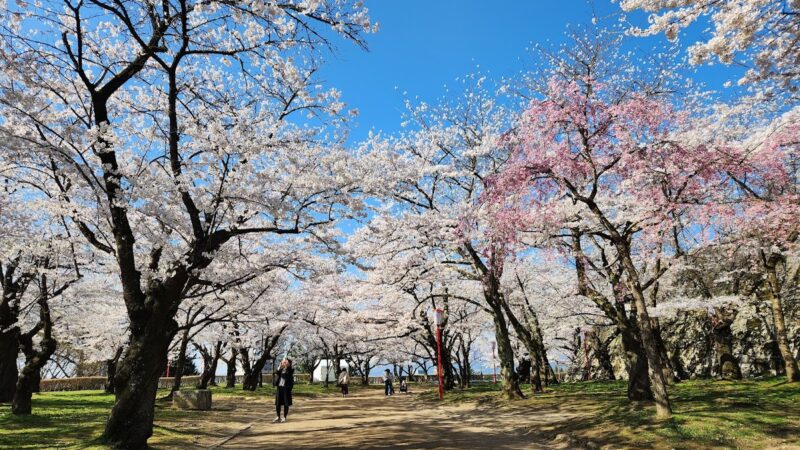
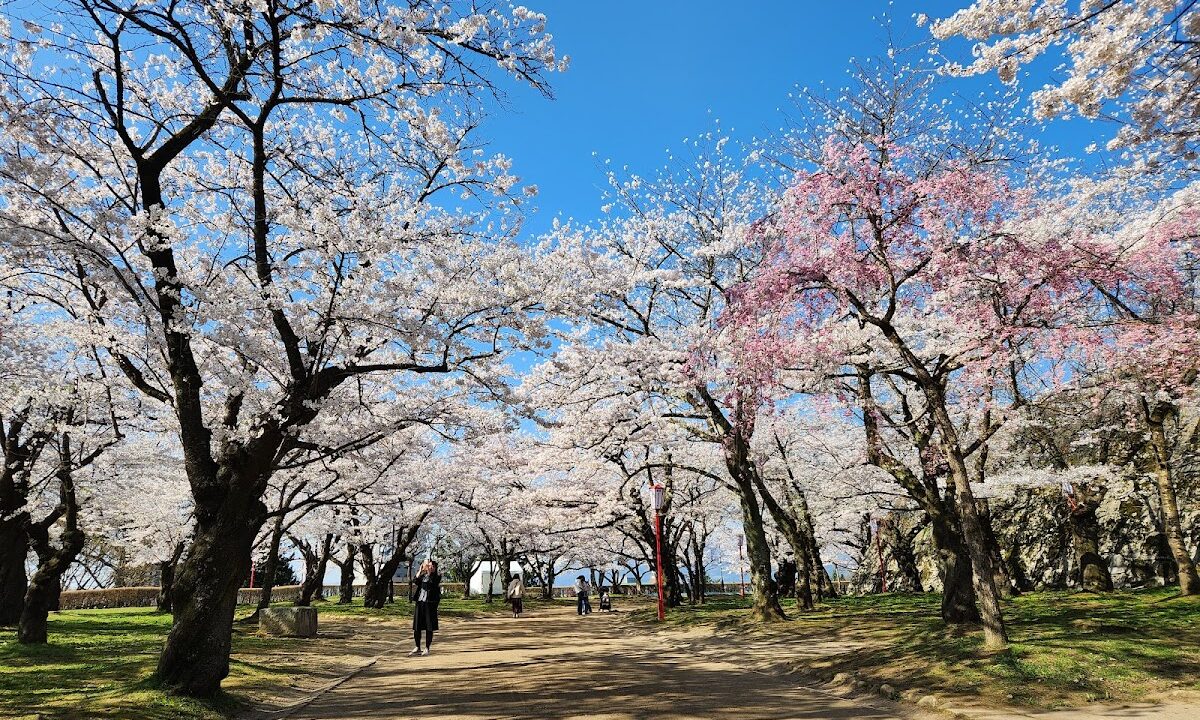
Morioka Castle Ruins Park is known as one of Morioka’s finest cherry blossom viewing spots. The park contains approximately 200 trees of Somei Yoshino and Edo higan cherries, which typically reach peak bloom from mid to late April.
The contrast between the cherry blossoms and the stone walls of the main enclosure is particularly spectacular, and the area becomes crowded with cherry blossom viewers. Nighttime illumination is also provided during the season, allowing visitors to enjoy the fantastical beauty of illuminated cherry blossoms. During the “Morioka Cherry Blossom Festival,” food stalls also open, raising the festive atmosphere.
Since cherry blossom bloom times vary with climate, it is recommended to check bloom information before visiting. The latest information can be confirmed on the Morioka City official website and the tourism association website.
Summer Greenery
From early summer through summer, the park is enveloped in vibrant green. The shaded areas are cool, making the season ideal for walks and jogging. Families enjoying picnics on the grassy plaza and people sketching around the stone walls are commonly seen.
Summer at Morioka Castle Ruins Park is relatively uncrowded with tourists, making it a hidden gem for leisurely historical exploration.
Autumn Foliage Information
Autumn at Morioka Castle Ruins Park is known for the beauty of its foliage. From late October through early November, maple and ginkgo trees turn color, painting the park in red and gold.
The combination of stone walls and autumn leaves in particular is as beautiful as a painting, attracting numerous tourists and photography enthusiasts. Events such as “Morioka Living Story” are also held in autumn, providing opportunities to enjoy foliage hunting alongside these activities.
Since peak foliage time varies with temperature, it is recommended to check foliage information before visiting.
Winter Snow Scenery
In winter, Morioka Castle Ruins Park’s snow-covered stone walls present an appearance like ink wash painting. The silent landscape of snow-covered stone walls and trees offers a charm entirely different from the other seasons.
Care must be taken with footing when snow accumulates, but the season offers an opportunity to enjoy fantastical winter scenery. Additionally, winter attracts fewer tourists, making it a season ideal for leisurely reflection on history while exploring.
Event Guide
Various events are held throughout the year at Morioka Castle Ruins Park.
Morioka Cherry Blossom Festival
The “Morioka Cherry Blossom Festival,” held annually from mid to late April in accordance with cherry blossom bloom time, is a representative spring event in Morioka. During the period, nighttime illumination is provided, and numerous food stalls open. Performances of local traditional arts are also held on weekends, drawing large numbers of residents and tourists.
Morioka Castle Ruins Park Foliage Festival
In autumn, a “Foliage Festival” is held, with events planned to enjoy the beauty of fall colors. Guided tours and photography contests are among the activities offered, allowing visitors to fully savor the autumn charm of Morioka Castle Ruins Park.
Other Events
In summer, the park is used as a starting point for the “Morioka Kitakami River Rubber Boat Descent,” and in autumn, it becomes a venue for “Morioka Living Story,” serving as a stage for various events.
Event information can be confirmed on the Morioka City official website and the Morioka Convention and Visitors Bureau website.
Access Information
Access by Train
Walking from JR Morioka Station
- Travel time: Approximately 15–20 minutes
- From the east exit of Morioka Station, head west along the main boulevard
Access by Bus
- Board the Morioka downtown circulation bus “Dendenmusashi” from the Morioka Station Front Bus Terminal
- Get off at the “Morioka Castle Ruins Park” bus stop, a short walk away
- Travel time: Approximately 5–10 minutes
- Fare: 100 yen per trip (as of 2024)
Access by Car
From the Tohoku Expressway
- Approximately 15 minutes from Morioka IC
- Approximately 20 minutes from Morioka Minami IC
Parking Information
Morioka Castle Ruins Park does not have dedicated parking. Nearby paid parking facilities must be used.
- Morioka Central Park Underground Parking: About 5 minutes on foot, 100 yen per 30 minutes for regular vehicles
- Uchimaru Parking: About 3 minutes on foot, 300 yen for the first hour, 100 yen per 30 minutes thereafter
- Morioka History and Culture Museum Parking: About 2 minutes on foot, 100 yen per 30 minutes for regular vehicles
During cherry blossom season and event periods, surrounding roads become congested; use of public transportation is recommended.
Nearby Tourist Spots
By visiting nearby tourist spots when exploring Morioka Castle Ruins Park, one can experience Morioka’s attractions more deeply.
Morioka History and Culture Museum
The “Morioka History and Culture Museum,” located just next to Morioka Castle Ruins Park, is a facility where one can learn about Morioka’s history and culture. Displays include information on Morioka Castle, the castle town’s history, and Nanbu clan materials. Visiting before or after exploring the castle ruins park will deepen understanding.
- Address: 1-50 Uchimaru, Morioka City, Iwate Prefecture
- Hours: 9:00 AM–6:00 PM (April–October), 9:00 AM–5:00 PM (November–March)
- Closed: Third Tuesday of each month (or the following day if it falls on a holiday)
- Admission: General 300 yen, High School students 200 yen, Elementary and Middle School students 100 yen
Sakurayama Shrine
Sakurayama Shrine, adjacent to the north of Morioka Castle Ruins Park, is a shrine established as the tutelary shrine of the Nanbu clan. The shrine grounds contain a 350-year-old eboshi rock and are also known as a power spot. A flea market is held the second Saturday of each month in front of “Morioka Tegami-kan.”
Nakatsugawa Riverbed
The riverbed of the Nakatsugawa River, which flows to the east of Morioka Castle Ruins Park, is a beautifully developed walking area. The cherry tree avenue along the river creates spectacular scenery in spring, and in summer, people can be seen enjoying sweetfish fishing.
Morioka Tegami-kan (Letter Museum)
A facility displaying letters and materials of literary figures connected to Morioka such as Ishikawa Takuboku and Miyazawa Kenji. It is approximately 5 minutes on foot from Morioka Castle Ruins Park.
Iwate Bank Red Brick Building
Built in 1911 (Meiji 44), this was the former Nakanohashi Branch of Iwate Bank and is a work by Tatsuno Kingo, who designed Tokyo Station. It is designated as an Important Cultural Property and interior tours are available. It is approximately 10 minutes on foot from Morioka Castle Ruins Park.
Explore by Purpose | Ways to Enjoy Morioka Castle Ruins Park
Recommended for History Enthusiasts
For history lovers, a walk carefully observing the stone wall structure and construction techniques is recommended. Visiting the Morioka History and Culture Museum for preliminary study before exploring the park will allow for deeper understanding. Free guided tours by volunteers are also conducted periodically (advance confirmation required).
Recommended for Photography
The combination of stone walls with cherry blossoms and autumn foliage are ideal photography spots. Photographs taken during early morning or evening when slanted light illuminates the stone walls are particularly beautiful. The city overview from the main enclosure is also a popular photography point.
Recommended for Families
The grassy plaza of the second enclosure is perfect for children to run around and for families to enjoy picnics. Bringing a bento box and spending time leisurely is recommended. However, areas around the stone walls have uneven footing, so care is necessary when visiting with small children.
Recommended for Literary Walks
A walking course visiting the literary monuments of literary figures connected to Morioka—such as Ishikawa Takuboku, Miyazawa Kenji, and Nitobe Inazo—is recommended. Pausing in front of each monument and reflecting on the writers’ works and lives allows one to feel the cultural depth of Morioka.
Facility Information and Basic Data
Name: Morioka Castle Ruins Park (Iwate Park)
Location: 〒020-0023 1-37 Uchimaru, Morioka City, Iwate Prefecture
Park Hours: Open 24 hours (though nighttime lighting is limited)
Admission: Free
Closed Days: None (Open year-round)
Manager: NPO Green Consultation Room (Designated Manager)
Contact Information:
- Morioka Parks and Greenery Division: 019-651-4111
- Morioka History and Culture Museum: 019-681-2100
Official Website: https://www.moriokashiroato.jp/
Barrier-Free Information:
- Wheelchair access within the park is possible, but some areas such as around the stone walls and stairs to the main enclosure are difficult to access
- Multi-purpose restrooms available
Pets Allowed: Permitted if kept on a leash (please observe proper etiquette)
Conclusion
Morioka Castle Ruins Park (Iwate Park) is a historical park representative of Morioka City, Iwate Prefecture, and is a charming spot where beautiful stone walls harmonize with nature that changes with the seasons. It preserves the vestiges of Morioka Castle, which served as the residence of the Nanbu clan for more than 200 years, and has been selected as one of “Japan’s 100 Historical Parks.”
The park, which presents a different face with spring cherries, summer greenery, autumn foliage, and winter snow scenery, is simultaneously a place of relaxation for residents and an unmissable destination for tourists. It is also a place beloved by literary figures such as Ishikawa Takuboku and Miyazawa Kenji, making it enjoyable as a literary walking tour.
The excellent accessibility, being within walking distance of JR Morioka Station, is also appealing, making it an ideal base for Morioka sightseeing. Historic attractions such as the Morioka History and Culture Museum, Sakurayama Shrine, and the Iwate Bank Red Brick Building are scattered throughout the surrounding area, and exploring them together allows for a deeper understanding of Morioka’s history and culture.
Being free to enter and open year-round, Morioka Castle Ruins Park can be visited anytime without hesitation. When visiting Iwate Prefecture, be sure to stop by. The landscape created by historic stone walls and the beauty of all four seasons will surely become a cherished memory.