
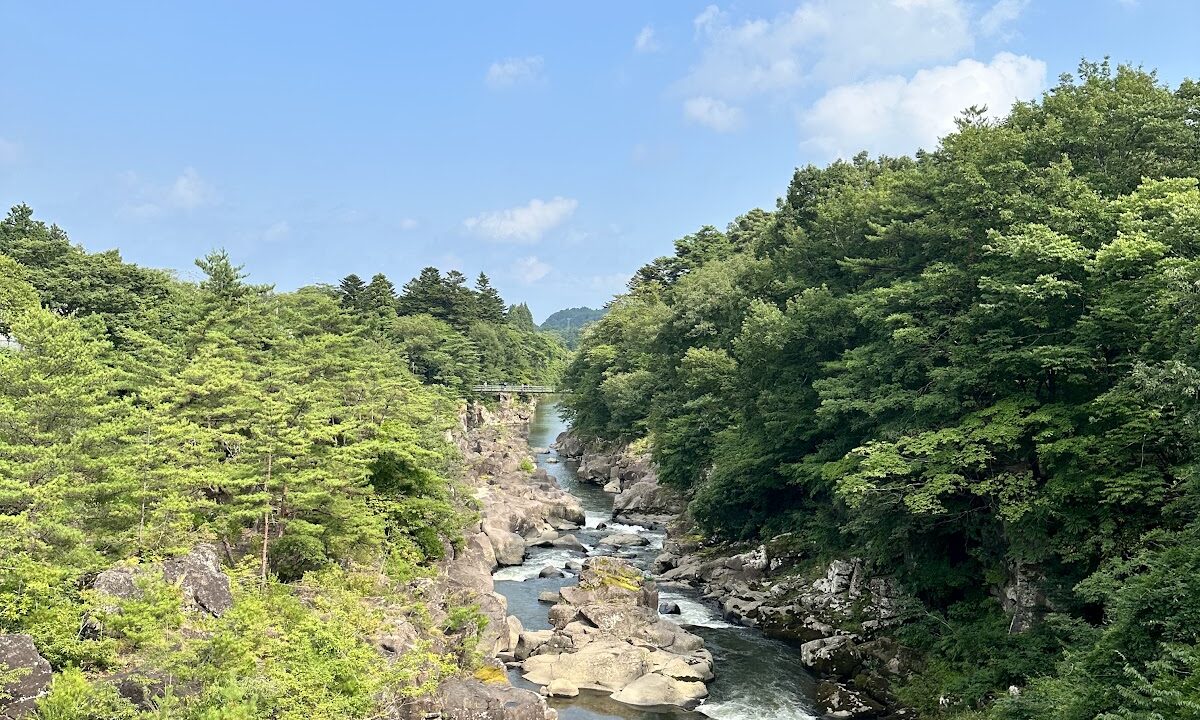
Sennin Pass, Iwate Prefecture: Complete Guide to the Tono and Kamaishi Pass Crossing with History and Spectacular Views
Sennin Pass is a mountain pass at an altitude of 887 meters located on the border between Tono City and Kamaishi City, connecting the inland and coastal areas of Iwate Prefecture. Surrounded by the deep mountains of the Kitakami Mountain Range, this pass has been utilized as a key point on the Kamaishi Highway since the Edo period and is now also known as a famous autumn foliage spot. Both the old road with its sharp curves and steep grades and the comfortable Sennin Pass Road that opened in 2007 (Heisei 19) exist, offering different experiences of crossing the pass.
Basic Information and Geographic Features of Sennin Pass
Sennin Pass is located near the center of the Kitakami Mountain Range, with the 887-meter altitude point serving as the true pass. This pass plays an important geographic role as the watershed between the Hayase River, a tributary of the Sarugaishi River (a tributary of the Kitakami River), and the Koshi River.
The current National Route 283 passes through the Sennin Tunnel constructed at an altitude of 560 meters, with the tunnel area serving as the actual pass crossing point. Just south of the tunnel lies the true Sennin Pass at 887 meters altitude, which can be experienced by using the old road.
Terrain and Natural Environment
The Kitakami Mountain Range runs north to south through central Iwate Prefecture, with Sennin Pass being one of the places where the elevation difference is particularly large. The surrounding area is covered in deep forests, where deciduous broadleaf trees such as beech and Mongolian oak grow abundantly. This rich natural environment produces spectacular autumn foliage in fall.
Both sides of the pass feature steep terrain, with the Kamaishi side in particular having a large elevation difference and historically feared as a difficult-to-traverse area. The Tono side is relatively gentle, but still continues through mountainous terrain.
History and Origins of Sennin Pass
Kamaishi Highway in the Edo Period
Sennin Pass has ancient origins and was known in the Edo period as the greatest difficult section of the Kamaishi Highway connecting inland Tono and coastal Kamaishi. This highway was an important logistics route that transported rice and timber produced in the inland areas to the coastal regions and, conversely, transported marine products and salt inland.
This mountain pass crossing the steep Kitakami Range posed a major obstacle to transporting cargo by horse or human power. Steep grades, narrow road width, and winter snowfall presented various difficulties.
The Path to Modernization
After the Meiji period began, with the development of the iron industry in Kamaishi, the importance of this pass road increased further. However, full-scale road construction did not begin until the Showa period.
In 1959 (Showa 34), the Sennin Tunnel opened and was developed as National Route 283. This made pass crossing easier than before, but the roads before and after the tunnel remained as difficult sections with continuous loop-style sharp curves and steep grades. Particularly for winter traffic and large vehicle passage, difficulties and frequent traffic accidents occurred.
Opening of Sennin Pass Road
In 2007 (Heisei 19), the long-awaited Sennin Pass Road opened. This motorway was developed as a general national highway motorway running parallel to the Tohoku Transverse Expressway Kamaishi-Akita Line, with a total length of 18.4 kilometers.
With the opening of Sennin Pass Road, travel time from Hirakura, Kamigsao Town, Tono City to Kamiishi Town, Kamaishi City was dramatically reduced, and it serves as an important artery for logistics and tourism connecting inland and coastal areas.
Road Conditions of Sennin Pass
New Road: Sennin Pass Road
Sennin Pass Road is an 18.4-kilometer motorway stretching from Daiichi Jiwarai, Kamiishi Town, Kamaishi City to Hirakura, Kamigo Town, Tono City. It functions as a bypass of National Route 283, enabling comfortable driving while avoiding sharp curves and steep grades.
This road is free to use and operates as a two-lane oncoming traffic road, but with sufficient road width and gently designed curves, safety has been greatly improved. With extensive use of tunnels and bridges and modern road design, winter passage has become relatively easier.
Speed limits vary by section, but many sections have a speed limit of 70 kilometers per hour. However, as a motorway, motorized bicycles, light vehicles, and pedestrians are prohibited from using it.
Old Road: National Route 283 (Former Sennin Pass)
Even after the opening of Sennin Pass Road, the old road remains available as a general road. This old road forms a loop pattern, particularly on the Kamaishi side, with a unique landscape of overlapping sharp curves going up and down.
The appeal of the old road is that it allows you to feel the depth of the mountains. Passing through the true 887-meter pass and experiencing a drive while closely observing the surrounding nature is an experience that cannot be had on the new road. However, with continuous sharp curves and steep grades, careful driving is necessary.
Particularly in winter, there are dangers of road surface icing and snowfall, and the road may be closed. Additionally, large vehicles have difficulty traversing many sections, and use by ordinary automobiles is recommended.
Sennin Ohashi Bridge Painted in Vermillion
One attraction of the old road is the vermillion-painted Sennin Ohashi Bridge. This bridge crosses a deep valley with an impressive structure, creating beautiful scenery through contrast with the surrounding green and autumn foliage.
Approximately six kilometers from the Sennin Ohashi Bridge is known as one of the finest autumn foliage spots in Iwate Prefecture. The fall foliage of the mountains as seen from the bridge and surrounding viewpoints is spectacular, attracting many tourists and drive enthusiasts.
Railway History of Sennin Pass
In discussing the history of Sennin Pass, one cannot omit the railway line that once existed.
Iwate Development Railway
From 1939 (Showa 14) to 1972 (Showa 47), the Iwate Development Railway ran near Sennin Pass. This railway was constructed as an industrial railway to transport ore and timber from the Kamaishi Mine, and Sennin Pass Station was established.
Noteworthy is that this railway passed through the Sennin Pass Tunnel (for railway use). This tunnel, approximately 880 meters in length, was completed as an important transportation infrastructure following difficult construction work at the time.
Relationship with Rikuchu Ohashi Station
The current Rikuchu Ohashi Station on the JR Kamaishi Line exists as a successor to the legacy of the former Iwate Development Railway. As one of the nearest stations when visiting Sennin Pass, it has become an interesting place for railway fans and history enthusiasts.
After the Iwate Development Railway was abandoned, portions of its roadbed and structures remain and are increasingly recognized for their value as industrial heritage.
Sennin Pass as a Famous Autumn Foliage Spot
Best Viewing Season and Timing
The autumn foliage at Sennin Pass typically peaks from late October to early November. Due to its high altitude, foliage begins earlier than in surrounding areas and changes to vivid colors within a short period.
Particularly the approximately six-kilometer section from around the vermillion-painted Sennin Ohashi Bridge is known as one of the finest autumn foliage spots in the prefecture. The gradations of red and yellow created by beech, Mongolian oak, maple and other trees are spectacular and captivate many tourists.
Points for Enjoying Autumn Foliage
Using the old road allows you to enjoy the autumn foliage while driving leisurely. As you ascend and descend the loop-shaped road, the attraction of the old road is being able to view the foliage from various angles.
From atop Sennin Ohashi Bridge, you can see an expansive view of autumn foliage spread across the valley. Additionally, near the pass summit there are parking spaces, and it is possible to explore the surrounding area on foot.
Autumn foliage can also be enjoyed from the new Sennin Pass Road, but because speeds are higher, it is recommended to stop at viewpoints and rest areas to observe the scenery.
Photography Spots
For photography enthusiasts, Sennin Pass is an excellent photography spot. The combination of the vermillion-painted Sennin Ohashi Bridge and autumn foliage is particularly popular, presenting different expressions depending on lighting conditions in early morning or evening.
The angle of looking down at the loop-shaped old road from above is also impressive, allowing you to capture the road, autumn foliage, and distant mountains in a single photograph.
Access Methods and Travel Time
By Automobile
From the Tono direction:
- From Tono city center using National Route 283 or Sennin Pass Road
- Travel time: approximately 30-40 minutes
- If using Sennin Pass Road, from Tono IC toward Kamaishi
From the Kamaishi direction:
- From Kamaishi city center using National Route 283 or Sennin Pass Road
- Approximately 30 minutes from JR Kamaishi Station on the Sanriku Railway Rias Line
- If using Sennin Pass Road, from Kamaishi West IC toward Tono
From the Morioka direction:
- Approximately 1 hour 30 minutes via Tono from Hanasaki IC on the Tohoku Expressway
- Or approximately 30 minutes from Tono IC on the Kamaishi Expressway
By Public Transportation
Public transportation access to Sennin Pass is limited. The nearest stations are Tono or Kamaishi stations, but there is no direct bus service from there to the pass.
Rental car or taxi use becomes a practical choice. There are rental car shops around Tono and Kamaishi stations, allowing you to enjoy a pass-crossing drive.
Winter Traffic
During winter (approximately December to March), there is a high risk of snow and road surface icing, particularly on the old road which may be closed. While Sennin Pass Road has snow removal systems in place, winter tires or chains are essential.
The latest road conditions can be confirmed on Iwate Prefecture’s road information service or the official websites of Kamaishi and Tono cities.
Nearby Tourist Attractions
Things to See in Tono City
Tono Furusato Village:
A facility where you can experience the traditional rural culture of Tono, the land of folk tales. Traditional thatched-roof farmhouses stand in a row, recreating the way of life of old times.
Kappa Fuchi:
The setting of the Kappa legend famous in Tales of Tono. Beside the quiet pond stands a small shrine, and stories of Kappa appearing still remain.
Tono City Museum:
A museum where you can learn about the history, culture, and folk traditions of Tono. Exhibits related to Tales of Tono are also extensive.
Things to See in Kamaishi City
Kamaishi Daikannon:
A massive Kannon statue 48.5 meters tall standing on a high plateau overlooking Kamaishi Bay. From the observation deck, you can see an expansive view of Kamaishi city and the Pacific Ocean.
Hashino Iron Mining District:
Designated as the birthplace of modern iron production in Japan and a component asset of the World Heritage site “Meiji Japan’s Industrial Revolution Heritage.” Blast furnace remains from the end of the Edo period are preserved.
Kamaishi City Local Museum:
Exhibits the history of Kamaishi’s iron production and records of the Great East Japan Earthquake.
Precautions When Visiting Sennin Pass
Driving Precautions
When using the old road, continuous sharp curves and steep grades require careful attention to excessive speed. Particularly in many places where the road ahead around curves is not visible, be cautious of collisions with oncoming vehicles.
During the autumn foliage season, tourist numbers increase, making safety confirmation at parking spaces and viewpoints important. Road-side parking is dangerous, so use designated parking areas.
Responding to Weather Conditions
As a mountainous area, weather changes readily and fog may develop. When visibility is poor, reduce speed and drive with lights on.
Due to high altitude, temperatures are lower than in flatlands. Particularly from autumn through spring, do not forget cold-weather preparations.
Mobile Phone Signal Reception
In some sections of the pass, mobile phone signals are weak or out of range. It is recommended to confirm necessary information in advance and consider means of communication in emergencies.
Future Prospects for Sennin Pass
With the opening of Sennin Pass Road, transportation convenience connecting inland and coastal areas has been greatly improved. This is expected to lead to increased tourism and efficient logistics.
On the other hand, there are efforts to preserve and utilize the old road as a road heritage with historical and cultural value. The loop road with continuous sharp curves and steep grades is a precious existence telling the history of civil engineering technology.
The reputation of Sennin Pass as an autumn foliage spot is also increasing year by year, becoming established as a fall driving course. In the future, further development as a tourism resource and improvement of safety measures are expected.
Community Connection
Sennin Pass is not merely a transportation route but also a symbol of the bond connecting the two regions of Tono and Kamaishi. As a place where inland agricultural culture and coastal fishing and industrial culture intersect, people have passed through since ancient times.
Currently, exchange between the two regions continues through this pass, and cooperative relationships have been built in tourism and industry. After the Great East Japan Earthquake, inland Tono became a rear-area support base assisting coastal Kamaishi in recovery, with Sennin Pass Road playing an important role in that capacity.
Summary: Experience the Charm of Sennin Pass
Sennin Pass in Iwate Prefecture is a fascinating place where history and nature converge, featuring both the true 887-meter pass and the 560-meter Sennin Tunnel. Known since the Edo period as a difficult section of the Kamaishi Highway, it now captivates many people as a famous autumn foliage spot.
While Sennin Pass Road, which opened in 2007 (Heisei 19), enables comfortable pass crossing, the old road with its continuous sharp curves and steep grades offers a precious experience of feeling the depth of the mountains. The scenery from the vermillion-painted Sennin Ohashi Bridge is particularly wonderful, and during the autumn foliage season from late October to early November, many tourists from within and outside the prefecture visit.
This pass connecting Tono and Kamaishi, linking inland and coastal areas, is a place where Iwate Prefecture’s nature, history, and people’s livelihoods are concentrated. When visiting Iwate Prefecture for driving or sightseeing, be sure to cross Sennin Pass and experience its charm.


