
.jpg)
Eikando Zenrinji Temple (Kyoto Prefecture) Complete Guide | Thorough Explanation of Mikaeri Amida and Famous Autumn Leaves
Eikando (Zenrinji Temple), located in Sakyo Ward, Kyoto City, is one of Kyoto’s most famous autumn foliage spots, long cherished as “Eikando in autumn with its maple leaves.” Its formal name is “Shojurakigo-san Muryojuin Zenrinji Temple,” and it stands as the head temple of the Jodo sect Nishiyama Zenrinji branch, boasting a history of nearly 1200 years. This article comprehensively introduces information you should know before visiting, from Eikando’s historical background, highlights, admission information, to access methods.
History and Origins of Eikando (Zenrinji Temple)
From Founding to Shingon Buddhist Monastery
The history of Eikando dates back to the early Heian period, to the third year of Jinsai (853). It began when Shinsho, a senior disciple of Kobo Daishi Kukai, received a mountain villa from Fujiwara Sekio and established a revered statue there, founding it as a Shingon Buddhist monastery. Initially functioning as a practice center for esoteric Buddhism, it gathered the faith of Heian nobility.
Eikan the Buddhist Priest and Transformation into a Pure Land Nembutsu Center
Zenrinji became widely known as “Eikando” due to the accomplishments of Eikan the Buddhist Priest, who became the seventh resident priest during the Enryaku era (1077-1081) in the late Heian period. There remains a legend that while Eikan the Buddhist Priest was walking in circumambulation around the statue of Amida Tathagata while chanting the nembutsu, Amida Tathagata descended from the altar platform and walked before Eikan, turned around, and called out, “Eikan, you are late.”
Following this event, Eikan the Buddhist Priest revived the temple as a center for Pure Land nembutsu practice and devoted himself to spreading the teachings to common people. In honor of his accomplishments, the temple came to be called “Eikando,” a name that continues to this day.
As Head Temple of the Jodo sect Nishiyama Zenrinji Branch
From the Kamakura period onward, Zenrinji developed as a base of the Jodo sect Nishiyama branch. Currently, as the head temple of the Jodo sect Nishiyama Zenrinji branch, it oversees many branch temples throughout the country. Despite suffering from fires multiple times throughout its long history, it was rebuilt each time, and during the Edo period, the various halls and corridors seen today were established.
Mikaeri Amida | The Principal Deity of Eikando
An Amida Tathagata Statue with a Unique Posture
The Amida Tathagata standing statue that is the principal deity of Eikando is known throughout Japan as “Mikaeri Amida” (looking-back Amida), possessing Japan’s only unique posture among Buddhist statues. While ordinary Amida Tathagata statues face directly forward, this statue turns its face to the left rear at an angle (approximately 45 degrees), as if looking back behind.
The Meaning of Mikaeri Amida
This unique posture contains a deep meaning. Based on the previously mentioned legend of Eikan the Buddhist Priest, it is said to express Amida Tathagata looking back to wait for those who fall behind. This symbolizes the spirit of compassion in Pure Land Buddhism that “no matter how late you are, Amida Tathagata will certainly turn back and wait for you,” and has become a spiritual support for many worshippers.
The statue is approximately 77 centimeters in height and is attributed to the Kamakura period. It is characterized by an elegant posture and serene expression, and is designated as an Important Cultural Property of the nation.
“Eikando with Autumn Leaves” | Autumn Foliage Highlights
A Spectacular View Woven by Approximately 3,000 Maples
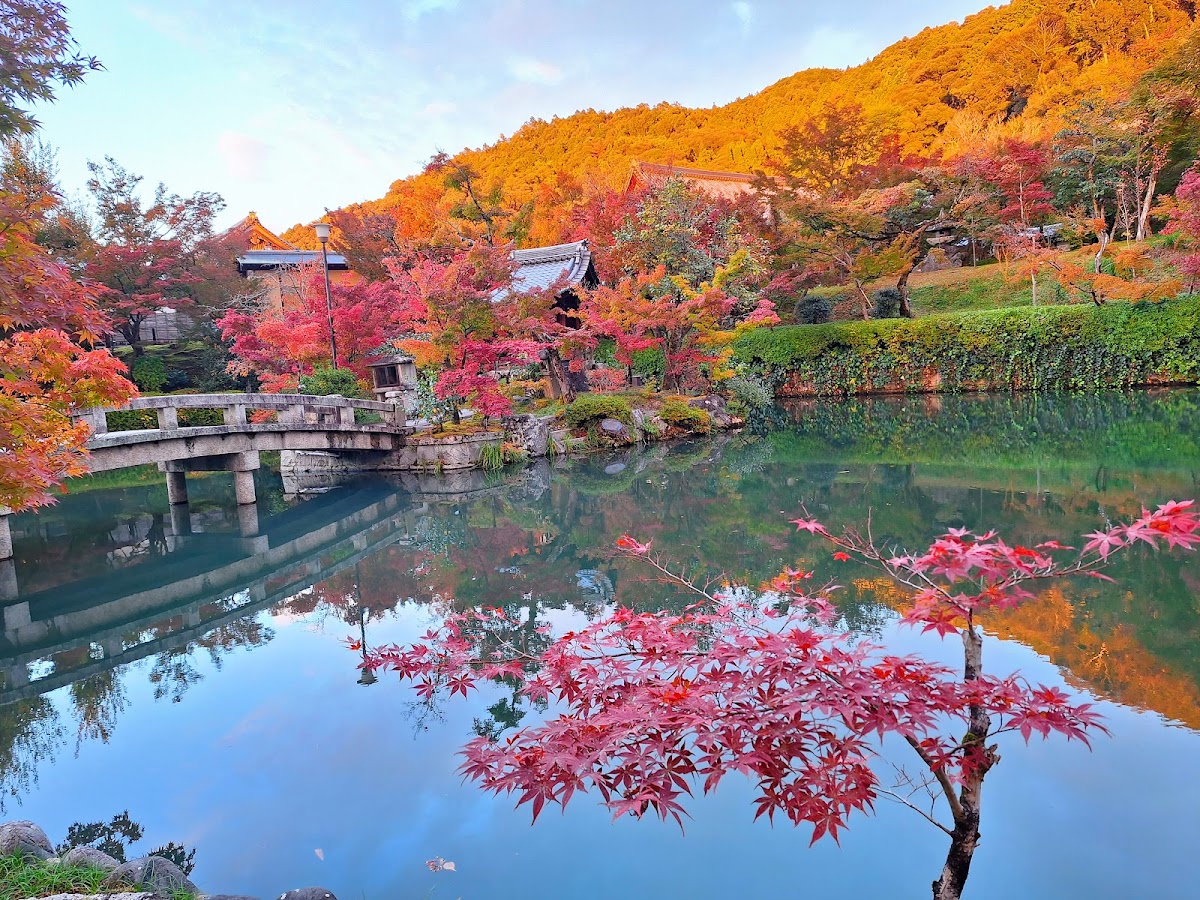
The reason Eikando is called “Eikando with autumn leaves” lies in approximately 3,000 maple trees planted throughout the temple grounds. Various species including Japanese maple, large maple, and mountain maple are planted, and from mid to late November, the entire temple grounds are dyed in fiery reds and yellows.
A History as a Famous Autumn Foliage Spot
Eikando’s autumn leaves have been famous enough to be mentioned in waka poetry since ancient times and have been known as a famous autumn foliage viewing spot for Heian nobility. The phrase “In autumn, the maple leaves of Eikando” has been used since the Edo period, establishing its position as a representative autumn foliage spot in Kyoto.
Autumn Foliage Viewing Highlights
Around the Hojoike Pond
The autumn foliage reflected on the surface of the Hojoike Pond within the temple grounds is one of Eikando’s representative views. The maples surrounding the pond are reflected in the water’s surface, creating a fantastical atmosphere.
Garyu-ro Corridor
Among the corridors connecting the various halls, the staircase-like corridor called “Garyu-ro” (Reclining Dragon Corridor) due to its shape resembling a reclining dragon allows visitors to experience passing through a tunnel of autumn foliage.
View from the Tahoto Pagoda
From the two-story pagoda standing on a high point within the temple grounds, one can overlook the entire temple grounds dyed with autumn foliage and enjoy views of Kyoto’s urban landscape. During the autumn foliage season, it becomes a particularly popular photography spot.
Main Highlights of Eikando
Various Halls and Architectural Beauty
Shakka-do Hall
One of the oldest buildings on the grounds, characterized by a solid appearance. A statue of Sakyamuni Buddha is enshrined inside.
Amida-do Hall
The hall where Mikaeri Amida is enshrined, serving as the center of faith at Eikando. The interior is enveloped in a solemn atmosphere.
Mikage-do Hall
A statue of Eikan the Buddhist Priest is enshrined here, an important building that tells the history of Eikando.
Temple Complex Configuration Connected by Corridors
A distinctive architectural feature of Eikando is that various halls are connected by corridors. These corridors are built along terrain with significant elevation differences, with some sections forming stairs. The design allows visitors to enjoy the changing scenery of each season while walking through the corridors.
Tahoto Pagoda
The two-story pagoda standing at the highest point within the temple grounds was rebuilt in the early Showa period and is a beautiful structure with a vermillion color. The stone steps leading to the pagoda are somewhat steep, but the views from the top are exceptional.
Gardens
Eikando has multiple gardens, each with different characteristics. In the pond-circuit style garden, visitors can enjoy natural beauty throughout the four seasons.
Temple Treasure Exhibitions and Cultural Properties
Numerous Valuable Temple Treasures
Eikando holds an annual treasure exhibition where visitors can view precious cultural properties that have been preserved throughout its long history. Buddhist statues, paintings, calligraphy, and crafts from the Heian to Edo periods are displayed with diverse treasures.
Principal Cultural Properties
- Yamakoshi Amida Figure: A Kamakura period painting designated as an Important Cultural Property
- Silk Painting with Color Taiama Mandala Figure: A precious mandala expressing Pure Land faith
- Seated Statue of Eikan the Buddhist Priest: An important sculpture conveying the likeness of Eikan the Buddhist Priest
These temple treasures serve as valuable resources for understanding Eikando’s history and Japanese Buddhist culture.
Admission Information
Regular Admission (Temple Treasure Exhibition)
Admission Hours
9:00 AM to 5:00 PM (Reception ends at 4:00 PM, closing at 5:00 PM)
Admission Fee
Adults: 1,000 yen
Elementary, junior, and high school students: 400 yen
Evening Special Admission (Autumn Illumination)
During the autumn foliage season, special evening viewing is offered, allowing visitors to enjoy the fantastical beauty of illuminated autumn leaves.
Admission Hours
5:30 PM to 8:30 PM (Reception closes, closing at 9:00 PM)
※Replacement system between regular and evening viewing
Admission Fee
Flat rate: 700 yen (Middle school students and above)
Notes on Admission
- The autumn foliage season (mid to late November) is extremely crowded. Weekday early mornings and evenings are relatively less crowded
- Evening special admission requires separate admission fee and operates on a replacement system with regular admission
- Photography is permitted on the grounds, but photography is prohibited in some halls
- There are many stairs and elevation changes, so comfortable walking shoes are recommended for your visit
Access Information
Basic Information
Address
〒606-8445 48 Eikando-cho, Sakyo Ward, Kyoto City, Kyoto Prefecture
Phone Number
075-761-0007
Access by Public Transportation
Using City Buses
- From JR Kyoto Station, take City Bus Route 5 to “Nanzenji・Eikando-michi” stop, approximately 3 minutes walk
- From Keihan Railway “Sanjo Station,” take City Bus Route 5 to “Nanzenji・Eikando-michi” stop, approximately 3 minutes walk
- From Hankyu Railway “Kawaramachi Station,” take City Bus Route 5 to “Nanzenji・Eikando-michi” stop, approximately 3 minutes walk
Using the Subway
Kyoto City Subway Tozai Line “Keage Station,” approximately 15 minutes walk
Access by Car
Approximately 20 minutes from “Kyoto East IC” on the Meishin Expressway
Parking Lot
There is no parking lot on the temple grounds. During the autumn foliage season, surrounding roads are extremely congested, and public transportation use is strongly recommended. Coin parking in the surrounding area often becomes full, so caution is necessary.
Nearby Tourist Attractions
Nanzenji Temple
Approximately 10 minutes walk from Eikando, this is the head temple of the Rinzai sect Nanzenji branch. With highlights including the sanmon gate and the water conduit, many tourists visit both Eikando and Nanzenji together.
Philosopher’s Walk
Approximately 15 minutes walk from Eikando. A walking path of approximately 2 kilometers along the Biwako Canal, known as a spot famous for both cherry blossoms and autumn foliage.
Ginkakuji (Jisho-ji Temple)
A World Heritage site located north along the Philosopher’s Walk. Its main attraction is a garden and architecture embodying the aesthetic of wabi and sabi.
Heian Shrine
Approximately 15 minutes from Eikando by city bus. A shrine founded in the Meiji period with extensive beautiful shrine gardens.
Recommended Plans for Visiting Eikando
Autumn Foliage Season (Mid to Late November)
Early Morning Visiting Plan
By entering at the 9:00 AM opening, visitors can enjoy the autumn foliage relatively leisurely. Visiting Eikando in the morning and then strolling through Nanzenji Temple and Philosopher’s Walk afterward is recommended.
Evening Viewing Plan
A popular plan is to tour nearby temples during the day such as Nanzenji and Ginkakuji, then visit Eikando’s evening special viewing from the evening. The illuminated autumn leaves possess a fantastical beauty different from daytime viewing.
New Green Season (May to June)
Not as crowded as the autumn foliage season, allowing leisurely viewing of the temple grounds with beautiful fresh greenery. The beauty of young green foliage is exceptional, and the appeal lies in being able to worship in a quiet atmosphere.
Winter Season (December to February)
Snow-covered Eikando also has its own charm. With fewer tourists, the temple grounds wrapped in silence offer the appeal of quiet and peaceful worship.
Annual Events and Services at Eikando
Principal Services and Events
Shusho-kai (New Year Service) (January 1-3)
A service welcoming the new year in which the peace of the coming year is prayed for.
Eikan-ki (Eikan Commemoration Service) (Second Saturday of November)
A service honoring the virtue of Eikan the Buddhist Priest. This is one of the most important events for Eikando.
Joya-no Kane (New Year’s Eve Bell) (December 31)
On New Year’s Eve, the temple bell is struck, and many worshippers visit.
Rules of Etiquette for Visiting Eikando
Worship Manners
Eikando is both a tourist attraction and currently functioning as a place of worship. Please observe the following manners when visiting.
- Maintain silence inside halls
- Do not photograph in areas where photography is prohibited
- Do not touch Buddhist statues or cultural properties
- Be considerate of other worshippers while on corridors
- Take all trash with you
Notes on Clothing
As the temple grounds have many stairs and elevation changes and the corridors are long, visiting in comfortable walking shoes and easy-to-move-in clothing is recommended. During evening autumn foliage viewing in the foliage season, temperatures drop, so cold-weather protection is necessary.
Summary | The Charm of Eikando
Eikando (Zenrinji Temple), as the head temple of the Jodo sect Nishiyama Zenrinji branch with nearly 1200 years of history, is a precious temple transmitting Japanese Buddhist culture to the present day. The unique principal deity “Mikaeri Amida” symbolizes the compassion of Amida Tathagata and has become spiritual support for countless people.
Known as “Eikando with autumn leaves,” the beauty of its autumn foliage has continued to captivate people unchanged from the Heian period to the present day. The autumn spectacle woven by approximately 3,000 maples can be said to be one of Kyoto’s representative views.
There is beauty unique to each season beyond the autumn foliage season—fresh greenery and snow-covered landscapes—and a peaceful space unfolds whenever you visit. When visiting Kyoto, be sure to visit Eikando and experience its history and natural beauty.
The precious cultural properties viewable at the temple treasure exhibition, the architectural beauty of various halls connected by corridors, and most importantly, the deep compassion embodied in the legend “Eikan, you are late.” Eikando has charm that resonates with each visitor differently. As a renowned temple representative of Kyoto’s Higashiyama area, Eikando will continue to inspire countless people in the future.
-800x450.jpg)
-800x450.jpg)
-800x450.jpg)