
.jpg)
Kifune Shrine, Northern Kyoto (Kyoto Prefecture) Complete Guide | Autumn Leaves, Access, Worship Information
Kifune Shrine, located in the northern part of Sakyo Ward, Kyoto City, in the source area of the Kamo River, is known as the head shrine of approximately 2,000 water deities throughout Japan. It is a representative tourist spot in the Rakuhoku area, and particularly during the autumn foliage season, the contrast between the vermillion-painted Kasuga lanterns and the red leaves is beautiful, drawing many worshippers. This article comprehensively introduces information you should know before visiting, including the history of Kifune Shrine, highlights, access methods, and surrounding spots.
History and Origins of Kifune Shrine
Legend of Founding
The founding of Kifune Shrine dates back extremely far, with records of shrine building repairs from Hakuhō 6 (677), indicating it was founded before that time. According to the founding legend, Tamayori-hime no Mikoto, the imperial mother of Emperor Jinmu, appeared at the port of Naniwa (present-day Osaka Bay), boarded a yellow ship (Kifune), ascended the Yodo River and Kamo River, and established a shrine near the current Okumiya to enshrine the water deity.
This legend also gave rise to the place name Kifune, with “yellow ship” transforming into “Kifune.” Located at the source of the Kamo River, it has been venerated since ancient times as a deity governing water supply.
Center of Water Deity Worship
The main enshrined deity at Kifune Shrine is Takaokami no Kami, known as a dragon god who governs water. During the Heian period, it was deeply revered by the imperial court, and rituals of “praying for rain and stopping rain” were performed by offering black horses during droughts and white horses during prolonged rains. This custom is said to have later become the origin of “ema” (votive picture plaques), and Kifune Shrine is also known as the birthplace of ema.
Highlights of Kifune Shrine
Main Shrine Approach and Kasuga Lanterns
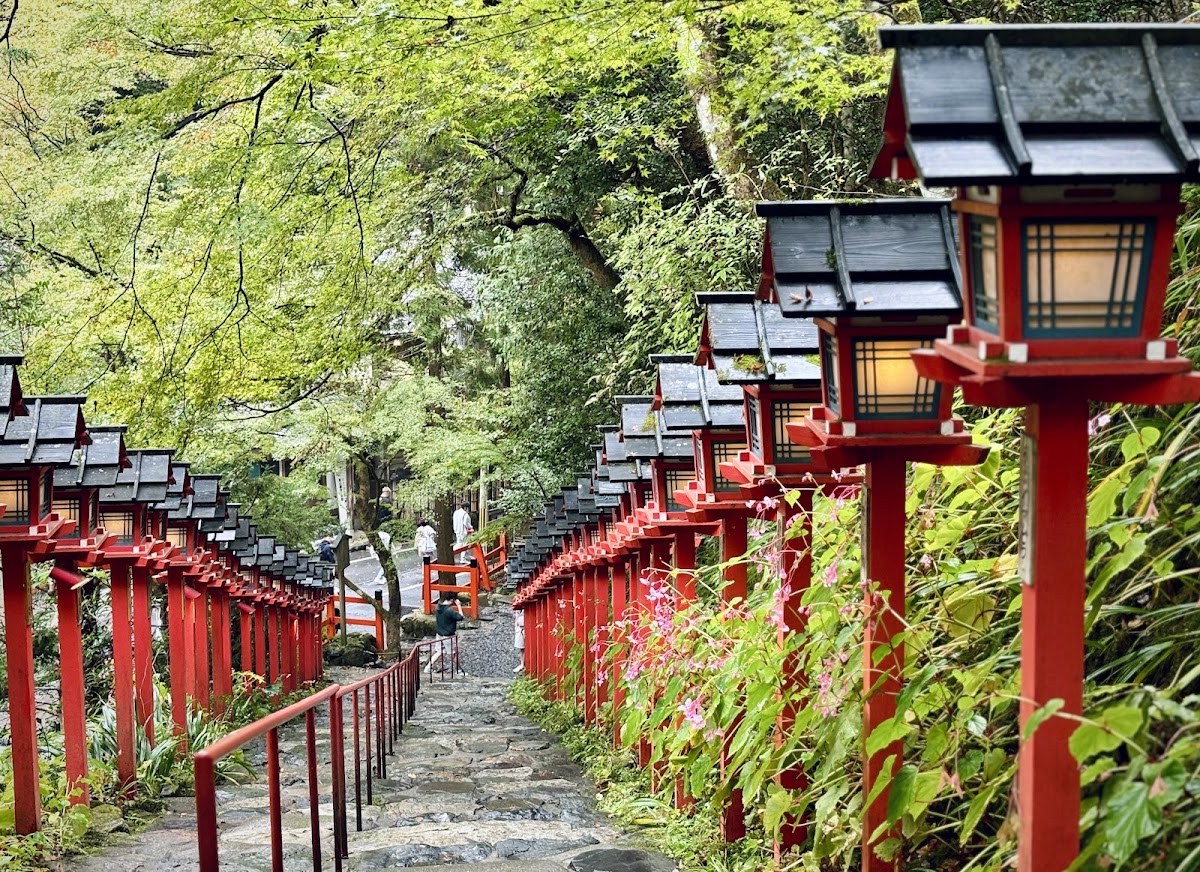
What all visitors to Kifune Shrine see are the vermillion-painted Kasuga lanterns standing in rows on the stone steps of the Main Shrine’s approach. The sight of approximately 90 lanterns lined up neatly on both sides is called “the finest scenery of Rakuhoku,” and especially during the new green and autumn foliage seasons, the approach surrounded by green or red leaves creates a fantastical atmosphere.
The stone steps total approximately 30 in all, and you can feel the sacred space while climbing slowly. On both sides of the approach, old cedar trees flourish, and the air is filled with clarity.
Water Divination Ema
A popular amulet at Kifune Shrine is the “water divination ema.” At first glance, it appears to be a blank piece of paper with no writing, but when soaked in the shrine’s sacred water at the Main Shrine, characters appear. This is a unique feature of a shrine dedicated to the water deity, and it is a popular divination method experienced by many worshippers.
The water divination ema is sold for 300 yen, and your fortune is told by the characters that appear. A dedicated place for floating the ema in water is provided, and waiting for the divination results while gazing at the clear flow of Kifune River is also one of the pleasures of visiting Kifune Shrine.
Yui Shrine (Chūgu) and Matchmaking Faith
The Yui Shrine (Yui no Yashiro), located on the way from the Main Shrine to the Okumiya, enshrines Iwanaga-hime no Mikoto, known as the deity of matchmaking. From the legend that Izumi Shikibu, a female poet of the Heian period, visited Kifune Shrine to pray for reconciliation with her husband, and her wish was granted, it is venerated as a power spot for matchmaking.
Izumi Shikibu composed a poem: “As I ponder / the fireflies of the marsh / seem to be my soul / that has wandered away / from my body.” Her sincere prayer is said to have reached the deity. Today, many worshippers seeking good relationships visit and offer special “musubi-bumi” (tied wishes) votive plaques with their wishes.
Mystical Atmosphere of Okumiya
Proceeding further along the mountain path from Yui Shrine, you arrive at Kifune Shrine’s Okumiya (Inner Shrine). The Okumiya is considered the place of founding legend and is thought to have an older history than the Main Shrine. The grounds are wrapped in a mystical atmosphere, with a giant interlocking cedar grove and legends of a dragon cave directly beneath the main hall.
Beneath the Okumiya’s main hall is one of Japan’s three great dragon caves, and it is said to be the source of underground water veins. It is said that powerful energy flows from this dragon cave, making it also a popular spot for those seeking spiritual places.
Autumn Foliage Information for Kifune Shrine in Northern Kyoto
Best Time for Autumn Foliage
The autumn foliage at Kifune Shrine typically reaches its peak from early to late November. Because it is at higher elevation and cooler temperatures than central Kyoto, it begins to color slightly earlier than the city center. Maple trees are the main varieties, and the sight of the entire grounds turning red and yellow is breathtaking.
Particularly on the Main Shrine’s approach, the vermillion color of the Kasuga lanterns and the red of the autumn leaves overlap, creating a unique beauty not seen elsewhere. The autumn foliage along Kifune River is also beautiful, and the ability to enjoy both the river’s murmuring and autumn leaves is a charm unique to Kifune.
Kifune Autumn Leaves Lantern Lighting
From early to late November each year, a lantern lighting event called “Kifune Autumn Leaves Lantern Lighting” is held. During the period, lanterns line the entire Kifune area, and the sacred space is wrapped in gentle light. The Kasuga lanterns and autumn leaves lining the stone steps of the Main Shrine’s approach are fantastically illuminated, allowing visitors to enjoy a ethereal atmosphere different from daytime.
During the lighting period, many worshippers visit in the evening and night, so congestion is expected. Especially on weekends and holidays, congestion peaks, so visiting on weekdays or at earlier times is recommended.
Expected Crowds During Autumn Foliage Season
Kifune Shrine during the autumn foliage season is one of Kyoto’s most popular spots and experiences considerable congestion. Especially during the peak viewing period in mid-November, the approach and surrounding roads become very crowded. To avoid congestion, the following times are recommended:
- Early morning (6 AM to 8 AM around the time of opening)
- Weekday mornings
- Right after the lighting begins
Weekends and holidays are expected to be crowded all day, so it is necessary to act with plenty of time to spare.
Access Information to Kifune Shrine
Access by Train
Route from Kyoto Station
From Kyoto Station to Kifune Shrine, the typical route is to transfer between a city bus and the Eizan Railway.
- Board Kyoto City Bus Route 17 from in front of JR Kyoto Station
- Get off at “Demachiyanagi Station-mae” (approximately 30-40 minutes, fare 230 yen)
- Board the Kurama Line of the Eizan Railway from Demachiyanagi Station
- Get off at the terminal “Kifuneguchi Station” (approximately 30 minutes, fare 420 yen)
- Board Kyoto Bus Route 33 from Kifuneguchi Station, or walk (approximately 2 km, 30 minutes)
- Get off at “Kifune” bus stop, and the Main Shrine is reached after a 5-minute walk
Scenery on the Eizan Railway
The Kurama Line of the Eizan Railway passes through the area between Ichihara Station and Ninose Station called the “Autumn Leaves Tunnel,” a famous autumn foliage spot. During the autumn foliage season, the interior lights are turned off, and a special performance allows passengers to slowly view the illuminated autumn leaves. The journey to Kifune Shrine is also enjoyable, which is the charm of using the train.
Access by Car and Parking Information
Kifune Shrine is also accessible by car, but surrounding roads become very congested during the autumn foliage season and on weekends.
From Central Kyoto
- Travel time: Approximately 40-50 minutes (without traffic)
- Route: Head north on Kawabata-dori, via Prefectural Road 361 (Kurama Kaido)
About Parking
Kifune Shrine has no dedicated parking lot, and visitors must use nearby private parking lots. The number of spaces at parking lots in the Kifune area is limited, and they often become full from early morning during the autumn foliage season, so use of public transportation is strongly recommended.
If you must visit by car, consider parking at a parking lot near Kifuneguchi Station and heading to the shrine by bus or on foot from there.
Bus Access
Kyoto Bus Route 33 operates from Kifuneguchi Station to Kifune Shrine.
- Travel time: Approximately 5 minutes
- Fare: 160 yen
- Operating interval: One bus approximately every 30 minutes to 1 hour
Since the number of buses is limited, it is recommended to check the schedule in advance. Operating conditions may change depending on weather and season, so check the latest information on the Kyoto Bus official website.
Walking Access (from Kifuneguchi Station)
From Kifuneguchi Station to Kifune Shrine’s Main Shrine is approximately 30 minutes on foot (approximately 2 km). The route follows the side of Kifune River, and a pleasant walk can be enjoyed while listening to the murmuring of the stream. A gentle uphill slope continues, but there is the pleasure of walking through a natural environment.
During the new green and autumn foliage seasons, walking is also quite enjoyable, so it is recommended for those with time to spare. However, caution is necessary as the ground becomes slippery during rain and in winter.
Basic Information about Kifune Shrine
Worship Hours and Admission Fees
Worship Hours (Main Shrine Opening Hours)
- May 1 – November 30: 6:00 AM – 8:00 PM
- December 1 – April 30: 6:00 AM – 6:00 PM
- Amulet booth reception hours: 9:00 AM – 5:00 PM
Admission Fee
- Shrine grounds worship: Free
- Water divination ema: 300 yen
- Various amulets and votive plaques: 300 yen and up
Location and Contact Information
Address
〒601-1112 Kifune-cho, Kurama, Sakyo Ward, Kyoto City, Kyoto Prefecture, Japan
Phone Number
075-741-2016
Official Website
The official website of Kifune Shrine provides up-to-date information on events and details related to worship.
Hiking Course from Kurama Temple to Kifune
Route Over Kurama Mountain
The hiking course connecting Kifune Shrine and Kurama Temple is a popular walking route in the Rakuhoku area. An approximately one-hour course from Kurama Temple over Kurama Mountain to Kifune, where you can immerse yourself in nature while hiking.
Recommended Route
- Start from Kurama Temple’s main hall
- Pass through the Inner Hall (Mao-den)
- Continue along Kurama Mountain’s ridge trail
- Arrive at Kifune Shrine’s Okumiya
- Descend through Yui Shrine and Main Shrine
The travel time is approximately 60-90 minutes with moderate ups and downs. While not as demanding as mountaineering, participation in hiking shoes and comfortable clothing is recommended.
Hiking Precautions
- Be cautious of slippery paths during rain and after rain
- Insect repellent measures in summer
- Bring drinks for hydration
- In winter, sunset is early, so act with plenty of time
- Mobile phone signals are weak in some areas, so bring a map
Kawadoko Dining in the Kifune Area
Summer Tradition “Kawadoko”
Kifune is known as a summer resort in Kyoto, and during summer, “kawadoko” (platform seating) can be set up over Kifune River to enjoy dining. Seating is arranged directly above the river, allowing diners to feel the cold river flow while eating. This experience is a popular summer tradition in Kyoto.
Kawadoko operation typically runs from May to September, with approximately 20 kawadoko restaurants in the Kifune area. Cuisine varieties include kaiseki cuisine, flowing noodles, and hot pot dishes, with options to suit various budgets and preferences.
Kawadoko Dining Reservations
Kawadoko dining is popular, and reservations are difficult to obtain, especially on weekends and during summer vacation periods. It is recommended to make reservations 1-2 months before visiting. Prices vary depending on the restaurant and cuisine, but average around 5,000 to 15,000 yen per person.
Surrounding Tourist Attractions
Kurama Temple
Located on the opposite side of Kurama Mountain from Kifune Shrine, Kurama Temple is known as the place where Ushiwaka-maru (Minamoto no Yoshitsune) trained. The view from the main hall is excellent, and the grounds contain historic sites related to Yoshitsune. Many tourists visit Kurama Temple as a set with Kifune Shrine.
Kyoto Rakuhoku Area
In the Rakuhoku area where Kifune Shrine is located, there are other attractive tourist spots.
Shimogamo Shrine
- An ancient shrine registered as a World Heritage site
- The new green and autumn foliage of Tadasu no Mori forest are beautiful
- Like Kifune Shrine, known for benefits of matchmaking
Sanzen-in
- A temple representative of the Ohara area
- The moss and autumn foliage garden is splendid
- Peaceful environment for leisurely viewing
Shisendo
- Remnants of the mountain villa of Ishikawa Jōzan, a cultured man of the early Edo period
- The autumn foliage of the garden is beautiful
- Can be reached by car in approximately 30 minutes from Kifune
Best Seasons to Visit Kifune Shrine
Spring (April – May)
During the new green season, trees along Kifune River are dyed in fresh green, and the air is filled with refreshment. Crowds are relatively small, and you can worship at leisure. Golden Week is crowded, but other weekdays are considered off-season.
Summer (June – August)
Kifune, called “Kyoto’s inner retreat,” is a summer resort where you can spend the season coolly. Temperatures are 5-10 degrees lower than central Kyoto, making it ideal for enjoying kawadoko dining. Around the time of the Tanabata Festival, bamboo decorations adorn the grounds, offering scenic, atmospheric views.
Autumn (October – November)
The autumn foliage season is when Kifune Shrine is busiest. Especially in mid-November, it reaches its peak viewing period, crowded with worshippers from morning to evening. For those wishing to avoid crowds, early morning worship is recommended, but the beauty surpasses the value of the congestion.
Winter (December – March)
Kifune Shrine covered in snow is wrapped in silence and beauty entirely different from other seasons. Snow cover days are limited, but the sight of snow-covered Kasuga lanterns and the approach is fantastical. Winter is when visitors are few, and it is an off-season spot to slowly feel the sacred space.
Worship Etiquette and Manners at Kifune Shrine
Worship Procedures
Worship at Kifune Shrine follows general Shinto shrine worship procedures.
- Bow once before passing through the torii gate
- Walk along the approach avoiding the center (the center is the path of the deity)
- Cleanse your body and mind at the water basin
- Before the main hall, perform two bows, two claps, and one final bow
Photography Etiquette
Kifune Shrine is popular as a photography spot, but please observe the following etiquette:
- Check if interior of the main hall is off-limits for photography
- Be considerate not to disturb other worshippers
- Avoid using tripods during crowded times
- When posting on social media, be careful not to include other worshippers
Dress Code Considerations
Since Kifune Shrine is located in a mountainous area, seasonally appropriate clothing is necessary.
- Even in summer, bring something to wear as it is cooler than the city
- The approach and road to Okumiya have stone steps and slopes, so wear comfortable shoes
- In winter, prepare thoroughly for cold weather
- Be cautious of slippery footing during rain
Conclusion
Kifune Shrine in northern Kyoto is a premier shrine in Kyoto with over 1,300 years of history as the head shrine of water deity worship, and is also known as a power spot for matchmaking. It is packed with seasonal charm year-round: the Kasuga lantern-lined approach, water divination ema, kawadoko dining, and autumn foliage season illuminations.
Simply extending your journey a bit from central Kyoto allows you to experience a special space surrounded by nature and sacred atmosphere. Combining it with a hiking course to Kurama Temple allows visitors to fully enjoy the Rakuhoku area over the course of a day.
Access is available via the Eizan Railway and on foot, or by bus. Especially during the autumn foliage season, early morning worship or weekday visits are recommended to avoid congestion. When visiting Kyoto, be sure to visit Kifune Shrine in northern Kyoto and feel the power of the sacred domain surrounded by water and green.
-800x450.jpg)
-800x450.jpg)
-800x450.jpg)