
Complete Guide to Okayama Korakuen | Charm, Highlights, Access, and Seasonal Enjoyment of One of Japan’s Three Greatest Gardens
Okayama Korakuen is counted as one of the “Three Greatest Gardens of Japan” alongside Kenroku-en in Ishikawa Prefecture and Kairakuen in Ibaraki Prefecture, and is designated as a Special Place of Scenic Beauty. This garden was constructed in the early Edo period by Ikeda Tsunamasa, the daimyo of Okayama Domain, and with a history of approximately 300 years, it is a strolling garden where vast lawns, beautiful ponds, and artificial hills are harmoniously combined, captivating many visitors from around the world both domestically and internationally.
This article comprehensively introduces information you should know before visiting, from the historical background of Okayama Korakuen to highlights in each season, access methods, and nearby tourist attractions.
What is Okayama Korakuen?
Prestige as One of Japan’s Three Greatest Gardens
Construction of Okayama Korakuen was initiated in 1687 (Jokyo 4) by order of Ikeda Tsunamasa, daimyo of Okayama Domain, with Tsuda Nagaoki serving as construction supervisor. This garden, which took approximately 14 years to complete in 1700 (Genroku 13), was used as a place for the daimyo’s relaxation and as a venue for entertaining important guests.
During the Meiji period, it was named “Korakuen,” and public opening began in 1884 (Meiji 17). In 1922 (Taisho 11) it was designated as a National Place of Scenic Beauty, and in 1952 (Showa 27) it was designated as a “Special Place of Scenic Beauty” under the Cultural Properties Protection Law, with its cultural value highly evaluated.
Characteristics of Strolling Garden Style
Okayama Korakuen adopts a “strolling garden” style. This is a garden form that developed during the Edo period, allowing visitors to enjoy landscapes rich in variety while walking around ponds, artificial hills, tea houses, and other features arranged throughout the garden.
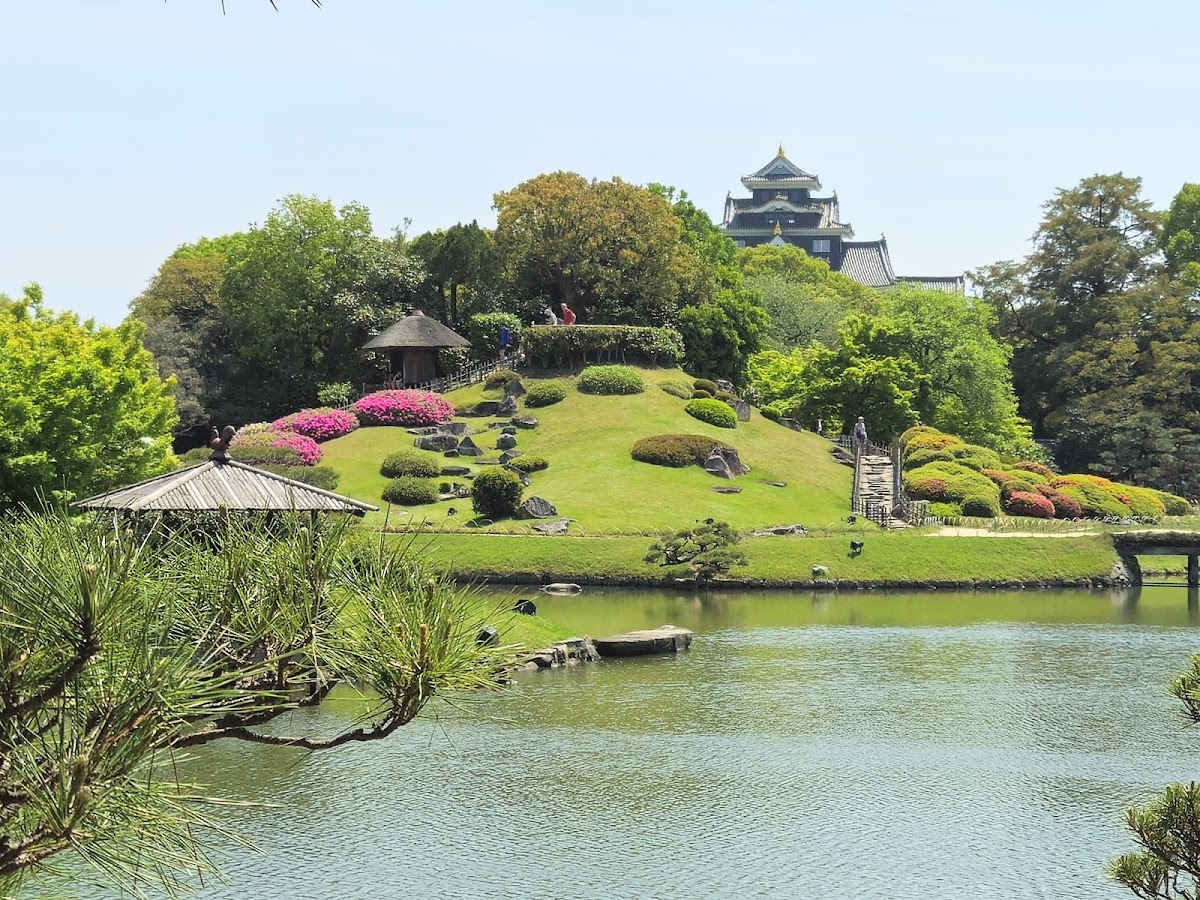
On its vast grounds of approximately 13.3 hectares (about 40,000 tsubo), a large central pond called “Sawa no Ike” is surrounded by lawns, artificial hills, tea houses, and a Noh stage. The design allows the Okayama Castle’s keep to be visible in the background from anywhere in the garden, with the technique of “borrowed scenery” skillfully employed.
History of Okayama Korakuen
Construction During the Edo Period
Ikeda Tsunamasa, who ordered the construction of Okayama Korakuen, was born as the eldest son of Ikeda Mitsumasa, the second daimyo of Okayama Domain, and ruled over lands yielding 315,000 koku. Tsunamasa was enthusiastic about cultural projects, and in constructing Korakuen, he brought together the finest landscape gardening techniques of the time.
Tsuda Nagaoki, who served as construction supervisor, was a retainer skilled in civil engineering, and besides Korakuen, he oversaw numerous large-scale projects including renovations of Okayama Castle and the excavation of the Kurayasu River. The design of Korakuen incorporated the concept of “famous places” modeled on scenic spots mentioned in Chinese classics and Japanese poetry.
Changes After the Meiji Period
After the Meiji Restoration, Okayama Korakuen became the property of Okayama Prefecture, and public opening began in 1884. During this period, the name “Korakuen” was officially established. The name’s origin comes from the Chinese phrase “Xian You Hou Le” (first worry, then joy) by Fan Zhongyan.
The 1934 Muroto Typhoon (Showa 9) and the 1945 Okayama air raid (Showa 20) caused damage to many buildings in the garden, but they were faithfully restored based on Edo-period drawings. Periodic preservation work continues to be conducted today, transmitting the Edo-period appearance to the present.
Main Highlights of Okayama Korakuen
Yuishin Hill (Yuishinyama)
Yuishin Hill is an artificial hill approximately 6 meters high and the highest elevated structure in the garden. At its summit stands a small shrine called “Yuishin-do,” from which the entire garden can be surveyed. Particularly, the view of Okayama Castle across Sawa Pond is known as a signature scenic spot of Korakuen.
The name Yuishin Hill comes from “Yuishin Jodo” (Pure Land of the Unified Mind), a Zen teaching that reflects the philosophy that the world changes according to one’s mindset. In spring the hill is colored by cherry blossoms, and in autumn by maple leaves, presenting different faces with each season.
Enyotei Hall (Enyotei)
Enyotei was the living room used by the daimyo when spending time in the garden. “Enyou” means “extending well-being,” and it is said that the daimyo rested his body and mind here while gazing at Sawa Pond and the garden scenery.
The current building is a postwar reconstruction, but its interior features displays recreating period furnishings, allowing visitors to catch glimpses of the life of a daimyo in the Edo period. The view from Enyotei is said to best embody the design philosophy of Korakuen.
Sawa Pond (Sawa no Ike)
A large pond located at the center of the garden and serving as the core of Korakuen’s landscape. The pond contains three islands—Nakanoshima, Onoshima, and Sunarishima—each arranged with pine trees and stone lanterns.
From the garden paths circulating around the pond, visitors can enjoy the pond and surrounding scenery from various angles. The images of Okayama Castle and Yuishin Hill reflected in the water surface display different expressions depending on season and time of day, offering new discoveries with each visit.
Renchiken Hall (Renchiken)
A building favored by Ikeda Tsunamasa, located in one of the quietest spots in the garden. A small pond lies in front of the building, allowing visitors to enjoy waterside scenery up close.
Renchiken is said to be the place where the daimyo devoted himself to reading and contemplation, with a calm atmosphere pervading the space. From within the building, one can observe the intricate details of the carefully constructed garden and appreciate the high level of Edo-period landscaping techniques.
Ryuten (Ryuten)
A rest pavilion built over a watercourse flowing through the garden, featuring an architectural style that is rare nationwide. Designed with a refreshing structure where water flows beneath the floor, it was engineered for comfortable use even in summer.
Ryuten served as a rest stop for the daimyo and guests as they strolled through the garden. Here they were served tea and light refreshments while enjoying the cool sound of flowing water. It remains a particularly popular spot in summer today.
Hana-yo Pond (Hanayokonike)
A pond renowned for its beautiful lotus flowers, with magnificent blooms carpeting the pond in summer. “Hana-yo” refers to lotus flowers and leaves, which are this pond’s greatest attraction.
Lotus flowers open in the early morning and close in the afternoon, so visiting in the morning is recommended for seeing beautiful blooms. The best viewing period is from July to August, when many photography enthusiasts visit.
Noh Stage
The garden contains a full-fledged Noh stage where performances of Noh and Kyogen are regularly held today. In the Edo period, Noh was performed before the daimyo, retainers, and guests, serving as a venue for cultural exchange.
The Noh stage was lost in wartime bombing but was reconstructed in 1960. During the “Gensou Teien” (Fantastical Garden) illumination events in spring and autumn, the Noh stage is beautifully lit, allowing visitors to enjoy a fantastical atmosphere.
Okayama Korakuen Through the Seasons
Spring (March–May)
Spring at Korakuen is lively with color as plum blossoms, cherry blossoms, azaleas, and various other flowers bloom in succession, adorning the garden. Particularly from late March to early April during cherry blossom season, the garden is crowded with flower-viewing visitors.
The garden contains approximately 280 cherry trees, primarily Somei Yoshino, along with diverse varieties including weeping cherry and wild cherry. The cherry blossoms around Yuishin Hill and the cherry tree-lined path in the outer garden are particularly beautiful, with cherry blossoms against Okayama Castle making for spectacular views.
From late April through May, azaleas and Japanese azaleas come into bloom. The contrast between fresh green lawns and colorful flowers is beautiful, allowing visitors to fully enjoy the pleasant season.
Summer (June–August)
During the rainy season in June, irises and hydrangeas color the garden. Particularly around Hana-yo Pond, irises bloom beautifully.
From July through August, the lotus flowers in Hana-yo Pond reach their peak. Visiting in the cool early morning hours allows one to see lotus blossoms covered with morning dew, providing a refreshing sensation that makes one forget summer’s heat.
During summer, special night opening called “Gensou Teien” (Fantastical Garden) is held. The garden is illuminated with lights, creating a completely different fantastical atmosphere from daytime visits. Beer gardens are also set up, allowing visitors to enjoy the garden’s beauty in a cool evening breeze.
Autumn (September–November)
Autumn at Korakuen features autumn leaves as the main attraction. From mid to late November, Japanese maples and other maples turn red and yellow, dyeing the garden in autumn colors.
The area around Yuishin Hill and Chishio no Mori (The Forest) are particularly known as beautiful autumn foliage spots. The reflection of autumn leaves on Sawa Pond is magnificent, allowing visitors to enjoy a feast of reflected colors on the water’s surface.
“Gensou Teien” is also held in autumn, with illumination of the autumn foliage. This offers a valuable opportunity to experience the fantastical beauty of illuminated foliage, different from daytime viewing.
Winter (December–February)
Winter at Korakuen is characterized by a serene, peaceful atmosphere. The winter landscape with withered lawns and bare trees is said to most closely resemble the depiction in Edo-period drawings.
Korakuen is particularly beautiful on snowy days. The contrast between the garden covered in white snow and Okayama Castle has an appearance like a sumi-e ink painting.
In January, plum blossoms begin to bloom, signaling the arrival of early spring. The garden contains approximately 100 plum trees, with white and red blossoms opening in succession. The fragrance of plum blossoms enjoyed in the crisp winter air is particularly special.
Access to Okayama Korakuen
Access by Train
From JR Okayama Station
- Take the Okayama Electric Railway Higashiyama Line bound for “Higashiyama,” get off at “Shiroshita” stop, then walk approximately 10 minutes
- Take the Okaden Bus bound for “Korakuen,” get off at “Korakuen-mae” bus stop, arriving immediately
- On foot: approximately 25 minutes from Okayama Station
JR Okayama Station is a major station where the Shinkansen bullet train stops, making access convenient from cities like Tokyo, Osaka, and Hiroshima. Multiple transportation options are available from the station, making it easy for sightseeing.
Access by Car
Using Expressways
- Approximately 20 minutes from “Okayama IC” on the Sanyo Expressway
- Approximately 30 minutes from “Okayama Soja IC” on the Okayama Expressway
Korakuen has a dedicated parking lot accommodating 570 regular cars and 10 buses, with parking fees of 100 yen per hour for regular cars. Congestion is common during tourist seasons and weekends, so early arrival is recommended.
Access from Airport
From Okayama Momotaro Airport to Okayama Station takes approximately 30 minutes by limousine bus. There is no direct bus from the airport to Korakuen, so you must transfer via Okayama Station.
Hours and Admission
Hours of Operation
- March 20–September 30: 7:30 AM–6:00 PM (admission until 5:45 PM)
- October 1–March 19: 8:00 AM–5:00 PM (admission until 4:45 PM)
The garden is open year-round with no closures. However, hours may be extended during special events.
Admission Fees
- Adults (age 15 and over): 410 yen
- Seniors (age 65 and over): 140 yen
- Elementary and junior high school students: Free
Combination Tickets
Combination tickets with Okayama Castle are also available, allowing economical enjoyment of both facilities.
- Adults: 640 yen (normally 820 yen)
- Seniors: 260 yen
Annual passes are also available for those planning multiple visits. At 2,060 yen for adults, visitors can enter unlimited times for one year.
Tourist Attractions Around Okayama Korakuen
Okayama Castle
Located immediately adjacent to Korakuen, Okayama Castle is also called “Karasu-jo” (Crow Castle) for its black exterior. Built in 1597 by Ukita Hideie, it later became the residence of the Ikeda clan.
The keep was destroyed in wartime bombing but was reconstructed in 1966, with the interior now functioning as a museum. Extensive renovation work was carried out from 2021 to 2022, completely updating the exhibits.
From Korakuen, Okayama Castle is approximately 5 minutes’ walk away across the Tsukimi Bridge spanning the Asahi River. Visiting both Korakuen and Okayama Castle together is the standard course for Okayama sightseeing.
Okayama Prefectural Museum
Located adjacent to the outer garden of Korakuen, this museum introduces the history and culture of Okayama. It features a wide range of exhibits from archaeological materials through the modern period, allowing deep understanding of Okayama’s history.
Exhibits related to Korakuen’s history are also included, making it beneficial to visit before exploring the garden to enjoy it more thoroughly.
Okayama City Oriental Museum
Positioned between Okayama Station and Korakuen, this museum houses valuable collections of ancient Oriental culture. Artworks from Mesopotamia, Egypt, Persia, and other regions are displayed, offering exposure to other cultures.
Kurashiki Bikan Historical Quarter
Approximately 15 minutes by train from Okayama City, the Kurashiki Bikan district in Kurashiki preserves Edo-period townscapes. Streets lined with whitewashed warehouse buildings create a picturesque atmosphere and have been designated as a National Important Traditional Building Preservation District.
Cultural facilities including the Ohara Museum of Art and the Kurashiki Folkcraft Museum are well-developed, with many visitors combining visits here with Okayama sightseeing, making it a popular destination.
Tips for Enjoying Okayama Korakuen
Best Times to Visit
While Korakuen displays beauty in all seasons, the particularly recommended periods are:
- Spring (early April): Cherry blossoms reach full bloom in the most vibrant season
- Summer (July–August): Lotus flowers and night illumination can be enjoyed
- Autumn (mid to late November): Autumn foliage at its peak with fall illumination events
- Winter (January–February): Serene atmosphere and plum blossom blooms
Time Required
For leisurely exploration of the garden, plan for 1.5 to 2 hours. For careful observation while taking photographs, allow 2 or more hours.
When visiting both Okayama Castle and Korakuen, plan for 3 to 4 hours combined to sightsee with adequate time.
What to Bring and Wear
- Comfortable walking shoes: Trails are extensive with gravel sections, so sneakers or similarly comfortable footwear is recommended
- Hat or parasol: Summer sun is intense, requiring heat stroke prevention measures
- Beverages: While vending machines exist in the garden, they are limited in number, so bringing your own is advisable
- Camera: With many scenic spots, don’t forget a camera or fully charged smartphone
Best Photography Spots
- Summit of Yuishin Hill: A classic spot for panoramic views of the entire garden and Okayama Castle
- View from Enyotei: The scenic Okayama Castle view across Sawa Pond
- From Tsukimi Bridge: Allows photographing both Korakuen and Okayama Castle simultaneously
- Hana-yo Pond: Optimal for close-up photography of summer lotus flowers
- Chishio no Mori area: Recommended for autumn foliage photography
Event Information
Various events are held at Korakuen throughout the year.
- Spring and Autumn Gensou Teien: Special night opening with illumination
- Summer Gensou Teien: Beer gardens and night illumination
- Tancho garden stroll in winter: On specific winter dates, tancho (Japanese cranes) maintained in the garden are released for strolling
- Tea-planting festival: Held in May as a traditional event where rice-planting occurs in paddies within the garden
- Lotus-viewing festival: Event to enjoy lotus blossoms from July to August
For the latest event information, check the official Okayama Korakuen website.
Cultural Value of Okayama Korakuen
Significance as a Special Place of Scenic Beauty
Okayama Korakuen is designated as a “Special Place of Scenic Beauty” under the Cultural Properties Protection Law. As of 2024, only 36 such designations exist in Japan, making this an extremely valuable cultural property.
This designation indicates that Korakuen is not merely a beautiful garden but holds an important position in Japanese landscape gardening history and possesses high academic value. As a representative example of Edo-period daimyo gardens, it is a precious cultural heritage transmitting design philosophy and landscaping techniques to the present.
International Evaluation
Okayama Korakuen receives high evaluation not only domestically but internationally. In the French travel guide “Michelin Green Guide Japan,” it has earned three stars, being introduced as a place “worth traveling to.”
Additionally, in ranking by “Journal of Japanese Gardening,” an American publication specializing in Japanese gardens, it consistently ranks highly, attracting attention from garden enthusiasts worldwide.
Preservation and Succession Efforts
Korakuen undergoes regular preservation work to maintain its Edo-period appearance. From lawn management and pine tree care to building restoration, maintenance using traditional techniques continues.
Lawn management is particularly important, with sod burning performed several times yearly. This traditional management method, continuing from the Edo period, serves to eliminate harmful insects and promote lawn renewal. The sod burning held in February is known as a winter sight of Okayama.
Conclusion
Okayama Korakuen is one of Japan’s representative gardens with over 300 years of history. Vast lawns, beautiful ponds, and carefully positioned artificial hills and buildings harmonize across its grounds, displaying different faces with each season.
It is a precious cultural heritage transmitting Edo-period daimyo culture to the present, while simultaneously serving as a place of recreation that modern visitors can casually enjoy. Combined with visits to Okayama Castle, deeper understanding of Okayama’s history and culture becomes possible.
With spring cherry blossoms, summer lotus flowers, autumn maple leaves, and winter plum blossoms, each seasonal visit offers different charms, providing new discoveries with every visit. When visiting Okayama, be sure to spend unhurried time at Korakuen and appreciate the beauty of Japanese gardens.
-800x450.jpg)