
.jpg)
Heirinji Temple (Niiza City, Saitama Prefecture) Complete Guide|From History and Woodlands to Access and Autumn Foliage Information
Heirinji Temple (平林寺), located in Nohishi, Niiza City, Saitama Prefecture, is a Rinzai Zen temple of the Myoshinji school that encompasses vast temple grounds spanning approximately 130,000 tsubo (roughly equivalent to 9 Tokyo Domes). The mixed woodland retaining the vestiges of Musashino has been designated as a National Natural Monument, and the temple is known as one of the foremost training monasteries in the Kanto region. This article provides comprehensive information you should know before visiting, covering the temple’s history, highlights, access methods, and seasonal attractions.
Overview and Basic Information About Heirinji
Basic Temple Data
Heirinji’s mountain name is Kinhosen, and its principal object of worship is Sakyamuni Buddha. According to tradition, this mountain name was given by taking the characters “kin” (金) and “hou” (鳳) from Hoentai Mountain Honing Temple in Kinryo (present-day Nanjing), where the temple’s founder, Sekishitsu Zenkyuu (1294-1389), studied in Yuan (China).
In 1903 (Meiji 36), the monastery hall was established as a training monastery, and it continues to serve as a prominent specialized training facility in the Kanto region, attracting unsui (training monks) from across the nation.
Visitor Information
- Visiting Hours: 9:00 AM to 4:30 PM (Last entry at 4:00 PM)
- Admission Fee: Adults 500 yen, Free for middle school students and younger
- Closed Days: December 31 (closed to entry)
- Location: 3-1-1 Nohishi, Niiza City, Saitama Prefecture
- Phone Number: 048-477-1242
- Parking: Free parking available (approximately 50 spaces)
History of Heirinji Temple
Founding Through the Iwatsuki Period
Heirinji Temple was founded in 1375 (Yonwa 1) in what is now Iwatsuki Ward, Saitama City. The temple’s founder was Sekishitsu Zenkyuu mentioned above, and during the Iwatsuki period, the temple marked nearly 300 years of history. During the Iwatsuki period, Heirinji served as a central institution in Heirinji Village, which belonged to Saitama County’s Iwatsuki domain.
Relocation to Nohishi and Matsudaira Nobutsuna
The most significant turning point in Heirinji’s history was its relocation to Nohishi in 1663 (Kanbun 3). This relocation occurred at the behest of Matsudaira Nobutsuna, the Kawagoe domain lord and senior councilor of the Tokugawa shogunate.
Matsudaira Nobutsuna was known by the name “Chie Izu” (知恵伊豆) and was a celebrated statesman who led important policies in the early Edo period, including the suppression of the Shimabara Rebellion and the reconstruction of Edo following the Great Meireki Fire. Nobutsuna held Heirinji in deep reverence and desired to make it his family’s temple of perpetual remembrance. Following his wishes, after Nobutsuna’s death, Heirinji relocated from Iwatsuki to Nohishi and became the Matsudaira family’s temple of perpetual remembrance.
Today, the “Tomb of Matsudaira Izu-no-kami Nobutsuna and His Consort” remains in the temple grounds and is designated as a Saitama Prefectural Historic Site. This tomb is a precious cultural property that conveys the deep connection between Heirinji and the Matsudaira family to the present day.
Development in Modern Times
With the arrival of the Meiji era, Heirinji strengthened its function as a training monastery. Following the opening of the monastery hall in 1903 (Meiji 36), the temple has continued to develop as an important center for training Rinzai Zen monks.
In 1968 (Showa 43), the temple grounds’ woodland was designated as a National Natural Monument as a mixed woodland retaining the vestiges of Musashino. This designation is unique among mixed woodlands as a nationally designated natural monument, demonstrating the high cultural value of Heirinji.
The Charm of Heirinji’s Temple Grounds Woodland
The Nationally Designated Natural Monument Woodland
The greatest highlight of Heirinji is undoubtedly the vast woodland spanning approximately 130,000 tsubo (approximately 43 hectares). This mixed woodland was designated as a National Natural Monument in 1968 (Showa 43) as a precious natural heritage conveying the appearance of the mixed woodland that once covered the entire Musashino plateau.
Heirinji’s temple grounds woodland is unique as the only nationally designated natural monument mixed woodland, and its cultural and ecological value is extremely high. Continuous conservation and maintenance efforts are conducted in coordination with the Agency for Cultural Affairs, Saitama Prefecture, Niiza City, and other organizations.
Flora Reflecting the Aspects of Musashino
The temple grounds woodland is composed of deciduous broadleaf mixed woodland, primarily consisting of konara (Quercus serrata), kunugi (Quercus acutissima), and inushide (Carpinus tschonoskii) trees. These trees represent the typical flora that once covered the Musashino plateau. In the modernized Kanto region of today, there are extremely few places where one can experience the original Musashino landscape on such a vast scale.
Various wild plants native to the forest floor display themselves seasonally, with katakuri and ichirin-sou in spring, yaburan in summer, and rindou in autumn, presenting different appearances with each season.
Harmony with the Nohishi Water Channel
The Nohishi water channel flowing through the temple grounds is a historic irrigation canal opened in the early Edo period. Originating from Tachikawa City, Tokyo and terminating at the Arakawa River in Shiki City, Saitama, this approximately 24-kilometer water channel was excavated in 1655 (Shoo 4) under the orders of Matsudaira Nobutsuna.
The murmur of the clear stream flowing through the grounds further enhances the quiet atmosphere of the mixed woodland, bringing deep peace to visitors. The walking path along the water channel is a popular spot to enjoy beautiful scenery throughout the seasons.
Buildings and Cultural Properties at Heirinji
Prefecturally Designated Tangible Cultural Properties
Heirinji preserves numerous precious structures that convey the architectural style of the Edo period to the present. In particular, the main gate, temple gate, Buddha hall, and middle gate are four structures designated as Saitama Prefectural Designated Tangible Cultural Properties (Architecture).
The main gate (somon) is an imposing thatched-roof gate adorning the entrance to Heirinji. It retains the architectural style of the Edo period in vivid detail, inviting visitors into a world of history. To the left of the main gate is the reception desk for entry, where visitors pay the admission fee and enter the grounds.
The temple gate (sanmon) features the heavy construction characteristic of Zen temples, creating a solemn atmosphere within the grounds. Passing through the gate opens onto vast temple woodland, a quiet space that makes one forget the hustle and bustle of the city.
The Buddha hall (butsuden) houses the principal object of worship, Sakyamuni Buddha, and exemplifies the simple yet dignified style of Zen Buddhist architecture.
The middle gate (chumon) is positioned on the path to the Buddha hall, conveying the strict atmosphere of Heirinji as a specialized training monastery.
Other Points of Interest
The grounds also contain other facilities for a specialized training monastery, including the monks’ dormitory (sodo) where training monks reside and the meditation hall (zendo) where zazen and training are conducted. However, these training facilities are not open to the general public, so only external viewing is possible.
Additionally, the tomb of Matsudaira Nobutsuna and his consort is protected as a Saitama Prefectural Historic Site and is a precious cultural property for understanding the style of Edo-period tomb architecture.
Heirinji Throughout the Seasons
Heirinji in Spring
Spring at Heirinji is a season of striking fresh greenery. From late March to early April, spring wildflowers such as katakuri and ichirin-sou bloom on the forest floor, announcing spring’s arrival in the mixed woodland. From mid-April onward, deciduous trees such as konara and kunugi bud forth simultaneously, and the entire temple grounds become enveloped in vivid yellowish-green.
During the new greenery season, Heirinji displays beautiful contrasts of light and shadow and is an ideal time for photography. Along the Nohishi water channel walking path, one can also enjoy the scenery of fresh green reflected in the water’s surface.
Heirinji in Summer
In summer, Heirinji’s deep green woodland creates cool shade. The temperature is several degrees lower than in the city center, allowing comfortable walks even in the height of summer.
The walking paths through dappled light in the mixed woodland offer a healing space that makes one forget the heat. The sounds of cicadas and bird songs echo through the air, allowing visitors to experience the summer Musashino nature through all five senses.
Heirinji in Autumn (Famous Autumn Foliage Destination)
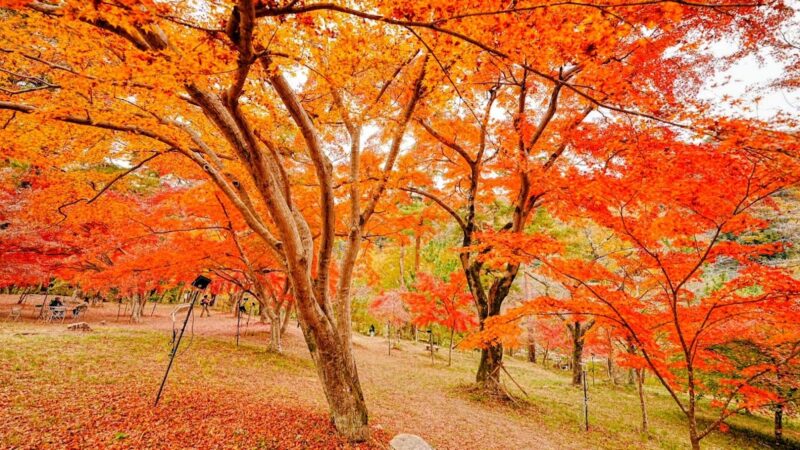
The season when Heirinji draws the largest number of visitors is autumn foliage season. Typically from mid-November through early December, the trees in the temple grounds woodland change to brilliant red and yellow hues, creating breathtaking beautiful scenery.
The harmony of colors created by the yellow leaves of konara and kunugi and the red foliage of momiji and hazenoki is a true work of art created by nature. The autumn foliage around the temple gate and along the Nohishi water channel is particularly spectacular, attracting many photography enthusiasts.
While the peak foliage season varies with weather conditions, it is recommended to check the latest foliage information on Niiza City and Saitama Prefecture tourist information websites before visiting. Weekends and holidays tend to be crowded, so visiting on weekday mornings allows for relatively relaxed viewing.
Heirinji in Winter
Winter at Heirinji is a season when the leafless mixed woodland displays its own unique beauty. The delicate patterns created by bare tree branches possess a quiet beauty distinct from spring, summer, and autumn.
Particularly after snowfall, the grounds are enveloped in a white world of ethereal beauty. Among the winter-withered landscape, scattered evergreen foliage creates points of green, allowing visitors to experience the winter character of Musashino.
Winter is a season when fewer visitors come, making it possible to walk through the grounds in quiet solitude. Worship in the bracing winter air soothes the mind and is ideal for renewing resolutions for the new year.
Access to Heirinji Temple
Access by Train and Bus
Heirinji can be accessed by bus from multiple stations.
From JR Musashino Line “Niiza Station”
- Board West Japan Bus from “Niiza Station” (approximately 15 minutes)
- Get off at “Heirinji” bus stop, walk a short distance
From Tobu Tojo Line “Asaka-Dai Station” / JR Musashino Line “Kita-Asaka Station”
- Board West Japan Bus from “Asaka-Dai Station” south exit (approximately 15 minutes)
- Get off at “Heirinji” bus stop, walk a short distance
From Tobu Tojo Line “Shiki Station”
- Board West Japan Bus from “Shiki Station” south exit (approximately 10 minutes)
- Get off at “Heirinji” bus stop, walk a short distance
From Seibu Ikebukuro Line “Hibarigaoka Station”
- Board West Japan Bus from “Hibarigaoka Station” north exit (approximately 20 minutes)
- Get off at “Heirinji” bus stop, walk a short distance
Bus frequency varies by route, so it is recommended to check the West Japan Bus timetable in advance. Especially during autumn foliage season on weekends, crowds are expected, requiring a plan with ample time.
Access by Automobile
Using the Kan-Etsu Expressway
- Approximately 20 minutes from “Tokorozawa Interchange”
From Tokyo
- Via National Route 254 (Kawagoe Kaido) toward Niiza City
Free parking (approximately 50 spaces) is available at Heirinji, but the lot often fills up during foliage season and on weekends, making public transportation use recommended. If the parking lot is full, nearby paid parking must be used, but spaces are limited, so arriving early is advisable.
Tourist Spots Around Heirinji
Nohishi Water Channel and Walking Paths
The Nohishi water channel flowing through Heirinji’s grounds continues to be a beautiful walking area outside the temple. The section flowing through Niiza City is equipped with pedestrian paths, allowing visitors to enjoy walking while experiencing nature’s seasonal changes.
The area is particularly popular for walking during cherry blossom season in spring and autumn foliage season among local residents. It is also recommended to walk along the water channel before or after visiting Heirinji.
Cultural Facilities in the Niiza Area
Beyond Heirinji, Niiza City has other facilities worth visiting. Around Niiza City Hall, cultural facilities and parks are scattered, making it possible to experience Niiza City’s charm in combination with Heirinji.
Tourist Attractions in the Tokorozawa and Shiki Areas
While Heirinji is located in Niiza City, neighboring Tokorozawa and Shiki cities have numerous tourist spots. Tokorozawa Aviation Memorial Park, commercial facilities within Tokorozawa City, historic buildings in Shiki City, and other attractions allow for a more enriched Saitama tourism experience by including the surrounding area in your travel plans.
Temple Visit Etiquette and Manners at Heirinji
Heirinji as an Active Training Monastery
Heirinji is simultaneously a tourist destination and an active training monastery. Training monks are engaged in rigorous training on the grounds daily, and visitors must observe certain etiquette to avoid hindering this practice.
Move quietly through the grounds and refrain from loud conversation or disruptive behavior. Particular silence is required near the monks’ dormitory and meditation hall, which are the living spaces of training monks.
Photography Etiquette
Heirinji’s beautiful scenery is popular for photography, but certain rules apply. Tripod use may be prohibited; prior confirmation is necessary. Take care not to disturb other visitors when choosing photography locations and times.
Photography inside buildings and of training monks is generally prohibited. When photographing natural features or external structures, behave respectfully toward the sacred atmosphere of the grounds.
Clothing and Belongings
Walking shoes and appropriate clothing are essential for woodland walks. After rain especially, walking paths may be muddy, so waterproof shoes are recommended. Bringing insect repellent, a hat, and drinking water makes summer visits more comfortable. Bring adequate winter clothing for cold season visits. As there are no vending machines or shops within the grounds, prepare necessary items beforehand.
Annual Events at Heirinji
Major Services and Events
Throughout the year, various religious services and events are held at Heirinji. While some are open to general visitors, many are private due to the temple’s training monastery character.
Visiting hours and entry permission may change during special events, so checking official information before visiting is recommended.
Zazen Meditation Experience
Heirinji regularly holds zazen sessions open to the general public. Experiencing authentic zazen at a Zen Buddhist temple offers a precious opportunity to step away from daily bustle and calm the mind.
For zazen session dates and times and participation methods, contact Heirinji directly or check Niiza City tourism information. Zazen sessions for beginners are also available, so those interested are encouraged to participate.
Tips for Maximizing Your Heirinji Visit
Optimal Visiting Times
For those wishing to walk through Heirinji’s woodland quietly, visiting in the morning just after opening is recommended. Particularly on weekday mornings, there are few visitors, allowing full appreciation of the mixed woodland’s quiet atmosphere.
During foliage season, afternoon hours tend to be crowded, so visiting early allows leisurely foliage appreciation.
Estimated Time Requirements
Given Heirinji’s expansive grounds, allocating 2-3 hours for thorough exploration is recommended. Viewing major structures and walking portions of the grounds can be done in about an hour, but with ample time, you can experience Heirinji’s appeal more deeply.
Combining with Nearby Facilities
Limited dining and rest facilities surround Heirinji. Plan meals and rest either before or after your visit at the nearest station or in neighboring cities like Tokorozawa or Shiki.
Niiza City has local restaurants using regional ingredients, making it enjoyable to experience local cuisine alongside your Heirinji visit.
Conclusion
Heirinji Temple in Niiza City, Saitama Prefecture, is a prestigious Rinzai Zen temple with deep historical connections to Matsudaira Nobutsuna and blessed with valuable woodland retaining Musashino’s character. This temple, featuring a nationally designated natural monument woodland, prefectural designated tangible cultural properties, and beautiful natural scenery throughout the seasons, stands as one of Saitama Prefecture’s premier tourist destinations.
There are few places in the Kanto region where one can experience such vast Musashino mixed woodland. With convenient access from the city center and the possibility of day trips, the temple’s appeal is further enhanced. Whether one’s interests lie in history, nature appreciation, photography, or spiritual peace, Heirinji satisfies a wide range of visitors.
Particularly during foliage season, its breathtaking beauty makes it one of the Kanto’s premier autumn foliage destinations. Yet Heirinji, displaying a different character in each season—vivid spring greenery, cool summer shade, and silent winter stillness—remains a place where new discoveries await with each visit.
Heirinji merges the strict atmosphere of a training monastery with the healing space of abundant nature. When visiting Saitama Prefecture, Heirinji is a destination worthy of your time—a memorable cultural landmark. For over 360 years since its relocation to Nohishi, Heirinji continues in its unchanged form to convey Musashino’s nature and the spirit of Zen to us—a truly irreplaceable cultural heritage for those living in the modern age.
-800x450.jpg)
-800x450.jpg)
-800x450.jpg)