
.jpg)
Complete Guide to Kuroyama Santaki (Saitama Prefecture) | Access, Highlights, and Four-Season Charm Explained in Detail
Kuroyama Santaki (黒山三滝), located in Ogose Town, Iruma District, Saitama Prefecture, is a naturally rich scenic spot accessible in about 2 hours from central Tokyo. It is the collective name for three waterfalls—the Male Waterfall, Female Waterfall, and Tengu Waterfall—and is known as a tourist destination where history and nature are harmonized, having been ranked 9th in the “Waterfall Section” of the New Japan Tourism Top 100 in 1950 (Showa 25).
Kuroyama Santaki | The Natural Beauty Woven by Three Waterfalls
Kuroyama Santaki is composed of three waterfalls that cascade down the Mitaki River, a tributary of the Oppegawa River. Located in a gorge at the east end of Daihira Mountain, it serves as the core scenic spot of the Prefectural Kuroyama Nature Park and is beloved by many tourists and hiking enthusiasts.
Male Waterfall (Odaki)
The Male Waterfall, standing approximately 11 meters high, is the main waterfall of Kuroyama Santaki. It forms the upper section of a two-stage structure, falling dramatically as it strikes the rock surface with powerful water flow. The area around the waterfall basin is enveloped in negative ions from water spray, creating a refreshingly clean space.
Female Waterfall (Medaki)
The Female Waterfall, standing approximately 5 meters high, is positioned below the Male Waterfall and is characterized by its graceful water flow. Together with the Male Waterfall, it forms a two-stage structure, creating contrasting beauty. The delicate water flow evokes an elegant, “feminine” charm.
Tengu Waterfall (Tengudaki)
Located slightly downstream from the Male and Female Waterfalls, Tengu Waterfall is the highest of Kuroyama Santaki at approximately 20 meters. Characterized by its thin, long water flow, it creates a mystical atmosphere deeply connected to mountain worship. This is an important site that preserves the history of its use as a training ground for Shugendo (mountain ascetic practice).
History of Kuroyama Santaki | Its Evolution as a Shugendo Holy Site
The history of Kuroyama Santaki dates back far in time. It is said to have been established as a base for Shugendo (mountain religious practice) during the Muromachi period. As a sacred site and training ground where mountain priests performed ascetic waterfall practices, it gathered widespread religious devotion.
During the Edo period, it was visited by many practitioners as a sacred site of Shugendo in Musashi Province, with waterfall ascetic practices being conducted frequently. Even today, the “Waterfall Opening” ceremony is held on the first Sunday of July each year, where traditional Shinto rituals and waterfall ascetic practices are performed. This event is passed down as an important cultural practice in the region, and general participants can also experience waterfall ascetic training.
In 1951 (Showa 26), the wider area centered on the three waterfalls was designated as the Prefectural Kuroyama Nature Park, establishing a balance between nature conservation and tourism promotion. Along with its selection for Japan’s Top 100 Tourist Attractions, it became established as a representative tourist destination in Saitama Prefecture.
Seasonal Charms | Highlights of Kuroyama Santaki
Kuroyama Santaki presents different faces with each season. Visitors can enjoy entirely different landscapes depending on when they visit.
Spring Greenery (April–May)
The Kuroyama Santaki area in spring is enveloped in vibrant fresh greenery. Newly sprouting leaves filter sunlight, and the entire gorge turns a bright green. The contrast between the increased water volume of the waterfall from snowmelt and the life-filled fresh greenery is a beauty unique to spring.
Summer Coolness (June–August)
During summer, the temperature around the waterfall is 5–10 degrees Celsius lower than in urban areas, functioning as a natural air conditioner. The cool air rich in negative ions, water spray, and shade provide relief from the heat. The waterfall opening ceremony in July offers an opportunity to view and experience traditional waterfall ascetic practices, providing a precious chance for physical and mental refreshment.
Autumn Foliage (Early to Late November)
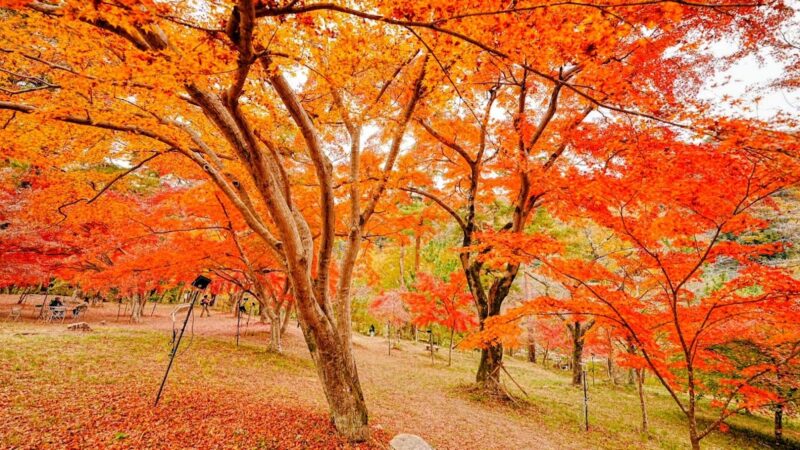
The season drawing the most tourists is autumn foliage season. Maples and other deciduous trees coloring the gorge red and yellow create breathtakingly beautiful collaboration with the waterfalls. The area around the Male and Female Waterfalls is particularly popular as a photography spot, drawing many photographers on weekends. The prime viewing season is typically mid-November, though it varies by climate, so it is recommended to check with the Ogose Town tourism information beforehand.
Winter Silence (December–February)
Winter at Kuroyama Santaki sees fewer visitors, allowing peaceful waterfall viewing in a quiet atmosphere. In years with severe cold waves, the waterfalls may partially freeze, offering the mystical sight of ice waterfalls. Viewed through bare trees, the waterfalls present a solemnity entirely different from summer and autumn.
Access Information | How to Reach Kuroyama Santaki
Access by Public Transportation
Train and Bus
- Get off at Ogose Station on the JR Hachiko Line or Tobu Ogose Line
- Board the Kawagoe Sightseeing Bus heading to “Kuroyama” from Ogose Station (approximately 15 minutes)
- Get off at “Kuroyama” bus stop and walk approximately 15 minutes to the waterfall
Service Information
- Bus service is limited, so it is necessary to confirm the schedule in advance
- Additional buses may be added on weekends during foliage season
- Check the latest service information with Kawagoe Sightseeing Bus or the Ogose Town Tourist Association
Access by Private Vehicle
Via Kan’etsu Expressway
- Approximately 30 minutes from “Tsurugi Island IC” or “Sakado West Smart IC” on the Kan’etsu Expressway
- Head toward Ogose Town via National Route 407
Via Kanto-Chuo Expressway
- Approximately 25 minutes from “Tsurugi Island IC” on the Kanto-Chuo Expressway
Parking Information
Multiple parking facilities are established around Kuroyama Santaki.
Parking near Kuroyama Bus Stop
- Capacity: Approximately 30 vehicles
- Fee: Free (may be paid during foliage season)
- Approximately 15-minute walk to the waterfall
Important Notes
- The area becomes very congested during foliage season and on weekends
- Parking lots frequently reach capacity, so use of public transportation is strongly recommended
- Street parking is prohibited as it causes inconvenience to local residents
Hiking Courses to Kuroyama Santaki
Kuroyama Santaki is also popular as a hiking destination. A variety of courses from easy, maintained trails to challenging mountain routes are available.
Beginner Level | Waterfall Viewing Course (Time Required: Approximately 1 Hour)
A round-trip course from the “Kuroyama” bus stop to the waterfall. With paved roads and maintained trails, beginners and families can enjoy it safely. Along the way, enjoy the scenery along the stream and forest bathing while heading leisurely toward the waterfall.
Intermediate Level | Karasugitoge Pass Course (Time Required: Approximately 2–3 Hours)
A course from Kuroyama Santaki via Karasugitoge Pass. The pass features a large umbrella cedar tree said to be over 1,000 years old, designated as a prefectural natural monument. This giant tree, with a trunk circumference of 15 meters and height of 30 meters, is impressive and has been recognized as 16th in Japan’s giant tree rankings (1988 Green Census) and first in the prefecture.
Advanced Level | Otakatori Mountain and Katsuragi Kannon Circuit Course (Time Required: Approximately 4–5 Hours)
A full-scale hiking course starting from Kuroyama Santaki, circuiting Otakatori Mountain (376 meters elevation) and Katsuragi Kannon. The mountain summit offers views of the Kanto Plain, making this an accomplishing course.
Hiking Attire and Necessities
Recommended Equipment
- Trekking shoes or non-slip sneakers (some areas are muddy)
- Comfortable clothing (long sleeves and pants recommended)
- Hat and sunscreen
- Drinking water (500ml or more)
- Towel and change of clothes
- Rain gear (folding umbrella or rainwear)
- Insect repellent spray (spring through autumn)
- Map or smartphone (GPS app)
Important Points
- Beyond Karasugitoge Pass, trails become natural mountain paths with exposed tree roots
- Trails become slippery after rain, requiring special caution
- Avoid hiking alone; travel with multiple people when possible
Nearby Tourist Attractions
Several tourist spots worth visiting in combination are scattered around Kuroyama Santaki.
Ogose Plum Grove
Counted as one of the three major plum groves in the Kanto region, Ogose Plum Grove has about 1,000 plum trees planted across approximately 2 hectares. The “Ogose Plum Grove Plum Festival” is held from late February to early March, where white and pink plum blossoms present a spectacular landscape. It is about 15 minutes by car from Kuroyama Santaki.
Godaizon Azalea Park
A park where about 10 varieties and over 10,000 azalea plants are cultivated, with peak bloom from late April to early May. The hillside covered with colorful azaleas is impressive and represents Ogose Town’s spring landscape.
Katsuragi Kannon (Katsuragi Temple)
The 33rd sacred site of the Bando Pilgrimage, an ancient temple that has gathered faith for centuries. The view from the grounds is excellent, and particularly during foliage season, it attracts many worshippers. It is popular as a hiking course visited together with Kuroyama Santaki.
Yamanekokin (Mountain Cat)
A café-restaurant in an old house renovation in the Kuroyama area, where meals using local ingredients can be enjoyed. It is ideal for resting and dining after hiking, where you can spend a leisurely time.
Lodging Facilities Around Kuroyama Santaki
While Kuroyama Santaki can be fully enjoyed as a day trip, there are lodging facilities nearby.
New Sanpia Saitama Ogose
A comprehensive leisure facility in Ogose Town offering lodging, hot springs, restaurant, and tennis courts. It is well-accessible at approximately 10 minutes by car from Kuroyama Santaki.
Minshuku and Inns
Several family-run guesthouses and inns are located around Ogose Town. They are attractive for their homey atmosphere, meals using local ingredients, and warm hospitality.
Hotels in Surrounding Areas
Surrounding cities such as Kawagoe and Hanno have abundant business hotels and city hotels. Combined with Kuroyama Santaki tourism, you can enjoy broader sightseeing such as exploring Kawagoe’s Little Edo and visiting Moomin Valley Park in Hanno.
Basic Information
Name
Kuroyama Santaki (黒山三滝)
Location
Kuroyama, Ogose Town, Iruma District, Saitama Prefecture
Hours
Open 24 hours (night visits not recommended due to no lighting; daytime visits are advisable)
Admission
Free
Best Season
Foliage: Early to late November
Fresh greenery: April–May
Waterfall opening: First Sunday of July
Time Required
Round trip from bus stop: Approximately 1–1.5 hours
Inquiries
Ogose Town Tourist Association
TEL: 049-292-3121
Official Website
Ogose Town Tourism Site, Saitama Prefecture Official Tourism Site “Choco Tabi Saitama”
Precautions and Etiquette When Visiting
Safety Notes
- The rocks around the waterfall are slippery, so walk with care
- Do not approach during high water levels
- Do not enter areas outside designated trails
- Keep close watch on small children
Environmental Protection and Etiquette
- Take all trash with you
- Collecting plants and feeding animals are prohibited
- Smoke only in designated areas
- Refrain from loud noise and playing music
- Waterfall ascetic practices are permitted only in designated periods and locations
Photography Etiquette
- When using tripods, ensure you do not obstruct other visitors’ passage
- Drone use is generally prohibited
- Be considerate to avoid including other tourists in your photos
Tips for Maximizing the Charm of Kuroyama Santaki
Optimal Visiting Times
Early morning hours (around 8–10 a.m.) have fewer tourists, allowing for quiet waterfall viewing. Especially on weekends during foliage season, early morning visits are recommended. Morning light is also favorable for photography.
Season-Specific Recommendations
Spring: Contrast between fresh greenery and waterfall, bird songs
Summer: Seeking coolness, refreshment with negative ions, waterfall opening ceremony
Autumn: Spectacular foliage scenery, chromatic beauty of the gorge
Winter: Waterfall viewing in silence, ice waterfalls if lucky
Combined Sightseeing Plans
Sample Day Trip Plan
- Morning: Kuroyama Santaki hiking
- Lunch: Yamanekokin or Ogose town area
- Afternoon: Ogose Plum Grove (spring) or Katsuragi Kannon pilgrimage
- Return: Kawagoe Little Edo exploration
Sample 1-Night, 2-Day Plan
- Day 1: Kuroyama Santaki and Otakatori Mountain hiking, lodging at New Sanpia Saitama Ogose
- Day 2: Ogose Plum Grove and Godaizon Azalea Park, Kawagoe sightseeing
Conclusion | Enjoy Nature at Kuroyama Santaki, Saitama’s Hidden Gem
Kuroyama Santaki is a representative scenic spot in Saitama Prefecture easily accessible from central Tokyo. It is full of diverse charms: the natural beauty woven by the three waterfalls of the Male, Female, and Tengu Waterfalls, the history of Shugendo dating back to the Muromachi period, and the gorge landscape showing different faces with each season.
As evidenced by its selection in Japan’s Top 100 Tourist Attractions, its beauty is nationally acclaimed, and the foliage season landscape in particular is well worth seeing. With hiking courses suitable for both beginners and advanced hikers, it is an ideal destination for those seeking communion with nature.
While accessible by public transportation, congestion is expected during foliage season, so early visits or weekday use is recommended. Respect etiquette, treasure the natural environment, and fully enjoy the charms of Kuroyama Santaki.
Ogose Town has many other attractive tourist spots beyond Kuroyama Santaki. Why not spend a healing time where nature and history harmonize in Ogose Town, which presents different faces with each season—plums, azaleas, and autumn foliage?
-800x450.jpg)
-800x450.jpg)
-800x450.jpg)