Anpi Kogen Beech Secondary Forest, Iwate Prefecture | Comprehensive Explanation of the Miracle of Natural Restoration and the Charm of Forest Bathing
The Anpi Kogen Beech Secondary Forest spreading across Anpi Kogen in Hachimantai City, Iwate Prefecture, is a beech forest covering approximately 1 million square meters that has been beautifully restored by the power of nature following human deforestation. After being completely clear-cut in the early Showa period as material for charcoal and lacquerware, this secondary forest has revived over approximately 80 years and has been selected as one of “Japan’s 100 Forest Bathing Spots” and “Japan’s 100 Starry Sky Spots,” offering visitors beauty and healing spaces throughout the four seasons.
This article provides a comprehensive explanation of the Anpi Kogen Beech Secondary Forest, covering its historical background, ecological characteristics, attractions as a tourist destination, and access methods—this miracle of natural restoration.
Anpi Kogen Beech Secondary Forest | The Meaning and Formation of Secondary Forests
Definition of Secondary Forests and Characteristics of Anpi Kogen
A secondary forest refers to a forest that has been restored by natural forces after being lost through natural disasters or human deforestation. The Anpi Kogen Beech Secondary Forest is a typical secondary forest that was completely clear-cut by local residents in the early Showa period (1920s to 1930s) and then regenerated naturally without artificial replanting.
Locally called “Shitano Makiba,” “Nakano Makiba,” and “Okuno Makiba,” this beech secondary forest is distributed over a wide area surrounding the grassland plateaus. Now, approximately 80 years after the clear-cutting, beech trees of uniform age form a beautiful forest canopy, which, along with a few remaining mother trees (old beech trees that escaped felling), creates a unique forest landscape.
Historical Background | From Early Showa Period Deforestation to Restoration
In the early Showa period, the beech forests around Anpi Kogen were an important resource supporting the lives of local residents. Large-scale deforestation was conducted for charcoal production, lacquerware materials, and building materials, and vast beech forests were temporarily lost.
However, in the land left abandoned after felling, the forest gradually recovered through the strong sprouting power of beech and natural regeneration from seeds. Beech is a representative tree species of Japan’s cool-temperate forests and prefers moderate humidity and cool climates; therefore, Anpi Kogen’s environment provided ideal conditions for regeneration.
Over approximately 80 years, the former clear-cut land was transformed into a magnificent beech forest and is now highly evaluated as a successful example of natural restoration.
Beech (Fagus crenata) Ecology and Distribution | Characteristics of the Forest King
Ecological Characteristics of Beech
Beech (scientific name: Fagus crenata) is a deciduous broad-leaved tree belonging to the family Fagaceae, genus Fagus, and is endemic to Japan. It reaches a height of 20 to 30 meters, with a pale gray trunk and characteristic smooth bark. The leaves are oval-shaped with wavy serrated margins and display beautiful seasonal changes from spring’s fresh greenery to autumn’s golden leaves.
Beech is also called the “king of the forest” and plays an important role in supporting a rich ecosystem. Its nuts (beech nuts) are a valuable food source for many wild animals, and Asiatic black bears, squirrels, and birds inhabit this forest. Additionally, beech leaf litter decomposes easily, forming rich humus, which enhances the forest’s water source conservation function.
Distribution of Beech and Environment at Anpi Kogen
Anpi Kogen is located at an elevation of approximately 500 to 1,000 meters in a cool-temperate climate zone. This environment is ideal for beech growth, and abundant annual precipitation allows beech to form forests as the dominant species.
A characteristic of the Anpi Kogen Beech Secondary Forest is that the trees are of relatively uniform age. Since clear-cutting occurred simultaneously and regeneration began at roughly the same time, the forest has a structure close to an even-aged stand. However, mother trees that escaped felling are scattered throughout, and these giant trees served as seed sources that promoted forest regeneration.
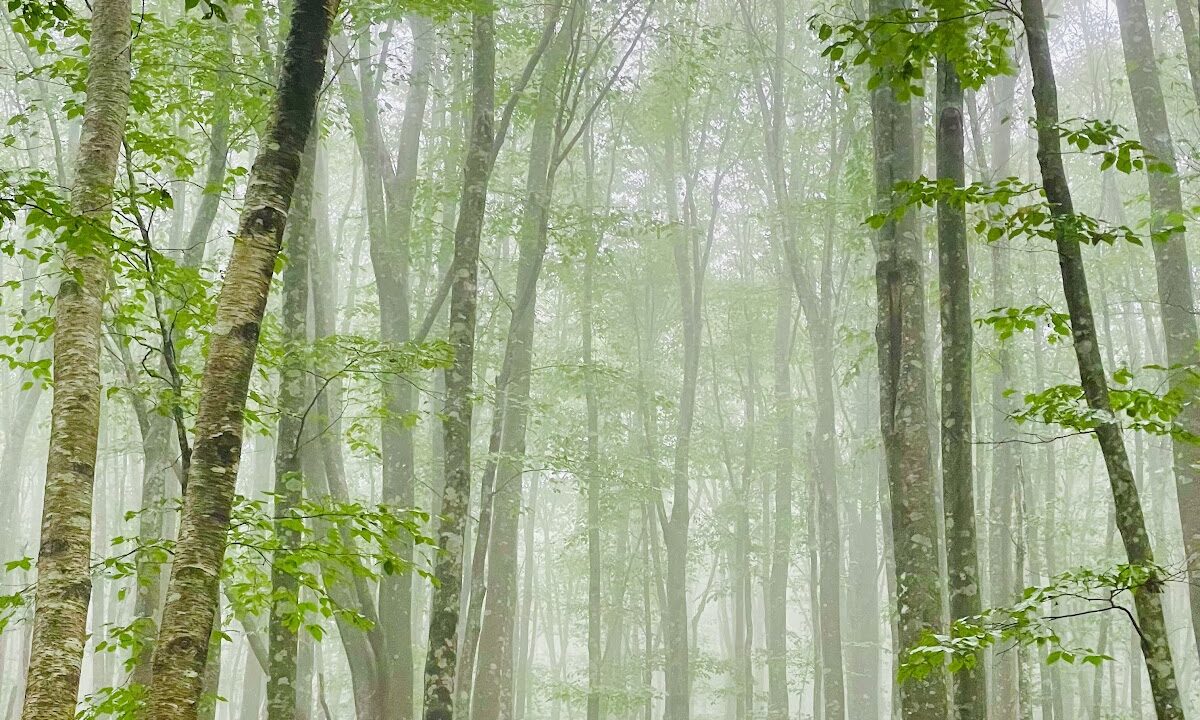
The understory has little undergrowth and good visibility. The dense beech canopy limits light reaching the forest floor, creating an environment where plants other than shade-tolerant young beech trees find it difficult to grow.
Anpi Kogen Beech Secondary Forest as a Tourist Attraction
A Healing Space Selected as One of Japan’s 100 Forest Bathing Spots
The Anpi Kogen Beech Secondary Forest has been selected as one of “Japan’s 100 Forest Bathing Spots” and is known as a healing space rich in negative ions and phytoncides (volatile substances released by trees).
The effects of forest bathing are scientifically proven, with expected health benefits including stress reduction, improved immunity, and lowered blood pressure. Beech forests offer soft dappled sunlight, the rustling of wind-swayed leaves, and bird songs, allowing visitors to experience nature through all five senses.
Especially during early summer’s fresh green season, the vibrant green forest welcomes visitors and provides an optimal environment for physical and mental refreshment.
Trekking Courses and Walking Paths
The Anpi Kogen Beech Secondary Forest features well-maintained trekking courses starting from “Buna no Eki” (Beech Station). The most distinctive feature of this course is the guideposts placed every 25 meters. Even when thick fog occurs, visitors can walk without getting lost, allowing beginners to enjoy forest bathing with peace of mind.
The walking paths are flat and easy to traverse, designed so that families and elderly people can walk comfortably. With little undergrowth in the forest, visibility is clear, allowing visitors to observe beech giants up close while spending a leisurely time.
During the walk, visitors encounter many moments to feel nature’s vitality—the beautiful bark of beech trees, layers of fallen leaves covering the ground, and occasional glimpses of wildlife.
Spectacular Fall Foliage | Golden Forest in Early October
The fall foliage at Anpi Kogen Beech Secondary Forest typically peaks in early October. Beech leaves turn a brilliant yellow, and the golden forest spreading over approximately 1 million square meters is breathtaking.
During the fall foliage season, visitors can walk on a carpet of yellow fallen leaves while bathed in soft dappled sunlight. The ground is covered with soft fallen leaves that make a pleasant rustling sound with each step.
When the temperature difference between morning and evening is large, the colors become particularly vivid. Viewing beech’s golden leaves in the clear autumn air creates a deep emotional impact on visitors.
Stargazing | Night Sky Selected as One of Japan’s 100 Starry Sky Spots
The “Nakano Makiba” area of the Anpi Kogen Beech Secondary Forest is a renowned stargazing location selected as the 5th best in “Japan’s 100 Starry Sky Spots.” Its high elevation and lack of major light sources nearby make it possible to observe a full starry sky.
Visitors can enjoy different celestial shows depending on the season—the summer Milky Way, winter Orion, and meteor showers. The open pasture area surrounded by beech forests is ideal for lying down and watching the stars.
When visiting for astronomical observation, prepare flashlights and warm clothing, and take sufficient precautions for nighttime safety.
Buna no Eki | The Base Facility for Walking
Buna no Eki (Beech Station) is the starting point facility for exploring the Anpi Kogen Beech Secondary Forest. Located at the entrance to the trekking course, it offers information on forest walks, rest areas, and toilets.
Buna no Eki also features exhibits about the history and ecology of the secondary forest, allowing visitors to deepen their knowledge before walking for a more enriching forest experience. Staff are stationed during certain periods and can provide advice about recommended courses and highlights.
It is also recommended to rest at Buna no Eki after the walk and reflect on the nature experienced in the forest.
Forest Nurturing Giant Trees | Coexistence of Mother Trees and Young Trees
One of the attractions of the Anpi Kogen Beech Secondary Forest is the coexistence of mother trees (giant trees) that escaped felling and young regenerated beech. Some mother trees are over 200 years old, and their presence is overwhelming.
These giant trees played an important role in the forest’s regeneration after felling, serving as seed sources. Seeds falling from mother trees germinated and formed the current uniform secondary forest.
When encountering a giant tree during the walk, try touching its trunk. You will feel the strength of a tree that has survived many years and experience nature’s restorative power.
Four-Season Appeal | Seasonal Highlights
Spring (April–May) | Season of Budding and Fresh Greenery
With snowmelt, beech budding begins. Pale green young leaves open one after another, and the entire forest is wrapped in soft green. Spring is also an ideal season for birdwatching as bird songs are active.
Early Summer (June–July) | Deep Green and Forest Bathing
Early summer, when leaves have grown and are covered in deep green, is ideal for forest bathing. The temperature is also mild, and this period is considered when negative ions and phytoncides are most abundant.
Autumn (September–October) | Spectacular Fall Foliage
In early October, golden fall foliage reaches its peak. Walking on a carpet of fallen leaves is a luxurious experience unique to autumn.
Winter (November–March) | Silent Snowy Landscape
During snow season, the beech forest is enveloped in silence. Walking with snowshoes or cross-country skis is possible, allowing visitors to enjoy fantastic winter scenery.
Access Information | How to Get to Anpi Kogen Beech Secondary Forest
Address and Basic Information
Address: Anpi Kogen, Hachimantai City, Iwate Prefecture
Inquiries: Hachimantai City Tourism Association TEL: 0195-78-3500
Access by Public Transportation
- JR: Approximately 65 minutes on JR Hanawa Line from Morioka Station to Anpi Kogen Station. About 10 minutes by taxi from the station.
- Bus: Buses to Anpi Kogen Ski Resort are operated during certain periods, but advance confirmation is necessary due to limited service.
Access by Automobile
- Tohoku Expressway: Approximately 30 minutes from Ashiro IC (now Hachimantai Ashiro IC)
- From Morioka City: Approximately 50 minutes via National Route 282
- Parking: Free parking available near Buna no Eki
Nearby Tourist Attractions
When visiting Anpi Kogen Beech Secondary Forest, it is recommended to enjoy nearby tourist attractions as well.
- Anpi Kogen Ski Resort: Winter skiing and summer golf and highland activities at a comprehensive resort
- Hachimantai Aspite Line: Scenic driving course (closed in winter)
- Hachimantai Hot Spring District: Multiple hot springs scattered throughout the area for relaxation after forest walks
- Matsukawa Hot Spring: A secret hot spring known for its milky-white sulfur waters
Notes and Etiquette for Visiting Anpi Kogen Beech Secondary Forest
Clothing and Supplies
- Clothing: Easy-to-walk shoes (trekking shoes recommended), long sleeves and pants (insect repellent)
- Supplies: Drinking water, towel, rain gear, insect repellent spray, bear bell (bear protection)
- Seasonal: Hat and sunscreen for summer; warm clothing for fall and winter
Nature Conservation Etiquette
- Always take trash with you
- Do not damage plants or trees
- Do not feed wild animals
- Stay on designated walking paths
- No campfires or smoking
Safety Measures
- Avoid going alone; walk in groups
- Be cautious of sudden weather changes; avoid forcing walks in thick fog
- Check for bear sighting information in advance and carry a bear bell
- Confirm mobile phone signal coverage beforehand
Conservation Activities and Future of Anpi Kogen Beech Secondary Forest
The Anpi Kogen Beech Secondary Forest holds high academic value as a successful example of natural restoration. Organizations including the Tohoku Forest Management Bureau and local residents cooperate to continue conservation activities for this precious forest.
Regular forest surveys, maintenance of walking paths, and updating guideposts are continuously undertaken to ensure visitors can safely enjoy forest bathing.
Additionally, the forest is utilized as a venue for environmental education, serving as a natural learning field for elementary and middle school students and as a research field for universities. It has become valuable educational material for learning about the impact of human activities on nature and nature’s recovery potential.
Accommodations in Anpi and Hachimantai Areas | Base for Forest Walks
To thoroughly enjoy Anpi Kogen Beech Secondary Forest, staying nearby is recommended.
Major Accommodations in Anpi Kogen Area
- Anpi Kogen Resort Hotel: Large resort hotel adjacent to the ski resort
- Anpi Grand Hotel: Comprehensive hotel with hot spring facilities
- Pensions and Minshuku: Several small family-style accommodations available
Accommodations at Hachimantai Hot Spring District
- Matsukawa Hot Spring: Hot spring inn with a secret hot spring atmosphere
- Tofushichi Hot Spring: Resort hotel famous for its open-air bath at 1,400 meters elevation
- Hachimantai Mountain Hotel: Resort hotel near the Hachimantai mountain summit
At accommodations, guests can enjoy dishes made with local ingredients and relaxation time in hot springs. A travel plan combining forest walks, hot springs, and local cuisine is recommended.
Conclusion | Experience the Miracle of Natural Restoration at Anpi Kogen Beech Secondary Forest
The Anpi Kogen Beech Secondary Forest in Hachimantai City, Iwate Prefecture, is a magnificent beech forest spanning approximately 1 million square meters that has been restored by nature’s power over approximately 80 years following early Showa period deforestation. Selected as one of “Japan’s 100 Forest Bathing Spots” and “Japan’s 100 Starry Sky Spots,” this location offers beautiful scenery and healing spaces throughout the four seasons.
Well-maintained trekking courses, guideposts placed every 25 meters, and walking paths starting from Buna no Eki ensure that visitors can safely enjoy forest bathing. Particularly during fall foliage season in early October, the golden forest enchants visitors.
With high academic value as a successful example of natural restoration and active use as an environmental education venue, Anpi Kogen Beech Secondary Forest is a place where you can experience the relationship between humans and nature and feel nature’s recovery potential. Please visit this location where you can spend special time refreshed both physically and mentally, surrounded by negative ions and phytoncides.
With excellent accessibility—approximately 65 minutes by JR Hanawa Line from Morioka Station and about 30 minutes by car from Ashiro IC—combined with nearby hot springs and tourist attractions, enjoy a trip to fully experience the rich nature of the Iwate Hachimantai area.