Arakawa Plateau, Iwate Prefecture Complete Guide | Charm of Pastureland Selected as Japan’s First Important Cultural Landscape and How to Enjoy All Four Seasons
Arakawa Plateau, located in the northeast of Tono City, Iwate Prefecture, is a vast highland area spanning from 700 to 1,000 meters in elevation, spreading across the southern foothills of Mount Hayachine. This plateau, covering approximately 2,500 hectares, is a symbolic landscape of Tono, known since ancient times as a horse-breeding region. In March 2008 (Heisei 20), it was selected as Japan’s first nationally designated “Important Cultural Landscape” related to pasturing. This article thoroughly explains the charm of Arakawa Plateau, including tourist spots, access information, and how to enjoy it throughout the four seasons.
What is Arakawa Plateau | Pastoral Scenery Remaining at the Stage of Tono Folktales
Arakawa Plateau is a highland area spreading across the foothills of Mount Yakushi, which continues south from Mount Hayachine at an elevation of 1,917 meters. Tono City is known as the setting for Kunio Yanagita’s “Tono Monogatari” (Tales of Tono), a region where folktales of kappa river spirits and zashiki-warashi house spirits have been passed down. Arakawa Plateau is a precious place where the original landscape of Tono still remains.
First Designation in Japan as Important Cultural Landscape
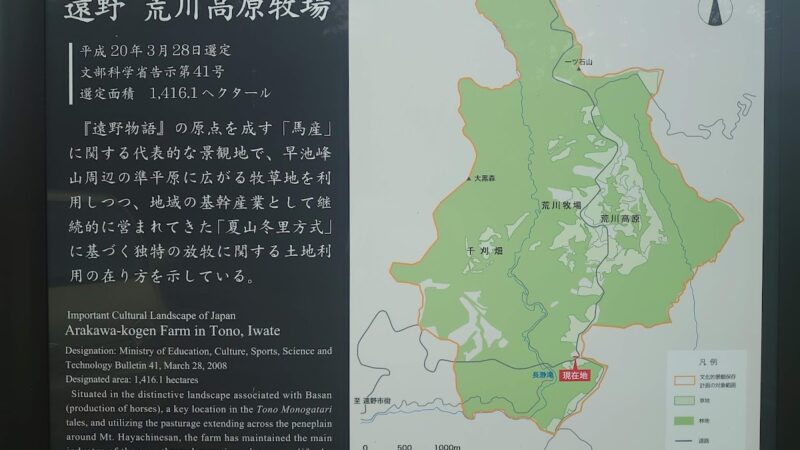
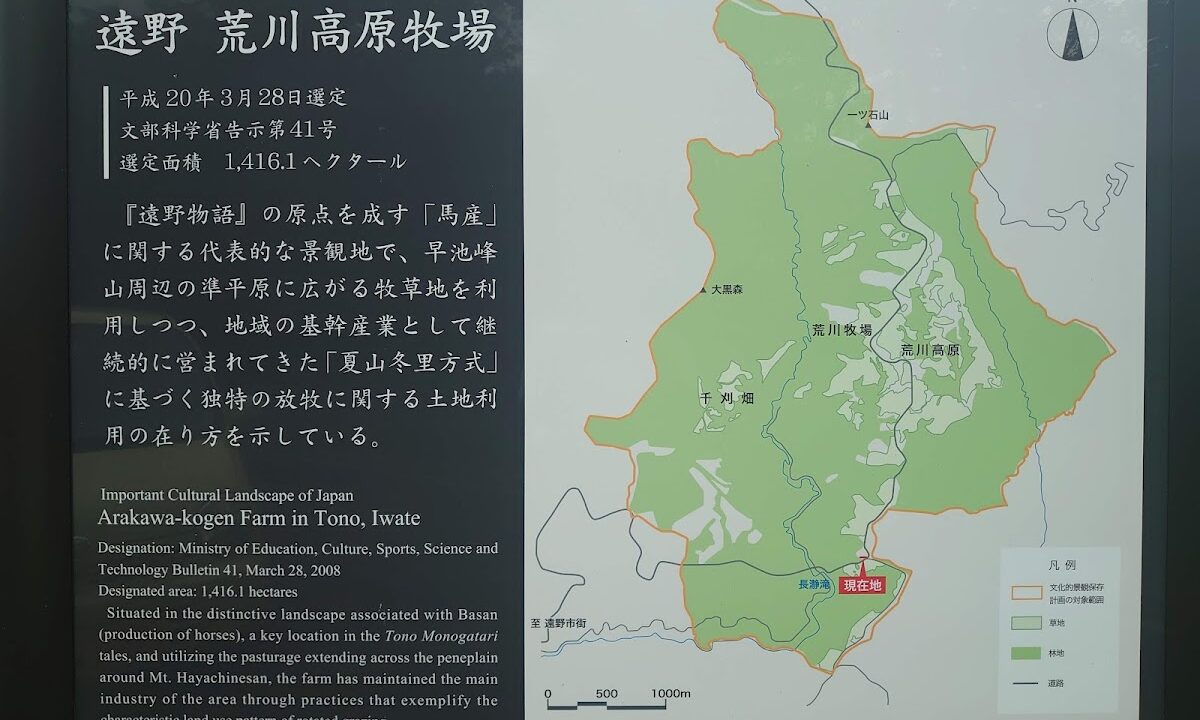
Arakawa Plateau Pasture has spread for centuries along the mountain path connecting Tono City and the former Kawai Village (now part of Miyako City). The pastoring activities passed down over many years have been highly evaluated. Since the Important Cultural Landscape system began in 2005 (Heisei 17), Arakawa Plateau Pasture became Japan’s first site designated for its pasturing-related landscape.
This designation recognizes not merely the beauty of natural scenery, but the cultural value created through the harmony between human activities and nature. The horse-breeding culture of the Tono region and the historical and cultural background of the highland pastureland that supported it have been highly valued.
Geographic Characteristics of Arakawa Plateau
Arakawa Plateau is a highland area ranging from 700 to approximately 1,000 meters in elevation, boasting an expansive area of approximately 2,500 hectares (25 million square meters). Located at the southern foothills of Mount Hayachine, it offers a unique landscape where mountain and plateau scenery converge.
The Arakawa Gorge flowing along the base of the plateau is known for its abundant river fish and is recognized as a spot for stream fishing. It is also used as part of a climbing course to Mount Hayachine from the Tono side, making it familiar to mountain climbing enthusiasts.
The Greatest Appeal of Arakawa Plateau | Encounters with Grazing Horses
The primary reason to visit Arakawa Plateau is undoubtedly the opportunity to see grazing horses. Tono City has long been known as a horse-breeding region and has supported Japan’s horse culture as a breeding ground for “Nanbu horses.”
Grazing Season and Points of Interest
From around June each year through autumn, approximately 100 horses are grazed on Arakawa Plateau. From spring through fall, many horses are sent to pasture and grow healthily in nature. The sight of horses galloping across vast pastureland at nearly 1,000 meters elevation is like a painting and never tires the eye. The pastoral landscape that can never be seen in urban areas—a landscape that might be called Japan’s original scenery—spreads before you.
You will witness various expressions: horses peacefully grazing, sometimes seen with foals staying close by, and groups moving together. Such pastoral scenery, which can never be experienced in cities, unfolds before you.
Appropriate Ways to Interact with Horses
The horses at Arakawa Plateau are livestock being grazed, so there are several precautions to observe when viewing them. Approaching suddenly or making loud noises may startle the horses. The proper etiquette is to maintain an appropriate distance and observe quietly.
Additionally, feeding the horses is basically prohibited. The pasture properly manages the horses’ health, so visitors should avoid giving them food without permission. While photography is freely permitted, it is important to act with respect for the horses’ safety and the pastoring operations.
Arakawa Plateau Road | Appeal as a Scenic Driving Route
The road leading to Arakawa Plateau is popular with many drivers and touring enthusiasts as a spectacular driving route. You can enjoy the changing scenery as elevation increases while driving through the mountain pass.
Driving Highlights
Arakawa Plateau Road is characterized by landscape transitions from forest to highland area. After driving endlessly through a mountain road and passing through the forest, the moment the view suddenly opens to reveal grassland is truly a scenic encounter.
The views along the route are exceptionally good, and driving while viewing the majestic figure of Mount Hayachine is exceptional. On fine days, there are points where you can overlook the entire Tono Basin, allowing you to feel the richness of Iwate’s nature.
Precautions While Driving
The road to Arakawa Plateau is a mountain road with many curves and some narrow sections. Particularly in winter, there is high risk of snow accumulation and icing, making winter tires essential. Also, wild animals may dart into the road, so avoid excessive speed.
Cellular signals are weak in some areas, so it is recommended to check maps and routes in advance. Gas stations are limited, so refuel with a comfortable margin.
Arakawa Plateau Through the Four Seasons | Ways to Enjoy Each Season
Arakawa Plateau presents a different appearance with each season, allowing visitors to enjoy entirely different landscapes depending on when they visit.
Spring at Arakawa Plateau (April–May)
Spring at Arakawa Plateau is a season when new greenery sprouts with the melting snow. Though the highland still retains some chill, the increasingly deep green displays vitality of life. This period is a preparation season for viewing clusters of hydrangeas and rhododendrons, making it suitable for plant observation.
The contrast between Mount Hayachine’s remaining snow and fresh greenery is beautiful and ideal for photography. However, due to the high elevation, mornings and evenings are bitterly cold, so cold-weather clothing is essential.
Summer at Arakawa Plateau (June–August)
Summer is the season when Arakawa Plateau comes most alive. Horse grazing begins around June, and the plateau becomes a paradise for horses. Due to the high elevation, temperatures are lower than in flatland, making it comfortable as a summer retreat.
Clusters of hydrangeas and rhododendrons are at their most beautiful during this period, with colorful flowers adorning the plateau. Well-maintained walking paths allow you to enjoy hiking. The ideal pastoral landscape of summer blue skies, green grassland, and grazing horses can be savored during this finest season.
Autumn at Arakawa Plateau (September–November)
Autumn at Arakawa Plateau is known as a location for autumn foliage. From mid-October through early November typically, maples, oaks, beeches and other trees turn red and yellow, and the entire plateau takes on the appearance of autumn brocade.
The autumn foliage viewed from the roughly 25-million-square-meter plateau spreading east of Mount Hayachine at 1,917 meters elevation is exceptional. Driving or hiking across the plateau, which preserves the landscape representing Tono’s origins, while sensing the deepening of autumn provides a luxurious escape from urban hustle and bustle.
While the peak foliage timing varies with weather conditions, the best viewing period is from mid-October through late November. Weekends can be crowded, so visiting on weekdays or early in the morning is recommended.
Winter at Arakawa Plateau (December–March)
Winter at Arakawa Plateau becomes a world of white snow. Heavy snowfall and harsh road conditions make visiting difficult for general tourists, but the area becomes an attractive field for winter sports enthusiasts engaging in snowshoeing and cross-country skiing.
However, roads may be closed during winter, so preparation and confirmation are essential before visiting. Visiting without knowledge and equipment for winter mountain conditions is not recommended.
Access Information to Arakawa Plateau
Since Arakawa Plateau is located where public transportation access is difficult, visiting by personal or rental vehicle is basically recommended.
Access by Car
From Tono Station
- Travel time: approximately 60 minutes
- Head north on National Route 340 from Tono city center toward Arakawa Plateau
From Chuchū Kawai Station
- Travel time: approximately 60 minutes
- Route for accessing from the Miyako side
From Tono IC
- Travel time: approximately 60 minutes
- Via National Route 340 from Kamaishi Expressway’s Tono IC
Access by Public Transportation
There is no public transportation directly to Arakawa Plateau. The nearest station is Tono Station on the JR Kamaishi Line, from which you will need to use a taxi or rent a car.
Rental car companies are available near Tono Station, so advance reservation is recommended. If using a taxi, the round-trip cost will be substantial, so it is advisable to check for sightseeing taxi plans in advance.
Parking Information
While there is no large dedicated parking lot at Arakawa Plateau, parking is available along roadsides. However, choose appropriate locations so as not to obstruct other vehicles or pasturing operations.
Tourist Spots Around Arakawa Plateau
Visiting nearby attractions when you visit Arakawa Plateau allows you to experience Tono’s charm more deeply.
Mount Hayachine
At 1,917 meters elevation, Mount Hayachine is the highest peak of the Kitakami Mountains and one of Japan’s One Hundred Famous Mountains. Known as a treasure house of alpine plants, endemic species such as Hayachine-ususyukisou can be seen. Arakawa Plateau is used as part of a climbing course to Mount Hayachine from the Tono side.
Tono Furusato Village
A facility where you can experience traditional rural culture of Tono. Old farmhouses such as magariya (bent houses) have been relocated and preserved here, allowing you to experience old-fashioned rural life. It is a popular spot for experiencing the world of Tono Monogatari.
Kappa Buchi
The setting for the kappa legend appearing in Tono Monogatari. Located behind Joukkenji Temple, this small stream is where kappa are said to still appear. It is easily accessible from Tono city center.
Tono-gō Hachiman Shrine
An ancient shrine that has long been worshipped as the chief shrine of Tono. The annual festival features performances of local arts and culture, allowing you to touch Tono’s culture.
Ways to Enjoy Arakawa Plateau | Activities and Events
At Arakawa Plateau, you can experience various activities beyond simply enjoying the scenery.
Hiking and Trekking
Well-maintained walking paths at Arakawa Plateau allow you to enjoy hiking. Hiking in the fresh mountain air of the plateau provides refreshment for both body and mind. It is also used as an entrance to Mount Hayachine climbing and allows for serious trekking.
Photography
Arakawa Plateau is an excellent photography spot. Grazing horses, vast grassland, Mount Hayachine’s appearance, and nature through all seasons provide no shortage of subjects. Light is especially beautiful at dawn and dusk, attracting photographers of all skill levels.
Bird Watching
The highland is home to various wild birds. Bringing binoculars offers opportunities to encounter birds you would not normally see.
Stargazing
With high elevation and minimal light pollution from surrounding areas, Arakawa Plateau is suitable for stargazing. On clear nights, you can enjoy a starry sky in all its splendor. However, nighttime visits require careful attention to safety.
Precautions When Visiting Arakawa Plateau
To safely enjoy Arakawa Plateau, please note the following points.
Clothing and Equipment
Due to high elevation, temperatures are lower than in flatland. Particularly at dawn and dusk, it becomes quite cold, so prepare seasonal cold-weather clothing. Even in summer, a long-sleeved jacket is essential. Also, wearing comfortable walking shoes is recommended.
Weather Changes
As a mountainous area, weather can change suddenly. Check weather forecasts in advance, and consider avoiding visits if bad weather is predicted. Fog reduces visibility and makes driving dangerous.
Items to Bring
Prepare drinking water and light snacks in advance. There are almost no shops or vending machines around the plateau. Also, cellular signals are weak in some areas, so prepare maps or navigation devices for peace of mind.
Restroom Facilities
Restroom facilities around Arakawa Plateau are limited. It is recommended to use facilities in Tono city before visiting.
Trash Disposal
There are no trash bins at Arakawa Plateau. Visitors must bring all their trash with them and help preserve the beautiful landscape.
History and Cultural Background of Arakawa Plateau
To deeply understand the charm of Arakawa Plateau, it is important to know its history and cultural background.
Tono’s Horse-Breeding Culture
The Tono region has long been known as a horse-breeding area, supporting Japan’s horse culture as a breeding ground for “Nanbu horses.” Nanbu horses, valued for their good physique and persistent temperament, were treasured as draft horses and military horses.
During the Edo period, horse breeding was encouraged as an important industry of the Nanbu Clan, making Tono a major horse-breeding center. Even after the Meiji period, it continued to play an important role as a supplier of military horses.
Pastoring Activities and Formation of Landscape
Pasturing at Arakawa Plateau is not merely a livestock herding method but a cultural practice formed over many years. The seasonal movement of grazing horses on the plateau from spring through fall and keeping them in lower areas during winter was a sustainable livestock method utilizing the natural environment.
Such pastoring activities created the characteristic landscape of Arakawa Plateau. The grassland maintained through appropriate human intervention, the horses utilizing it, and the surrounding natural environment in harmony together constitute a landscape truly worthy of being called a “cultural landscape.”
Value as Important Cultural Landscape
In 2005 (Heisei 17), the Cultural Properties Protection Law was revised, establishing “Important Cultural Landscape” as a new type of cultural property. This system protects landscape areas shaped by local people’s lives, livelihoods, and natural conditions—areas indispensable for understanding the Japanese people’s way of life.
Arakawa Plateau Pasture was designated in March 2008 (Heisei 20) as “Tono Arakawa Plateau Pasture Tsuchifuchi Yamaguchi Settlement,” becoming Japan’s first Important Cultural Landscape designated for pasturing-related scenery. This designation recognizes that Arakawa Plateau’s landscape possesses cultural value formed and preserved through human activities over long history, not merely natural beauty.
Best Season for Arakawa Plateau and Crowd Conditions
The best time to visit Arakawa Plateau varies depending on your purpose.
For Seeing Pasturing: June–September
Horse grazing primarily occurs from June through September. Visiting during this period guarantees seeing horses grazing on the plateau. Particularly from July through August, with stable weather, you can enjoy the ideal sight of blue skies, green grassland, and horses.
For Autumn Foliage: Mid-October to Early November
For the most beautiful fall colors, mid-October through early November is the best season. However, this period is highly popular, and weekends can be crowded. Visiting on weekdays or during early morning and evening hours allows relatively peaceful enjoyment of foliage.
For Flowers: June–July
To see clusters of hydrangeas and rhododendrons, June through July is peak season. Flowers on the plateau, blooming later due to high elevation, appear later than in flatland areas.
To Avoid Crowds: Weekdays and Early Morning
While Arakawa Plateau is relatively uncrowded, weekends and holiday periods during foliage season can see increased visitors. For quiet enjoyment of the landscape, weekday visits or early morning hours are recommended.
Mount Hayachine Climbing and Arakawa Plateau
Arakawa Plateau is used as part of a climbing route to Mount Hayachine from the Tono side.
Mount Hayachine Climbing Course
Mount Hayachine has several climbing routes, and the Tono-side course uses Arakawa Plateau. With large elevation gain and long climbing time, the appeal is being able to enjoy the plateau’s scenery while climbing.
The climbing season is approximately June through October, with July–August being a beautiful period for alpine flowers. However, Mount Hayachine’s weather changes readily, requiring thorough preparation and climbing experience.
Climbing Precautions
Mount Hayachine, one of Japan’s One Hundred Famous Mountains, requires proper mountaineering equipment. A climbing plan submission, appropriate gear, sufficient strength, and experience are required. Avoid climbing with only beginners and consider climbing with experienced partners or using a guided tour service.
One-Day Tono Tourism Model Course Including Arakawa Plateau
Here is a one-day tourism model course for the Tono area including Arakawa Plateau.
One-Day Course
Morning
- 9:00 Depart from Tono Station
- 9:30 Visit Kappa Buchi and Joukkenji Temple
- 10:30 Experience traditional culture at Tono Furusato Village
Lunch
- 12:00 Enjoy local cuisine in Tono city center (hittsumi, jingisukan lamb, etc.)
Afternoon
- 13:30 Head toward Arakawa Plateau
- 14:30 Arrive at Arakawa Plateau, observe grazing scenery and photography
- 16:00 Depart Arakawa Plateau
- 17:00 Arrive at Tono Station
This course allows efficient touring of Tono’s major tourist attractions and Arakawa Plateau. With extra time, consider adding Tono-gō Hachiman Shrine or Denshoen.
Gourmet Information Around Arakawa Plateau
Since there are no restaurants near Arakawa Plateau, you will dine in Tono city center. Here is Tono’s distinctive cuisine.
Jingisukan
Jingisukan (lamb dish) is a specialty of Tono. Branded as “Tono Jingisukan,” the city has many jingisukan specialty restaurants.
Hittsumi
A local dish where wheat dough is kneaded thin, stretched, and torn by hand before being added to soup. Simple yet deeply flavorful, it is especially delicious during cold seasons.
Nanbu Senbei
Traditional crackers from the Nanbu region of Iwate Prefecture, available in various flavors. Suitable as souvenirs.
Doburoku
Tono produces doburoku (cloudy sake) using special zone provisions. Restaurants serve locally-made doburoku.
Summary | Fully Savor Arakawa Plateau’s Charm
Arakawa Plateau in Tono City, Iwate Prefecture, is a precious location designated as Japan’s first Important Cultural Landscape for pasturing. The sight of horses grazing across 2,500 hectares of grassland spanning 700–1,000 meters elevation is truly Japan’s original scenery itself.
Arakawa Plateau presents different appearances through each season—spring greenery, summer grazing, autumn foliage, and winter snow—offering new discoveries whenever you visit. Popular as a scenic driving route, it is a precious tourism spot where you can simultaneously experience Tono’s culture and nature, the setting of Tono Monogatari.
Though access is somewhat inconvenient, this allows you to enjoy pristine nature and quiet solitude. When visiting Tono, be sure to extend your trip to Arakawa Plateau to experience Japan’s beautiful cultural landscape. The pastoral scenery of grazing horses will surely become a cherished memory.
When visiting, prepare appropriate clothing and equipment, and fully savor Arakawa Plateau’s charm while respecting natural environments and pastoring activities.