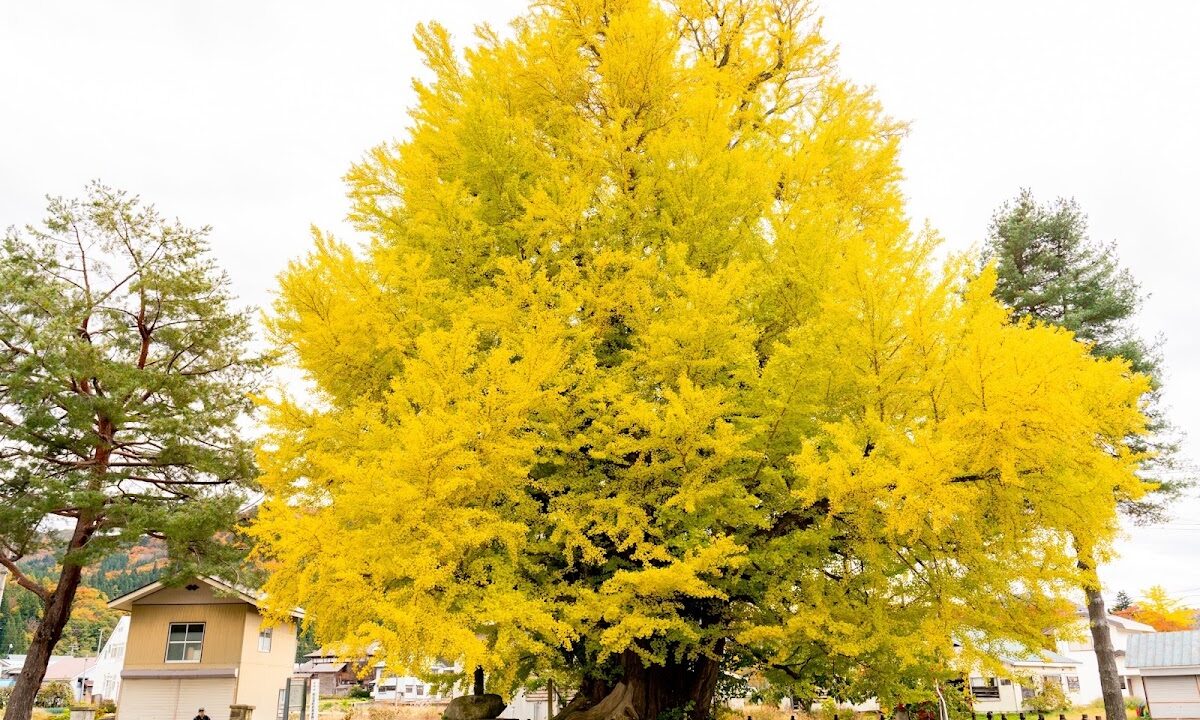
The Great Ginkgo of Komachi, Fukushima Prefecture | Complete Guide to a 800-Year-Old Giant Tree and Autumn Foliage Viewing Spots
The “Great Ginkgo of Komachi” standing in the Komachi district of Minamiaizu Town, Minamiaizu County, Fukushima Prefecture, is the most magnificent giant tree in Fukushima Prefecture, boasting an age of over 800 years. Designated as a natural monument of the prefecture and selected as one of “Fukushima’s Hundred Scenic Green Landscapes,” this ancient tree enchants many visitors each autumn with its spectacular golden foliage.
About the Great Ginkgo of Komachi
The Great Ginkgo of Komachi stands on the south side of the schoolyard of the former Ina Elementary School (now closed) in Komachi, former Ina Village, and is one of Japan’s most notable large ginkgos. Its impressive appearance can be confirmed from a distance and has long been cherished as a symbol of the community.
Overwhelming Scale
- Age: Over 800 years (estimated)
- Height: Approximately 35 meters
- Root circumference: Approximately 16 meters
- Girth at breast height: Approximately 11 meters
These figures rank first in Fukushima Prefecture, and standing before this tree, one is overwhelmed by its immensity. The height of 35 meters is equivalent to about a 10-story building, and the root circumference of 16 meters is so wide that it takes over 10 adults with outstretched arms to barely encircle it.
Value as a Natural Monument
The Great Ginkgo of Komachi has been officially recognized as a Fukushima Prefecture-designated natural monument, with its academic and cultural value highly valued. Additionally, it has been selected as one of “Fukushima’s Hundred Scenic Green Landscapes,” making it one of Fukushima Prefecture’s representative natural spots.
History and Origins
History from the Kenkyū Period
This great ginkgo is said to have been planted during the Kenkyū period (1190-1199). According to tradition, when one of the four Aizu families, Kurokawa Castle Lord Shigenori Kawahara (also known as Morimichi Kawahara), built the Higashitachi mansion and had retainers live there, a garden tree was planted at that time, which is believed to be the origin of this tree.
Planted in the early Kamakura period, a turning point in Japanese history, this tree coincides with the era when Minamoto no Yoritomo became the Seii Taishogun and established the Kamakura Shogunate. For over 800 years since then, it has continued to watch over the history of this region.
Connection to Kurokawa Castle Ruins
The Great Ginkgo of Komachi is one of the historical heritage sites related to the ruins of Kurokawa Castle. Kurokawa Castle was one of the important bases in the Aizu region and was the residence of the Kawahara clan when they ruled this area. The great ginkgo was planted as a garden tree of the mansion at that time and has become a precious existence conveying vestiges of samurai culture to the present day.
Faith as the “God of Lactation”
The trunk of the Great Ginkgo of Komachi has several aerial roots hanging down in shapes like breasts (knobs). From this distinctive shape, in ancient times it was the subject of faith as the “God of Lactation,” and it is said that women praying for abundant breast milk came as visitors.
Aerial roots of ginkgos are a characteristic that appears in ancient trees that have accumulated many years, and the aerial roots of this great ginkgo are particularly well-developed, making it an impressive sight worthy of veneration.
The Alternate Name “Snow-Viewing Ginkgo”
It is also called the “Snow-Viewing Ginkgo” as an affectionate nickname among local residents. This derives from an interesting tradition unique to a snowy region.
- Years when leaves fall all at once: Snow falls early and ground frost comes early
- Years when leaves fall sporadically: Snow falls late and ground frost comes late
This observation of natural phenomena has been utilized by local people as a guide for agricultural work. The wisdom of life based on long-standing experience is embedded in this great ginkgo.
Autumn Foliage Viewing Spots and Best Viewing Period
The Golden Spectacle of Shining Autumn
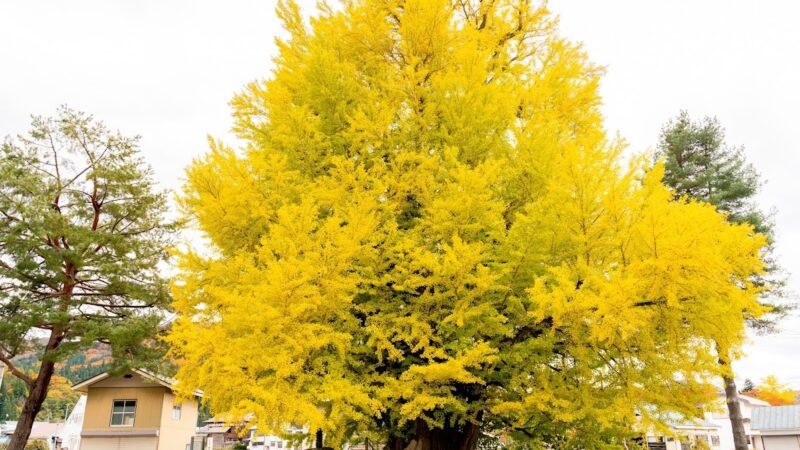
The greatest charm of the Great Ginkgo of Komachi is the autumn foliage season. Its appearance dyed in the vivid yellow characteristic of ginkgos creates a truly spectacular sight worthy of being called a “tree of gold.”
The way the enormous tree body, with its height of 35 meters and girth of 11 meters, turns completely yellow has an impact unmatched elsewhere. The golden leaves shining against a blue sky are stunningly beautiful, captivating all who visit.
Best Viewing Period for Autumn Foliage
Late October to early November is the typical best viewing period.
The Minamiaizu region has high elevation and experiences the autumn foliage season relatively early compared to other parts of Fukushima Prefecture. Depending on the climate conditions of that year, it generally follows this progression:
- Mid-October: Color begins to appear
- Late October: Beginning of peak viewing
- Early November: Peak season
- Mid-November: Leaves fall
When planning a visit, it is recommended to check with local tourism associations or the latest autumn foliage information.
The Carpet of Fallen Leaves is Also Spectacular
After peak foliage and the leaves begin to fall, the ground becomes carpeted with yellow leaves. This sight is also extraordinary, and the experience of walking on a golden carpet of fallen leaves is extremely memorable.
The timing of leaf fall is related to the climate of that year, as the legend of the “Snow-Viewing Ginkgo” suggests, with some years seeing all leaves fall at once and other years seeing gradual scattering.
Winter Snowy Landscape
The Great Ginkgo Dressed in Snow
Even after the foliage season ends, the charm of the Great Ginkgo of Komachi continues. The Minamiaizu region is known as a heavy snowfall area, and in winter, the landscape becomes a world of silver.
The appearance of the great ginkgo adorned with snow has a different kind of solemn beauty from the autumn foliage. Snow accumulates on the leafless branches, and the contrast of white and black creates a serene and powerful winter scene.
Precautions for Winter Visits
When visiting in winter, the following points require attention:
- Snow and ice measures: Studless tires and winter equipment are essential
- Cold weather preparation: Minamiaizu winters are extremely cold, so prepare adequate winter clothing
- Daylight hours: Winter has short days, so plan visits early
- Road conditions: Roads may be closed during snowfall
Development as Ina Great Ginkgo Park
The area surrounding the Great Ginkgo of Komachi has been developed as “Ina Great Ginkgo Park,” providing a comfortable environment for visitors to appreciate the tree.
Park Facilities
The park, utilizing the schoolyard of the former Ina Elementary School, has the following facilities:
- Parking lot: Free parking spaces available (approximately 20 spaces)
- Information board: Explanations of the ginkgo’s history and characteristics
- Benches: Rest areas
- Walking trail: Strolling around the great ginkgo is possible
During peak foliage season, many tourists visit, and parking may become crowded. Weekday or early morning visits are recommended if possible.
Photography Spots
The great ginkgo can be photographed from various angles.
- Full view from the front: Emphasizes the height of the tree
- Looking up from the base: Photographs the impressive trunk and branching
- From a distance: Composition including surrounding scenery
- Together with fallen leaves: Including the golden carpet on the ground
Access Information
Address
Fukushima Prefecture, Minamiaizu County, Minamiaizu Town, Komachi, Iiheijira
Within the grounds of the former Ina Elementary School (currently closed)
Access by Car
Route from Tohoku Expressway
- From Nishinasushio-Shiobara IC via National Route 400, approximately 1 hour 30 minutes
- From Aizuwakamatsu IC via National Routes 121 and 118, approximately 1 hour 20 minutes
Minamiaizu Town is located in a mountainous area with many curves on mountain roads. Please drive carefully if you are not confident in your driving skills.
Parking: Free (approximately 20 spaces)
Parking tends to be crowded during foliage season, so arriving early is recommended.
Access by Public Transportation
Aizu Railway Aizu Line “Aizu Tajima Station” is the nearest station
- Board the Aizu Bus “Ina/Hinoemata direction” bound bus from Aizu Tajima Station
- Get off at “Komachi” bus stop, approximately 5 minutes on foot
Bus service is limited, so it is strongly recommended to confirm the schedule in advance. Especially on foliage season weekends, be sure to check the return bus times.
Aizu Bus Inquiry
Operating status and schedules can be confirmed through the Aizu Bus official website or by phone.
Tourist Information Office
Ina Tourism Center
Provides tourism information for Minamiaizu Town and offers the latest information about the Great Ginkgo of Komachi. You can inquire about the best foliage viewing period, nearby tourist attractions, and event information.
Nearby Tourist Attractions
When visiting the Great Ginkgo of Komachi, it is recommended to also visit other natural spots and attractions in the Minamiaizu region.
Maesawa Magari-ya Cluster
A thatched-roof village designated as an Important Preservation District for Groups of Traditional Buildings. A precious place where Japan’s original scenery remains, approximately 20 minutes by car from Komachi.
Hinoemata Village
Known as the gateway to Oze, a village nestled in deep mountains. Traditional culture such as Hinoemata kabuki and kiri soba thrives here. Approximately 40 minutes by car from Komachi.
Aizu Tajima Gion Festival
Held in July each year, one of Tohoku’s representative summer festivals. Held around Aizu Tajima Station, with elaborate floats parading through town.
Minamiaizu Hot Springs
- Tokusa Hot Spring: A secluded hot spring known as a hidden gem
- Yunohana Hot Spring: A hot spring near Aizu Tajima
- Hinoemata Hot Spring: A hot spring serving as a base for Oze tourism
Precautions for Visiting
Manners and Rules
- Respect for private property and school grounds: Although on former school grounds, please observe proper manners when viewing
- Carry out all trash: For nature conservation, always take trash with you
- Caution about touching the tree: As a natural monument, be careful not to damage the tree
- Consideration for surrounding residents: Residential areas are nearby, so be considerate of noise and other impacts
About Photography
Personal photography is free, but commercial use may require prior permission. Additionally, drone use requires consideration for surrounding residents and other tourists.
Best Visiting Times
- Early morning: Few people, and the great ginkgo is beautiful in the morning light
- Morning: Good lighting conditions for photography
- Evening: The yellow foliage tinted by sunset also has charm
During peak foliage season (especially weekends), there is crowding, so weekday or early morning visits are recommended.
Nearby Dining and Local Specialties
Minamiaizu Local Cuisine
- Tachi soba: Hand-made buckwheat noodles using 100% buckwheat flour without binders
- Shingorou: Glutinous rice pounded and grilled with miso
- Mountain vegetable dishes: Delicacies from nature’s abundance
Roadside Stations and Direct Sales Shops
Around Aizu Tajima, there are direct sales shops dealing in local specialties where fresh vegetables and processed foods can be purchased.
Charms of All Four Seasons
Spring (April-May)
The season of new green. Young leaves bud forth, showing a figure full of vitality.
Summer (June-August)
Dense green leaves flourish, and the shade is refreshing. The contrast between the summer blue sky and green foliage is beautiful.
Autumn (September-November)
The most popular autumn foliage season. A spectacular golden landscape unfolds.
Winter (December-March)
A solemn appearance dressed in snow. The winter great ginkgo wrapped in silence also has exceptional charm.
Summary
The Great Ginkgo of Komachi is the most magnificent giant tree in Fukushima Prefecture, bearing the passage of over 800 years. Since its planting in the Kenkyū period, it has continued to watch over Aizu’s history, revered and cherished by local people.
Especially during the autumn foliage season, the enormous tree body with its height of 35 meters and girth of 11 meters shines with brilliant golden color, creating a spectacular sight. Designated as a natural monument and selected as one of “Fukushima’s Hundred Scenic Green Landscapes,” this ancient tree is a natural spot well worth visiting.
Relatively good access is available from Aizu Tajima Station, whether by car or public transportation. As part of a journey to experience the abundant nature and history of Minamiaizu, please visit the Great Ginkgo of Komachi.
The great ginkgo shows different faces throughout the four seasons—not just during foliage season but with fresh green in spring, deep green in summer, and snow-dressed beauty in winter. The figure of this mighty tree, standing strong for 800 years across time, will surely move all who come to visit.