
Hibiya Park Complete Guide | Charm and Enjoyment of a Historic Urban Park in Central Tokyo
Hibiya Park, located in Chiyoda Ward, Tokyo, is an oasis in the city center that boasts over 100 years of history as Japan’s first modern Western-style park, which opened during the Meiji era. While situated in the heart of a business district, this special space where seasonal nature and historic structures harmonize has continued to be loved by many people.
Basic Information about Hibiya Park
Location and Access
Hibiya Park is located in Hibiya Park, Chiyoda Ward, Tokyo, and is adjacent to the Imperial Palace Outer Gardens and the Kasumigaseki government office district. With an area of approximately 161,636.66 square meters (approximately 16 hectares), it provides vast green space in the heart of the city.
Main access methods:
- Tokyo Metro Marunouchi Line/Chiyoda Line “Kasumigaseki Station” 2 minutes walk from Exit B2
- Tokyo Metro Hibiya Line/Chiyoda Line “Hibiya Station” 2 minutes walk from Exits A10/A14
- Toei Mita Line “Uchisaiwaicho Station” 3 minutes walk from Exit A7
- JR “Yurakucho Station” 8 minutes walk from the Hibiya exit
Accessible from multiple train lines, it boasts excellent location convenience even within walking distance from Tokyo Station.
Operating Hours and Admission Fee
Hibiya Park is open year-round, and admission is free. However, some facilities within the park (Hibiya Public Hall, Matsumoto-ro Restaurant, etc.) have their own operating hours and usage fees.
As the park is also open at night, you can enjoy the illuminated fountains and night views, but daytime use is recommended for safety reasons.
History of Hibiya Park
Birth of Japan’s First Modern Western-Style Park
Hibiya Park opened on June 1, 1903 (Meiji 36), as Japan’s first modern Western-style park. Before the park was established, this area was the residence of the Mouri clan of the Choshu domain, and after the Meiji Restoration, it was used as a military training ground.
The park’s design was undertaken by Dr. Shizoku Honda, then head of Tokyo City’s Parks Division, and German engineer Georg de Lalande. Western park design techniques were incorporated while reflecting unique landscaping philosophy adapted to Japan’s natural environment.
Revolutionary Facilities at the Time of Opening
When Hibiya Park opened, it was equipped with facilities that were groundbreaking for the time:
- Western-style flower beds: Geometrically designed flower beds
- Fountains: Western-style fountains, which were rare in Japanese parks
- Music hall: Outdoor concert facilities
- Sports facilities: Tennis courts and others
- Restaurant: Dining facilities within the park
These facilities symbolized the spirit of the Meiji era, which actively embraced Western culture.
The Great Kanto Earthquake and Reconstruction
In the Great Kanto Earthquake of 1923 (Taisho 12), Hibiya Park suffered significant damage. However, the park played an important role in saving many lives by serving as an evacuation site. During post-earthquake reconstruction, the park was reorganized with strengthened disaster prevention functions, laying the foundation for its current form.
From Postwar Period to Present
After World War II, Hibiya Park became a venue for democratization movements and various social movements, also serving as a “forum for free speech.” The Hibiya Public Hall was constructed in 1961, and the park developed as a center for cultural and artistic expression.
In 2003, the park celebrated its 100th anniversary, and park facilities were renovated as part of commemoration projects. Under the management of Tokyo Metropolitan Government, the park continues to evolve as an urban park that preserves its historical value while responding to modern needs.
Highlights of Hibiya Park
The Grand Fountain and the First Flower Bed
The grand fountain, which can be considered the symbol of Hibiya Park, is located in the center of the park. It is a circular fountain approximately 30 meters in diameter, surrounded by seasonal flower beds called the First Flower Bed.
The fountain regularly sprays water, and rainbows can sometimes be seen on sunny days. At night, it is illuminated, creating a romantic atmosphere. The First Flower Bed features tulips in spring, salvia in summer, and cosmos in autumn, entertaining visitors throughout the seasons.
Shinnji Pond and the Crane Fountain
Shinnji Pond is a Japanese garden-style pond located on the south side of Hibiya Park. Named after its shape, which resembles the character for “heart,” the pond features a graceful fountain in its center called the “Crane Fountain.”
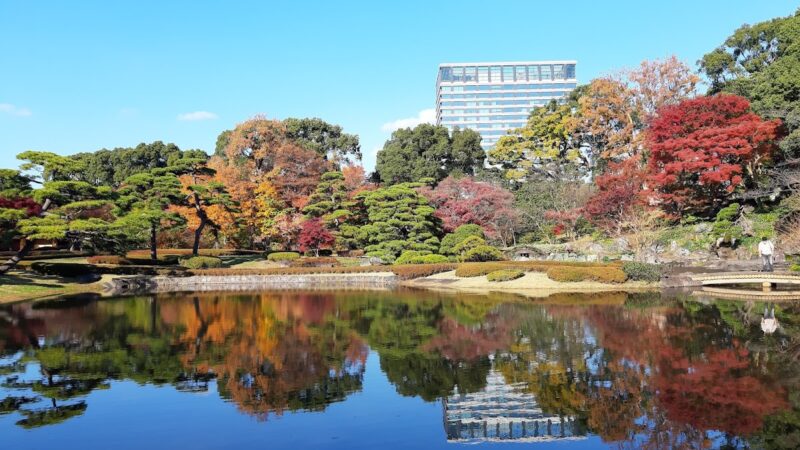
A walking path is maintained around the pond, allowing visitors to enjoy the changing seasons in a quiet atmosphere. Carp swim in the pond, and waterfowl can be seen along the water’s edge. Particularly during the season of fresh greenery and fall foliage, you can enjoy natural beauty that belies the urban setting.
Kumogata Pond and the Pelican Fountain
Kumogata Pond is another pond located north of Shinnji Pond. As its name suggests, it has a cloud-like shape, with the “Pelican Fountain” at its center. This fountain dates back to the park’s opening and holds significant historical value.
The area around Kumogata Pond is also lush with greenery, with many benches, making it an ideal spot for reading or resting.
Hibiya Public Hall
Hibiya Public Hall, constructed in 1929 (Showa 4), is a historic structure and multipurpose facility with a large hall that can accommodate over 2,000 people. It has hosted various events including concerts, lectures, and ceremonies.
The building is an important example of post-earthquake reconstruction architecture and holds significant architectural-historical value. The exterior features solid brick construction, and the interior is decorated with ornamental design.
From 2016, major renovation work was conducted, implementing seismic reinforcement and modernization of facilities. The building has been revived as a facility that preserves its historic appearance while responding to modern usage needs.
Hibiya Library and Culture Museum
Hibiya Library and Culture Museum, which opened in 2011, is a multipurpose cultural facility operated by Chiyoda Ward. In addition to library functions, it features exhibition spaces, a café, and a convention hall.
The collection includes approximately 200,000 volumes, with materials on Chiyoda Ward’s history and culture particularly well represented. Regular exhibitions, lectures, and workshops are also held, making it a hub for cultural dissemination.
At the café inside the museum, you can enjoy reading and café time while gazing at the park’s greenery.
Outdoor Music Halls, Large and Small
Hibiya Park has two outdoor music facilities.
The Outdoor Grand Music Hall is a large-scale outdoor stage that can accommodate approximately 3,000 people, hosting concerts and events primarily during summer months. It is popular as a valuable venue for enjoying music in an open-air setting.
The Outdoor Small Music Hall is a smaller facility used for acoustic live performances, talk events, and the like.
These facilities are beloved by many music fans as places to casually enjoy outdoor events in the city center.
Matsumoto-ro
Matsumoto-ro is a historic restaurant that began operations when Hibiya Park opened in 1903. Specializing in Western cuisine, it is particularly famous for its curry rice.
The building was destroyed in the Great Kanto Earthquake but was rebuilt; the current structure was constructed after the disaster. In the retro-styled interior, diners can enjoy meals while feeling the weight of history.
There is also a terrace seating area where you can enjoy an elegant lunch while looking out over the park’s greenery. Every September 25, a “10-Yen Curry Charity” event is held, becoming a signature event that draws long lines.
The Icho Tree with Staked Life
Known as a symbol tree of Hibiya Park, the “Icho Tree with Staked Life” is a giant tree estimated to be over 400 years old.
When the park was being constructed, there was a plan to run a road through this location, and the icho tree was scheduled for felling. However, Dr. Shizoku Honda insisted on transplanting it, “staking his life” on the success. At the time, this was a groundbreaking large-tree transplant. The tree came to be called the “Icho Tree with Staked Life” from this anecdote.
Today it stands majestically on the north side of the park, and in autumn, its beautiful yellow foliage captivates visitors.
Rupia Romana (Roman Stone Pillar)
An ancient Roman stone pillar gifted to Tokyo City from Rome, Italy, is installed within Hibiya Park. It is a valuable presence as a symbol of international exchange and as a historic artifact.
The Liberty Bell
A replica of the “Liberty Bell” gifted from the United States is installed in the park. It is carefully preserved as a symbol of Japan-U.S. friendship and as a symbol of peace.
Seasonal Enjoyment
Spring: Cherry Blossoms and Flower Bed Displays
Spring at Hibiya Park begins with cherry blossoms. Approximately 40 cherry trees are planted throughout the park, centering on Somei Yoshino, which come into bloom from late March to early April.
As a cherry blossom viewing spot, the area around Shinnji Pond and the northern section of the park are particularly beautiful, drawing crowds of flower viewers. However, as open fires are prohibited at Hibiya Park, picnic-style flower viewing parties are not possible, but flower viewing while walking is certainly enjoyable.
The First Flower Bed features vibrant pansies and petunias in spring, making a striking contrast with the grand fountain. In May, azaleas and roses also bloom, enveloping the entire park in floral fragrance.
Summer: Fresh Greenery and Event Season
Summer at Hibiya Park is covered in deep green, becoming a cool space that alleviates the heat of the city center. The shade created by large trees is valued as a lunch spot and rest area for business people.
The outdoor music hall hosts numerous concerts and events during the summer season, livening up summer nights. Summer festivals and bon odori (traditional dances) are also held, making the park a venue for community exchange.
The First Flower Bed features summer flowers such as salvia and marigolds, offering vibrant colors.
Autumn: Fall Foliage and Autumn Flowers
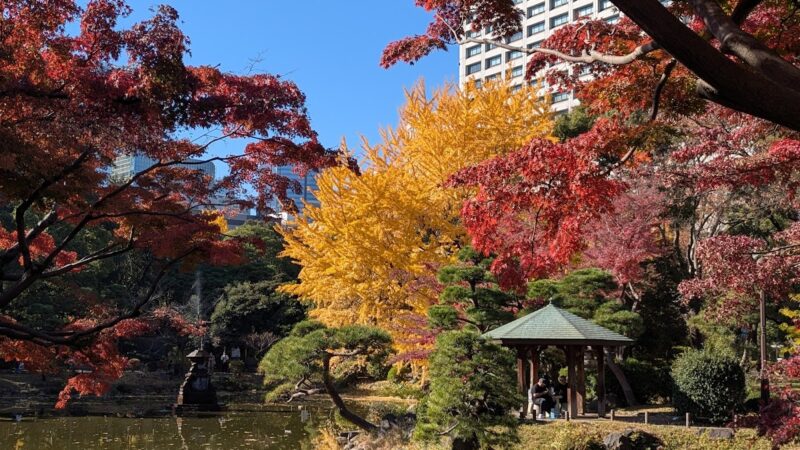
Autumn at Hibiya Park captivates visitors with the beauty of fall foliage. In particular, the yellow leaves of the “Icho Tree with Staked Life” are spectacular, with the best viewing time from mid to late November.
Beyond the icho tree, ginkgo, Japanese maple, zelkova, and cherry trees also change color, and the scenery of foliage reflected in the water around Shinnji Pond is particularly reputed to be beautiful.
The First Flower Bed features autumn flowers such as cosmos and salvia, with striking harmony with the fountain. The mild climate makes it an ideal season for walking.
Winter: Illuminations and Beauty in Silence
Winter at Hibiya Park brings out the unique character of trees that have shed their leaves. On clear days, the blue sky and tree silhouettes create a beautiful contrast.
From December to February, combined with the illuminations of surrounding buildings, the nighttime park is enveloped in a fantastic atmosphere. In particular, the illumination of the grand fountain continues through winter, making it also a popular romantic date spot.
In the winter flower beds, cold-resistant flowers such as pansies and violas are planted, allowing visitors to enjoy color even in winter.
Events and Programs
Regularly Held Events
Various events are held at Hibiya Park throughout the year.
Gardening Shows: Spring and autumn garden events featuring the latest gardening techniques and plants.
Oktoberfest: An event modeled after Germany’s beer festival where you can enjoy authentic beer and cuisine.
Tokyo Christmas Market: A European-style Christmas market held in winter featuring Christmas merchandise and food stalls.
Various Food Festivals: Events such as Thai Festival, Ramen Festival, and others are held.
Musical Events
The outdoor music hall hosts concerts in diverse genres including classical, jazz, rock, and pop. Free public concerts are regularly held, allowing people to enjoy music casually.
Cultural Events
Hibiya Library and Culture Museum frequently hosts lectures, workshops, and exhibitions. Many events relate to the history and culture of Chiyoda Ward, offering opportunities to rediscover the charm of the area.
Hibiya Park Usage Guide
Picnicking and Lunch
Hibiya Park is a precious place to enjoy picnicking in the city center. Numerous grassy areas and benches are available, and the park is filled with people enjoying packed lunches.
However, the following points should be noted:
- Open fires are prohibited: Barbecuing or using grills is not allowed
- Take trash home: As trash cans in the park are limited, please take trash home with you
- Grass maintenance periods: At certain times, entry onto the grass may be restricted
There are also many convenience stores and restaurants in the surrounding area, so you can enjoy meals even if you come empty-handed.
Walking and Jogging
Hibiya Park is also popular as a walking and jogging course. Walking around the park takes about 1 kilometer, making it ideal for moderate exercise.
Early mornings are particularly refreshing, and you can see business people jogging before work. From evening to night, the park is bustling with people enjoying evening walks on their way home from work.
Photography Spots
Hibiya Park is popular with photography enthusiasts as a spot where natural-looking landscapes can be captured despite being in central Tokyo.
Recommended photography spots:
- Grand fountain and First Flower Bed: Seasonal flowers combined with the fountain
- Shinnji Pond: Scenery reflected in the water and the Crane Fountain
- Icho Tree with Staked Life: Especially during fall foliage season
- Hibiya Public Hall: The exterior of the historic building
- Walking paths during fall foliage: Tree-lined tunnels with autumn colors
Wedding photo pre-shoots also use the park, and the beautiful backgrounds are popular.
Walking Pets
Walking pets is possible at Hibiya Park, but the following rules must be observed:
- Leash required: Always keep pets on a leash
- Proper waste disposal: Always take your pet’s waste home
- Consideration for other users: Prevent barking, jumping, and other problematic behaviors
- Restricted areas: Avoid entering flower beds and grass maintenance areas
Wheelchair and Stroller Accessibility
Hibiya Park has been progressing with barrier-free improvements and is easy to use for wheelchairs and strollers.
- Garden paths with minimal steps: Main garden paths are paved with few steps
- Multi-purpose restrooms: Multi-purpose restrooms are installed in several locations throughout the park
- Slopes: Ramps are installed at main entrances
However, some areas around historic structures still have steps due to older construction.
Restrooms and Rest Facilities
Multiple restrooms are installed throughout the park and kept clean. Main restrooms also have multi-purpose facilities.
For rest facilities, benches are installed throughout the park, and you can also use the café in Hibiya Library and Culture Museum, Matsumoto-ro restaurant, and gift shops.
Nearby Sightseeing Spots
Imperial Palace Outer Gardens and Imperial Palace East Gardens
The Imperial Palace Outer Gardens and Imperial Palace East Gardens, within walking distance from Hibiya Park, are sightseeing spots where you can feel Japan’s history and culture. The Nijubashi (Double Bridge) in the Imperial Palace Outer Gardens is one of Tokyo’s representative landscapes, drawing many tourists.
The Imperial Palace East Gardens are free to enter and allow you to enjoy the remains of Edo Castle and beautiful Japanese gardens. Visiting together with Hibiya Park allows you to enjoy lush green surroundings all day long.
Ginza
Ginza, approximately 10 minutes walk from Hibiya Park, is Japan’s representative upscale shopping district. Long-established department stores, brand shops, and fine restaurants line the streets, offering shopping and gourmet experiences.
On weekends, the Chuo Street becomes a pedestrian mall, making the atmosphere even more lively.
Tokyo Station
Tokyo Station, known for its beautiful red brick facade, is approximately 15 minutes walk from Hibiya Park. The station building is designated as an Important Cultural Property, and you can enjoy its architectural beauty.
The area around the station has many commercial and museum facilities, allowing you to combine sightseeing and shopping.
Yurakucho and Marunouchi Areas
Immediately near Hibiya Park, the Yurakucho and Marunouchi areas spread out. This area features commercial facilities such as Tokyo International Forum, Marubuilding, and Shin-Maru Building, offering shopping, dining, and cultural events.
Tokyo International Forum hosts concerts, exhibitions, international conferences, and diverse events.
Hibiya Chante and Tokyo Midtown Hibiya
As commercial facilities adjacent to Hibiya Park, there are Hibiya Chante and Tokyo Midtown Hibiya.
Tokyo Midtown Hibiya, which opened in 2018, is a multipurpose facility housing shops, restaurants, and a cinema. It is ideal for enjoying shopping and dining after strolling through the park.
Cultural Significance of Hibiya Park
Venue for Democratization Movements
From the Meiji era to the present, Hibiya Park has been a venue for various social movements and gatherings. The 1905 Hibiya Incendiary Incident, postwar labor movements, student movements, and other events are deeply connected to Japan’s history of democratization.
Today, it continues to serve as a departure point and gathering place for protest marches, playing a role as a symbol of “freedom of speech.”
Model for Urban Parks
As Japan’s first modern Western-style park, Hibiya Park became a model for urban parks throughout the country. The design methodology that incorporated Western park design philosophy while adapting it to Japan’s climate and culture had a major influence on subsequent park construction.
Elements that modern urban parks should have—such as parks as the “lungs of the city,” their function as places of rest for citizens, and their role as disaster prevention centers—were already incorporated into Hibiya Park’s design.
Hub for Culture and Arts
Centered on Hibiya Public Hall and the outdoor music hall, Hibiya Park has played an important role as a hub for cultural and artistic expression. Many renowned artists have held concerts here, and numerous historically significant performances have taken place.
With the opening of Hibiya Library and Culture Museum, library functions and cultural dissemination functions have been integrated, making it an even more diverse hub for cultural activities.
Management and Conservation of Hibiya Park
Management by Tokyo Metropolitan Government
Hibiya Park is a Tokyo Metropolitan Park managed by Tokyo Metropolitan Government, with jurisdiction under Tokyo Metropolitan Bureau of Construction. Daily maintenance and management are handled by private companies under a designated manager system.
Regular cleaning, plant maintenance, and facility inspections and repairs are conducted to keep the park in excellent condition.
Preservation of Historical Value
Hibiya Park faces the challenging task of preserving its historical value while responding to modern needs.
While respecting the design philosophy of the park’s opening, planned improvements include updating deteriorated facilities, making accessibility improvements, and strengthening disaster prevention functions. Historic trees such as the Icho Tree with Staked Life are also protected through regular diagnosis and treatment by tree doctors.
Environmental Conservation Activities
In central Tokyo where heat island effects are serious, Hibiya Park contributes to environmental conservation as valuable green space.
The temperature reduction effects of trees, air purification functions, preservation of biodiversity, and other multifaceted environmental functions are recognized. Additionally, functions such as rainwater infiltration for groundwater recharge and mitigation of urban flooding are important for disaster prevention.
Notes and Etiquette for Visitors
Prohibited Activities
The following actions are prohibited to ensure comfortable use of Hibiya Park:
- Use of open flames: Barbecuing, fireworks, smoking (outside designated areas), etc.
- Plant collection: Picking flowers or branches, harvesting plants
- Feeding animals: Feeding wild birds and pond carp is prohibited
- Ball games: Baseball, soccer, and other sports using hard balls
- Musical instrument playing: Playing instruments loudly without permission
- Commercial activities: Selling merchandise without permission
- Tent installation: Setting up camping tents
Manners and Etiquette
- Take trash home: As trash cans in the park are limited, please try to take trash home
- Consideration for other users: Avoid loud noise, running around, and other actions that disturb others
- Care for plants: Do not enter flower beds or grass areas, and avoid damaging trees
- Consideration during photography: Be mindful not to photograph other people and respect privacy
- Pet etiquette: If bringing pets, ensure proper waste disposal and keep them on a leash
Safety Considerations
- Nighttime use: While open at night, it is safer to avoid times with fewer people
- Valuables management: Be careful with valuables, such as when resting on a bench
- Weather preparedness: Take measures for heat stroke in summer and wear warm clothing in winter
- Evacuation in disasters: The park is designated as an evacuation site during earthquakes and other disasters, but be careful of falling objects
Hibiya Park Seasonal Event Calendar
Spring (March–May)
- Late March–Early April: Cherry blossom bloom, flower viewing season
- April–May: Gardening shows
- May: Golden Week special events
Summer (June–August)
- June 1: Park opening anniversary
- July–August: Summer concerts at the outdoor music hall
- August: Bon odori festival
Autumn (September–November)
- September 25: Matsumoto-ro 10-Yen Curry Charity
- October: Oktoberfest
- November: Fall foliage season, autumn gardening shows
Winter (December–February)
- December: Tokyo Christmas Market
- December–February: Illuminations
- January: New Year events
Conclusion: The Charm of Hibiya Park
Hibiya Park is a special space in central Tokyo where rich nature, history, and culture harmonize. Since its opening in 1903, it has continued to be loved by countless people for over 120 years.
Main attractions of Hibiya Park:
- Historical value: Historical significance as Japan’s first modern Western-style park
- Access convenience: Excellent location within walking distance of multiple stations
- Seasonal beauty: Cherry blossoms, fresh greenery, fall foliage, and winter scenery throughout the seasons
- Cultural facilities: Well-equipped with facilities such as Hibiya Public Hall and Hibiya Library and Culture Museum
- Event diversity: Various events held throughout the year
- Urban oasis: Valuable green space in the heart of a business district
- Free enjoyment: Free admission, accessible to everyone
Whether as a lunch break refuge for business people, a rest spot for tourists, a daily walking course for local residents, or a venue for cultural and artistic events, Hibiya Park serves diverse roles.
When visiting Tokyo, be sure to visit Hibiya Park and experience the lush green space and landscapes bearing over 100 years of history that make you forget the hustle and bustle of the city. The park, which shows a different face with each season, is sure to offer new discoveries and moving experiences each time you visit.