Tadami Line – Complete Guide to Fukushima Prefecture|Thorough Explanation of the Scenic Local Line’s Charm, Photography Spots, and Access Methods
What is the Tadami Line? Basic Information on Fukushima’s Representative Scenic Local Line
The JR Tadami Line is a 135.2 km local railway operated by East Japan Railway Company (JR East), connecting Aizu-Wakamatsu Station in Aizu-Wakamatsu City, Fukushima Prefecture to Ogizo Station in Uonuma City, Niigata Prefecture. This line connecting the Aizu region of Fukushima and the Uonuma district of the Chuetsu region of Niigata has been gaining attention from both domestic and international audiences as one of Japan’s most scenic railway lines.
The greatest charm of the Tadami Line lies in the scenery from the train windows as it runs along the Tadami River, part of the Agano River system. The landscape created by deep canyons, mountains covered in primeval forests, and clear streams has been evaluated as “the most beautiful local line in Japan,” and in 2008 it ranked first in the Nikkei Plus One “Top Ten Railway Lines with Beautiful Autumn Leaves.”
The region along the line is one of Japan’s heaviest snowfall areas, sometimes receiving over three meters of snow in winter. This harsh natural environment creates the dramatic seasonal scenery. Spring brings the powerful flow of snowmelt waters in the Tadami River, summer brings forests wrapped in deep green, autumn displays blazing fall colors, and winter presents a world of white snow—each season shows a completely different face.
History of the Tadami Line and Full-Line Service Resumption in 2022
The Tadami Line opened entirely in 1971 but suffered significant damage from the July 2011 Niigata-Fukushima heavy rain. Between Aizu-Kawaguchi Station and Tadami Station, railroad bridges were washed away and railway lines collapsed due to landslides, resulting in approximately 11 years of service suspension.
Fukushima Prefecture took the lead in restoration, adopting an upper-lower separation system (where local government owns and manages infrastructure while JR East handles operations). With a total project cost of approximately 8.5 billion yen, restoration work proceeded, and full-line operations resumed on October 1, 2022. This restoration decision was highly valued not only as a local transportation lifeline but also for its value as a tourism resource.
After full-line service resumption, the Tadami Line has attracted many tourists, railway enthusiasts, and photography lovers from across Japan and the world as a new tourism route. Fukushima Prefecture is actively engaged in regional revitalization using the Tadami Line, implementing tourism promotion in cooperation with municipalities along the line.
Tadami Line Route Details and Major Station Information
The Tadami Line connects 37 stations in total (27 in Fukushima Prefecture, 10 in Niigata Prefecture) from Aizu-Wakamatsu Station to Ogizo Station. It is a single-track, non-electrified line with only about 3 round trips per day running through the entire section, so frequencies are limited.
Major Stations in Fukushima Prefecture
Aizu-Wakamatsu Station is the starting point of the Tadami Line and the gateway to the Aizu region. It is a connection point with the Banetsu-Saibu Line, and the typical access route from the Shinkansen is to transfer to the Banetsu-Saibu Line at Koriyama Station. Tourist attractions such as Aizu-Wakamatsu Castle (Tsuruga Castle) and samurai mansions gather in the area around the station.
Nanoka-Cho Station is an unmanned station in Aizu-Wakamatsu’s city center but is characterized by a retro station building that evokes Taisho-era romanticism. Cafes and galleries occupy the station premises, making it a popular spot for tourists.
Aizu-Miyashita Station is the central station of Mishima Town, with accommodation and dining facilities nearby. It also serves as an access point to the Tadami Line’s photography spots.
Aizu-Kawaguchi Station was selected as one of Japan’s “Top 100 Stations in Tohoku” and is located at the midpoint of the Tadami Line. After the 2011 heavy rain disaster, this station was the terminus on the Fukushima side for approximately 11 years. The station building has a space displaying the history and records of restoration of the Tadami Line.
Tadami Station is the central station of Tadami Town, with hot spring facilities and a roadside station nearby. As the westernmost station in Fukushima Prefecture, it is located close to the prefecture border with Niigata.
Operating Frequency and Travel Time
The Tadami Line’s operating frequency is limited, with only about 3 round trips per day running through the entire line between Aizu-Wakamatsu Station and Ogizo Station. The travel time for the entire line is approximately 4.5 to 5 hours.
The section from Aizu-Wakamatsu Station to Aizu-Kawaguchi Station has relatively frequent service, with about 7 round trips per day. The travel time for this section is approximately 2 hours. For tourists, popular plans include round-trip service from Aizu-Wakamatsu Station to Aizu-Kawaguchi Station or combining intermediate station sightseeing.
During winter (December to March), heavy snow can cause service suspensions or delays. Additionally, during severe weather conditions, operations may be suspended for safety reasons, so it is recommended to confirm operating conditions in advance.
Top 10 Scenic Photography Spots on the Tadami Line
There are numerous photography spots along the Tadami Line, and here we introduce 10 particularly popular locations in detail.
① First Tadami River Bridge | The Most Famous Photography Spot on the Tadami Line
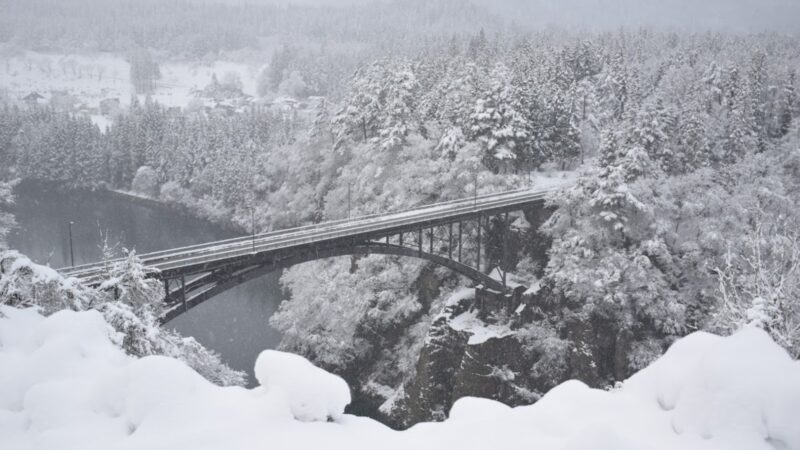
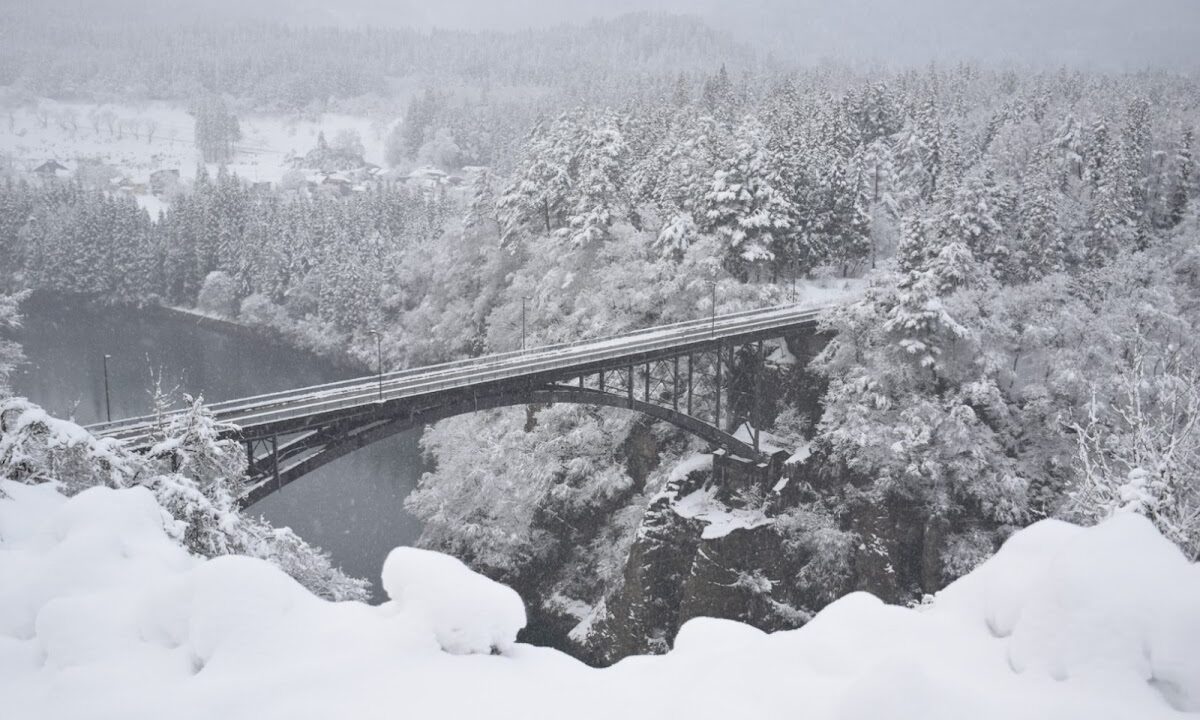
The First Tadami River Bridge is the most famous photography spot on the Tadami Line. Located between Aizu-Hinokihara Station and Aizu-Nishikata Station, the 174-meter-long iron bridge crossing the Tadami River and the surrounding mountains have become the symbolic representation of the Tadami Line.
Photography is typically conducted from an observation deck near the “Michi-no-Eki Ozegaidou Mishima-Shuku” roadside station. From the observation deck, one can view the entire bridge and background mountains at a glance, and the combination of fall colors and trains during the autumn foliage season is spectacular. Early morning fog and sunset-illuminated landscapes also allow for mystical photography.
Access is approximately 10 minutes by car from Aizu-Miyashita Station, or by Aizu Bus to the “Miyashita Hot Spring” bus stop followed by approximately 15 minutes on foot. The parking lot can be accessed via the roadside station.
② Kiri-Genkyo Ferry and Spectacle Bridge | Mystical Waterside Scenery
The “Kiri-Genkyo Ferry” along the Tadami River in Mishima Town is a hand-rowed ferry that operates from late May to early November. In early morning hours, river mist fills the air, creating a mystical landscape. Nearby is the “Spectacle Bridge,” a beautiful arch bridge where photography combining the Tadami Line trains is possible.
The Kiri-Genkyo Gorge is particularly beautiful in June and July in the early morning when river mist is most prominent. The ferry operates by reservation with local guides providing guidance. Combined with photography, this location offers a nature experience unique to the region.
③ Kaneyama Fureai Plaza | Tadami Line and Japan’s Original Scenery
From “Kaneyama Fureai Plaza” in Kaneyama Town, it is possible to photograph the Tadami Line running through rural landscape. One can enjoy the four seasons of Japan’s original scenery—fresh green in spring, green paddies in summer, golden rice stalks in autumn, and snowy landscape in winter.
The plaza has well-maintained parking and restroom facilities, making it accessible for families. It is approximately 15 minutes by car from Aizu-Kawaguchi Station.
④ Eighth Tadami River Bridge | Shared View with the “Matterhorn of Aizu”
The Eighth Tadami River Bridge is a photography spot with the “Matterhorn of Aizu,” known as Mount Gamao, rising in the background. Located between Hayato Station and Aizu-Shiozawa Station, one can capture the beautiful ridgeline of the mountain, the bridge, and the train in a single photograph.
Particularly during autumn foliage season, the contrast between the colored mountainside and the train is impressive. In winter, the snow-capped Mount Gamao presents a majestic appearance.
⑤ Miyashita Arch Three Brothers (Bridges) | Japan’s Only Triple Arch Bridge
Near Aizu-Miyashita Station, three arch bridges cross the Tadami River side by side. The JR Tadami Line’s iron bridge, the National Route 252 road bridge, and the old road bridge lined up create a landscape called the “Miyashita Arch Three Brothers,” a rare sight found nowhere else in Japan.
There are viewpoints from which all three bridges can be captured simultaneously in a photograph, attracting not only railway enthusiasts but also civil engineering structure enthusiasts. It is accessible on foot from Aizu-Miyashita Station.
⑥ Second Tadami River Bridge | Powerful Train Photography
The Second Tadami River Bridge is located near Aizu-Hinokihara Station, allowing photography from a relatively low angle looking up at the bridge, capturing the imposing appearance of the train. The clear Tadami River and surrounding greenery are beautiful, making summer photography particularly recommended.
From an angle downstream of the bridge, the river’s flow, bridge, and train can be captured three-dimensionally in the composition.
⑦ Third Tadami River Bridge | Capturing the Moment a Train Emerges from the Tunnel
The Third Tadami River Bridge is a popular photography spot where the moment a train emerges from a tunnel onto the bridge can be captured. Located between Aizu-Hinokihara Station and Aizu-Nishikata Station, the dynamic appearance of the train bursting from the tunnel is captivating.
During the fall foliage season, the appearance of a train emerging from the tunnel against a backdrop of colored mountains resembles a painting’s beauty. A telephoto lens will allow more impressive photographs.
⑧ Fourth Tadami River Bridge | Perfect Point for Photographing the Entire Bridge
The Fourth Tadami River Bridge is a photography point where the entire bridge can be captured from the side. Located between Aizu-Hinokihara Station and Aizu-Nishikata Station, the meandering river and curved bridge create a beautiful composition.
From the opposite bank, the river’s flow, bridge, train, and background mountains can be balanced well in the composition. Spring’s fresh green and autumn’s fall foliage seasons are particularly beautiful.
⑨ Aizu-Kawaguchi Station | Selected for Top 100 Stations in Tohoku
Aizu-Kawaguchi Station has a beautiful station building selected for “Top 100 Stations in Tohoku.” History materials and restoration records of the Tadami Line are displayed inside the station building, serving as a place to learn about the line’s history.
The gorge beauty of the Tadami River can be enjoyed from the station’s vicinity, and photography combining the stopped train with the station building is also popular. The waiting room contains abundant local tourism information and is ideal as a travel rest point.
⑩ Aizu-Wakamatsu Station Area | Photography at the Starting Point Station
Aizu-Wakamatsu Station is the starting point of the Tadami Line, where the journey begins. On the platform, the Tadami Line’s vehicles can be photographed alongside Banetsu-Saibu Line trains.
The area around the station is rich in Aizu-Wakamatsu Castle and historical structures, allowing one to enjoy Aizu’s history and culture along with the Tadami Line journey. Bus access from the station front makes city sightseeing convenient.
Access Methods and Transportation for the Tadami Line
There are three main options for accessing the Tadami Line: train, bus, and rental car.
Access by Train
From Tokyo Area: Approximately 1 hour 20 minutes to Koriyama Station on the Tohoku Shinkansen, then approximately 1 hour 10 minutes from Koriyama Station to Aizu-Wakamatsu Station on the Banetsu-Saibu Line. Total access is approximately 2 hours 30 minutes.
From Niigata Area: Take the Joetsu Shinkansen to Urasa Station, transfer to a local line to Ogizo Station. From Ogizo Station, travel on the Tadami Line toward the Fukushima area.
After arriving at Aizu-Wakamatsu Station, transfer to the Tadami Line to move to various stations along the line. However, since the Tadami Line has limited service frequency, it is important to check the timetable in advance and make detailed plans.
Access by Bus
Aizu Bus and local buses operate in Aizu-Wakamatsu City and major points along the line. However, since many photography spots are located away from stations and bus stops, relying solely on buses has significant time constraints.
Access to roadside stations and major tourist attractions is possible by bus from Aizu-Wakamatsu Station or Aizu-Miyashita Station in some cases, though frequencies are limited.
Travel by Rental Car
For efficient sightseeing of photography spots, rental car use is most convenient. Multiple rental car companies operate near Aizu-Wakamatsu Station, allowing direct travel from the station.
Since National Route 252 runs along the Tadami Line, car travel is relatively easy. However, in winter, studded tires are essential as the region is a heavy snowfall area. Additionally, some mountain road sections are narrow, requiring careful driving.
Parking spaces exist at major photography spots, though they become congested during busy seasons like fall foliage. Early morning or weekday visits are recommended.
The Tadami Line’s Appeal Across the Four Seasons
The greatest appeal of the Tadami Line lies in showing different faces according to each of the four seasons.
Spring (April-May): Season of Snowmelt and Fresh Green
Spring on the Tadami Line is the snowmelt season. In April, snow remains on the mountains while the Tadami River’s water volume increases, showing a powerful flow. By May, new leaves begin to sprout and mountains become tinted with pale green.
This season has a high probability of fog occurrence, increasing chances of encountering mystical landscapes. The Kiri-Genkyo Gorge in early morning is particularly mysterious and beautiful.
Summer (June-August): Deep Green and Clear Stream Concerto
Summer along the Tadami Line becomes covered in deep green. The Tadami River’s clear waters increase in transparency, displaying an emerald green color. Mountains are wrapped in deep green, showing landscapes full of vitality.
From June to July, early morning river mist is most beautiful. Additionally, summer’s long daylight hours expand photography time options.
Autumn (September-November): Japan’s Top Autumn Foliage Line
Autumn is the season when the Tadami Line shines brightest. From mid-October to early November, mountains along the line turn red and yellow, demonstrating the true value as Japan’s premier autumn foliage line.
Fall foliage peaks differ by elevation and location, with late October considered the most beautiful period. During this time, many photography enthusiasts and tourists from Japan and abroad visit, with photography spots becoming crowded.
Extra trains sometimes operate during foliage season, providing more photography opportunities than usual.
Winter (December-March): A World of White Snow
Winter along the Tadami Line becomes covered in snow exceeding three meters, with a white world unfolding. Snow-buried settlements, frozen Tadami River, and snow-capped mountains create a harsh yet beautiful winter landscape.
In winter, heavy snow or blizzards may cause service suspension, but on clear days the contrast between blue sky and snow is exceptional. However, accessing photography spots becomes difficult due to snow in some places, requiring sufficient equipment and preparation.
Model Courses for Tadami Line Tourism
Several model courses for efficiently enjoying the Tadami Line are introduced.
Day Trip Course: Aizu-Wakamatsu to Aizu-Kawaguchi Round Trip
Morning: Depart Aizu-Wakamatsu Station (around 8:30) → Tadami Line to Aizu-Miyashita Station (approximately 1 hour 30 minutes) → Rental car or taxi to First Tadami River Bridge observation deck → Photography and sightseeing (1 hour)
Lunch: Lunch and souvenir shopping at Michi-no-Eki Ozegaidou Mishima-Shuku roadside station
Afternoon: Kiri-Genkyo Gorge area sightseeing → Move to Aizu-Kawaguchi Station → Station building visit → Depart Aizu-Kawaguchi Station (around 3:00 PM) → Arrive Aizu-Wakamatsu Station (around 5:00 PM)
Evening: Dinner in Aizu-Wakamatsu, see Aizu-Wakamatsu Castle illumination
This course efficiently covers the Tadami Line’s main spots in a day-trip plan.
1-Night 2-Day Course: Aizu-Wakamatsu to Ogizo Full-Line Journey
Day 1: Depart Aizu-Wakamatsu Station → Tadami Line to Aizu-Miyashita Station → Rental car to major photography spots → Stay near Aizu-Kawaguchi Station
Day 2: Depart Aizu-Kawaguchi Station → Tadami Line to Ogizo Station (approximately 2 hours) → Joetsu Line to Urasa Station → Joetsu Shinkansen for return trip
Alternatively, a plan from Ogizo Station returning on the Tadami Line toward Aizu-Wakamatsu, stopping near Tadami Station to enjoy hot springs is also recommended.
2-Night 3-Day Photography-Focused Course
Day 1: Arrive at Aizu-Wakamatsu Station → City sightseeing → Stay near Aizu-Miyashita Station
Day 2: Early morning photography spot tour (First to Eighth Tadami River Bridge) → Kiri-Genkyo Ferry experience → Stay near Aizu-Kawaguchi Station
Day 3: Photography toward Tadami Station area → Return to Aizu-Wakamatsu and begin return trip
This course allows time for leisurely photography, making it ideal for photography enthusiasts. Early morning and sunset photography targeting favorable light becomes possible.
Tourist Attractions and Cuisine Along the Tadami Line
Tadami Line travel offers enjoyment of not only railway and natural scenery but also tourist attractions and cuisine along the line.
Tourist Attractions in Aizu-Wakamatsu
Aizu-Wakamatsu Castle (Tsuruga Castle) is the symbol of Aizu and the site of the Boshin War in the late Edo period. From the main tower, one can overlook the Aizu basin, and it is known as a cherry blossom and autumn foliage viewing spot.
Mount Iimori has the graves of the Byakko Tai (White Tiger Corps) and is a place to learn about Aizu’s history. The Sazaedo (Entsusan Tonsodo), an unusual architectural structure, is also noteworthy.
Nanoka-Cho Street has preserved Taisho-era romantic atmosphere with cafes, craft shops, and sake breweries lining the street, making it ideal for strolling.
Charm of Mishima, Kaneyama, and Tadami Towns
Mishima Town is known as the center of paulownia production, with traditional craftsmanship in braiding and weaving being famous. The “Mishima Town Living Crafts Museum” allows viewing of craftsmen’s techniques.
Kaneyama Town is a nature-rich town known as the “Natural Carbonated Water Village” with naturally carbonated spring water sources. The unique “Fairy Art Museum” is also noteworthy.
Tadami Town is surrounded by primeval Beech forests and is a nature-rich town. The “Tadami-Beech and River Museum” allows learning about Tadami’s nature and culture. Tadami Dam and Tagokura Dam are also worth seeing.
Aizu Cuisine
Kitakata Ramen is a representative local delicacy of the Aizu region. Numerous Kitakata Ramen restaurants exist in Aizu-Wakamatsu.
Sauce Cutlet Rice Bowl is an Aizu-Wakamatsu local specialty where thick cutlet is topped generously with sauce.
Kozuyu is an Aizu folk dish, a refined broth made from scallop muscles.
Aizu Chicken and Horse Meat are also noted Aizu cuisines. They can be enjoyed at local izakayas and traditional cuisine restaurants.
Japanese Sake is a specialty product of which Aizu is proud, with many nationally famous brands including “Hiroshiki,” “Sharakusai,” and “Suehiro.”
Local product roadside stations sell local vegetables, specialty items, and homemade prepared foods.
Photography Tips and Precautions for the Tadami Line
Points and cautions for successful Tadami Line photography are summarized.
Confirm Train Times in Advance
Since the Tadami Line has limited service frequency, confirming train times in advance is most important. Check the latest timetable on the JR East official website or Tadami Line portal site.
Consider travel time to photography spots and create schedules with adequate margin. Since trains run approximately every 1-2 hours, missing a photography opportunity means waiting long hours.
Choose Season and Time of Day
The most popular period is fall foliage season (mid-October to early November), but the new green of May or winter snow scenery also recommend if crowding is to be avoided.
Early morning and evening have good light conditions for beautiful photography. Early morning especially has high probability of fog occurrence, increasing chances of mystical landscapes.
Respect Photography Etiquette
Many photographers gather at popular photography spots. Remember considerate conduct regarding location reservation and photography. Avoid unauthorized entry to private property and damage to crops or traffic obstruction.
Since parking is limited in some places, avoid roadside parking and use designated parking areas.
Equipment and Clothing
Since the region is mountainous, weather changes quickly and temperatures may be lower than plains. Prepare warm and rain gear.
Some photography spots have poor footing, requiring comfortable walking shoes. Winter snow requires thorough cold and waterproof protection.
A telephoto lens allows photography of distant bridges and trains in close-up. A tripod enables stable photography in low-light conditions of early morning and evening.
Safety Precautions
Entry into railroad tracks is legally prohibited. Never enter railroad tracks.
Avoid scattered attention when focused on photography. Particularly in roadside photography, pay full attention to vehicle traffic.
In winter, risks of road freezing and avalanche exist. Check meteorological information and avoid reckless behavior.
Community Efforts Supporting the Tadami Line
The Tadami Line’s full-line service resumption resulted from the efforts of community residents, Fukushima Prefecture, JR East, and supporters throughout Japan.
Operations through Upper-Lower Separation System
The Tadami Line’s restoration adopted the upper-lower separation system. This has Fukushima Prefecture owning and managing infrastructure (the lower part) while JR East handles train operations (the upper part).
This system reduced JR East’s burden while establishing a framework to maintain the Tadami Line as essential regional transportation infrastructure. Fukushima Prefecture established a “Tadami Line Management Office” for maintaining tracks and bridges.
Regional Revitalization Efforts by Municipalities
Municipalities along the Tadami Line (Aizu-Wakamatsu City, Aizu-Sakadate Town, Yanazu Town, Mishima Town, Kaneyama Town, Showa Village, and Tadami Town) cooperate on tourism revitalization efforts.
The “Tadami Line Portal Site” disseminates the Tadami Line’s appeal, photography spots, tourism information, and event information in multiple languages. Tours and events using the Tadami Line are regularly held.
As a Lifeline for Local Residents
The Tadami Line serves not only as a tourism route but also as an essential lifeline for regional residents’ commuting, medical care, and shopping needs.
Though depopulation advances in areas along the line, the Tadami Line’s presence helps maintain regional vitality. Increased tourism benefits the regional economy, with the Tadami Line becoming the core of regional revitalization.
Summary: Meeting Japan’s Original Scenery on a Tadami Line Journey
The JR Tadami Line running through Fukushima Prefecture is a scenic local railway preserving Japan’s original landscape. The 135.2 km line runs through scenery woven by the Tadami River gorge beauty, four-season nature, and regional living.
After 11 years following the July 2011 heavy rain disaster, the Tadami Line achieved full-line service resumption in October 2022 through the thoughts of regional people and support from across the nation. This restoration story itself gives deep meaning to the Tadami Line journey.
Tadami Line travel is not merely a train journey. It is a journey touching Japan’s beautiful nature, regional culture, and people’s livelihoods. The settlements, fields, and mountains visible from train windows are landscapes Japanese people have preserved.
Because operating frequency is limited, time flows slowly. Enjoy waiting for trains and station stays as parts of the journey. Conversations with local people, shopping at roadside stations, relaxation in hot springs—everything becomes part of the Tadami Line journey’s appeal.
Photography enthusiasts seeking dramatic scenery, railway fans, nature lovers, and those seeking healing from Japan’s original landscape are all warmly welcomed by the Tadami Line. Create unforgettable travel memories on Fukushima’s pride, the Tadami Line.
-800x450.jpg)
-800x450.jpg)