.jpg)
Nationally Designated Scenic Spot Agatsuma Gorge (Gunma Prefecture) Complete Guide | Thoroughly Explained Including Highlights, Access, and Surrounding Information
Agatsuma Gorge, located in Higashi-Agatsuma Town, Agatsuma District, Gunma Prefecture, is a beautiful gorge also known as the “Kanto Yabakei.” This scenic area, designated as a national scenic spot, attracts many people as a tourist destination where you can enjoy the natural beauty of each season. This article comprehensively provides information you should know before visiting, from the charm of Agatsuma Gorge to practical tourism information.
What is Nationally Designated Scenic Spot Agatsuma Gorge?
Agatsuma Gorge is a valley that extends for approximately 2.5 kilometers along the Agatsuma River. It is praised in the Jomo Karuta as “Yabakei’s Agatsuma Gorge,” and is known as a leading scenic spot representing Gunma Prefecture.
The Geology and Formation of Agatsuma Gorge
The characteristic landscape of Agatsuma Gorge was formed as the clear waters of the Agatsuma River deeply eroded lava ejected by ancient volcanoes over long periods of time. The sight of sheer cliffs and fantastically-shaped rocks succeeding one another can truly be called a work of art created by nature. The depth of the gorge and the texture of the rock surfaces convey to visitors the history of the Earth, making it a valuable geological heritage.
Value as a Nationally Designated Scenic Spot
Agatsuma Gorge has been designated as a national scenic spot in recognition of its excellent scenic beauty. The landscape woven together by lush vegetation growing along the gorge and sheer cliffs is highly valued as particularly excellent natural beauty in the Kanto region. The alternative name “Kanto’s Yabakei” was given because it possesses beauty that rivals the Yabakei, a scenic spot in Kyushu.
The Charm of Agatsuma Gorge Through the Four Seasons
Agatsuma Gorge displays different faces with each season, making it worth visiting throughout the year. Here we introduce the characteristics and highlights of each season.
Spring Agatsuma Gorge (Mid-April to May)
Spring in Agatsuma Gorge is colored by the blooming of Mitsuba azaleas. From mid-April, pink flowers bloom in profusion along the gorge, creating a beautiful landscape with contrasting fresh greenery. This is a season full of vitality as nature awakens, freed from winter’s harshness.
Cherry blossoms also bloom, and the entire gorge is enveloped in spring’s breath. The temperature is mild and suitable for walking, and hiking while listening to birdsong is extraordinary.
Fresh Greenery Season (May to June)
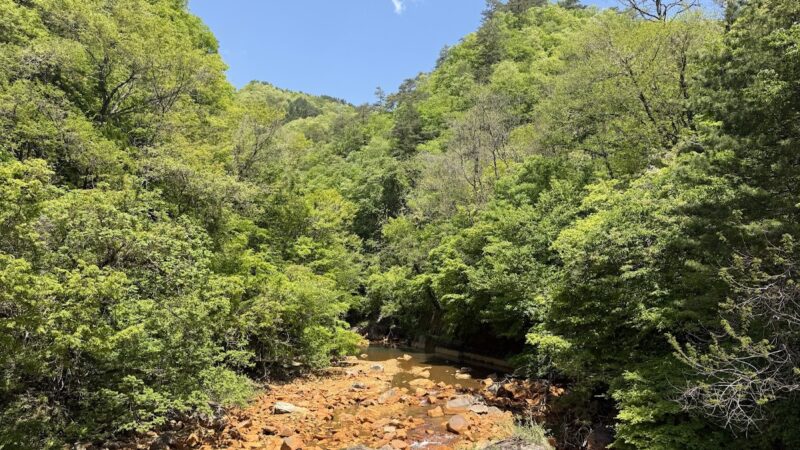
From May through June, when fresh greenery appears, Agatsuma Gorge displays its most vibrant face. Maples, Japanese hackberries, Japanese hornbeams, and lyonias all unfurl their tender leaves at once, covering the entire gorge in brilliant green.
During this period, the contrast between deep green and the clear stream is beautiful, and a walk in air filled with negative ions refreshes both body and mind. The transparent beauty of fresh greenery has a different charm from autumn foliage and is perfect for photography.
Summer Agatsuma Gorge (July to August)
Summer in Agatsuma Gorge is popular as a cool retreat covered in deep green. The shade in the gorge is cool in temperature, making it the perfect place to escape the summer heat of the city. The murmur of the clear Agatsuma River provides a feeling of coolness.
In the Hakoshima district of Higashi-Agatsuma Town nearby, you can also enjoy firefly viewing from mid-June through mid-July. The fantastical nighttime scenery of summer is a unique charm of the Agatsuma Gorge area.
Autumn Foliage in Agatsuma Gorge (Late October to Early November)
Agatsuma Gorge is busiest with tourists during autumn foliage season. From late October through early November, deciduous trees such as maples, Japanese hackberries, Japanese hornbeams, lyonias, and cherry trees lining the gorge turn red and yellow, enveloping the entire gorge in the beauty of a brocade picture.
The scenery during the autumn foliage period is particularly wonderful, and this is the season when the alternative name “Kanto’s Yabakei” is most fitting. The contrast between sheer cliffs and vividly colored autumn leaves is truly a magnificent view. The autumn foliage season typically lasts from late October through mid-November, making this the finest season for gorge walking.
Winter Agatsuma Gorge (December to March)
Winter in Agatsuma Gorge has few visitors and is enveloped in a tranquility that feels like another world. After deciduous trees shed their leaves, the rock faces of the gorge become clearer, allowing you to feel the complexity and power of the terrain.
If you’re lucky, you may see Agatsuma Gorge dressed in snow, and the monochrome world of black and white possesses a fantastical beauty. However, winter requires adequate equipment and caution due to the possibility of frozen road surfaces and snow accumulation when visiting.
Highlights of Agatsuma Gorge
There are multiple highlights along Agatsuma Gorge. Here we introduce the main spots.
Fureai Ohashi Bridge
The gateway to Agatsuma Gorge is Fureai Ohashi Bridge. From this bridge, you can overlook the flow of the Agatsuma River and the entire gorge. The view from the bridge is an excellent viewpoint to experience the grandeur of Agatsuma Gorge.
Katobibashi Bridge (Deer Flying Bridge)
The Katobibashi Bridge, which spans the gorge, is a highlight of Agatsuma Gorge. From atop the bridge, you can closely feel the sheer cliffs and depth of the gorge. During autumn foliage season, the sea of autumn leaves viewed from above the bridge is spectacular.
The name Katobibashi has various theories behind it, but it is said that according to legend, a deer once leaped across this gorge.
Shinhourai (New Penglai)
Shinhourai, located in the upper reaches of Agatsuma Gorge, is an area where gorge beauty stands out especially. Located approximately 2.5 kilometers upstream from Fureai Ohashi, the woodland trail along the way to this point is dotted with various oddly-shaped rocks and scenic viewpoints.
Around Yatsuba Ohashi and Karigasawa Bridges
The extent of Agatsuma Gorge varies slightly depending on the source, but in the broader definition, it sometimes includes approximately 3.5 kilometers from Karigasawa Bridge to Yatsuba Ohashi. This section also offers beautiful gorge scenery and is popular as a walking course.
How to Access Agatsuma Gorge
While access to Agatsuma Gorge by car is convenient, you can also reach it using public transportation.
Access by Car
From the Kan-Etsu Expressway:
- Approximately 50 minutes from “Shibukawa Ikaho IC” on the Kan-Etsu Expressway
- Via National Routes 17 and 145 toward Higashi-Agatsuma Town
From the Joshin-Etsu Expressway:
- Approximately 70 minutes from “Usui Karuizawa IC” on the Joshin-Etsu Expressway
- Via National Routes 18 and 145
There are several parking lots around Agatsuma Gorge. The main parking lots are as follows.
Parking Information
Michi-no-Eki Agatsuma Gorge Parking Lot:
- Capacity: Approximately 100 vehicles
- Fee: Free
- Located at the gateway to Agatsuma Gorge, this is the most convenient parking lot
During busy periods such as autumn foliage season, early arrival is recommended. Particularly after 10:00 AM, the parking lot may reach capacity.
Access by Public Transportation
Using JR Agatsuma Line:
- Get off at “Iwashima Station” on the JR Agatsuma Line, approximately 20 minutes on foot
- The distance from the station to Agatsuma Gorge is approximately 1.5 kilometers
Access from Tokyo:
- Limited Express Kusatsu from JR Ueno Station for approximately 2 hours, get off at Iwashima Station
- Or change to the Agatsuma Line at JR Takasaki Station
If using public transportation, the number of trains is limited, so checking the timetable in advance is recommended.
Walking Courses Through Agatsuma Gorge and Time Required
Here we introduce walking courses for fully enjoying Agatsuma Gorge.
Basic Course (Approximately 1.5 to 2 Hours)
The basic course is a round-trip from Fureai Ohashi Bridge via Katobibashi Bridge to Shinhourai. The distance is approximately 2.5 kilometers one way, or approximately 5 kilometers round-trip.
Course Characteristics:
- The woodland trail is relatively well-maintained, but some sections are steep
- There is ups and downs, so shoes suitable for walking are essential
- Including time for photography and viewing, plan for 2 to 3 hours overall
Comprehensive Course Including Surrounding Areas (Approximately 3 to 4 Hours)
This course includes walking through Agatsuma Gorge plus nearby tourist spots such as Yatsuba Dam and surrounding attractions. Walking distance may exceed 10 kilometers.
Recommended Route:
- Start at Michi-no-Eki Agatsuma Gorge
- Agatsuma Gorge walking (approximately 2 hours)
- Yatsuba Dam sightseeing (approximately 1 hour)
- Rest at Michi-no-Eki Agatsuma Gorge and purchase souvenirs
Notes for Walking
- The woodland trail has some narrow sections and poorly paved areas
- Extra caution is needed on rainy days or soon after rain as surfaces are slippery
- Bring insect repellent in summer and warm clothing in winter
- Prepare drinking water in advance (vending machines are limited along the way)
- It is recommended to use restrooms at places like Michi-no-Eki Agatsuma Gorge beforehand
Basic Information (Business Hours, Admission Fees, etc.)
Business Hours and Admission
- Business Hours: Open 24 hours (always accessible)
- Admission Fee: Free
- Closed Days: None (however, the woodland trail may close during severe weather)
Best Season and Crowd Predictions
Most Crowded Times:
- Weekends and holidays during autumn foliage season (late October to early November)
- Peak congestion between 10:00 AM and 2:00 PM
Relatively Quiet Times:
- Weekdays overall
- Early morning (before 8:00 AM)
- Winter season (December to March)
To avoid crowds, visiting on weekdays or taking an early morning walk is recommended.
Contact Information
Higashi-Agatsuma Town Government, Tourism and Commerce Division:
- Address: 1046 Hara-cho, Higashi-Agatsuma Town, Agatsuma District, Gunma Prefecture 377-0892
- Phone: 0279-68-2111
Michi-no-Eki Agatsuma Gorge:
- Phone: 0279-67-3193
- Business Hours: 9:00 AM to 6:00 PM (varies by facility)
Michi-no-Eki Agatsuma Gorge | Agatsuma Gorge Tourism Hub
The hub for Agatsuma Gorge tourism is “Michi-no-Eki Agatsuma Gorge.” Located at the gateway to the nationally designated scenic spot “Agatsuma Gorge,” it is a convenient facility with hot spring facilities and a direct agricultural produce store.
Facility Features
Tengu-no-Yu (Day-Trip Hot Spring Facility):
- Spring Quality: Sodium and calcium-chloride and sulfate hot spring
- Business Hours: 10:00 AM to 9:00 PM (final admission 8:30 PM)
- Fee: Adults 500 yen, Elementary school children 300 yen, Preschoolers free
- Ideal for relaxing after walking through Agatsuma Gorge
Agricultural Produce Direct Sale Shop “Agatsuma Minori-kan”:
- Business Hours: 9:00 AM to 6:00 PM
- Sells fresh local vegetables, fruits, processed foods, and more
- Seasonal specialty products are well-stocked
Restaurant:
- Enjoy dishes made with local ingredients
- Menus that emphasize Gunma Prefecture produce are popular
Access
- Address: 6441 Mishima, Higashi-Agatsuma Town, Agatsuma District, Gunma Prefecture
- Parking: Free (100 regular vehicles, 5 large vehicles)
- Approximately 15 minutes on foot from JR Iwashima Station
Recommended Tourist Spots in the Area
There are many tourist spots worth visiting in combination around Agatsuma Gorge.
Yatsuba Dam
Yatsuba Dam, completed in 2020, is approximately 10 minutes by car from Agatsuma Gorge. The massive dam, 116 meters high, is impressive in its power.
Highlights:
- Panoramic views from the dam top
- Full view from Yambamiho-odai
- Learning at the Yatsuba Dam Information Center
- Dam card distribution (at the information center)
Shirako Gorge Line
The Shirako Gorge Line, located upstream from Agatsuma Gorge, is also known as a beautiful autumn foliage spot. It is popular as a driving course, and you can enjoy scenery of each season from the road along the gorge.
Kusatsu Hot Spring
Kusatsu Hot Spring, approximately 40 minutes by car from Agatsuma Gorge, is one of Japan’s representative hot spring destinations. Combining Agatsuma Gorge sightseeing with Kusatsu is recommended for a 2-day, 1-night trip.
Kusatsu Hot Spring Highlights:
- Yubatake
- Nishinokawara Park
- Hot spring bath stirring show at Netsu-no-Yu
- Abundant hot spring inns and day-trip bathing facilities
Firefly Viewing in Hakoshima District, Higashi-Agatsuma Town
From mid-June through mid-July, firefly viewing is possible in the Hakoshima district of Higashi-Agatsuma Town. Located approximately 15 minutes by car from Agatsuma Gorge, the fantastical nighttime scenery of summer is a must-see.
Firefly Viewing Tips:
- Prime Viewing Period: Mid-June through mid-July
- Time: Around 8:00 PM to 9:00 PM
- Weather: Warm and humid evenings after rain are ideal
- Etiquette: Avoid using flashlights, observe quietly
Iwabitsujou Castle Ruins
The ruins of Iwabitsujou, a mountain castle from the Sengoku period, are recommended for history enthusiasts. Known as a castle associated with the Sanada clan, the view from the mountaintop is also wonderful.
Accommodation Information in the Area
There are various types of accommodation facilities around Agatsuma Gorge.
Forest Resort Conifer Iwabitsutsu
A comprehensive resort facility approximately 20 minutes by car from Agatsuma Gorge.
Facility Features:
- Diverse accommodation styles including cottages, bungalows, and campsites
- Activity facilities including tennis courts and park golf courses
- Ideal for families and groups
- You can fully enjoy outdoor activities surrounded by nature
Hot Spring Inns in Higashi-Agatsuma Town
Small but warm hot spring inns are scattered throughout Higashi-Agatsuma Town.
Recommended Points:
- Cuisine using local ingredients
- Homey atmosphere
- Reasonable rates
- Convenient access to Agatsuma Gorge
Kusatsu Hot Spring Accommodations
Extending your trip slightly from Agatsuma Gorge to stay at Kusatsu Hot Spring is also recommended.
Types of Accommodation:
- Luxury Inns: Traditional hospitality and high-quality hot springs
- Business Hotel Type: Reasonable and casual use
- Pensions: Western-style atmosphere and homey service
- Guesthouses: Enjoy interaction with local people
Model Courses for Agatsuma Gorge Tourism
We propose model courses centered on Agatsuma Gorge.
Day-Trip Course (Total Time: Approximately 5 to 6 Hours)
Morning:
- 8:00 AM Arrive at Michi-no-Eki Agatsuma Gorge, park
- 8:30 AM Begin Agatsuma Gorge walk
- 10:30 AM End walk, return to the station
- 11:00 AM Lunch at the station restaurant
Afternoon:
- 12:00 PM Yatsuba Dam sightseeing
- 1:30 PM View from Yambamiho-odai
- 2:00 PM Return to the station, soak in the hot spring “Tengu-no-Yu”
- 3:30 PM Purchase souvenirs at the produce shop
- 4:00 PM Depart for home
1 Night, 2 Days Course
Day 1:
- Morning: Depart from Tokyo area
- 12:00 PM Lunch at Michi-no-Eki Agatsuma Gorge
- 1:00 PM Agatsuma Gorge walk (approximately 2 hours)
- 3:00 PM Yatsuba Dam sightseeing
- 4:30 PM Move to Kusatsu Hot Spring (approximately 40 minutes)
- 5:30 PM Check in at Kusatsu Hot Spring accommodation
- Evening to night: Walk around Yubatake, enjoy the hot spring town
Day 2:
- Morning: Kusatsu Hot Spring sightseeing (Nishinokawara Park, hot spring bath stirring show, etc.)
- 12:00 PM Lunch at Kusatsu Hot Spring
- 1:00 PM Drive along Shirako Gorge Line
- 2:30 PM Purchase souvenirs at Michi-no-Eki Agatsuma Gorge
- 3:00 PM Depart for home
History and Culture of Agatsuma Gorge
Agatsuma Gorge has long been loved by many literary and artistic figures because of its beauty.
Jomo Karuta and Agatsuma Gorge
In the “Jomo Karuta” beloved by Gunma Prefecture residents, there is a card that reads “Yabakei’s Agatsuma Gorge.” This means possessing beauty that equals or even surpasses that of Yabakei, a scenic spot in Kyushu.
The Jomo Karuta was established in 1947 and is widely used as teaching material for learning about Gunma Prefecture’s geography, history, and culture. That Agatsuma Gorge is featured in this karuta demonstrates its status as a scenic spot representing Gunma Prefecture.
Designation as a National Scenic Spot
Agatsuma Gorge was designated as a national scenic spot in recognition of its excellent scenic value. Through this designation, the preservation and proper management of the landscape are carried out.
Relationship with the Community
Agatsuma Gorge is an important tourism resource for the local Higashi-Agatsuma Town and contributes significantly to the regional economy. Efforts to preserve the landscape, such as cleaning activities and woodland trail maintenance conducted by local residents, continue.
Tips for Photography at Agatsuma Gorge
Agatsuma Gorge is an ideal spot for photography. Here we introduce tips for taking beautiful photographs.
Tips for Autumn Foliage Photography
Optimal Times:
- Soft morning light (8:00 AM to 10:00 AM)
- Late afternoon sidelighting (3:00 PM to 5:00 PM)
Recommended Photography Spots:
- Looking down from atop Katobibashi Bridge
- Looking up at autumn foliage and cliffs from the woodland trail
- Composition capturing the Agatsuma River’s flow with autumn foliage together
Shooting Setting Tips:
- Using a polarizing filter makes autumn foliage colors more vivid
- Using a tripod with slow shutter speed to express water flow
- Cloudy days sometimes provide soft colors ideal for foliage photography
Tips for Fresh Greenery Photography
During fresh greenery season, backlit or semi-backlit shooting of young leaves is beautiful. The transparency of leaves can be expressed well.
Tips for Gorge Beauty Photography
Sidelighting is effective for expressing the texture of rock faces and the depth of the gorge. Shadow contrast creates a sense of three-dimensionality.
Frequently Asked Questions (FAQ)
How Much Time is Required to View Agatsuma Gorge?
The basic walking course (round-trip from Fureai Ohashi to Shinhourai) takes approximately 1.5 to 2 hours. Including photography and rest, plan for 2 to 3 hours. If including surrounding attractions, a half-day to full-day plan is recommended.
Can Agatsuma Gorge Be Explored with a Wheelchair or Baby Carriage?
Unfortunately, the woodland trail at Agatsuma Gorge has much elevation change and some narrow sections, making it difficult to explore with a wheelchair or baby carriage. It is possible to enjoy the scenery from the Michi-no-Eki Agatsuma Gorge area or parking lot.
When is the Peak Autumn Foliage Season?
Typically, late October through early November is the peak autumn foliage season. However, the timing may vary depending on weather conditions that year. For the latest autumn foliage information, contact the Higashi-Agatsuma Town Tourism Association or Michi-no-Eki Agatsuma Gorge.
Can I Walk Through the Gorge with Pets?
Pets are allowed on the Agatsuma Gorge woodland trail. However, always keep them on a leash and be considerate of other visitors. Be sure to take their waste with you.
Can I Walk Through During Winter?
Walking is possible during winter, but adequate equipment and caution are necessary due to the possibility of snow accumulation and frozen road surfaces. The woodland trail may close during severe weather. It is recommended to confirm conditions in advance with the Higashi-Agatsuma Town Government.
Are There Restaurants Around Agatsuma Gorge?
There is a restaurant at Michi-no-Eki Agatsuma Gorge. Additionally, several restaurants are scattered along National Route 145. However, there are no dining facilities along the woodland trail, so it is recommended to eat before walking or bring a packed lunch.
Can I Enjoy It on Rainy Days?
Light rain allows for walking, but extra caution is needed as the woodland trail becomes slippery. In heavy rain or severe weather, it is recommended to refrain from walking for safety. On rainy days, you can enjoy indoor facilities such as the hot spring at Michi-no-Eki or the Yatsuba Dam Information Center.
Summary: Experience Gunma’s Natural Beauty at Agatsuma Gorge
The nationally designated scenic spot “Agatsuma Gorge” is a scenic area where you can enjoy gorge beauty representative of the Kanto region. The grand landscape worthy of the alternative name “Kanto’s Yabakei” continues to captivate visitors throughout the four seasons.
The beauty during autumn foliage season is particularly exceptional, with many tourists visiting from late October through early November. However, the fresh greenery in May and Mitsuba azaleas blooming in mid-April are also wonderful, and Agatsuma Gorge, displaying a different face with each season, offers new discoveries every time you visit.
Access is relatively convenient, located approximately one hour by car from the Kan-Etsu and Joshin-Etsu expressways, and accessible by the JR Agatsuma Line as well. Using Michi-no-Eki Agatsuma Gorge as a base, you can enjoy hot springs before and after walking, local cuisine, and souvenir shopping.
The area has many attractive tourist spots including Yatsuba Dam and Kusatsu Hot Spring nearby, and organizing a 1-night, 2-day itinerary allows you to fully savor Gunma Prefecture’s nature and culture.
When visiting Gunma Prefecture, be sure to visit the nationally designated scenic spot “Agatsuma Gorge.” The gorge beauty created by nature is sure to leave a deep impression on your heart.
-800x450.jpg)
-800x450.jpg)
-800x450.jpg)