Municipally-Managed Natural Park Akaiwa Seigankyō Complete Guide | Scenic Spots and How to Enjoy Yubetsu District, Shimokakeppu Village, Hokkaido
Municipally-Managed Natural Park Akaiwa Seigankyō (赤岩青巌峡), located in Shimokakeppu Village, Yubetsu District, Hokkaido, is a scenic destination known for its unique landscape created by rare red and blue giant rocks interwoven with the clear waters of the Yubetsu River. Beyond being a famous autumn foliage spot, it has gained attention as a holy site for rock climbing and a popular rafting destination.
This article provides comprehensive information for fully enjoying this hidden gem, covering everything from the appeal of Akaiwa Seigankyō to the best times to visit, access methods, and information about surrounding areas.
What is Akaiwa Seigankyō? The Reason Behind Its Unique Landscape
Origins of the Name and Geological Significance
The name Akaiwa Seigankyō literally comes from the red and blue giant rocks that exist in this location. This gorge, extending approximately 1km along the Yubetsu River basin, is protected as a municipally-managed natural park of Shimokakeppu Village, captivating many visitors.
Of particular note is the true nature of the red rocks. These red stones are called “chert,” a sedimentary rock formed over long periods as remains of microorganisms such as radiolarians accumulated on ancient ocean floors and were compressed. They are a precious geological heritage conveying the history of ancient seas to the present day.
Meanwhile, the blue and gray rocks are primarily composed of sandstone and mudstone. The coexistence of these differently colored giant rocks creates a unique landscape unlike anywhere else.
Natural Sculptural Beauty Created by the Yubetsu River
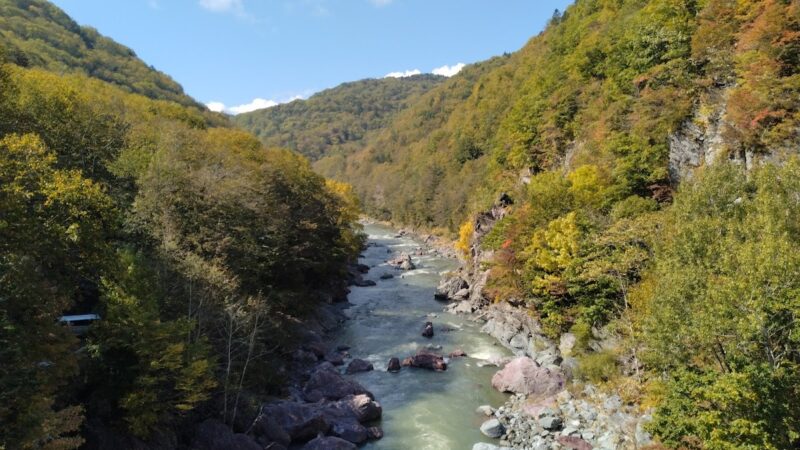
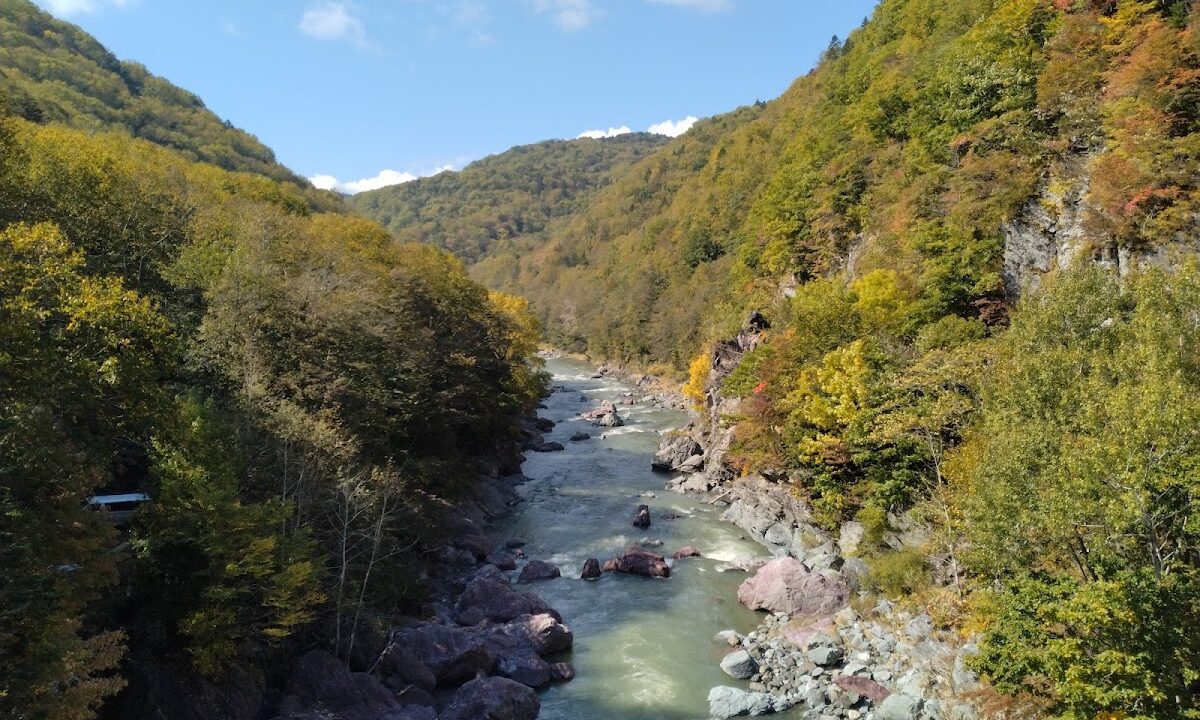
The appeal of Akaiwa Seigankyō is not limited to the rocks alone. The Yubetsu River, known for its clear waters, flows through the giant rocks like a thread, and the transparency of the water combined with the colors of the rocks creates breathtaking beauty.
When afternoon sunlight reflects off the water surface, the red and blue giant rocks are mirrored in the water, creating a landscape like a painting. Particularly on clear days, the contrast between the crystalline flow and the vividly colored rocks is most beautiful, so visiting on favorable weather is recommended.
Seasonal Appeal | Ways to Enjoy Akaiwa Seigankyō
Autumn Foliage Season | The Most Popular Period
The time when Akaiwa Seigankyō draws the most tourists is autumn foliage season. Typically, foliage reaches its peak from late September to early October, and beautiful scenery can be enjoyed until mid-October.
The maple trees (acer), which are the village tree of Shimokakeppu, turn red and yellow, contrasting particularly beautifully with the red giant rocks. The gradient of red created by nature—red chert, colored maples, and clear waters—united together forms a landscape that can be called one of Hokkaido’s finest autumn foliage spots.
When visiting during foliage season, note the following points:
- Peak Period: Late September to early October (varies slightly year to year)
- Foliage Status: Checking with Shimokakeppu Village Office Planning and Commerce Division ensures accuracy
- Crowds: As a lesser-known spot, it does not experience the crowds of Kyoto or Nikko
- Photography Time: Early afternoon around 1-3 PM when sunlight beautifully illuminates the rocks is best
Spring Azaleas and Fresh Greenery
Though less well-known than foliage, the spring azaleas are a hidden charm of Akaiwa Seigankyō. From May to June, azaleas bloom along the walking path, creating a refreshing landscape with the contrast of giant rocks and fresh spring greenery.
In spring, snow melt increases the water volume of the Yubetsu River, allowing views of its powerful flow. This is a season where you can feel the energy of nature awakening from winter’s silence.
Summer Activity Season
Summer is when rafting and rock climbing enthusiasts visit, enjoying thrilling experiences against the backdrop of a verdant gorge.
Winter Silence and Snow Landscape
In winter, snow makes the walking path difficult to access, but the fantastical scenery created by snow-covered giant rocks and the frozen Yubetsu River offers a special experience for adventurous visitors. However, winter visits are recommended only for experienced outdoor enthusiasts due to safety concerns.
Akaiwa Seigankyō as a Rafting Holy Site
Special Views from the Boat
In recent years, rafting on the Yubetsu River has become popular, and Akaiwa Seigankyō has gained attention as a rafting spot. The experience of viewing the giant rock formations from angles visible only from a boat offers entirely different appeal than land-based sightseeing.
Viewing the giant rocks from water level is breathtaking, revealing details of rock texture and color changes not normally noticed. Especially during autumn foliage season, rafting offers the luxurious experience of enjoying colored maples reflected in the river surface from the water.
Rafting Tour Information
Rafting tours are conducted by outdoor companies in Shimokakeppu Village and nearby Tomamu areas. Beginner-friendly courses are available, making it safe for families to participate.
- Season: May-October (varies with water volume)
- Duration: 2-3 hours approximately
- Cost: Around ¥5,000-¥8,000
- Reservations: Advance booking required (especially during foliage season)
Japan’s One Hundred Rock Climbing Spots | Holy Site for Rock Climbers
Why Climbers Gather Here
Akaiwa Seigankyō is counted among Japan’s One Hundred Rock Climbing Spots and is recognized nationally as Hokkaido’s premier rock climbing destination, attracting climbers from across the country.
The giant rock formations made of chert and sandstone provide diverse routes and grades, suitable for everyone from beginners to advanced climbers. Particularly, the vertical walls of red giant rocks are popular routes for testing technical skills.
Precautions When Climbing
- Equipment: Always use appropriate climbing gear
- Safety Management: Accompany experienced climbers or participate in guided tours
- Environmental Protection: This is a natural park, requiring care not to damage rocks or vegetation
- Etiquette: General tourists also visit, necessitating safe distance maintenance and noise consideration
Those interested in climbing can obtain guide information from Shimokakeppu Village and nearby outdoor shops.
Walking Path Exploration | Nature Experience for Everyone
Overview of the Walking Course
Akaiwa Seigankyō has a walking path developed for those who cannot climb or raft, allowing easy enjoyment of the giant rock formations and gorge beauty.
The walking path extends approximately 1km along the Yubetsu River, requiring 30 minutes to 1 hour round trip. While the terrain is relatively gentle, some areas have stairs or unpaved sections, making hiking boots or sturdy shoes recommended.
Highlights of the Walk
Walking the path reveals the following points of interest:
- Red Rock Viewpoint: A place where the largest red chert giant rock can be seen up close
- Blue Rock Observation Deck: A scenic overlook with views of blue-gray rock formations and the Yubetsu River flow
- Maple Path: Particularly beautiful maple tree-lined path during foliage season
- Riverside Rest Area: Benches provided for relaxation while listening to water sounds
Clothing and Items to Bring
- Clothing: Comfortable, appropriate for the season with layering options
- Shoes: Trekking shoes or athletic shoes (no sandals)
- Items: Drinking water, insect repellent spray (summer), camera, rain gear
- Autumn: Warm clothing (mornings and evenings are cold)
Access Information | How to Get to Akaiwa Seigankyō
Access by Car
Car access is the most convenient way to reach Akaiwa Seigankyō.
Travel Time from Major Cities:
- From New Chitose Airport: Approximately 1 hour 30 minutes (via Dōtō Expressway)
- From Sapporo City: Approximately 2 hours (via Dōō and Dōtō Expressways)
- From Asahikawa: Approximately 2 hours 30 minutes
- From Obihiro: Approximately 2 hours
Detailed Route:
- Exit at “Shimokakeppu IC” on Dōtō Expressway
- Head toward central Shimokakeppu on National Route 237 for approximately 5km
- Follow signage and turn onto village roads
- Approximately 7 minutes from Shimokakeppu Village Office (approximately 4km)
The parking lot is free and accommodates approximately 20 regular vehicles. During peak foliage season weekends, congestion may occur, making early morning visits recommended.
Access by Public Transportation
Using public transportation, Shimokakeppu Station on the JR Sekihoku Line is the nearest station.
- Sapporo Station to Shimokakeppu Station: Approximately 1 hour 20 minutes by limited express
- New Chitose Airport Station to Shimokakeppu Station: Approximately 50 minutes by limited express
From Shimokakeppu Station, the site is approximately 8km away, with options including taxi (approximately 15 minutes, around ¥2,500) or rental bicycle (available from village office, advance confirmation required).
When using public transportation, schedule planning with attention to limited train frequencies is essential.
Winter Access Information
During winter (late November to early April), the walking path may be closed due to snow. Before visiting, confirm opening status by contacting Shimokakeppu Village Office Planning and Commerce Division (TEL: 0167-56-2124).
Surrounding Tourist Spots | Places to Visit with Akaiwa Seigankyō
Hoshino Resorts Tomamu
Located approximately 20 minutes by car from Akaiwa Seigankyō, Hoshino Resorts Tomamu is a premier resort representing Hokkaido. Seasonal attractions include the Cloud Sea Terrace, Minami Beach, and Ice Village.
Combining Akaiwa Seigankyō exploration with Tomamu accommodations and dining creates an enriching itinerary for fully experiencing the Shimokakeppu area.
Shimokakeppu Village Hot Springs
To relax after exploration and activities, hot spring facilities in Shimokakeppu Village are recommended.
- Yunozawa Hot Spring: A day-use hot spring facility near the village office
- Tomamu Area Hot Springs: Hot spring facilities within the resort are also available
Soaking in natural hot springs while reflecting on a day spent enjoying Hokkaido’s great nature is unparalleled.
Michi-no-Eki Shizen Taikan Shimukkapu (Rest Stop)
For local specialty goods and souvenirs, visit the Michi-no-Eki Shizen Taikan Shimukkapu (Rest Stop). Fresh local vegetables, processed goods, and Shimokakeppu-produced honey are available.
The restaurant offers dishes using local ingredients, adding final touches to travel memories.
Yubetsu River Source Region Nature Exploration
The source region of the Yubetsu River flowing through Akaiwa Seigankyō is also a must-see for nature enthusiasts. In areas where primeval forest remains, wildlife encounters and observation of rare plants are possible.
Photography Spots and Best Shot Strategy
Photography Guide for Photography Enthusiasts
Akaiwa Seigankyō is a popular photography destination for photo enthusiasts. Techniques to maximize the unique colors and natural beauty are introduced below.
Best Photography Times:
- Afternoon 1-3 PM: Sun illuminating rocks at angles, creating vivid red colors
- Early Morning (6-8 AM): Morning mist rising from the river creating a mystical atmosphere
- Dusk: Soft light enveloping everything, creating dramatic expression
Autumn Foliage Photography Tips:
- Use Polarizing Filter: Suppress water reflections, bringing out vivid foliage colors
- Low Angle Framing: Capture both rock drama and foliage simultaneously
- Long Exposure: Use ND filter for smoothly expressing water flow
- Macro Photography: Rock texture and moss details are also appealing
Composition Ideas:
- Position red giant rocks as foreground with colored maples as background
- Frame Yubetsu River flow in S-curve for depth
- Minimize composition emphasizing blue-red rock contrast
- Create symmetrical composition utilizing water reflections
Important Precautions and Etiquette When Visiting
Safety Considerations
As a natural park, the following precautions are necessary:
- Slippery Rocks: Wet rocks are extremely slippery; walk carefully
- River Fall Risk: The Yubetsu River has fast-flowing sections; never take eyes off children
- Weather Changes: Mountain areas experience sudden weather changes; carry rain gear
- Wildlife: If bear alerts exist, avoid visiting (carrying bear bells is recommended)
- Cell Phone Signal: Some areas may lack signal
Environmental Protection and Etiquette
To protect this valuable natural environment designated as a municipally-managed natural park, observe the following:
- Take All Trash Home: No garbage bins are provided
- Do Not Collect Plants: Taking colored branches or wild plants is prohibited
- No Rock Graffiti: Preserve natural heritage for future generations
- Use Designated Paths: Mandatory for vegetation protection
- Control Noise: Respect other visitors enjoying nature’s silence
- No Fires: Fire use is strictly prohibited
Planning to Maximize Enjoyment of Akaiwa Seigankyō
Day Trip Plan Example
[Autumn Foliage Season Day Trip Plan]
- 9:00 Depart Sapporo (by car)
- 11:00 Arrive Akaiwa Seigankyō, explore walking path (1 hour)
- 12:00 Lunch at rest stop
- 13:30 Photography at Akaiwa Seigankyō (best lighting time)
- 15:00 Bathe at Shimokakeppu village hot spring
- 16:30 Depart for return
- 18:30 Arrive Sapporo
1 Night 2 Day Plan Example
[Active Visitors 1 Night 2 Day Plan]
Day 1:
- Morning: Depart Sapporo, arrive Tomamu
- Afternoon: Participate in rafting tour
- Evening: Check into Tomamu Resort
- Night: Hot spring and dinner
Day 2:
- Early Morning: Photography at Akaiwa Seigankyō
- Morning: Walking path exploration
- Noon: Lunch at rest stop
- Afternoon: Return journey (Furano/Biei area sightseeing also possible)
Recommended Visiting Periods by Season
- Foliage Priority: Late September to early October
- Rafting Priority: July-September (stable water volume period)
- Rock Climbing Priority: May-October (rocks in dry conditions)
- Quiet Walk Priority: June or mid-September (relatively fewer tourists)
The Charm of Shimokakeppu Village | The Region Nurturing Akaiwa Seigankyō
About Shimokakeppu Village
Shimokakeppu Village is located near central Hokkaido with a population of approximately 1,200 people. The place name “Shimokakeppu” derives from the Ainu word “Shimokapu” (a very quiet and peaceful upper stream place).
With approximately 90% of village land covered in forest, Shimokakeppu retains much untouched nature and is a treasure trove of natural scenery including Akaiwa Seigankyō.
Shimokakeppu Village Specialties
Check out Shimokakeppu specialties to commemorate your visit:
- Shimokakeppu Honey: Pure flavor nurtured by abundant nature
- Mountain Vegetable Products: Pickles and simmered dishes from locally harvested plants
- Shimokakeppu Buckwheat: Flavorful buckwheat grown in cool climate
- Woodcraft Items: Crafts using Shimokakeppu timber
Conclusion | Meeting Hokkaido’s Primordial Beauty at Akaiwa Seigankyō
The Municipally-Managed Natural Park Akaiwa Seigankyō, where red chert preserving ancient sea memories, the clear Yubetsu River, and nature’s seasonal changes create one of Hokkaido’s finest scenic destinations.
As an autumn foliage spot, an activity destination for rafting and rock climbing, and a location for quiet nature walks, it offers multifaceted appeal for diverse visitor interests.
With convenient access from Sapporo and New Chitose Airport and combination potential with Tomamu Resort, yet retaining hidden gem appeal due to limited tourism development, Akaiwa Seigankyō awaits as a new destination for Hokkaido travel.
The ancient story told by red and blue giant rocks, the pure flow of the Yubetsu River, maples colored by autumn—primordial beauty found nowhere else awaits you here.
Contact Information:
Shimokakeppu Village Office Planning and Commerce Division
Phone: 0167-56-2124
Before visiting, confirm opening status and foliage conditions for a safe and comfortable trip.