
.jpg)
Kogenji Temple (Hyogo Prefecture) Complete Guide | Thorough Explanation of the History and Highlights of Tanba’s Three Autumn Foliage Mountains
Kogenji Temple (高源寺) is a Rinzai Zen Buddhist temple of the Myoshinji school located in Hikura, Aogaki Town, Tanba City, Hyogo Prefecture. Its mountain name is Zuiganzan (瑞巌山), and its principal image is Shakyamuni Buddha. It is known for the beautiful autumn foliage of the Tenmoku maple (天目楓) transmitted from China, and together with Entsuji and Sekiganji temples, it is counted as one of the “Three Tanba Autumn Foliage Mountains” and attracts many worshippers.
History of Kogenji Temple
Founding and Priest Enkai Soyū
Kogenji Temple was founded in 1325 (Shōchū 2), at the end of the Kamakura period, by the high priest Enkai Soyū (遠谿祖雄). Priest Enkai Soyū was an eminent monk who accumulated Zen training at Tianmu Mountain in Hangzhou, China. Upon his return to Japan, he established this temple in this location.
In the following year, 1326 (Kareki 1), Emperor Go-Daigo granted the temple the name “Kogenji,” and it was established as the head temple of the Rinzai Zen Chūhō school. While Seiunji Temple in Kai Province (present-day Yamanashi Prefecture) came to be called the “Eastern Tianmu,” Kogenji was named the “Western Tianmu” and became known as a first-rate temple in the Tanba region.
Peak Period and Status as an Imperial Prayer Temple
Kogenji Temple thrived greatly from the Muromachi period through the Sengoku period. At its height, it is said to have had over 1,000 subsidiary temples. During the reign of Emperor Go-Kashiwabara, it was treated as an imperial prayer temple (chokuganjo), and its chief priests were granted an imperial edict permitting them to wear purple robes (shie) in perpetuity.
Purple robes were vestments of purple color that only high-ranking monks were permitted to wear, and this edict demonstrated the elevated status of Kogenji. Its position as an imperial prayer temple speaks to its profound ties with the imperial court.
Changes Since the Modern Era
After passing through the period of Buddhist temple destruction and suppression (Haibotsu Kishaku) during the Meiji era and the waves of modernization, Kogenji Temple went into temporary decline but subsequently underwent revival. Today it belongs to the Rinzai Zen Myoshinji school, is widely known as a famous site for Tenmoku maple autumn foliage, and continues to maintain its function as a Zen training monastery.
Highlights of the Temple Grounds
The Approach Road from the Outer Gate to the Mountain Gate
The grounds of Kogenji Temple begin by passing through the outer gate (sōmon). Beyond the outer gate, a path lined with approximately 50 stone steps appears. On both sides of this approach path are planted numerous maple trees, including Tenmoku maples. During the autumn foliage season, they form a magnificent tunnel of colored leaves.
Upon reaching the top of the stone steps, a stately mountain gate welcomes visitors. The mountain gate has the heavy, imposing construction characteristic of Zen Buddhist temples, indicating that what lies beyond is a place of serious spiritual practice.
Layout of the Main Temple Buildings
The grounds of Kogenji Temple display the typical arrangement of temple buildings (garan) found in Zen Buddhist monasteries. The main structures include the following:
Buddha Hall (Butsuden): This is the central building housing the principal image, Shakyamuni Buddha. It exudes an atmosphere of austere yet sublime dignity characteristic of Zen temples.
Abbot’s Quarters (Hōjō): This is the living quarters of the chief priest and the place where religious services and Zen meditation are conducted. From the abbot’s quarters, one can view a beautiful garden.
Bell Tower (Shōrō): The grounds contain a bell tower with a hanging bronze bell, and the sound of the bells echoes through the mountain valley morning and evening.
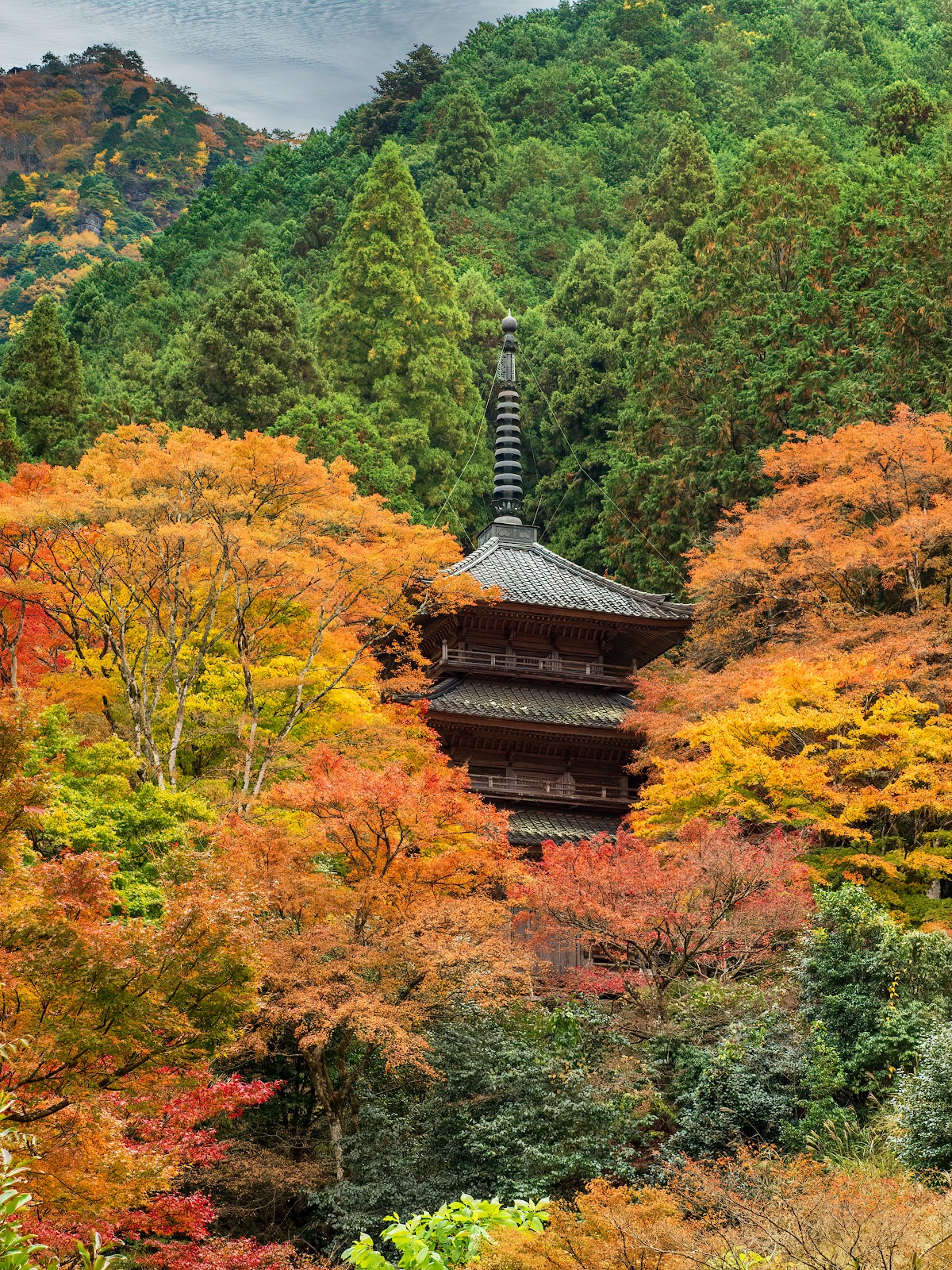
Pagoda of Many Treasures (Tahōtō): Standing on an elevated part of the grounds, this pagoda is a symbolic structure of Kogenji. During the season of autumn leaves, the combination of the crimson-stained maples and the pagoda creates a spectacular vista.
Origin and Characteristics of the Tenmoku Maple
One cannot discuss Kogenji Temple without mentioning the Tenmoku maple. It is said that the founding priest Enkai Soyū brought it from Tianmu Mountain in Hangzhou, China, and planted it in the temple grounds.
The Tenmoku maple differs from the common Iroha maple in that its leaves have deep indentations and possess a delicate beauty. Currently, the grounds contain between 200 and 500 maple trees (the number varies depending on the source), many of which are Tenmoku maples or related varieties.
When autumn arrives, these maples color all at once, and the entire temple grounds turn a vivid crimson. The autumn foliage along the approach path from the outer gate to the mountain gate, and especially around the pagoda, are spectacular. As the leading example of the “Three Tanba Autumn Foliage Mountains,” they continue to captivate many tourists and photography enthusiasts.
Spring Double Blossoms (Yamazakura)
Kogenji Temple is known not only for its autumn foliage but also for its spring double-petaled cherry blossoms. The grounds are planted with dozens of double-petaled cherry trees, which reach full bloom from mid- to late April. These double-petaled cherry blossoms, characterized by voluminous petals, combine with fresh greenery to create beautiful spring scenery.
Since this season is less crowded than the foliage season, a spring visit is also recommended for those who wish to worship quietly.
Cultural Properties and Temple Treasures
Kogenji Temple preserves numerous valuable cultural properties accumulated over its long history.
Temple Treasures
Relics and personal belongings related to the founding priest Enkai Soyū, Buddhist art objects collected by successive chief priests, and old documents have been transmitted. Particularly, documents concerning the temple name bestowed by Emperor Go-Daigo and imperial edicts from Emperor Go-Kashiwabara are important historical materials demonstrating Kogenji’s elevated status.
Value of Architectural Structures
Most of the existing structures are reconstructions dating from the Edo period onward, but they are valued as an important architectural complex transmitting the traditional styles of Zen temples to the present day. In particular, the pagoda is known as a fine example of Buddhist pagoda architecture in the Tanba region.
Kogenji and the Three Tanba Autumn Foliage Mountains
Kogenji Temple is called one of the “Three Tanba Autumn Foliage Mountains” along with Entsuji Temple (Hyogo Town, Tanba City) and Sekiganji Temple (Yamana Town, Tanba City). Since each offers autumn leaves of different character, visiting all three temples during autumn foliage season is popular.
Kogenji is particularly known among the three for the beauty of its Tenmoku maples, and is also called “the finest autumn foliage destination in the three Tanba regions” (San-Tan: Tanba, Tajima, and Tango). The peak foliage season is typically early to mid-November, when the temple is bustling with many visitors.
Shojin Ryori (Vegetarian Temple Cuisine) Experience
At Kogenji Temple, one can enjoy vegetarian cuisine (shojin ryori) handmade by the chief priest through a reservation system. Based on Zen teachings, shojin ryori is a subtly flavored cuisine that uses no meat or fish, prepared instead with seasonal vegetables, tofu, yuba (tofu skin), and other ingredients.
The vegetarian cuisine carefully prepared by the chief priest is not merely a meal but also an experience of “eating Zen” (shoku-zen), an aspect of Zen practice. Enjoying vegetarian cuisine in the quiet abbot’s quarters while reflecting on the world of Zen provides a rare and meaningful experience.
Since the provision of vegetarian cuisine requires advance reservations, those who wish to participate should contact the temple beforehand.
Location and Basic Information
Official Name: Saitenmokuneizaiganzan Kogenji
Sect: Rinzai Zen Myoshinji School
Principal Image: Shakyamuni Buddha
Founding Priest: Enkai Soyū
Year Founded: 1325 (Shōchū 2)
Location: 514 Hikura, Aogaki Town, Tanba City, Hyogo Prefecture
Telephone: 0795-87-5081
Visiting Hours and Admission
Visiting Hours: 8:30 AM–5:00 PM (may vary by season)
Admission:
- Adults: 300 yen
- Middle school students and younger: Free
- Autumn foliage season (November): Approximately 500 yen for adults (varies yearly)
※Admission fees may change, so it is recommended to confirm before visiting.
How to Get There
By Car
Visiting Kogenji Temple by car is convenient.
Via Kitakinki Toyooka Expressway:
- Approximately 15 minutes from Aogaki Interchange
- Exit at Aogaki IC and proceed via Prefectural Route 7, following directional signs
Via Maizuru-Wakasa Expressway:
- Approximately 40 minutes from Kasuga Interchange
Parking:
- Free parking available (capacity of approximately 50 regular vehicles)
- During the autumn foliage season, it becomes crowded, so early arrival is recommended
By Public Transportation
Using public transportation is somewhat inconvenient, but the following options are available.
By JR Train:
- Get off at Ikutsu Station on the JR Fukuchiyama Line
- Approximately 20 minutes by taxi from the station
- Alternatively, board a Shinki Green Bus heading to “Saji” and exit at “Hikura” bus stop; approximately 15 minutes on foot
Regarding Bus Service:
Since the number of bus services is limited, it is important to check the timetable in advance. Temporary buses may be operated during the autumn foliage season.
Nearby Tourist Attractions
When visiting Kogenji Temple, it is recommended to visit nearby tourist attractions as well.
Michi-no-Eki Tanba Obachan no Sato: A popular roadside station where local specialty products and fresh vegetables can be purchased. Approximately 10 minutes by car from Kogenji Temple.
Aogaki Ikimonoふれあい no Sato: A facility for nature observation and environmental learning, recommended for families.
Tanbafu Densho-kan: A facility where one can learn about the history and manufacturing process of tanbafu, a traditional craft of the Tanba region.
Notes When Visiting Kogenji Temple
Crowding During the Autumn Foliage Season
During the November autumn foliage season, particularly on weekends and holidays, the temple becomes very crowded. Parking lots often reach capacity. Visiting on weekdays or in the early morning is recommended. Additionally, surrounding roads may experience traffic congestion, so it is advisable to plan with ample time.
Clothing and Belongings
Since Kogenji Temple is located in a mountainous area, temperatures are lower than in urban areas. Especially in autumn and early spring, take proper precautions against cold. Also, the grounds contain stone steps and inclines, so visiting in easy-walking shoes is recommended.
Photography
Photography on the grounds is generally permitted, but taking photos is restricted in certain areas such as inside the Buddha Hall and the abbot’s quarters. Also, please be considerate of other worshippers, and it is recommended to confirm in advance regarding the use of tripods.
Annual Events at Kogenji Temple
As a Zen Buddhist temple, Kogenji observes various annual events.
Spring Religious Services: Memorial services for ancestors are held during the spring equinox.
Summer Zazen Sessions: Zazen (seated meditation) sessions that are open to the general public may be held during summer.
Autumn Grand Festival: Special religious services are held during the autumn foliage season.
New Year’s Eve Bell Striking: On New Year’s Eve, one can ring the temple bell (with limitations on number of participants).
Details of events and whether general participation is possible should be confirmed with the temple in advance.
Kogenji Temple and Zen Teaching
Kogenji Temple functions not only as a tourist attraction but also as an active Zen training monastery. Based on the teachings of the Rinzai school, training through zazen meditation and samu (labor) is conducted.
In Zen teaching, all activities in daily life are considered practice. Cleaning the grounds, maintaining the garden, and preparing vegetarian cuisine are all viewed as paths to enlightenment. When visiting Kogenji, one can have a deeper experience by contemplating this Zen spirit while quietly walking through the grounds.
Conclusion
Kogenji Temple is a historically significant Rinzai Zen Buddhist temple founded in the Kamakura period and represents one of the foremost temples of the Tanba region as the Western Tianmu. The beautiful autumn foliage of the Tenmoku maple brought back from China by Priest Enkai Soyū continues to captivate many people as the leading example of the Three Tanba Autumn Foliage Mountains.
Within the grounds, temple buildings are arranged including the outer gate, mountain gate, Buddha Hall, abbot’s quarters, bell tower, and pagoda, transmitting the traditional beauty of Zen temples to the present day. Beyond the autumn foliage, the spring double-petaled cherry blossoms and the serene atmosphere throughout the year are also attractions.
Kogenji Temple, situated in the natural surroundings of Hikura, Aogaki Town, Tanba City, Hyogo Prefecture, is a place where one can touch history, culture, and the spirit of Zen. It is recommended not only during the autumn foliage season but also to visit during quieter seasons and leisurely stroll through the grounds.
When visiting Tanba, be sure to visit Kogenji Temple and experience the beauty of the Tenmoku maple and the world of Zen.
-800x450.png)
-800x450.jpg)
-800x450.jpg)