Mt. Mitsuishi (Iwate Prefecture) Complete Guide | Climbing Routes, Autumn Foliage, and Access Information
About Mt. Mitsuishi
Mt. Mitsuishi (Mitsuishi-san) is a mountain with an elevation of 1,466 meters located on the border between Hachimantai City and Shizukuishi Town in Iwate Prefecture. It is positioned at approximately the midpoint of the Ura-Iwate Ridge Traverse course that extends from Mt. Iwate to Hachimantai, and has been selected as one of the One Hundred Best Mountains of Tohoku.
Near the summit, there are distinctive exposed rocks that appear as three rock peaks from any direction, which is said to be the origin of the name “Mt. Mitsuishi.” With a gentle mountain shape formed by viscous lava flows, the summit offers a 360-degree panorama.
Geographical Features of Mt. Mitsuishi
As a peak of the Ura-Iwate Ridge, Mt. Mitsuishi is surrounded by many other mountains. To the northwest is Tenpyo-no-Dai (elevation 1,448 meters), with Mitsuishi Swamp dotting its saddle. To the east is Daisho-kurayama (elevation 1,407 meters), with the Mitsuishi Wetland spreading across its saddle.
Standing in this wetland is the Mitsuishi Mountain Lodge, serving as a rest point for climbers. The wetland, with its scattered ponds, is also known as a treasure trove of alpine plants, and in summer various flowers bloom in profusion.
Attractions of Mt. Mitsuishi
Honshu’s Fastest Autumn Foliage Spot
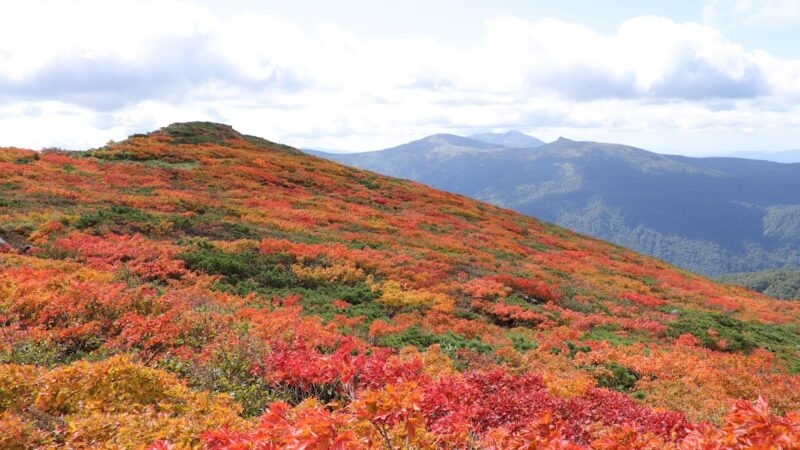
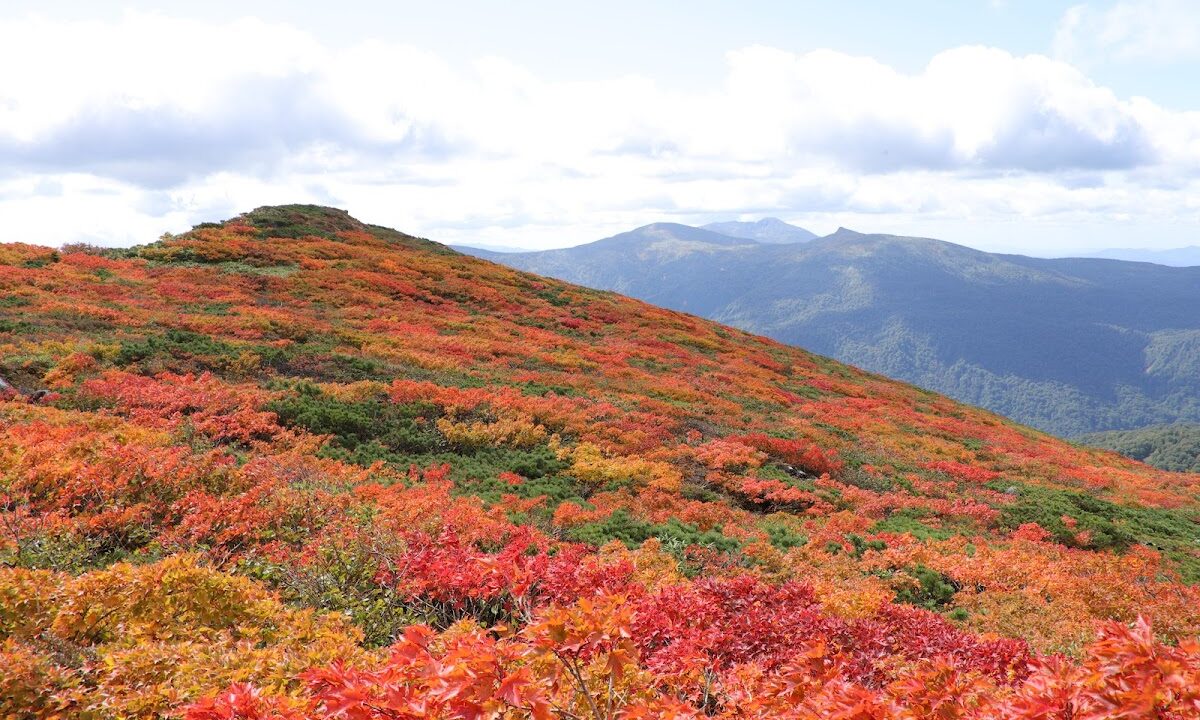
The greatest attraction of Mt. Mitsuishi is undoubtedly the beauty of its autumn foliage. It typically becomes scenic in mid-September and is nationally known as one of the earliest autumn foliage spots in Iwate Prefecture and among the fastest on Honshu.
Rowan, alpine maple, and birch trees turn color simultaneously, and the sight of the mountainside dyed deep crimson is referred to as “the finest in Tohoku.” Particularly from near the summit, one can view the foliage along the ridgeline extending toward Mt. Iwate, and this spectacular scenery captivates many climbers.
The peak foliage season is from mid to late September, when parking areas and restrooms become extremely congested. Even at dawn, parking spaces may not be available, demonstrating its popularity, and careful planning is necessary for climbing.
360-Degree Panoramic Views
The summit area is rocky with a cairn marking the peak, offering open vistas in all directions. Majestic Mt. Iwate (elevation 2,037 meters) rises before you, and you can see at a glance representative peaks of Tohoku including Hachimantai, Akita-Komagatake, Nyuto-yama, Hayachine-yama, and Moriishi-yama.
On clear days, you can sometimes even see the distant Pacific Ocean, and the wonderful landscape spread before you makes you forget the effort of climbing.
Alpine Plants and Wetland Nature
Centered on the Mitsuishi Wetland, diverse alpine plants bloom in summer. You can enjoy vegetation unique to wetlands around 1,400 meters in elevation, including Japanese false hellebore, Hakusan rhododendron, and chinguruma. The reflection of sky and mountains in the ponds is also beautiful and popular as a photography spot.
Mt. Mitsuishi Climbing Routes
Mt. Mitsuishi has multiple climbing routes, and here we introduce three representative routes in detail.
Aibari Onsen Course (Beginner-Friendly · Most Common)
Course Overview:
- Trailhead: Aibari Onsen Ski Resort
- Round-trip hiking time: Approximately 5.5 to 6 hours
- Distance: Approximately 10 km
- Total elevation gain: Approximately 640 meters
- Difficulty: Beginner
This course starting from Aibari Onsen Ski Resort is the most common route for climbing Mt. Mitsuishi. Ski lifts can also be used (operating in summer and autumn foliage seasons), making it an accessible course even for those without great confidence in their stamina.
Route Details:
- Start from Aibari Onsen Ski Resort parking area (elevation approximately 826 meters)
- If using the lift, easy travel to mid-slope possible
- Pass through forested area to Mitsuishi Wetland (approximately 2.5 hours)
- Via Mitsuishi Mountain Lodge
- Approximately 1 hour climb from wetland to summit
- Reach summit (elevation 1,466 meters)
With an average gradient of approximately 3.9 degrees, this relatively gentle course is perfectly enjoyable for climbing beginners. However, during autumn foliage season, the parking area becomes full from early morning, so planning based on ski lift use is recommended.
Matsukawa Onsen Course (Intermediate Level)
Course Overview:
- Trailhead: Matsukawa Onsen
- Round-trip hiking time: Approximately 6 to 7 hours
- Difficulty: Intermediate
Starting from Matsukawa Onsen, this course is a varied route passing through Mt. Genta and Mt. Daifuka toward Mt. Mitsuishi. A popular course where you can fully enjoy the nature of Ura-Iwate, the parking area features free parking and restroom facilities.
Route Details:
- Start from Matsukawa Onsen parking area
- Climb through forested area to Mt. Genta
- Via Mt. Daifuka
- Enjoy ridge walking toward Mt. Mitsuishi
- Return via the same route or loop via Mitsuishi Wetland
From the summit, you can see Mt. Iwate, Nyuto-yama, Hachimantai, Akita-Komagatake, Hayachine-yama, and Moriishi-yama. Summer offers alpine flowers, and autumn offers wonderful foliage.
Ura-Iwate Ridge Traverse Course (Advanced Level)
Course Overview:
- Route: Mt. Iwate ~ Mt. Mitsuishi ~ Hachimantai (Toshichi Onsen)
- Required time: 1 night 2 days ~ 2 nights 3 days
- Difficulty: Advanced
A full-fledged traverse course following the ridgeline from Mt. Iwate to Hachimantai. Mt. Mitsuishi is positioned at approximately the midpoint of this traverse route and serves as an important passage point.
With long-distance walking and elevation changes, adequate physical fitness and mountaineering experience are necessary. Accommodation plans using mountain lodges or tent sites are essential.
Mt. Mitsuishi Autumn Foliage Information
Autumn Foliage Viewing Period
The autumn foliage of Mt. Mitsuishi typically progresses according to the following schedule:
- Early September: Color begins to appear near the summit
- Mid-September: Peak foliage from summit to Mitsuishi Wetland
- Late September: Foliage descends to mid-elevation
- Early October: Foliage reaches the trailhead
The peak period is around September 15-25, when many climbers from across the nation visit.
Autumn Foliage Season Precautions
Mt. Mitsuishi is extremely crowded during foliage season. Iwate Prefecture has issued cautions, and the following points require attention:
- Parking area congestion: May be full before dawn
- Mountain trail congestion: Photo-taking lines form at popular spots
- Restroom congestion: Long queues form from early morning
- Accommodation facility reservations: Nearby onsen lodges become fully booked months in advance
Tips for Avoiding Congestion:
- Consider weekday climbing
- Aim for early departure (targeting arrival around 4 a.m.)
- Plan to use the ski lift
- Avoid peak period (late September to early October can still be beautiful)
Access Information
By Car
To Aibari Onsen Ski Resort:
- Approximately 40 km from Morioka IC on the Tohoku Expressway, approximately 50 minutes by car
- Via National Route 46 toward Shizukuishi Town
- Via Prefectural Route 219 (Shizukuishi Higashi-Hachimantai Line) toward Aibari Onsen
To Matsukawa Onsen:
- Approximately 20 km from Matsuo-Hachimantai IC on the Tohoku Expressway, approximately 30 minutes by car
- Via Prefectural Route 23 (Osarashi Hachimantai Line)
Parking Information
Aibari Onsen Ski Resort Parking Area:
- Capacity: Approximately 500 spaces
- Fee: Free
- Restrooms: Available
- Becomes full from early morning during foliage season
Matsukawa Onsen Parking Area:
- Capacity: Approximately 30 spaces
- Fee: Free
- Restrooms: Available
By Public Transportation
To Aibari Onsen Ski Resort:
- Approximately 60 minutes from Morioka Station via Iwate Kenpoku Bus “Aibari Onsen Line”
- Additional buses may be added during foliage season
- It is recommended to check operating status in advance
To Matsukawa Onsen:
- Approximately 90 minutes from Morioka Station via Iwate Kenpoku Bus “Matsukawa Onsen Line”
- Limited bus service, so checking the timetable is essential
Climbing Preparation and Precautions
Clothing and Equipment
Basic Equipment:
- Climbing shoes (with waterproof properties)
- Rain jacket and pants
- Warm clothing (fleece or down jacket)
- Hat and gloves
- Backpack (20-30 liters)
- Water (1.5-2 liters)
- Snacks
- Headlamp
- Map and compass (or GPS)
- First aid kit
Seasonal Considerations:
- Summer (July-August): Strong sunlight requires sun protection measures. Bring insect repellent
- Autumn (September-October): Bring warm clothing as mornings and evenings cool down. Plan for congestion during foliage season
- Early summer and late autumn: Possibility of lingering snow or frozen conditions. Lightweight crampons are reassuring
Climbing Notification
Submission of a climbing notification is recommended for climbing Mt. Mitsuishi and the Ura-Iwate Ridge. You can submit through Iwate Prefectural Police’s online system or at posts placed at trailheads.
Weather and Temperature
At the summit of 1,466 meters, the temperature is approximately 10 degrees lower than at sea level. Even in summer, the summit reaches 15-20 degrees, and in early autumn, early morning temperatures can drop below 5 degrees.
Weather changes easily, and sudden fog development or rain can occur even on clear days. Always check the latest weather forecast, and it is important to make the judgment to turn back during bad weather rather than push forward.
Climbing Etiquette
To preserve the beautiful nature of Mt. Mitsuishi, please follow the following etiquette:
- Always carry out all trash
- Do not collect plants or trample them
- Stay on designated trails
- Do not feed wild animals
- Practice a spirit of mutual consideration
- Do not speak loudly
- Use restrooms in designated areas (bring portable toilet)
Nearby Hot Springs and Accommodations
Aibari Onsen
Kyukamura Iwate Aibari Onsen:
Perfect for refreshing yourself after climbing. Day-use bathing is also available, and the outdoor bath offers views of the impressive Mt. Iwate.
- Hot spring type: Simple sulfurous spring
- Benefits: Neuralgia, muscle pain, fatigue recovery, etc.
- Day-use bathing: Available (confirm in advance)
Matsukawa Onsen
Matsukawa Soh, Kyoum Soh, etc.:
A secret hot spring characterized by milky sulfurous water. Convenient for staying before or after climbing as it is near the trailhead.
- Hot spring type: Simple sulfurous spring
- Benefits: Skin conditions, neuralgia, rheumatism, etc.
- Day-use bathing: Available
Mitsuishi Mountain Lodge
A mountain lodge standing in Mitsuishi Wetland and an important base for ridge traverse climbers.
- Capacity: Approximately 50 people
- Operating period: Early June to mid-October (varies by year)
- Reservations: Recommended (essential during foliage season)
- Facilities: Bedding and meals provided
Tourist Attractions Near Mt. Mitsuishi
Mt. Iwate
At 2,037 meters, Iwate Prefecture’s highest peak. Known as the “Nambu Single Fuji,” this beautiful independent peak stands out particularly in views from Mt. Mitsuishi.
Hachimantai
A highland area north of Mt. Mitsuishi. Popular as a driving course, the Hachimantai Aspite Line is a scenic route.
Koiwai Farm
One of Japan’s largest private comprehensive farms spanning Morioka City and Shizukuishi Town. You can enjoy pastoral scenery with Mt. Iwate in the background.
Shizukuishi Town Tourist Facilities
Shizukuishi Town (read as “Shizukuishi”) has abundant tourism resources including hot springs, ski resorts, and gourmet dining. An area to visit along with climbing.
Best Seasons for Mt. Mitsuishi Climbing
Summer (July-August)
A season when alpine plants bloom profusely. In Mitsuishi Wetland, the reflection of blue sky and mountains in ponds is beautiful, and refreshing climbing can be enjoyed. However, with strong sunlight and afternoon thunderstorm possibilities, early departure and early arrival are essential.
Autumn (September-Early October)
The most popular season. Honshu’s fastest autumn foliage can be seen, and temperatures are suitable for climbing. However, due to extreme congestion, adjustments such as climbing on weekdays or shifting the period are necessary.
Early Summer and Late Autumn
In June or mid-October onward, quiet climbing can be enjoyed with fewer people. However, as there is a possibility of lingering snow, freezing, or early snowfall, it is for experienced climbers.
Conclusion
Mt. Mitsuishi, despite being 1,466 meters in elevation, is a notable peak with diverse attractions including Honshu’s fastest autumn foliage, 360-degree views, and rich nature. Located on the border of Hachimantai City and Shizukuishi Town in Iwate Prefecture and serving as a key point on the Ura-Iwate Ridge Traverse route, it is cherished by many climbers.
The Aibari Onsen course is accessible for beginners, while the Matsukawa Onsen course and traverse route offer full-fledged mountain walking. Particularly spectacular in mid-September foliage season, but early action and careful planning are necessary to manage congestion.
After climbing, refresh yourself at nearby hot springs, and enjoy sightseeing of Mt. Iwate and Hachimantai. Experience the charm of Tohoku mountains in all its seasonal beauty at Mt. Mitsuishi.
To preserve the attractions of Mt. Mitsuishi and pass them on to the future, enjoy the mountain while following climbing etiquette and cherishing nature.