
.jpg)
Mitsumine Mountain (Saitama Prefecture) Complete Guide | Trekking and Tourism Information for the Three Peaks of Kumotori Mountain, Shiraiwayama, and Myohoji Peak and Mitsumine Shrine
Mitsumine Mountain, located deep in Chichibu City, Saitama Prefecture, has long captivated many mountaineers and pilgrims as a sacred site of mountain worship. This article comprehensively introduces information necessary for visiting this spiritual peak, covering everything from an overview of Mitsumine Mountain to climbing routes, access methods, and nearby tourist attractions.
Overview and History of Mitsumine Mountain
What is Mitsumine Mountain?
Mitsumine Mountain (Mitsumine-san) is originally a collective term for three mountains located in the Oku-Chichibu mountain range: Kumotori Mountain (2,017m), Shiraiwayama (1,921m), and Myohoji Peak (1,332m). Many people mistakenly believe that Mitsumine Shrine is located at the summit, but in fact, Mitsumine Shrine is positioned at the base of Myohoji Peak, and these three mountains together are referred to as Mitsumine Mountain.
It belongs to the Chichibu Tama Kai National Park and forms a vast mountainous region spanning the borders of three regions: Koshu (Yamanashi Prefecture), Bushu (Saitama Prefecture), and Shinshu (Nagano Prefecture). This geographical characteristic is said to be one of the origins of the name “Mitsumine” (three peaks).
Positioning as One of the Chichibu Three Mountains
Mitsumine Mountain is counted as one of the “Chichibu Three Mountains” along with Ryokami Mountain and Butai Mountain, and has been revered as a spiritual peak of mountain worship. In particular, the faith centered on Mitsumine Shrine has been flourishing since the Edo period and is known as a sacred site visited by many pilgrims from throughout the Kanto region.
History of Mountain Worship
The history of faith on Mitsumine Mountain is ancient, said to derive from the legendary eastern expedition of Yamato Takeru (Yamato Takeru no Mikoto). Mitsumine Shrine flourished as a spiritual training ground of Shugendo, and in the Edo period, a faith organization called “Mitsumine-ko” (Mitsumine Fraternity) spread throughout the Kanto region. Today, many pilgrims visit each year, with the “white ki-mamori” (white protective amulet) being particularly famous, and it has also gained attention as a power spot.
Three Mountains Comprising Mitsumine Mountain
Kumotori Mountain (2,017m)
Kumotori Mountain is the highest peak comprising Mitsumine Mountain and spans Tokyo, Saitama, and Yamanashi Prefectures. The elevation of 2,017m meant that many mountaineers visited in 2017. The view from the summit is spectacular, offering views of Mount Fuji, the Southern Alps, and the Yatsugatake mountain range.
Kumotori Mountain is also selected as one of Japan’s 100 Famous Mountains and is one of the most popular mountains in the Kanto region. Near the summit, there are Kumotori Mountain Lodge and Kumotori Mountain Emergency Shelter, and many mountaineers enjoy mountain lodge stays.
Shiraiwayama (1,921m)
Shiraiwayama is located between Kumotori Mountain and Myohoji Peak and can be said to be the quietest mountain among the Mitsumine Mountains. While the hiking trail is well-maintained, it does not attract as many mountaineers as Kumotori Mountain, allowing for peaceful mountain walking.
The name Shiraiwayama derives from white rocks exposed on the mountainside. Broadleaf forests of beech and mizunara spread throughout the surrounding area, and the scenery is particularly beautiful during the fall foliage season.
Myohoji Peak (1,332m)
Myohoji Peak is a sacred mountain where the inner shrine of Mitsumine Shrine is located. A round-trip hiking course of about 2 hours from Mitsumine Shrine is well-established, allowing relatively easy access. The summit has an inner shrine, and the view of the Chichibu mountains from here is spectacular.
The hiking trail to Myohoji Peak includes chain sections and steep climbs, but it is possible for beginners to challenge it with proper mountaineering equipment. From the summit, you can see a panorama of Kumotori Mountain, Ryokami Mountain, and even the Chichibu Basin.
Access Methods to Mitsumine Mountain
Access by Public Transportation
For those using public transportation to reach Mitsumine Shrine, the gateway to Mitsumine Mountain, the following routes are common.
Access from Ikebukuro Station
- About 1 hour 20 minutes by Seibu Railway Ikebukuro Line to Seibu-Chichibu Station (limited express)
- About 1 hour 30 minutes by Seibu Kanko Bus “Mitsumine Shrine bound” from Seibu-Chichibu Station
- Since the bus operates only several times daily, it is necessary to check the timetable in advance
Access from Hachioji and Tachikawa Area
- To Higashi-Hanno Station by JR Hattaka Line
- Transfer to Seibu-Chichibu Line to Seibu-Chichibu Station
- From Seibu-Chichibu Station to Mitsumine Shrine by bus
The bus to Mitsumine Shrine has varying numbers of services depending on the season and day of the week. It is recommended to check the latest information on the Seibu Kanko Bus official website.
Access by Automobile
Via Kan’etsu Expressway
- About 2 hours from “Hanazono IC” on the Kan’etsu Expressway via National Route 140 (Saikousai Road)
- Pass through Chichibu city center and head toward Minemine-guchi via National Route 140
- Proceed via Prefectural Road 278 (Otaki Main Line) to Mitsumine Shrine
Via Chuo Expressway
- About 2 hours 30 minutes from “Katsumine IC” on the Chuo Expressway via National Route 140
- Pass through the Ganoseki Tunnel (toll) to Saitama Prefecture side
Parking Information
Parking lots for pilgrims are provided at Mitsumine Shrine.
- First Parking Lot: Accommodates approximately 240 vehicles
- Second Parking Lot: Accommodates approximately 42 vehicles
- Parking fee: 510 yen for ordinary cars
- Operating hours: Open 24 hours
The parking lots may fill up during weekends, autumn foliage season, and New Year holidays, so arriving early is recommended. In winter, due to the possibility of frozen road surfaces and snow, studless tires or chains may be necessary.
Climbing Routes of Mitsumine Mountain
Climbing Myohoji Peak from Mitsumine Shrine
Course Overview
- Trailhead: Mitsumine Shrine grounds
- Required time: Round trip approximately 2 hours
- Elevation gain: Approximately 200m
- Difficulty: Beginner to intermediate
The climb to Myohoji Peak’s inner shrine from Mitsumine Shrine is the most easy way to enjoy one portion of Mitsumine Mountain. The hiking trail begins next to the main shrine building and proceeds along a well-maintained path. While there are chain sections and rocky areas along the way, there are no problems if you walk carefully.
The view from the summit shrine is wonderful, offering a 360-degree view of Chichibu’s mountains. Early morning worship is particularly popular among mountaineers, with the mountains illuminated by the rising sun creating a mystical atmosphere.
Front Main Trail to Mitsumine Shrine
Course Overview
- Trailhead: Omwa Bus Stop
- Required time: Approximately 2 hours 30 minutes to 3 hours
- Elevation gain: Approximately 600m
- Difficulty: Intermediate
This course follows the pilgrimage path used from the Edo period until the Taisho period. It is an attractive route that allows you to feel the history, with old stone monuments and guideposts remaining along the way.
While the hiking trail is relatively well-maintained, a long climb continues, requiring adequate physical fitness. The surrounding natural forests are beautiful, and the scenery is particularly wonderful during the spring growth and autumn foliage seasons.
Ridge Traverse Route to Kumotori Mountain
From Mitsumine Shrine to Kumotori Mountain
- Required time: Approximately 6 to 7 hours (one way)
- Elevation gain: Approximately 700m
- Difficulty: Advanced
This route is a full-scale mountaineering course suitable for advanced mountaineers. The trail from Mitsumine Shrine via Kirimoke Peak to Kumotori Mountain allows you to enjoy the deep nature of Oku-Chichibu.
Main Points
- Mitsumine Shrine (elevation approximately 1,100m)
- Kirimoke Peak (elevation 1,523m)
- Shiraiwayama (elevation 1,921m)
- Kumotori Mountain (elevation 2,017m)
For those using mountain lodge accommodations, Kumotori Mountain Lodge and Kumotori Mountain Emergency Shelter are available. Kumotori Mountain Lodge offers meals with lodging, and breakfast includes unlimited rice refills, with pickled plums and furikake (seasoning sprinkles) freely available.
Cautions and Equipment for Mountaineering
The following points require attention when mountaineering on Mitsumine Mountain.
Basic Equipment
- Mountaineering boots (high-cut preferred)
- Rainwear (separate top and bottom)
- Warm clothing (depending on season)
- Headlamp
- Map and compass (GPS device also recommended)
- Sufficient water and snacks for the journey
Seasonal Precautions
- Spring (April-May): Remaining snow may be present; light crampons may be necessary, especially in the Kumotori Mountain area
- Summer (June-August): Heat stroke prevention and insect repellent measures are essential
- Autumn (September-November): Fall foliage season is crowded, so early action is recommended
- Winter (December-March): Full winter mountaineering equipment is necessary. Crampons and ice axes are essential
Highlights of Mitsumine Shrine
History and Origins of the Shrine
Mitsumine Shrine is said to have originated when Yamato Takeru visited this area during his eastern expedition and enshrined Izanagi-no-Mikoto and Izanami-no-Mikoto here. It developed as a spiritual training ground of Shugendo and is known as one of the foremost power spots in the Kanto region.
Highlights of the Grounds
Zuishin Gate
The distinctive vivid red zuishin gate is an iconic symbol of Mitsumine Shrine. Passing through the gate, you are enveloped in a solemn atmosphere.
Main Shrine Hall and Inner Sanctuary
The main shrine hall, decorated with elaborate colorful carvings, is a valuable cultural property conveying Edo period architectural styles. The inner sanctuary is located behind the main hall, with a solemn atmosphere.
Sacred Tree
A giant cedar tree said to be over 800 years old, touching it is believed to bring good fortune. It is a popular spot visited by many pilgrims.
Wolf Worship
Mitsumine Shrine reveres wolves as divine messengers. A unique feature is that wolf statues, rather than guardian lion dogs (komainu), are enshrined in the grounds.
White Ki-Mamori and Visitor Information
The “white ki-mamori” (white protective amulet) of Mitsumine Shrine was previously distributed only on the first day of each month, but as of 2024, distribution has been suspended to ease congestion. Regular protective amulets are distributed year-round and are also popular as powerful charms.
Visiting Hours
- April to November: 9:00 AM to 5:00 PM
- December to March: 9:00 AM to 4:30 PM
Admission
- Free (grounds open to the public)
Tourist Attractions Around Mitsumine Mountain
Chichibu Lake (Nise Dam)
A man-made lake on the way to Mitsumine Shrine, characterized by its beautiful emerald green surface. It is also selected as one of the 100 Best Dam Lakes and has a walking trail around it. With a parking lot available, it is also ideal as a rest spot for driving.
Nakatsugawa Gorge
A beautiful gorge with a clear stream, particularly popular with tourists during the autumn foliage season. A walking trail is established along the gorge, allowing enjoyment of negative ions while strolling.
Otaki Hot Spring
Several hot spring facilities nearby are ideal for relieving fatigue from mountaineering on Mitsumine Mountain. Many facilities offer day-trip bathing, recommended for refreshment after climbing.
Mitsutsutsuichi Ice Pillars
A limited-time winter scenic spot featuring a massive group of ice pillars created by frozen spring water from the rocks. Evening illumination is also provided, allowing enjoyment of a fantastical landscape. The best viewing period is typically mid-January to mid-February.
Autumn Foliage Information for Mitsumine Mountain
Foliage Season and Types
The autumn foliage of Mitsumine Mountain is known for being particularly beautiful even within Saitama Prefecture.
Best Viewing Period
- Color beginning: Mid-October
- Prime season: Late October to early November
- Due to higher elevation, foliage advances earlier than in Chichibu city center
Trees That Change Color
- Japanese maple
- Maple
- Nana kamate
- Beech
- Azalea
- Mizunara oak
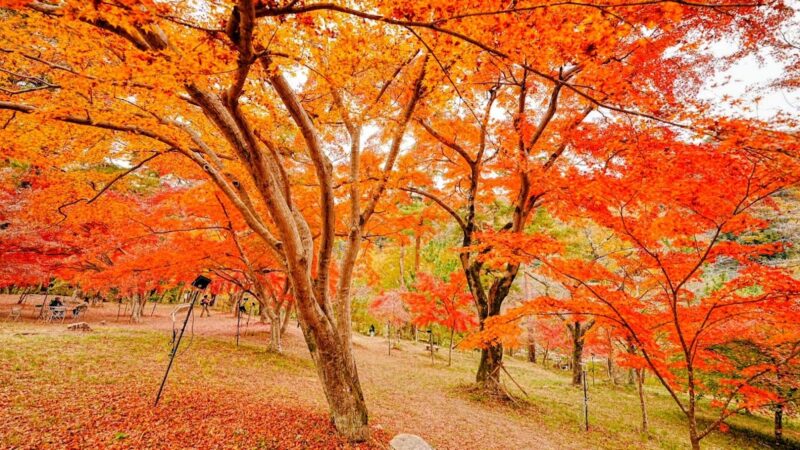
Centered around Mitsumine Shrine, gradients of red, yellow, and orange color the entire mountain. The maples in the shrine grounds are particularly stunning, creating spectacular views when combined with the zuishin gate and main hall.
Recommended Spots for Foliage Viewing
Mitsumine Shrine Grounds
Autumn foliage can be enjoyed throughout the grounds, with particularly beautiful views near the stone steps in front of the main hall and around the sacred tree.
Myohoji Peak Climbing Trail
The foliage along the trail is also spectacular, and from the summit, you can see a panorama of Chichibu mountains tinged with autumn colors.
Mitsumine Visitor Center Area
The area around the visitor center near the shrine is also a famous foliage spot. Close to the parking lot, it allows for casual enjoyment of the autumn foliage.
Mountain Lodges and Accommodations in Surrounding Areas
Kumotori Mountain Lodge
A mountain lodge located directly below the Kumotori Mountain summit, serving as a base for mountaineers heading to Kumotori Mountain from the Mitsumine area.
- Capacity: Approximately 200 people
- Operating season: Year-round (reservation required)
- Meals: Breakfast and dinner included
- Facilities: Bedding provided, toilet available
Breakfast features unlimited rice refills, with pickled plums and furikake freely available—a well-liked service. The sunrise from the lodge is spectacular, with many mountaineers enjoying the early morning views.
Kumotori Mountain Emergency Shelter
An emergency shelter near Kumotori Mountain summit for use during emergencies or basic accommodation. Since it is an unmanned facility, basic equipment and food must be prepared by users.
Mitsumine Shrine Koun-kaku
A temple lodging within Mitsumine Shrine grounds available to pilgrims and mountaineers.
- Rooms: Japanese-style
- Meals: Breakfast and dinner included (vegetarian cuisine option available)
- Hot spring: Large communal bath
- Rates: Approximately 10,000 yen and up per night with two meals
Situated adjacent to the shrine, it is convenient for early morning worship. The ability to bathe in the hot spring is also an attractive feature.
Best Season for Mitsumine Mountain Climbing
Spring (April to June)
The season of fresh greenery, with the beauty of newly sprouted leaves. Cherry blossoms can be enjoyed around Golden Week. However, remaining snow may be present, especially in the Kumotori Mountain area, requiring careful equipment preparation.
Summer (July to August)
Alpine flora bloom and deep green forest bathing can be enjoyed. However, even at high elevations, temperatures rise, necessitating heat stroke prevention and sufficient hydration. Afternoon thunderstorms can occur, so early action is advised.
Autumn (September to November)
The best season for Mitsumine Mountain. Especially from late October to early November during autumn foliage, you can enjoy the year’s most beautiful scenery. Temperatures are suitable for mountaineering and fair weather frequency is high. However, as a popular season, crowds are unavoidable.
Winter (December to March)
A season for experienced snow mountaineers. While snowy forests and winter landscapes are beautiful, full winter mountaineering equipment and skills are necessary. Roads to Mitsumine Shrine may be frozen or snow-covered, requiring considerable caution for vehicle access.
Nature and Ecosystem of Mitsumine Mountain
Vegetation and Forests
The vegetation of Mitsumine Mountain changes with elevation. Up to about 1,000m elevation are cypress and hinoki cypress plantations, while above that elevation, natural forests of beech, mizunara, and sirabe spread.
The beech forest particularly around Shiraiwayama is magnificent, turning golden in autumn. Near the Kumotori Mountain summit, coniferous forests of sirabe and kometsugas appear.
Wildlife
Diverse wildlife inhabits the Mitsumine Mountain area.
- Mammals: Japanese sika deer, Japanese serow, Asian black bears, Japanese monkeys
- Birds: Japanese pheasant, common cuckoo, blue-and-white flycatcher, narcissus flycatcher
- Insects: Large purple emperor butterfly, miyama stag beetle, etc.
Since Asian black bears have been sighted in the area, carrying a bear bell during mountain climbing is recommended.
History of Mitsumine Mountain Mountaineering
As a Shugendo Training Ground
Mitsumine Mountain has long flourished as a spiritual training ground for Shugendo. Ascetic practitioners performed rigorous training, deepening mountain worship. The faith centered on Mitsumine Shrine was organized as “Mitsumine-ko” in the Edo period, spreading throughout the Kanto region.
Development of Modern Mountaineering
After the Meiji period, as modern mountaineering developed, Mitsumine Mountain gained attention as a mountaineering destination. In particular, Kumotori Mountain, as the closest 2,000-meter peak to Tokyo, has been cherished by many mountaineers.
In the 1950s, it was designated as Chichibu Tama National Park (currently Chichibu Tama Kai National Park), with hiking trails and mountain lodges developed. Today, it serves as a mountaineering area enjoyable by beginners to advanced mountaineers, attracting many mountaineers year-round.
Planning and Preparation for Mitsumine Mountain Mountaineering
How to Create a Mountaineering Plan
When planning a climb on Mitsumine Mountain, consider the following points.
Day Hike or Mountain Lodge Stay
- Myohoji Peak only: Day hike possible
- Ridge traverse to Kumotori Mountain: Mountain lodge stay recommended
Physical Fitness and Experience of Members
If beginners are included, the route from Mitsumine Shrine to Myohoji Peak is appropriate. The Kumotori Mountain ridge traverse is suited for intermediate mountaineers and above.
Weather and Season
Check weather forecasts in advance, and have the courage to change plans if bad weather is expected.
Mountaineering Notification Submission
For the Oku-Chichibu mountain area including Mitsumine Mountain, mountaineering notifications are recommended.
Submission Methods
- Saitama Prefecture Police mountaineering notification online system
- Mountaineering notification post at trailhead
- Japan Mountaineering Association’s Compass (online mountaineering notification)
Always submit a mountaineering notification as a precaution.
Emergency Response
Emergency Contact Numbers
- Police (110)
- Fire/Ambulance (119)
- Saitama Prefecture Police Chichibu Police Station: 0494-23-0110
Mobile phone signal is generally good on major hiking trails, though some areas may have no reception. Carrying backup batteries is recommended.
Conclusion
Mitsumine Mountain (Saitama Prefecture), composed of Kumotori Mountain, Shiraiwayama, and Myohoji Peak, is a spiritual peak of mountain worship. It offers the unique opportunity to simultaneously enjoy the rich history and culture centered on Mitsumine Shrine and the magnificent nature of Oku-Chichibu.
Various mountain routes are established, from beginner-friendly Myohoji Peak hiking to advanced Kumotori Mountain ridge traverses, accommodating mountaineers of various skill levels. The scenic beauty is particularly impressive during the autumn foliage season, and this sacred peak continues to enchant many mountaineers and pilgrims throughout the year.
When visiting Mitsumine Mountain, prepare appropriate equipment and plans, exercise caution for safety, and fully savor the natural beauty and historical depth that this spiritual peak offers.
-800x450.jpg)
-800x450.jpg)
-800x450.jpg)