
Complete Guide to Nasu-dake (Tochigi Prefecture): Thoroughly Explaining the Charm and Climbing Information of One of Japan’s 100 Famous Mountains
What is Nasu-dake: A Collective Name for an Active Volcano Boasted by Tochigi Prefecture
Nasu-dake (那須岳) is widely known as a collective name for the Nasu mountain range located in the northern part of Tochigi Prefecture. In a narrow sense, it refers to the main peak, Chausudake (elevation 1,915m), and in a broad sense, it encompasses the entire volcanic group centered on Chausudake, Asahidake, and Sambonjagidake. It was selected as one of Japan’s 100 Famous Mountains by Fukada Kyuya, and it is positioned at the southern end of the Nasu volcanic belt stretching north-south along the border between Tochigi and Fukushima prefectures.
As an active volcano currently emitting smoke, it is the only actively volcanic mountain in Tochigi Prefecture, and its majestic appearance continues to fascinate many climbers. With the help of a ropeway, even beginners can reach near the summit with relative ease, making it a popular mountain crowded with many climbers during the season.
Geographic Location and Characteristics of Nasu-dake
Nasu-dake spreads centered around Nasu Town, Nasu District, Tochigi Prefecture, with some parts extending to the Fukushima Prefecture border. It is protected as part of Nikko National Park, maintaining a rich natural environment. The Nasu volcanic group stretches for approximately 15 kilometers from south to north, with each peak possessing its own unique character.
The mountain body is composed of multiple lava flows, pyroclastic flows, and lava domes (troide), making it extremely interesting from a geological perspective. The foothills are home to the Nasu hot spring district, providing a blessed environment where climbing and hot springs can be combined for tourism.
Main Peaks Comprising Nasu-dake: The Charm of the Five Peaks of Nasu
The Nasu mountain range is composed of multiple peaks, and in particular, five representative peaks are called the “Nasu Go-peaks” (Five Peaks of Nasu). Additionally, the three peaks of Chausudake, Asahidake, and Sambonjagidake are especially appreciated as the “Nasu San-zan” (Three Mountains of Nasu).
Chausudake (1,915m): The Main Peak of Nasu-dake
Chausudake is the main peak of Nasu-dake and the most active volcano in the Nasu mountain range. White smoke rises from the summit, and there is a unique atmosphere with the smell of sulfur wafting through the air. It displays the typical shape of a lava dome and is characterized by gentle mountain contours.
Using the Nasu Ropeway, you can reach from the base station to the summit station in approximately 4 minutes, and from there it takes about 40 to 50 minutes on foot to reach the summit. The summit offers a 360-degree panorama, and on clear days, you can see all the way to the Kanto Plain, the Nikko mountain range, and the mountains of Aizu.
Asahidake (1,896m): A Peak with Steep Rocky Ridges
Asahidake is located on the north side of Chausudake and is a steep rocky peak with an elevation of 1,896m. In contrast to Chausudake, it is characterized by sharp rocky ridges, and some sections of the climbing trail have chains and ladders installed. The view from the summit is excellent, particularly offering a close-up view of Chausudake’s smoke.
The ridge traverse from Chausudake to Asahidake has become a popular climbing course for Nasu-dake, with a route via Touge-no-chaya (Mountain Pass Tea House) being standard. Since rock climbing skills are required, it is more suitable for intermediate and advanced climbers rather than beginners.
Sambonjagidake (1,917m): The Highest Peak of the Nasu Mountain Range
Sambonjagidake stands at 1,917m and is the highest peak of the Nasu mountain range. It is located at the point where three boundaries—Tochigi Prefecture, Fukushima Prefecture, and Nasu Town—meet, which is said to be the origin of its name. Compared to Chausudake and Asahidake, it has a gentler mountain form and is characterized by a spacious summit.
The summit offers 360-degree views where the entire Nasu mountain range can be seen. Alpine plants are abundant, and from early to mid-summer, a colorful array of flowers welcomes climbers. The ridge traverse from Asahidake to Sambonjagidake is popular as a route that lets you fully enjoy the essence of Nasu-dake climbing.
Minami-Tsukiyama (1,776m): A Mountain of Gentle Grassland
Minami-Tsukiyama stands at 1,776m and is counted as one of the Nasu Go-peaks. It is characterized by gentle, grassland-like mountain contours and is located on the south side of Chausudake. The summit area is covered with expansive grassland, allowing climbers to enjoy hiking in a leisurely atmosphere.
The view is excellent, offering vistas of Chausudake and the Nikko mountain range. It is a relatively quiet mountain area, making it suitable for climbers who want to enjoy mountain walking slowly while avoiding crowds.
Kuro-oyatani-dake (1,589m): A Place for Quiet Mountain Walking
Kuro-oyatani-dake stands at 1,589m and is the lowest peak among the Nasu Go-peaks. Located south of Minami-Tsukiyama, it offers quiet climbing through a forest zone. Compared to other peaks, fewer climbers visit, and it is known as a place where one can fully immerse oneself in nature amid silence.
The Volcanic Activity History of Nasu-dake: The Continuing Breath of the Earth
Nasu-dake is the newest volcano in the Nasu volcanic group and continues to show activity. Its volcanic activity history has had a significant impact on the formation of the terrain in this region.
Formation Process and Geological Characteristics
The formation of the Nasu volcanic group is believed to have begun approximately 500,000 years ago. Multiple volcanoes became active at different times, creating the complex terrain we see today. Chausudake is the newest volcano, which began its activity approximately 16,000 years ago and continues to grow as a lava dome.
The mountain body is composed of andesite lava flows and pyroclastic flow deposits, and there are currently active fumaroles near the summit. Volcanic gases containing sulfur are emitted from these fumaroles, and sulfur crystals can be seen in the surrounding area.
Historical Eruption Records
Nasu-dake (Chausudake) has several eruption records remaining in historical times. The oldest record is from 1408 (Ōei 15), with subsequent eruptions recorded in 1410 and 1881 (Meiji 14), among others.
In particular, the 1881 eruption was relatively large in scale, with erupted stones scattered from the crater and ashfall affecting surrounding areas. Currently, small-scale fumarolic activity continues, and the volcano is designated by the Japan Meteorological Agency as an active volcano under constant observation.
Current Volcanic Activity Status
There are multiple fumaroles near the summit of Chausudake, with white smoke rising from them. The temperature of the fumaroles exceeds 100 degrees Celsius, and a strong sulfur smell wafts through the air. The volcanic activity level is typically set to “Level 1 (Note the active volcano status),” allowing for climbing, but attention to volcanic gases is necessary.
Monitoring by the Japan Meteorological Agency and research institutions at universities continues, including seismic meters, tiltmeters, and GPS observations, with volcanic activity changes monitored 24 hours a day. Climbers are advised to check the latest volcanic information before entering the mountain.
Climbing Nasu-dake: Diverse Routes and Ways to Enjoy
Nasu-dake offers diverse, well-maintained routes that can be enjoyed by climbers of all levels, from beginners to advanced. You can choose from easy courses using the ropeway to full-scale ridge traverses depending on your objectives.
Beginner-Friendly Course Using the Nasu Ropeway
The easiest way to enjoy Nasu-dake is a course using the Nasu Ropeway. It connects the base station (elevation 1,390m) to the summit station (elevation 1,684m), covering a total distance of approximately 812m in about 4 minutes.
From the summit station to the Chausudake summit, there is a well-maintained climbing trail of approximately 40 to 50 minutes, which even beginners can navigate without difficulty. The trail is predominantly volcanic scree, passing by the ruins of Touge-no-chaya on the way. Near the summit, fumaroles can be observed up close, offering a sense of the power of an active volcano.
The round-trip takes approximately 2 to 3 hours and is ideal for day hiking. However, weather changes rapidly, so preparing windbreaker clothing and rain gear is essential.
Climbing Route from Touge-no-chaya
The climbing route starting from Touge-no-chaya (elevation approximately 1,462m) is a standard course for Nasu-dake climbing. Touge-no-chaya has a parking lot, making access by private vehicle possible (it becomes congested during the season).
From Touge-no-chaya to the Chausudake summit, the trail continues for approximately 1.5 to 2 hours. Without using the ropeway, the elevation gain increases, but you can experience the sense of achievement that comes with climbing step by step on your own. The standard route passes by the Nasu Ropeway summit station on the way.
Starting from Touge-no-chaya, a ridge traverse from Chausudake to Asahidake and even further to Sambonjagidake is possible, making this a popular route for those seeking genuine mountain hiking.
Ridge Traverse Course from Chausudake to Asahidake
The ridge traverse from Chausudake to Asahidake is a popular course that lets you fully experience the essence of Nasu-dake climbing. From the Chausudake summit, you descend temporarily, pass via Tsurugi-ga-mine, and proceed toward Asahidake.
This route includes chains and rocky areas, requiring intermediate or advanced skills. Particularly around Tsurugi-ga-mine, the walking involves exposed rocky ridges, so days with poor weather should be avoided. The time from Chausudake to Asahidake is approximately 1.5 to 2 hours.
The view from the Asahidake summit is excellent, offering a close view of Chausudake’s smoke. Extending further to Sambonjagidake makes for a fulfilling climb that conquers the highest peak of the Nasu mountain range.
Ridge Traverse Course to Sambonjagidake
The ridge traverse from Asahidake to Sambonjagidake is the most full-scale course for Nasu-dake climbing. From Asahidake, you descend once, then proceed via Shimizudaira and the Kita-Onsen junction toward Sambonjagidake.
Along the way, you pass through a wetland area rich in alpine plants, where you can enjoy colorful flowers depending on the season. The Sambonjagidake summit is spacious with a 360-degree view opening up. The trek from Asahidake to Sambonjagidake takes approximately 2 to 2.5 hours.
A round-trip course starting from Touge-no-chaya that loops through Chausudake, Asahidake, and Sambonjagidake makes for a fulfilling 6 to 8-hour climb. It is important to plan with sufficient time and physical stamina in mind.
Route toward Minami-Tsukiyama
Climbing toward Minami-Tsukiyama is suitable for those wishing to enjoy relatively quiet mountain walking. Various routes are available, including one from Touge-no-chaya via Minami-Tsukiyama descending toward Hinode-hira, or one heading to Minami-Tsukiyama from the Numahara wetland.
The walk primarily consists of gentle grassland hiking with excellent views. Fewer climbers visit compared to the Chausudake direction, allowing you to enjoy nature in a leisurely atmosphere.
Alpine Plants of Nasu-dake: Flowers of Each Season
Despite its relatively low elevation, Nasu-dake is known for abundant alpine plants. Volcanic soil and a cool climate nurture a diverse plant community.
Spring and Early Summer Flowers
From late May through June, as the snow melts, spring flowers begin to bloom on Nasu-dake. Species such as Chionographis japonica, Soldanella nipponica, and Coptis trifolia line the climbing trails.
Particularly around Touge-no-chaya and along the trail to Asahidake, colonies of Soldanella japonica blooming on rocky areas are magnificent. The delicate pink flowers covering the rocky surface fascinate many climbers.
Summer Alpine Plants
From July through August is the season when alpine plants on Nasu-dake are most abundant. Along the ridge traverse to Sambonjagidake and in the Shimizudaira area, flowers such as Geranium eriostemon, Eupatorium niveum subsp. japonicum, and Ranunculus acris subsp. nipponicus bloom in a colorful display.
Particularly in wetland areas, the white cotton-like flowers of Eriophorum scheuchzeri sway in the wind, symbolizing the summer of the high mountains. The large colonies of Veratrum album subsp. oxysepalum are also impressive.
Autumn Foliage
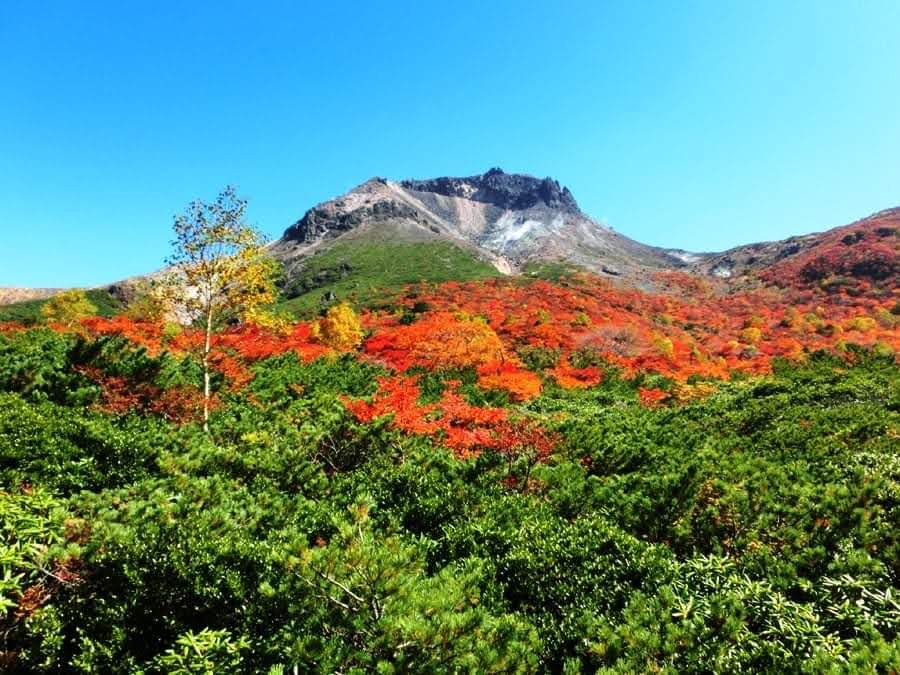
From late September through early October, Nasu-dake is crowded with many visitors as a famous autumn foliage destination. Red and yellow colors of Sorbus commixta and Betula ermanii dye the mountainside, creating beautiful scenery contrasting with the rugged form of Chausudake.
Viewing autumn foliage from the ropeway is also popular, allowing you to enjoy the color gradient of foliage that changes from the base to the summit of the mountain. This period is crowded, so visiting early in the morning is recommended.
Access to Nasu-dake and Climbing Trailhead Information
The main climbing trailheads to Nasu-dake are Touge-no-chaya and the Nasu Ropeway base station. Access methods and characteristics of each are introduced below.
Access by Private Vehicle
From the Nasu IC on the Tohoku Expressway, proceed toward the Nasu Ropeway via Prefectural Road 17 (Nasu Kogen Line). Travel time is approximately 40 to 50 minutes. Touge-no-chaya has a parking lot with approximately 100 parking spaces, but on weekends during the season and autumn foliage season, it becomes full early in the morning, so arriving early is recommended.
Parking lots are also available around the Nasu Ropeway base station, but these also become full during congested times. Parking fees vary by location but are generally around 500 to 1,000 yen.
Access by Public Transportation
From Kuroiso or Nasu-Shiobara stations on the JR Tohoku Main Line, take the Tobu Intercity Bus bound for the Nasu Ropeway. However, bus service is limited, particularly on weekdays with few runs, making it important to check the timetable in advance.
During the season, additional temporary buses may be provided, but when planning a climbing trip, it is crucial to confirm public transportation schedules and create a schedule with adequate margin.
Nasu Ropeway Operating Information
The Nasu Ropeway operates year-round, but it may close due to strong winds or maintenance. Operating hours vary by season, with standard hours from mid-March through late November being 8:30 AM to 4:30 PM (last ascent at 4:00 PM), and from December through mid-March being 9:00 AM to 4:00 PM (last ascent at 3:30 PM).
Fares are approximately 1,800 yen for adults round-trip and 1,200 yen for one-way (as of 2024). Waiting times occur during congested periods, so it is recommended to visit with adequate time margin.
Precautions for Climbing Nasu-dake and Required Equipment
Although Nasu-dake is relatively easy to climb, careful preparation and attention are necessary due to it being an active volcano and experiencing rapidly changing weather conditions.
Caution Regarding Volcanic Gas
Near the Chausudake summit, volcanic gas containing sulfur is emitted. Depending on wind direction, gas may flow into the climbing trail, requiring special attention for those with asthma or respiratory disorders.
At locations with high gas concentration, eyes and throat may feel irritation. If you experience any bodily changes, it is important to immediately move to the windward side or descend the mountain. Volcanic activity conditions can be confirmed on the Japan Meteorological Agency website.
Response to Weather Changes
Nasu-dake is a mountain with high elevation where weather changes quickly. Even when clear, fog can suddenly develop, or you may encounter thunderstorms. Particularly during summer afternoons, thunderstorms are prone to occur, so starting early in the morning and aiming for an early afternoon descent is advisable for safety.
Windbreaker clothing and rain gear must be carried, and clothing that responds to temperature changes should be prepared. Wind is often strong near the summit, significantly reducing the felt temperature.
Required Equipment
Even for short climbs using the ropeway, basic climbing equipment is necessary. Prepare climbing shoes (trekking shoes), rain wear, windbreaker clothing, hat, gloves, drinking water, provisions, map, and headlamp.
When planning a ridge traverse to Asahidake or Sambonjagidake, more serious climbing equipment is required. Carry shoes suitable for rock climbing, gloves, sufficient water and provisions, and first aid supplies.
Submission of Climbing Notification
When climbing Nasu-dake, submission of a climbing notification (climbing plan) is recommended. Posting boxes for climbing notifications are installed at Touge-no-chaya and the Nasu Ropeway base station. You can also use the Tochigi Prefecture Police’s online climbing notification system or apps such as Compass from the Japan Mountain Guides Association.
Tourist Attractions Around Nasu-dake
Attractions around Nasu-dake that can be enjoyed in conjunction with climbing are introduced below. There are abundant hot springs to soothe climbing fatigue and facilities to enjoy the nature of Nasu Kogen.
Nasu Hot Spring District
The Nasu hot spring district spreading on the foothills of Nasu-dake is a hot spring resort with over 1,300 years of history. Seven hot springs—Shikanoyu, Omaru, Kita-Onsen, Benten, Takao, Yahata, and Sanzuko—are known as the “Seven Hot Springs of Nasu.”
In particular, Shikanoyu is the oldest of the hot springs in the Nasu district and is characterized by white turbid sulfur spring water. It is ideal for post-climbing fatigue recovery, with many climbers stopping by. With high source temperatures, there are bathing pools at six different temperature levels ranging from 41 to 48 degrees Celsius, allowing you to choose a temperature suited to your preference.
Sesshoseki (Killing Stone)
Sesshoseki at the foothills of Nasu-dake is a place where volcanic gas emission creates a desolate landscape. According to legend from the Heian period, a nine-tailed fox that appears in the legend was transformed into a stone, and it has long been known as a tourist attraction.
A walking trail is well-maintained, and amid the smell of sulfur, you can observe traces of volcanic activity up close. In 2022, Sesshoseki cracked, which became news and drew many visitors.
Nasu Kogen
Nasu Kogen to the south of Nasu-dake has developed as a resort destination with many tourist facilities scattered throughout. Museums, farms, theme parks, restaurants, and shopping facilities are available, allowing families to enjoy the area.
Facilities for interacting with animals such as Nasu Doubutsu Kingdom and Nasu Safari Park, as well as shopping facilities like the Nasu Garden Outlet, provide abundant entertainment beyond climbing.
Numahara Wetland
Located to the northeast of Nasu-dake, Numahara Wetland is a high-level wetland at an elevation of 1,230m. Approximately 230 plant species grow naturally, with Hemerocallis flava var. flava and Eriophorum scheuchzeri displaying beautiful flowers particularly in early summer.
A wooden trail is well-maintained with a walking course that can be completed in approximately one hour. In a quiet environment where you can observe wetland plants, it is also a popular spot for bird watching.
History and Culture of Nasu-dake
Nasu-dake has long been an object of faith and is deeply connected to regional culture. The history of mountain-based belief systems and relationships with literary works are introduced, presenting the cultural aspects of Nasu-dake.
Mountain Faith and Yamabushi Asceticism
Nasu-dake has long been an object of mountain faith. The Nasu-dake Shrine is enshrined at the summit and has collected the faith of local people. It was also used as a place of training for Yamabushi (mountain ascetics), with records remaining of their severe practice.
Since ancient times, the smoke from Chausudake has inspired awe in people, and volcanic activity itself was considered sacred. The hot springs at the foothills were also cherished as gifts from the mountain, with a history of reverence.
Literary Works and Nasu-dake
Nasu-dake appears in many literary works. In Fukada Kyuya’s “Japan’s 100 Famous Mountains,” the charm of Nasu-dake is described in detail, and many climbers have visited Nasu-dake after reading this work.
Additionally, Nasu-dake appears in the poetry of Kichiji Ozaki, where its majestic nature is expressed poetically. From the Meiji period onward, many literary figures and calligraphers visited Nasu and left their works.
Best Seasons for Nasu-dake Climbing
Nasu-dake is climbable through all four seasons, but each season has distinctive characteristics. Choosing the optimal time based on your objectives leads to a more fulfilling climbing experience.
Spring (May to June)
From late May through June, as snow melts, is the season when spring flowers begin to bloom. Some patches of snow remain, but with beautiful new foliage and flowers, this is also a relatively uncrowded period. However, weather is often unstable, making it important to carefully check weather forecasts.
Summer (July to August)
Summer is the season with the most abundant alpine plants and attracts many climbers. Weather is relatively stable, but afternoon thunderstorms are prone to occur, making early morning starts recommended. Temperatures rise even near the summit, making frequent water breaks important.
Autumn (September to October)
From late September through early October is the peak autumn foliage season and the most crowded period. The foliage dyeing the mountainside is spectacular, drawing many visitors. As temperatures drop, cold weather preparations are necessary. On weekends and holidays, parking lots become full early in the morning, so visiting on weekdays is recommended.
Winter (November to April)
Winter climbing of Nasu-dake requires full winter mountain climbing equipment and technical skills due to snow and strong winds. Although the ropeway operates, the area beyond the summit station is snow-covered, making crampons and ice axes essential.
Only experienced climbers should attempt this season, but on clear winter days, ice formations and rime are beautiful, allowing climbing in silence. However, the risk of accidents is high, requiring thorough preparation and experience.
Conclusion: Fully Enjoying the Charm of Nasu-dake
Nasu-dake possesses numerous attractions, including the power of an active volcano, diverse climbing routes, abundant alpine plants, and fully developed surrounding tourist facilities. As a representative Japanese mountain and one of Japan’s 100 Famous Mountains, it continues to be loved by climbers of all levels, from beginners to advanced.
Using the ropeway allows for easy access near the summit, while full-scale ridge traverses can also be enjoyed, a flexibility that is a major characteristic of Nasu-dake. Paying careful attention to volcanic activity and weather changes, fully enjoy the majestic nature unique to Nasu-dake.
After climbing, soothe your fatigue in the Nasu hot spring district and enjoy tourism in Nasu Kogen for a fulfilling mountain journey. Please visit Nasu-dake, which shows different faces throughout the four seasons.
-800x450.jpg)
-800x450.jpg)