Tochoku Toyama Park, Tokyo Complete Guide|History, Highlights, Access Explained in Detail
Tochoku Toyama Park, located in Shinjuku Ward, Tokyo, is a precious space where you can feel abundant greenery and history despite being in the heart of the city. Divided by Meiji-dori into two areas—the Hakone-yama district and the Okubo district—this park has different charms in each area. We will introduce you in detail to everything from its historical background to its current facilities and ways to enjoy it through the four seasons.
Overview of Tochoku Toyama Park
Tochoku Toyama Park is a comprehensive park spanning Toyama 1-chome, 2-chome, and 3-chome and Okubo 3-chome in Shinjuku Ward. With a total area of approximately 186,000 square meters, it boasts one of the largest expanses among municipal parks within the Yamanote Line loop.
The park’s greatest characteristic is that it is composed of two districts completely divided by Meiji-dori. The Hakone-yama district on the east side features Hakone-yama (elevation 44.6 meters), the highest point within the Yamanote Line loop, while the Okubo district on the west side has spacious lawn areas and sports facilities.
Characteristics of the Hakone-yama District
The Hakone-yama district is characterized by varied topography centered on Hakone-yama. This artificial mound is a remnant of Edo period daimyo gardens and is known as a historically valuable structure.
From the summit of Hakone-yama, you can command a panoramic view of Shinjuku’s high-rise buildings, making it an excellent viewing point. Despite its modest elevation of only 44.6 meters, it is a precious spot where you can enjoy the urban landscape of the city center. A gently sloped walking path leads to the summit, allowing everyone from children to elderly visitors to climb it easily.
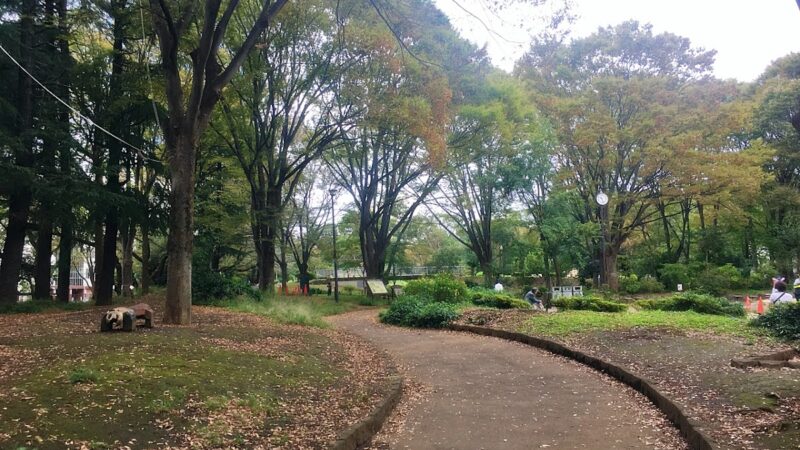
Many cherry trees are planted throughout the district, and in spring it becomes crowded with flower-viewing visitors. Additionally, Japanese maple and other autumn foliage trees are planted, allowing visitors to enjoy beautiful autumn colors in fall.
Characteristics of the Okubo District
The Okubo district is developed as a space for sports and relaxation. Centered on a spacious lawn area, various facilities are scattered throughout, and it is cherished as a place of respite for local residents.
The Shinjuku Ward Sports Center is annexed to the park, offering full-scale sports facilities including gymnasiums, a heated swimming pool, training rooms, and martial arts halls. While separate fees are required to use these facilities, using them together with the park allows for a more fulfilling experience.
Walking paths where seasonal flowers can be enjoyed are also developed, and you can see people enjoying walking and jogging. Despite being in the city center, it is a precious space where you can refresh yourself in a verdant environment.
History of Toyama Park
The history of Toyama Park goes back to the early Edo period. Understanding the changes in this area allows for a deeper appreciation of the cultural and historical value the park holds.
Edo Period: A Lower Residence of the Owari Tokugawa Family
The area where Toyama Park is now located was used as a lower residence of the Owari Tokugawa family called “Toyama Villa (Toyama-so)” during the Edo period. On this vast estate, a strolling garden was created using the most advanced landscaping techniques of the time, and it was known as one of Edo’s finest gardens.
The garden featured twenty-five scenic spots called “Toyama Villa’s Twenty-Five Views,” with carefully designed landscapes placed throughout. The renowned painter Buncho Tani captured the beauty of this garden in a picture scroll, leaving precious records of what it was like at the time.
The present-day Hakone-yama is a remnant of the artificial mound created during this period. In Edo period daimyo gardens, it was fashionable to recreate famous landscapes from various regions within the garden, and Hakone-yama is thought to have been created as part of this trend.
Meiji Period and Beyond: From the Imperial Army Toyama School to a Park
After the Meiji Restoration, the Owari Tokugawa family’s lower residence was confiscated by the Meiji government, and the Rikugun Toyama School was established on this site. The Rikugun Toyama School functioned as an important military facility responsible for training military bands and physical education, playing a significant role in Japanese modern military education.
After World War II, the military facilities were dismantled, and part of the grounds was developed into a park. It opened as a metropolitan park in 1954 (Showa 29) and continues to the present day.
In the process of converting it to a park, Hakone-yama, a remnant of the Edo period garden, was preserved, and new lawn areas and sports facilities were constructed, creating a space where history and modernity harmonize.
The Present Toyama Park
The current Toyama Park is managed by the Tokyo Metropolitan Construction Bureau, with planned management and operation based on the “Toyama Park Management Plan.” The latest management plan formulated in 2022 (Reiwa 4) identifies the preservation and utilization of historical resources, conservation of biodiversity, and strengthening functions as a community hub as key priorities.
The park is open year-round, and admission is free. As a place of respite for citizens that anyone can freely use, it is enjoyed by many people throughout the year.
Main Facilities and Spots
Toyama Park has distinctive facilities and spots arranged in each of its two districts.
Hakone-yama
Hakone-yama is a symbolic presence in Toyama Park. While its elevation of 44.6 meters is not particularly high, it is known as the highest point within the Yamanote Line loop.
There are multiple routes to the summit, and all are relatively gently graded, so even small children can safely reach the top. There is a viewing space at the summit from which you can overlook Shinjuku’s high-rise buildings and the surrounding townscape.
In spring, the entire mountain is covered with cherry blossoms, and in autumn the foliage takes on beautiful colors. Particularly around late November during autumn foliage season, the vivid red Japanese maple captivates visitors.
Lawn Area (Okubo District)
The center of the Okubo district is a spacious lawn area. In this open space, you can spend time as you wish—picnicking, playing ball games, sunbathing, and more.
On weekends, families and groups of friends can be seen spreading out leisure sheets to relax, functioning as an oasis in the city center. The grass is well-maintained, providing a comfortable environment for visitors.
Shinjuku Ward Sports Center
The Shinjuku Ward Sports Center, adjacent to the Okubo district, is a comprehensive facility supporting residents’ sports activities. It is equipped with gymnasiums, a heated swimming pool, training rooms, martial arts halls, and more, allowing people to enjoy various sports.
While a separate fee is required to use the facilities, using them together with the park allows for a more enriching time.
Children’s Playground and Yakudo Plaza
In the Okubo district, there is a “Children’s Playground” with play equipment for children and “Yakudo Plaza” with health exercise equipment.
The Children’s Playground has standard play equipment such as slides and swings, providing a safe environment for small children to play. Yakudo Plaza features health equipment beneficial for maintaining the health of elderly people, with a design that accommodates a wide range of age groups.
Walking Paths
Walking paths are developed throughout the park where visitors can enjoy seasonal plants. Cherry blossoms, azaleas, hydrangeas, autumn foliage, and other plantings change appearance with each season, beloved by people enjoying walks and jogging.
Early in the morning, you can see groups of local residents doing radio calisthenics and people enjoying jogging, and it also functions as a community hub.
How to Enjoy Each Season
Toyama Park has different charms in each of the four seasons.
Spring: As a Famous Cherry Blossom Spot
Toyama Park is known as one of the finest cherry blossom viewing spots in Shinjuku Ward. Particularly in the Hakone-yama district, many cherry trees are planted and bloom magnificently from late March to early April.
The cherry blossoms that bloom like covering the slopes of Hakone-yama are spectacular, and the view of the blossoms from the summit is equally special. During cherry blossom season, many people visit, spreading leisure sheets to celebrate the arrival of spring.
Summer: Shade and Respite
In summer, Toyama Park’s abundant greenery creates cool, shaded areas. In the Okubo district’s lawn area, you can see people relaxing in the shade.
In early morning and evening, people gather to jog and walk while avoiding the heat. Despite being in the city center, it is a precious space where you can enjoy coolness amid greenery.
Autumn: Beauty of Fall Foliage
Around late November, the fall foliage comes into bloom, centered on the Hakone-yama district. Trees with autumn colors, including Japanese maples, take on vivid hues, evoking the spirit of autumn.
Hakone-yama’s autumn foliage is popular as an autumn foliage spot where you can easily enjoy fall colors in the city center, and many photography enthusiasts with cameras can be seen.
Winter: Quiet Walks
In winter, Toyama Park receives fewer visitors compared to other seasons, allowing you to enjoy quiet walks. There is beauty unique to winter—winter sunlight filtering through the branches of bare trees and the landscape on frosty mornings.
Because the air is clear, the view from the summit of Hakone-yama becomes even more distinct, allowing you to see farther into the distance.
Access Methods
Toyama Park can be accessed from several train stations.
Access to the Hakone-yama District
Tokyo Metro Fukutoshin Line
- About 7 minutes walk from Nishi-Waseda Station (nearest station)
JR Yamanote Line
- About 15 minutes walk from Takadanobaba Station
Tokyo Metro Tozai Line
- About 12 minutes walk from Waseda Station
Access to the Okubo District
JR Yamanote Line
- About 10 minutes walk from Shin-Okubo Station (nearest station)
JR Sobu and Chuo Lines
- About 8 minutes walk from Okubo Station
Tokyo Metro Fukutoshin Line
- About 10 minutes walk from Higashi-Shinjuku Station
Access by Car and Parking
Toyama Park does not have dedicated parking. Public transportation is recommended, but if you arrive by car, you will need to use nearby coin parking.
As Shinjuku Ward is an area where parking congestion is expected, we recommend using public transportation as much as possible.
Hours of Operation and Fees
Opening Hours: Open year-round (available 24 hours)
Closed Days: None
Admission: Free
Use of Shinjuku Ward Sports Center: Separate fees apply (varies by facility)
The park is open year-round and can be entered freely at any time. However, nighttime use requires consideration for safety.
Adjacent Facilities and Surrounding Information
There are various facilities and tourist spots in the vicinity of Toyama Park.
Waseda University
Within walking distance from the Hakone-yama district is Waseda University’s campus. You can enjoy walking while experiencing the atmosphere of this historic university.
Shin-Okubo Korea Town
Near the Okubo district, Shin-Okubo’s Korea Town extends. After walking in the park, you can enjoy Korean cuisine and shopping.
National Center for Global Health and Medicine
Adjacent to the park is the National Center for Global Health and Medicine, which serves as a medical hub for the region.
Points to Note When Visiting Toyama Park
The Two Districts Are Separate
The Hakone-yama district and Okubo district are completely separated by Meiji-dori, and it takes about 10 minutes to walk between them. If you plan to visit both districts, it is recommended to allow extra time.
Seasonal Crowding
During cherry blossom season and autumn foliage season, many people visit and the park becomes crowded. If you wish to enjoy it leisurely, visiting on weekdays or early in the morning is recommended.
Heat Illness Prevention in Summer
During summer months, temperatures can be high, so be sure to stay hydrated and protect yourself from the sun. While vending machines are installed throughout the park, they are limited in number.
Bringing Pets
Pets can be brought into the park, but they must be on a leash. Also, be considerate of other visitors and follow rules of conduct.
Summary of Toyama Park’s Appeal
Tochoku Toyama Park is a precious space where you can feel abundant nature and history despite being in the heart of Tokyo. It has diverse appeal—the remains of an Edo period daimyo garden in Hakone-yama, spacious lawn areas, and seasonal plants.
Despite being located in the heart of Shinjuku Ward, it is a free, open-access park that serves various roles as a place of respite for residents, a tourist destination, and a place for historical learning.
With different faces through each season—spring cherries, summer greenery, autumn foliage, and winter serenity—Toyama Park offers varying expressions. When you want to escape the hustle and bustle of the city and spend unhurried time, please visit.
The view of Shinjuku’s high-rise buildings from the summit of Hakone-yama symbolizes Tokyo’s intersection of history and modernity, offering a unique experience found only in this park. Its excellent accessibility within walking distance of multiple stations is also an attraction.
Tochoku Toyama Park, where you can refresh both body and mind while pondering the area’s history, at an urban oasis. When visiting Shinjuku Ward, Tokyo, why not stop by?