Eikan-do (Zenrin-ji) Complete Guide | Kyoto’s Premier Autumn Foliage Destination – Highlights, Visiting Information, and Access
Eikan-do (Zenrin-ji), located in Sakyo Ward, Kyoto City, Kyoto Prefecture, is a representative temple of Kyoto that has long been cherished as “Eikan-do in autumn for its maple leaves” and “Eikan-do of the maples.” Its formal name is Zenrin-ji Temple, and it boasts over 1,200 years of history as the head temple of the Jodo sect Nishi-Hongan-ji Zenrin-ji School. This article comprehensively introduces information you should know before visiting, including the history of Eikan-do, highlights such as the Mika-gaeri Amida, the charm of the autumn foliage season, visiting information, and access methods.
Eikan-do (Zenrin-ji) | A Historic Kyoto Temple with 1,200 Years of History
From Founding to Present | A Temple Founded by a Disciple of Kukai
The history of Eikan-do dates back to the early Heian period, to Jinshu 3 (853). Shinsho, a senior disciple of Kukai, founder of the Shingon sect, sought to establish a center for esoteric Buddhism in the capital and donated land holdings from his home province of Kawachi (present-day Osaka Prefecture) to the imperial court. In recognition of this contribution, Emperor Seiwa granted him land in Kyoto, where Zenrin-ji Temple was founded.
Initially starting as an esoteric Buddhist temple of the Shingon school, it underwent a major transformation during the late Heian period under the seventh head priest, Yokan Risshi, in Eihō 2 (1082). Yokan spread the teachings of nembutsu (Buddhist recitation) and built a Medicine King Hall within the temple grounds to dedicate himself to the relief of the sick. Through his deeply compassionate activities, people came to affectionately call it “Eikan-do,” a nickname that has been passed down to the present day.
In Jōgan 5 (863), Emperor Seiwa granted a plaque inscribed “Zenrin-ji” in his own handwriting, thus establishing the formal name. Subsequently, it developed as a nembutsu Pure Land practice center and now welcomes many visitors as the head temple of the Jodo sect Nishi-Hongan-ji Zenrin-ji School.
The Origin of “Eikan-do of the Maples” | Praised in the Kokin Wakashū
Eikan-do became known as “Eikan-do of the maples” due to the exceptional beauty of its autumn foliage, which has been appreciated since ancient times. The maple leaves of Eikan-do are even mentioned in the Kokin Wakashū, showing that it was recognized as a famous foliage viewing spot from the Heian period.
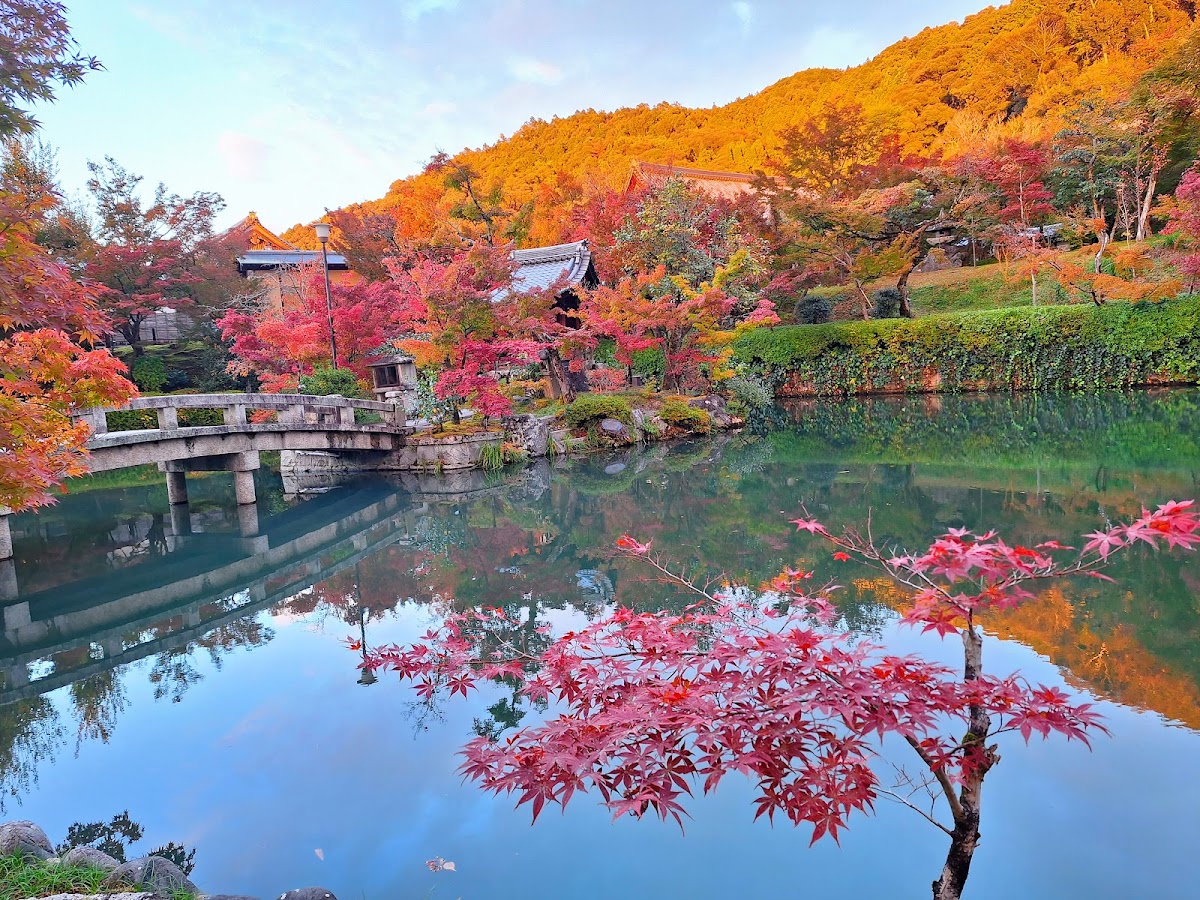
The grounds are planted with approximately 3,000 Japanese maple and large-leaf maple trees, and in autumn, the entire temple grounds turn a fiery red and yellow. In particular, the autumn leaves surrounding the Hōjō-ike Pond in the stroll garden style landscape are breathtakingly beautiful, and the image of the maples reflected on the water’s surface continues to captivate photographers and tourists alike.
Highlights of Eikan-do | Thorough Explanation of Must-See Spots
Mika-gaeri Amida Nyorai | Eikan-do’s Greatest Treasure
If you visit Eikan-do, you must see the principal image enshrined in the Main Hall, “Mika-gaeri Amida Nyorai Standing Image.” This Buddhist statue is extremely rare throughout Japan, depicting a figure with its face turned back to the left.
This unique posture is related to a legend about Yokan Risshi. One day, as Yokan chanted the Buddhist invocation in the Main Hall and practiced gyōdō (the ascetic practice of walking around a Buddhist image), Amida Buddha descended from the pedestal and began walking in front of Yokan. When Yokan stopped in surprise, Amida Buddha turned back and said, “Yokan, you are late.” This moment is represented in the Buddhist statue as Mika-gaeri Amida.
This Amida Buddha image is not merely a work of art but symbolizes “the compassionate heart of walking ahead while always watching over and guiding all sentient beings.” When viewing it, take time to face its gentle expression and unique posture.
The Tahoto Pagoda | A Spectacular Viewpoint Overlooking Kyoto
The Tahoto (multi-tiered) Pagoda, standing at the highest point of the temple grounds on the mountainside, is an iconic symbol of Eikan-do. From this pagoda, one can see an expansive view of Kyoto city, and especially during the autumn foliage season, the combination of the pagoda surrounded by colored maple leaves creates a spectacular scene.
To reach the Tahoto Pagoda, one must climb stone steps, but along the way, you are surrounded by beautiful maple leaves on a scenic path. Upon arrival at the pagoda, the cityscape of Kyoto and the Higashiyama mountains come into full view, and you can also overlook the entire grounds of Eikan-do. It is a popular photography spot, especially attracting many photographers during the autumn foliage season.
Corridors Connecting the Various Halls | Picturesque Architectural Beauty
One characteristic architectural feature of Eikan-do is the corridor connecting various halls such as the Shaka Hall, Kaisan Hall, and Goei Hall. You can traverse the corridor while visiting each hall, and from the corridor, you can view the foliage of the garden.
The corridor is designed to accommodate the uneven terrain, and part of it is called the “Garyō-rō” (Crouching Dragon Corridor). This name comes from the corridor’s curved design, resembling a dragon lying down. Walking through the corridor itself becomes an experience, and you can enjoy different scenery for each season.
Hōjō-ike Pond and Stroll Garden Landscape | The Spectacular View of Maple Leaves Reflected on Water
Eikan-do’s garden is designed as a stroll garden landscape, allowing you to enjoy various perspectives while walking around the central Hōjō-ike Pond. This garden is also called “Kinkun-kei” (Golden Cloud Valley), and during the autumn foliage season, it displays a beauty likened to clouds of brocade, which is the origin of this name.
The maple leaves reflected on the water’s surface of Hōjō-ike Pond are popular as “inverted maples,” and on windless days, you can see a perfect mirror image. Stone bridges and stepping stones are arranged around the pond, with careful attention to design allowing you to fully appreciate the garden beauty from various angles.
Iwagaki Momiji | Distinctive Landscape Beauty
Among Eikan-do’s autumn foliage, what is particularly striking is the landscape called “Iwagaki Momiji” (stone fence maples). This refers to the appearance of maple leaves planted along the stone walls of the temple grounds coloring like a hedge.
The contrast between rock and foliage creates a distinctive beauty, embodying the aesthetic sensibility of Japanese gardens and captivating many visitors. Particularly at sunset, the illuminated Iwagaki Momiji glows in golden tones, allowing you to enjoy scenery that changes its appearance throughout the day.
Eikan-do’s Autumn Foliage | The Charm of Kyoto’s Premier Foliage Viewing Destination
Peak Foliage Viewing Season | Mid-to-Late November is the Best Season
The autumn foliage at Eikan-do typically reaches its peak from mid-November through late November. However, these dates may vary depending on climatic conditions that year, so it is recommended to check the latest foliage information before your visit.
The leaves gradually begin to color from early November, reach nearly complete coloring by mid-November, and maintain their beauty through late November. At peak season, the entire temple grounds turn red and yellow, creating a landscape truly worthy of the phrase “autumn brocade.”
Evening Special Viewing and Illumination | Enchanting Nighttime Foliage
During the foliage season, Eikan-do offers evening special viewing with illuminated maple leaves, allowing you to enjoy the foliage in an entirely different, enchanting atmosphere. The maple leaves floating in the darkness of night display a breathtaking beauty.
In particular, the illuminated foliage reflected in the Hōjō-ike Pond creates a mirror-like surface, producing a breathtaking symmetrical scene. The Tahoto Pagoda is also illuminated, and the image of the pagoda surrounded by foliage becomes Eikan-do’s most representative landscape.
Evening special viewing is typically held from around 17:30 to 20:30 (admission ends), but dates and times may vary year to year, so it is recommended to check the official website for the latest information before visiting. Note that daytime viewing and evening viewing operate on a replacement basis, and a separate admission fee is required.
Crowds During Foliage Season and Countermeasures
As one of Kyoto’s premier foliage viewing destinations, Eikan-do is very crowded during peak season, particularly on weekends and holidays. Early morning immediately after opening and weekday mornings tend to be relatively uncrowded.
During the evening illumination period, the opening time is when it is most crowded, so visiting at a slightly later time or near closing time is one option. However, be aware of the admission cutoff time.
If you wish to avoid crowds, visiting slightly before peak foliage in early November or slightly after peak in early December is also recommended. While not at complete peak, you can view relatively quietly and still enjoy sufficiently beautiful foliage.
Eikan-do Visiting Information | Fees, Hours, and Important Notes
Viewing Hours and Admission Fees
Regular Viewing (Spring, Summer, Winter)
- Hours: 9:00 AM–5:00 PM (last admission 4:00 PM)
- Admission: Adults ¥600, Students (elementary through high school) ¥400
During Autumn Temple Treasures Exhibition Period (typically November)
- Hours: 9:00 AM–5:00 PM (last admission 4:00 PM)
- Admission: Adults ¥1,000, Students (elementary through high school) ¥400
Autumn Evening Special Viewing (Illumination Period)
- Hours: 5:30 PM–8:30 PM (last admission, closing at 9:00 PM)
- Admission: Middle school students and above ¥600
※Fees and hours may be subject to change. Please check the official website for the latest information before your visit.
※Evening special viewing operates on a replacement basis with daytime viewing.
Important Notes When Viewing
Please note the following when visiting Eikan-do:
- Photography: Photography is permitted on the grounds, but photography is prohibited in buildings and of Buddhist images in certain areas. Follow the posted signs.
- Clothing: As there are stairs and elevation changes when visiting the various halls and corridors, comfortable walking shoes are recommended.
- Time Required: Plan for 1 to 1.5 hours to thoroughly view the temple grounds. During foliage season or when taking photographs, more time may be needed.
- Wheelchair Access: The grounds have elevation changes and many stairs, so wheelchair access is limited. It is recommended to contact the temple in advance.
Basic Information
- Official Name: Shōjū Raigō-zan Muryōjuin Zenrin-ji
- Denomination: Jodo sect Nishi-Hongan-ji Zenrin-ji School (Head Temple)
- Principal Image: Amida Buddha (Mika-gaeri Amida)
- Founded: Jinshu 3 (853)
- Founding Priest: Shinsho
- Address: 48 Eikan-do-chō, Sakyo Ward, Kyoto City, Kyoto Prefecture 606-8445
- Phone: 075-761-0007
- Official Website: https://www.eikando.or.jp/
Access to Eikan-do | How to Get There from Kyoto Station
Access by City Bus
From Kyoto Station
- Board City Bus Route 5 (bound for Ginkaku-ji or Iwakura) from Platform A1 at Kyoto Station Bus Terminal
- Get off at “Nanzen-ji/Eikan-do-michi” Bus Stop (approximately 30 minutes travel time)
- A 3-minute walk from the bus stop
From Shijo Kawaramachi
- From Shijo Kawaramachi Bus Stop, board City Bus Route 5 (bound for Ginkaku-ji or Iwakura) or Route 203 (bound for Ginkaku-ji-michi or Kinrin Shako)
- Get off at “Nanzen-ji/Eikan-do-michi” Bus Stop
- A 3-minute walk from the bus stop
City buses are the main transportation for Kyoto tourism, but during busy seasons such as foliage season, road congestion can cause significant delays. It is recommended to plan with extra time.
Access by Subway
From Kyoto Station
- Take the Kyoto City Subway Karasuma Line to “Karasuma Oike Station” (approximately 5 minutes)
- Transfer to the Subway Tōzai Line and get off at “Keage Station” (approximately 5 minutes)
- A 15-minute walk from Exit 1 of Keage Station
The subway is not affected by road congestion, making travel time more predictable than buses during busy seasons such as foliage season. However, the walk from Keage Station to Eikan-do is uphill, so comfortable walking shoes are recommended.
Access by Taxi
Using a taxi from Kyoto Station to Eikan-do typically takes about 20 minutes under normal conditions, with fares roughly ¥2,000–¥2,500. However, during busy seasons such as foliage season, travel time may increase significantly.
Taxi use is worth considering when traveling with multiple people, when carrying luggage, or when wanting to make efficient use of time.
Parking Information
Eikan-do has a parking lot for visitors, but spaces are limited. Especially during foliage season, the lot often reaches capacity, and surrounding roads become congested, making public transportation highly recommended.
If you must drive, consider using paid parking lots in the surrounding area or parking further away and walking or taking a bus to reach the temple.
Sightseeing Spots Around Eikan-do | Recommended Nearby Attractions
Nanzen-ji | A Zen Temple Within Walking Distance
Located about a 10-minute walk from Eikan-do, Nanzen-ji is the head temple of the Rinzai sect Nanzen-ji school and holds the highest ranking as one of the “Five Mountains Above.” With the famous Sanmon Gate, water conduit aqueduct, and beautiful gardens, it is an ideal spot to visit together with Eikan-do.
Tetsugaku-no-Michi | A Scenic Path for Cherry Blossoms and Autumn Foliage
About 15 minutes’ walk north of Eikan-do is Tetsugaku-no-Michi (Philosopher’s Path), an approximately 2 km walking path along the Lake Biwa Canal. Beautiful with cherry blossoms in spring and autumn foliage in fall, it takes its name from philosopher Nishida Kitarō, who was said to walk along it in contemplation. A leisurely stroll after visiting Eikan-do is also recommended.
Ginkaku-ji (Jishō-ji) | A Temple Representing Muromachi Culture
Located at the northern end of Philosopher’s Path, Ginkaku-ji is a temple founded from a villa built by Ashikaga Yoshimasa, the eighth shōgun of the Muromachi shogunate. The architecture and garden, which embody the aesthetic of wabi and sabi (refined simplicity and subtle, unobtrusive beauty), are a representative destination of Japanese culture, attracting many visitors.
Heian Jingū | A Representative Shinto Shrine of Kyoto
Located about 20 minutes’ walk west of Eikan-do, or a few minutes by city bus, Heian Jingū was founded in 1895 (Meiji 28) to commemorate the 1,100th anniversary of the moving of the capital to Heian (Kyoto). Characterized by vermillion-painted shrine buildings and expansive sacred gardens, it is particularly beautiful in spring with cherry blossoms and autumn with foliage.
Recommended Visiting Plans for Eikan-do
One-Day Plan During Foliage Season
Morning
- 9:00 AM Enter Eikan-do when it opens (to avoid crowds)
- 10:30 AM Move to Nanzen-ji for viewing
- 12:00 PM Enjoy yudōfu (hot pot tofu) lunch around Nanzen-ji
Afternoon
- 1:30 PM Walk along Philosopher’s Path
- 2:30 PM Visit Ginkaku-ji
- 4:00 PM Stroll around Heian Jingū
Evening
- 5:30 PM Evening special viewing at Eikan-do (illuminated foliage)
- 7:30 PM Finish viewing and head toward Kyoto Station
This plan allows you to enjoy Eikan-do’s foliage twice—both during day and at night—seeing different aspects of its beauty. During the day, you also explore nearby sightseeing spots, making for a fulfilling Kyoto experience.
Half-Day Plan During Regular Seasons
When visiting outside the foliage season, you can enjoy a relatively leisurely viewing experience.
- 10:00 AM View Eikan-do (1–1.5 hours)
- 11:30 AM Move to Nanzen-ji for viewing
- 1:00 PM Lunch nearby
- 2:00 PM Stroll along Philosopher’s Path toward Ginkaku-ji
- 3:00 PM View Ginkaku-ji
This course allows you to efficiently visit the main sightseeing spots in the Higashiyama area in half a day.
Eikan-do Through the Seasons | Attractions Beyond Autumn Foliage
Spring at Eikan-do | Fresh Greenery and Cherry Blossoms
While Eikan-do is famous for its foliage, the fresh spring greenery is also beautiful, and cherry blossoms are planted throughout the grounds. In early April, cherry blossoms bloom, and you can enjoy the sight of pale pink set against fresh green. The lack of the foliage-season crowds is also a spring advantage, allowing for leisurely viewing.
Summer at Eikan-do | Deep Green and Tranquility
Summer at Eikan-do is wrapped in deep green and exudes a quiet, peaceful atmosphere. Tourist numbers are relatively low, allowing you to deeply engage with the temple’s history, architecture, and Buddhist images. While Kyoto summers are hot, the shade within the temple grounds is cool, providing a serene setting for contemplation.
Winter at Eikan-do | The Fantastical Beauty of a Snowy Landscape
When snow falls on Kyoto, Eikan-do displays a fantastical beauty entirely different from usual. The snow-covered Tahoto Pagoda and gardens resemble ink-wash paintings, offering a serene beauty distinct from the foliage season. However, exercise caution as snow-covered paths can be slippery.
Conclusion | Eikan-do is an Essential Stop in Kyoto Sightseeing
Eikan-do (Zenrin-ji) in Sakyo Ward, Kyoto City, is a temple boasting over 1,200 years of history and is known as “Eikan-do of the maples,” one of Kyoto’s premier autumn foliage viewing destinations. With a principal image of the rare Mika-gaeri Amida Buddha, a spectacular view from the Tahoto Pagoda, a beautiful stroll garden landscape centered on a pond, and scenic corridors connecting various halls, the temple offers abundant attractions.
Particularly during the foliage season from mid-to-late November, approximately 3,000 maple trees color the grounds, and both daytime viewing and evening illumination are offered, creating an enchanting landscape. While the foliage season brings crowds, the spectacular scenery is worth the visit.
Conveniently accessible by city bus or subway from Kyoto Station, and surrounded by other major sightseeing spots such as Nanzen-ji, Philosopher’s Path, and Ginkaku-ji, you can efficiently enjoy Kyoto sightseeing.
As more than just a famous foliage viewing destination, but as a historic temple and a place to calm the spirit, Eikan-do is a destination you should definitely visit when coming to Kyoto. Experience the beauty and history of Kyoto fully at Eikan-do, which reveals a different face with each season.