Nakano Momiji Mountain, Aomori Prefecture | Highlights and Tourist Guide to this Historic Autumn Foliage Destination
Located in Kuroishi City, Aomori Prefecture, Nakano Momiji Mountain is known as one of the prefecture’s premier autumn foliage viewing destinations. The rich and colorful autumn leaves created by approximately 130 Japanese maple trees, some over 100 years old, continue to captivate visitors. This location, which is also called “Shō-Arashiyama” (Little Arashiyama), in comparison to Kyoto’s famous Arashiyama, is a special place where history and nature harmonize.
History and Origins of Nakano Momiji Mountain
Transplantation from Kyoto by the Hirosaki Domain Lord
The history of Nakano Momiji Mountain dates back to Kyowa 2 (1802). The 9th lord of the Hirosaki Domain, Tsugaru Yasuchika, was enchanted by the beauty of the maples on Nakano Mountain and the Fudō Falls. He ordered over 100 varieties of maple saplings from Kyoto, and in the following year, 1803, they were dedicated and transplanted to Nakano Fudō Temple, marking the beginning of present-day Nakano Momiji Mountain.
Lord Tsugaru Yasuchika was from the Kuroishi domain, and from his deep affection for this region, he attempted to recreate the famous scenic spots of Kyoto. The creation of an autumn foliage destination with direct involvement from a daimyo at that time is a rare and precious historical background even by the standards of the Tōhoku region.
Autumn Foliage Tradition Spanning Over 220 Years
More than 220 years have passed since the transplanting, and the descendants of the original maples, along with trees planted later, now form a magnificent autumn foliage landscape. Approximately 130 Japanese maples over 100 years old remain, making this a precious natural heritage that conveys the weight of history.
Since the feudal era, it has been cherished as the premier autumn foliage viewing destination in the prefecture, and even today it is visited by numerous tourists from within and outside the prefecture, making it a representative tourist attraction in Aomori.
Highlights of Nakano Momiji Mountain
Spectacular Autumn Foliage Landscape
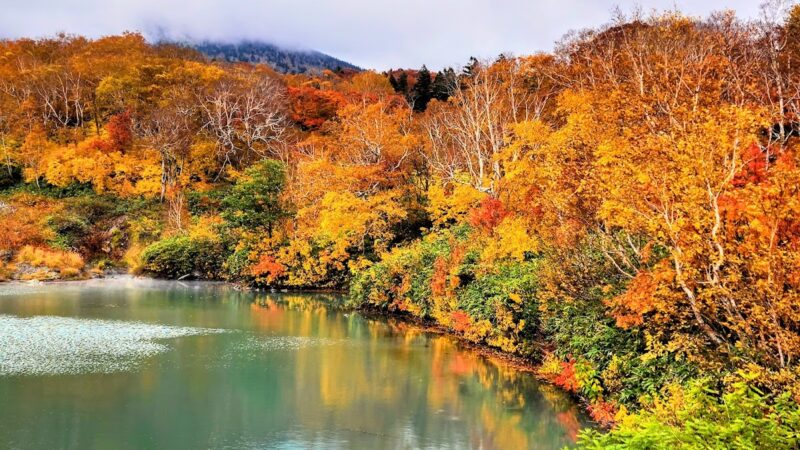
The greatest charm of Nakano Momiji Mountain is undoubtedly its autumn foliage. With over 100 varieties of maples planted here, visitors can enjoy a multi-colored gradient from red to yellow and orange. The sight of everything dyed red and yellow as far as the eye can see is spectacular, with a breathtaking panorama spreading before you.
During the day, the foliage illuminated by sunlight glows in brilliant crimson, and walking through the forest, a tunnel of leaves overhead creates a fantastical space. The view from the Kanbōdai observation platform is particularly stunning and is a must-see viewpoint for anyone visiting Nakano Momiji Mountain.
Fudō Falls and Foliage in Harmony
Nakano Momiji Mountain features “Fudō Falls,” and the interplay between the waterfall and foliage is spectacular. The falling water and foliage reflected in the stream display a natural artistry of breathtaking beauty.
During the foliage season, a special viewing area called “kōyō-toko” (foliage bed) is set up, where visitors can enjoy foliage bento boxes while gazing at Fudō Falls and the autumn colors. The luxurious experience of listening to the sound of the falls while savoring brilliantly colored foliage is unique to Nakano Momiji Mountain.
Enchanting Illumination
Each year during the foliage season, illumination is conducted, offering a completely different fantastical view from daytime. The lighting typically runs from around 4:30 p.m. to 9 p.m., and the sight of foliage and falls floating in the darkness is breathtakingly beautiful.
The illuminated foliage is reflected in the falls and stream, creating a mysterious and serene atmosphere in contrast to the vibrant appearance during the day. It has become a popular photography spot among camera enthusiasts, with many Instagram-worthy photos to capture.
Nakano Shrine and the Three Fudō Deities of Tsugaru
Within the forest of Nakano Momiji Mountain stands “Nakano Shrine,” where one of the Three Fudō Deities of Tsugaru is enshrined. The Three Fudō Deities of Tsugaru refer to three Fudō Myōō (Immovable Wisdom Kings) venerated in the Tsugaru region, and Nakano Shrine, as one of them, has long been cherished by local residents.
Nakano Shrine is home to a Japanese maple tree approximately 200 years old, a fir tree of similar age, and a massive cedar tree ranging from 500 to 700 years old. All of these are designated as natural monuments by Kuroishi City. Beyond the foliage, these giant trees are impressive and convey both the power of nature and the weight of history.
Fudōdatsujo Castle Ruins
Within the forest are also the remains of Fudōdatsujo Castle, an interesting spot for history enthusiasts. As a mediaeval castle site, it offers a rare opportunity to experience Tsugaru’s history alongside the foliage.
The distance from Nakano Shrine to the Kanbōdai observation platform is about a 10-minute walk, allowing visitors to enjoy both nature and history while strolling—this is the charm of Nakano Momiji Mountain.
Best Time for Autumn Foliage
When is the Peak Season?
The foliage at Nakano Momiji Mountain typically begins to color in mid-October. The peak viewing period is from late October through early November, when the entire mountain is enveloped in magnificent fall colors.
Since the timing of color change varies slightly by elevation and tree species, visitors can enjoy changes in the foliage over approximately two weeks. In the early period, the contrast between green and red is beautiful; at peak season, the entire area glows in brilliant red; and in the later period, fallen leaves carpet the ground.
Relationship Between Weather and Foliage
The intensity of foliage coloring is influenced by that year’s temperature and weather conditions. Years with greater temperature fluctuations between day and night tend to produce more vivid foliage, and Aomori Prefecture’s climate provides ideal conditions for autumn colors.
It is recommended to check the latest foliage information before visiting. The Kuroishi Tourism Association and Aomori Prefecture tourism information websites regularly update foliage conditions during the season, allowing you to visit at the perfect time.
Access Information
Access by Car
To reach Nakano Momiji Mountain by car, it is approximately 15 minutes from the Kuroishi IC on the Tōhoku Expressway. It is approximately 40 minutes from Aomori City and approximately 30 minutes from Hirosaki City.
The address is Minaminakano Fudōdatsujo, Kuroishi City, Aomori Prefecture. When entering the destination into your car navigation system, it is convenient to set “Nakano Momiji Mountain” or “Tsugaru Densho Kogeikan” as your destination.
Parking Information
Dedicated parking areas are provided during the foliage season. There are parking spaces near the Tsugaru Densho Kogeikan, from which Nakano Momiji Mountain is accessible on foot. Heavy congestion is expected at peak foliage season, so visiting during early hours or on weekdays is recommended.
A cooperation fee may be required for parking lot use, so it is helpful to have small change on hand. This fee supports the protection of local tourism resources, and your understanding and cooperation are appreciated.
Access by Public Transportation
If using train transportation, Kuroishi Station on the Kōnan Railway Kōnan Line is the nearest station. From Kuroishi Station, take the Kōnan Bus to either the “Itadome” or “Ōkawara” bus stop, from which it is approximately a 15-minute walk to Nakano Momiji Mountain.
Bus service is limited, so it is recommended to check the timetable in advance. Particularly during the foliage season, temporary buses may operate, so check the Kuroishi Tourism Association website for the latest information.
Nearby Tourist Attractions
Tsugaru Densho Kogeikan (Tsugaru Traditional Crafts Museum)
The Tsugaru Densho Kogeikan, located near Nakano Momiji Mountain, is a facility that displays and sells traditional Tsugaru crafts. Visitors can see close-up examples of regional traditional techniques such as Tsugaru lacquerware, kogin embroidery, and Tsugaru kites.
Demonstrations by craftspeople are held at the museum, providing a valuable opportunity to observe the traditional craft-making process. It is also an ideal place to purchase souvenirs and is a worthwhile stop to combine with visiting Nakano Momiji Mountain.
Itadome Hot Spring
The Itadome Hot Spring area near Nakano Momiji Mountain has hot spring facilities offering day-use bathing. It is ideal for soothing tired muscles after foliage viewing and is beloved by local residents.
The spring water is gentle on the skin, offering a leisurely and relaxing experience. Why not enjoy a luxurious day combining autumn foliage viewing with a hot spring bath?
Sightseeing in Central Kuroishi City
In central Kuroishi City is the “Nakamachi Komise-dōri Street,” designated as an Important Preservation District for Groups of Historic Buildings. The street features well-preserved merchant houses from the Edo period and is characterized by a distinctive architectural style called “komise”—arcade-like structures.
Local cuisine such as Kuroishi yakisoba and Kuroishi tsuyu yakisoba is abundant, allowing visitors to enjoy both sightseeing and dining. Combined with Nakano Momiji Mountain, you can fully experience the charm of Kuroishi City.
Points to Note and Etiquette When Visiting
Clothing and Belongings
Nakano Momiji Mountain is located in a mountainous area, so it is cooler than urban areas. Particularly in the early morning and evening, temperatures drop significantly, so bringing a layer to wear is recommended. From late October through early November, Aomori Prefecture experiences early winter weather, making cold-weather precautions necessary.
While the walking trails are well-maintained, fallen leaves can make some sections slippery. It is advisable to wear comfortable, sturdy shoes. Also, do not forget to charge your camera or smartphone. You will definitely want to photograph the beautiful foliage.
Dealing with Crowds
During peak foliage season, particularly on weekends and holidays, the area is crowded with tourists. For those wishing to enjoy the foliage leisurely, weekday visits or early morning times are recommended.
While the illumination period experiences congestion in the evening hours, the fantastical scenery differs from the daytime view, making it worthwhile to visit with extra time available.
Nature Conservation and Etiquette
Nakano Momiji Mountain is a precious natural heritage. Avoid damaging trees and plants, and stay on designated walking paths. Always take your trash with you to help protect the natural environment.
When photographing, be considerate of other tourists, and if using a tripod, select a location that does not obstruct foot traffic. A spirit of mutual consideration is important so that everyone can comfortably enjoy the foliage.
How to Enjoy Nakano Momiji Mountain
Savoring Foliage Bento in Luxury
During the foliage season, special viewing areas called “kōyō-toko” are established where foliage bento boxes can be enjoyed. The experience of savoring locally-sourced bento while gazing at foliage and waterfalls is incomparable.
Advance reservations may be required in some cases, so it is recommended to contact the Kuroishi Tourism Association before visiting. Dining in nature is a luxurious experience that engages all five senses to feel the essence of autumn.
Prime Photography Spots
Nakano Momiji Mountain has excellent photography locations throughout. The panoramic view from the Kanbōdai observation platform, the combination of Fudō Falls with foliage, and foliage tunnels all offer picturesque scenes.
Photography during illumination is particularly rewarding with a tripod, allowing for beautiful long-exposure shots of falling water or vivid captures of foliage color. It is an excellent opportunity to test your photography skills.
The “Nakano Momiji Mountain SNS Photo Contest” is also held in recent years, and submitting your best shot is another enjoyable way to participate.
Enjoying Historical Exploration
Beyond foliage, consider visiting historical sites such as Nakano Shrine and Fudōdatsujo Castle Ruins. At Nakano Shrine, one of the Three Fudō Deities of Tsugaru, visitors can worship in a serene atmosphere.
The great cedar trees, 500 to 700 years old, are overwhelming in their presence alone. These giant trees, designated as natural monuments, are living witnesses that have watched over this land for centuries. Savor the unique charm of Nakano Momiji Mountain, where nature and history blend together.
Dining Information in the Area
Sampling Kuroishi Specialties
Kuroishi City is famous for “Kuroishi yakisoba.” When visiting Nakano Momiji Mountain, be sure to enjoy the local cuisine. Kuroishi yakisoba, characterized by thick, flat noodles and exquisite sauce balance, is known nationwide as a B-class gourmet specialty.
“Kuroishi tsuyu yakisoba,” where sauce is poured over yakisoba, is also popular. Many excellent restaurants throughout the city offer this local specialty, making it fun to try multiple establishments.
Cuisine Using Local Ingredients
Aomori Prefecture is blessed with abundant natural resources, providing fresh ingredients in plenty. Visitors can enjoy local flavors such as apples, scallops, and tuna at various restaurants throughout Kuroishi City.
After foliage viewing, enjoying local cuisine at a izakaya or dining establishment is recommended. Savoring Aomori’s flavors alongside local sake will deepen your travel memories further.
Lodging Information
Accommodations Near Itadome Hot Spring
Near Nakano Momiji Mountain is Itadome Hot Spring, where visitors can stay at hot spring inns. Reservations fill up early during the foliage season, so advance planning is necessary. Soaking in hot spring waters while reflecting on the foliage creates a truly luxurious experience.
Hotels in Central Kuroishi City
Central Kuroishi City has business hotels and traditional inns that serve as convenient tourism bases. Staying in the city allows for enjoying local restaurants in the evening and visiting Nakano Momiji Mountain early the next morning.
Day Trips from Hirosaki City
A plan to stay in Hirosaki City and visit Nakano Momiji Mountain as a day trip is also recommended. This allows you to combine it with sightseeing at Hirosaki Castle and other local attractions, making a comprehensive tour of the Tsugaru region possible.
Conclusion
Nakano Momiji Mountain is Aomori Prefecture’s premier autumn foliage destination, with a history spanning over 220 years. The rich and colorful autumn leaves created by over 100 varieties of maples transplanted from Kyoto by Hirosaki Domain Lord Tsugaru Yasuchika continue to captivate visitors.
With approximately 130 Japanese maples over 100 years old, harmonious interplay with Fudō Falls, enchanting illumination, Nakano Shrine, and natural monument giant trees, there is much to see. During the peak viewing period from late October through early November, be sure to visit.
Please spend special time fully savoring Aomori’s autumn at Nakano Momiji Mountain, where history and nature harmonize. Access is relatively convenient, and the surrounding area is rich with hot springs, tourist attractions, and dining options, making for a fulfilling trip.
Nakano Momiji Mountain, called “Shō-Arashiyama” in comparison to Kyoto’s Arashiyama, is a worthwhile scenic destination where the Tōhoku region’s abundant nature and history blend together. Why not visit this historic autumn foliage destination, camera in hand, to explore Tsugaru’s autumn landscape?