Complete Guide to Kifune Shrine | Kyoto’s Premier Power Spot with Attractions, Access, and Goshuin Information
Kifune Shrine (きふねじんじゃ), nestled in the mountains of Kifune in Sakyo Ward, Kyoto City, is an ancient shrine dedicated to the water deity with a history spanning over 1,300 years. Also known as a deity of good relationships, it attracts countless pilgrims from across the nation and ranks among Kyoto’s most renowned power spots. This article presents the full charm of Kifune Shrine.
About Kifune Shrine
History and Background
According to shrine tradition, Kifune Shrine was founded when Tamayorihime no Mikoto, mother of Emperor Jinmu, traveled by yellow boat up the Yodo River, Kamo River, and Kifune River to enshrine the water deity at this location. While the exact founding date is unknown, records of shrine building renovations exist from Hakuhō 6 (666), indicating this is an ancient shrine with at least 1,300 years of history.
During the Heian period, the imperial court held deep faith in the shrine, dispatching imperial messengers for prayers for rain and cessation of rain during droughts and prolonged rains. Heian nobility also regularly visited Kifune, and the legend of Izumi Shikibu praying for reconciliation with her husband is particularly famous.
Principal Deity and Divine Benefits
The principal deity of Kifune Shrine is Takaokami no Kami, a dragon god who governs water. The character “龗” represents a dragon, and this deity has long been revered as governing the supply of water.
The main divine benefits are as follows:
- Good Relationships: Worshipped as a deity of good relationships based on Izumi Shikibu’s legend
- Rising Fortune: Rise in fortune through the energy of water, the source of all things
- Fulfillment of All Wishes: Known as a deity of wish-fulfillment with miraculous divine favor
- Warding Off Misfortune: Purification and removal of misfortune through water’s cleansing power
- Business Prosperity: Prosperity for water-related trades and all businesses
The Three Shrines of Kifune
Kifune Shrine comprises three sanctuaries: the Main Shrine, the Musubi Shrine (Middle Shrine), and the Inner Shrine. The formal order of visitation is Main Shrine → Inner Shrine → Musubi Shrine, though today many visitors follow Main Shrine → Musubi Shrine → Inner Shrine, both of which are acceptable.
Main Shrine (Hongu)
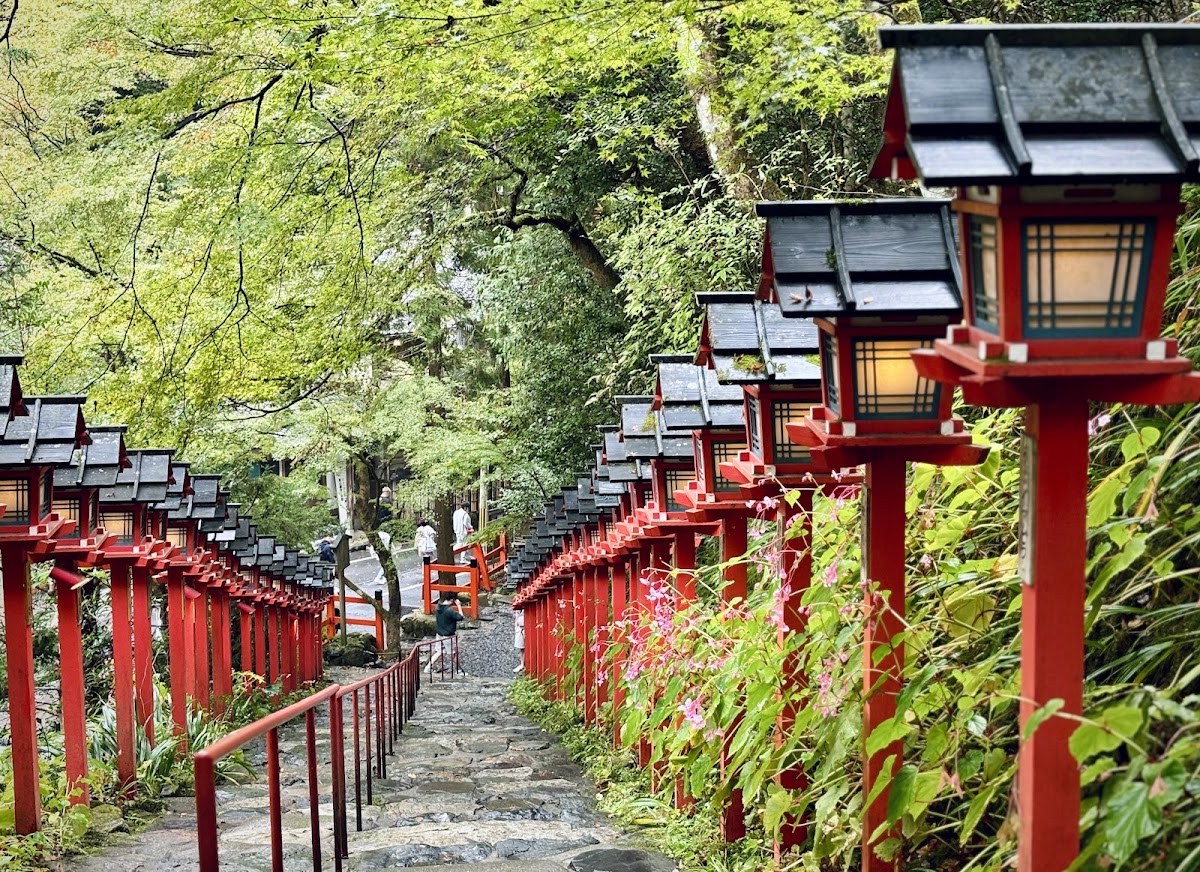
The central sanctuary of Kifune Shrine. The stone steps are flanked by Kasuga lanterns on both sides, and the “Snow-Day-Only Illumination” is particularly known for its fantastical beauty.
Highlights:
- Stone Steps with Kasuga Lanterns: Red-lacquered lanterns lining the approach path create an iconic view of Kifune Shrine
- Main Hall: Beautiful sanctuary built in the Gonden architectural style
- Birthplace of Ema: Kifune Shrine is said to be the birthplace of ema (votive plaques), with live horses once being offered
- Sacred Water: Spring water flowing from the grounds is safe for drinking and may be taken home
Water Divination Omamori
The most popular offering at the Main Shrine is the water divination omamori. At first glance blank, when this omamori is floated on the sacred water within the shrine grounds, text mysteriously appears. The offering fee is 200 yen, and as a unique offering befitting a water deity shrine, it is beloved by many pilgrims.
A QR code is printed on it, allowing translations in English, Chinese, and Korean via smartphone.
Musubi Shrine (Yui no Yashiro/Middle Shrine)
Located about a 5-minute walk from the Main Shrine and before the Inner Shrine, the Musubi Shrine is particularly popular with women as the shrine of good relationships.
Principal Deity:
Iwanagahime no Mikoto
Background:
When Iwanagahime’s sister, Konohanasakuyahime no Mikoto, married Ninigi no Mikoto, Iwanagahime was sent back home alone due to her appearance. Enduring this shame, she settled at this location and made a vow to become the deity of good relationships, praying for the blessed unions of all people.
Legend of Izumi Shikibu:
During the Heian period, the female poet Izumi Shikibu, when her relationship with her husband Tachibana no Michisada had grown cold, stayed overnight at Kifune Shrine in prayer and made a vow for reconciliation. When her wish was granted, the Musubi Shrine became widely known as a sanctuary with miraculous divine favor for good relationships.
Method of Visitation:
Write your wish on special paper called musubi fumi (relationship papers) and tie it at the designated location to imbue your relationship wishes with spiritual intention. The benefits are said to extend beyond romantic love to all good relationships including work connections and personal relationships.
Inner Shrine (Okunoiya)
Located another 5-minute walk beyond the Musubi Shrine, at the deepest point of the Kifune River, the Inner Shrine is said to be the birthplace of Kifune Shrine and the most sacred location.
Highlights:
- Dragon Hole Beneath the Main Hall: Beneath the main hall is a large opening called the “dragon hole,” considered one of Japan’s three great dragon holes. This opening extends deep into the earth and is known as a powerful power spot, though it is not open to the general public as a sacred space
- Ofunakata Stone: A ship-shaped stone formation said to cover the yellow boat on which Tamayorihime rode, with “kifune” deriving its name from yellow boat
- Renri Cypress: Two sacred trees—a cypress and maple—bound together as one, symbolizing good relationships
- Gon-chi: Once the location of the main hall, the current Main Shrine was later relocated to its present site
The Inner Shrine’s grounds possess a serene atmosphere compared to the Main Shrine and Musubi Shrine, allowing visitors to experience mystical spiritual energy.
Four Seasons at Kifune Shrine
Approximately 10 degrees Celsius cooler than Kyoto’s urban areas, Kifune Shrine offers beautiful natural scenery throughout the seasons.
Spring (March–May)
A season of fresh greenery, where the babbling Kifune River and young green leaves create a refreshing atmosphere. While not a famous cherry blossom location, wild cherry blossoms bloom quietly, heralding spring’s arrival. By Golden Week, the fresh greenery reaches its most beautiful state.
Summer (June–August)
The summer signature of Kifune is kawadoko (riverside platforms). Seating built directly over the Kifune River, kawadoko dining is known as a summer tradition in Kyoto. Numerous restaurant inns surround Kifune Shrine, where visitors can enjoy Kyoto cuisine while listening to the refreshing murmur of the river.
Tanabata Bamboo Decoration Illumination (July–Mid-August)
Bamboo decorations are placed along the Main Shrine’s approach and illuminated from dusk through evening. Under the fantastical atmosphere, visitors may write wishes on paper strips and offer them.
Autumn (September–November)
Kifune Shrine is known as a famous autumn foliage destination, with peak viewing typically occurring from early to mid-November.
Kifune Autumn Foliage Lantern Festival (Early to Late November)
Special evening illumination is provided during the foliage season, allowing visitors to enjoy the fantastical scenery created by red lanterns and autumn leaves. The Eizan Railway also dims interior lights in the “Maple Tunnel” section to highlight the illumination.
Winter (December–February)
Kifune Shrine blanketed in snow possesses extraordinary beauty. Particularly on snowy days, special illuminations may be held.
Snow-Day-Only Limited Illumination
On days with snowfall, special illumination is held from evening through night without advance notice. The contrast between white snow and red lanterns creates a fantastical scene that becomes a social media topic. Since implementation is announced on the official social media the same day evening, checking beforehand is necessary.
Goshuin and Offering Information
Goshuin (Shrine Seals)
Goshuin can be obtained at the Main Shrine, Musubi Shrine, and Inner Shrine respectively.
Reception Locations:
- Main Shrine: Shrine office
- Musubi Shrine: Normally handled at the Main Shrine
- Inner Shrine: Normally handled at the Main Shrine
Offering Fee: 300 yen each
Reception Hours: 9:00–16:30 (hours vary by season)
Many visitors collect goshuin from all three shrines, each featuring different calligraphy and seal stamps. Original Kifune Shrine goshuin books are also available, popular for their cool water-blue design.
Main Offerings
- Water Protective Charm: Representative charm of Kifune Shrine. A beautifully water-colored charm containing sacred water
- Musubi Charm: Popular good relationship charm available at the Musubi Shrine. Can be carried as a pair for couples
- Rising Fortune Charm: Charm to elevate fortune through dragon deity power
- Water Divination Omamori: As described previously, an omamori that floats on water to reveal text
- Ema (Votive Plaques): Befitting the birthplace of ema, various designs are available
Access Methods
As Kifune Shrine is located in mountains distant from Kyoto’s urban center, reaching it requires some travel time.
Train and Bus Access (Recommended)
Using the Eizan Railway:
- From Kyoto’s urban area to Eizan Railway “Demachi-Masugata Shotengai Station”
- Transfer from Keihan Electric Railway “Demachi Masugata Shotengai Station”
- Approximately 15-minute walk from Subway Karasuma Line “Imadegawa Station”
- From “Demachi-Masugata Shotengai Station” to “Kibune-guchi Station” on Eizan Railway (approximately 27 minutes)
- From “Kibune-guchi Station” on Kyoto Bus Line 33 to “Kifune” bus stop (approximately 5 minutes)
- From “Kifune” bus stop to Main Shrine (approximately 5-minute walk)
Walking from Kibune-guchi Station:
Approximately 30 minutes on foot to the Main Shrine (approximately 2km, uphill)
Suitable for those with good weather and wishing to enjoy hiking.
Automobile Access
From Kyoto’s Urban Area:
- Approximately 40 minutes via Shimogamo-Honmichi → Prefectural Road 38 → Prefectural Road 361
- Satnav destination: 180 Kifune Takakura-cho, Sakyo Ward, Kyoto City
Parking:
- Paid parking available before the Main Shrine (approximately 10 spaces, 800 yen for 2 hours)
- Parking also available near the Inner Shrine
- Public transportation is recommended during foliage season and weekends due to congestion
Precautions:
- Winter snow and icing may require studded tires or chains
- Narrow road sections require careful driving
Taxi
Approximately 40 minutes from Kyoto Station to Kifune Shrine, with fares around 5,000–6,000 yen. Convenient for group visits or families with elderly members or small children.
Visiting Hours and Admission
Visiting Hours:
- 6:00–20:00 (May 1–November 30)
- 6:00–18:00 (December 1–April 30)
- Until 20:00 during the first three days of the New Year
Admission: Free
Visiting Hours During Illumination Events:
Hours vary by event; confirmation via the official website is necessary.
Attractions Near Kifune Shrine
Kurama Temple
Positioned on the opposite mountainside from Kifune Shrine, Kurama Temple is an ancient temple known as the site where Ushiwakamaru (Minamoto no Yoshitsune) trained. A hiking course (approximately 1 hour) connects Kifune Shrine to Kurama Temple, allowing visitors to enjoy both locations while appreciating nature.
Kifune Kawadoko Dining
Numerous restaurant inns along the Kifune River offer Kyoto cuisine from riverside platforms during summer. Most require advance reservations. Dining while experiencing the river’s murmur and cool breezes offers a special Kyoto summer experience.
Kurama Hot Spring
A day-use hot spring facility near Kurama Station. Visitors may refresh themselves here after exploring Kifune and Kurama. The open-air bath overlooks Kurama’s natural scenery.
Visitation Etiquette and Notes
Attire
- Walking shoes are recommended for the approximately 15-minute walk from Main Shrine to Inner Shrine
- A layer to wear is useful even in summer, as the area is cooler than the city
- Winter requires proper cold-weather preparation
Visitation Protocol
- Bow once before passing through the torii gate
- Purify yourself at the water ablution basin
- Offer prayers with the sequence: two bows, two hand claps, one bow
- When receiving sacred water, use provided cups or bring your own container
Photography
Photography within the shrine grounds is generally permitted, with the following restrictions:
- Photography inside the main hall is prohibited
- Avoid disrupting other visitors
- Refrain from using tripods during crowded times
- When posting to social media, be mindful that other visitors are not inadvertently included
Additional Notes
- Do not go behind the main hall near the Inner Shrine’s dragon hole, as it is a sacred space
- Visiting with pets is generally not permitted
- Refrain from eating or drinking except in designated areas
- Always take trash with you
The Charm of Kifune Shrine as a Power Spot
Water’s Energy
Kifune Shrine’s greatest characteristic is its dedication to the water deity. Water symbolizes the source of life and represents purification and rebirth. The Kifune River flowing through the grounds, the sacred water welling up, and the spiritual energy emanating from the dragon hole beneath the main hall are said to purify visitors’ minds and bodies while imparting renewed vitality.
Dragon Hole Power
The dragon hole beneath the main hall of the Inner Shrine is a large opening extending deep underground where powerful spiritual energy is said to emerge. Counted among Japan’s three great dragon holes, it is considered spiritually significant from a feng shui perspective. While direct viewing is impossible, visiting the Inner Shrine allows one to experience its energy.
Miraculous Divine Favor for Good Relationships
Since Izumi Shikibu’s legend, Kifune Shrine has been revered as a deity of good relationships, fulfilling the wishes of countless people. The benefits extend beyond romantic love to include work connections, friendships, family ties, and all forms of blessed relationships. Sincere prayers at the Musubi Shrine have brought positive changes to many lives.
Natural Energy
Positioned in mountains distant from Kyoto’s urban center, Kifune Shrine is surrounded by abundant nature. Ancient trees centuries old, clear river flows, and birdsong provide natural energy that heals minds and bodies fatigued by modern society, helping visitors reconnect with their true selves.
Model Courses for Visiting Kifune Shrine
Half-Day Course (Approximately 3–4 Hours)
- Arrival at Kibune-guchi Station on Eizan Railway (9:00)
- Travel to Kifune by bus or on foot
- Main Shrine visit and water divination (9:30–10:00)
- Musubi Shrine visit and paper offering (10:10–10:30)
- Inner Shrine visit (10:40–11:10)
- Lunch at Kifune kawadoko restaurant (11:30–13:00)
- Return journey
Full-Day Course (Approximately 6–8 Hours)
- Arrival at Kurama Station on Eizan Railway (9:00)
- Kurama Temple visit (9:30–11:00)
- Kurama Mountain hiking (11:00–12:00)
- Arrival at Kifune Shrine Inner Shrine (12:00)
- Visitation in sequence: Inner Shrine → Musubi Shrine → Main Shrine (12:00–13:30)
- Lunch at Kifune kawadoko restaurant (13:30–15:00)
- Kifune exploration (15:00–16:00)
- Kurama Hot Spring bathing (16:30–17:30)
- Return journey
Conclusion
Kifune Shrine is an ancient shrine with over 1,300 years of history dedicated to the water deity, also renowned as a Kyoto premier power spot for good relationships. Each of the three sanctuaries—Main, Musubi, and Inner—possesses unique characteristics, and visiting all three is said to provide deeper spiritual benefits.
Seasonal natural scenery, unique offerings such as water divination and relationship papers, and the mystical power of the dragon hole all draw visitors to Kifune Shrine.
Though distant from Kyoto’s urban center, this distance allows visitors to escape city bustle and experience serene visitation. For those seeking good relationships, wishing to elevate fortune, desiring spiritual purification, and those wishing to experience Kyoto’s nature, Kifune Shrine is an essential destination.
On your next Kyoto visit, be sure to experience Kifune Shrine and feel the water deity’s power and natural energy. It promises to be an unforgettable experience.